
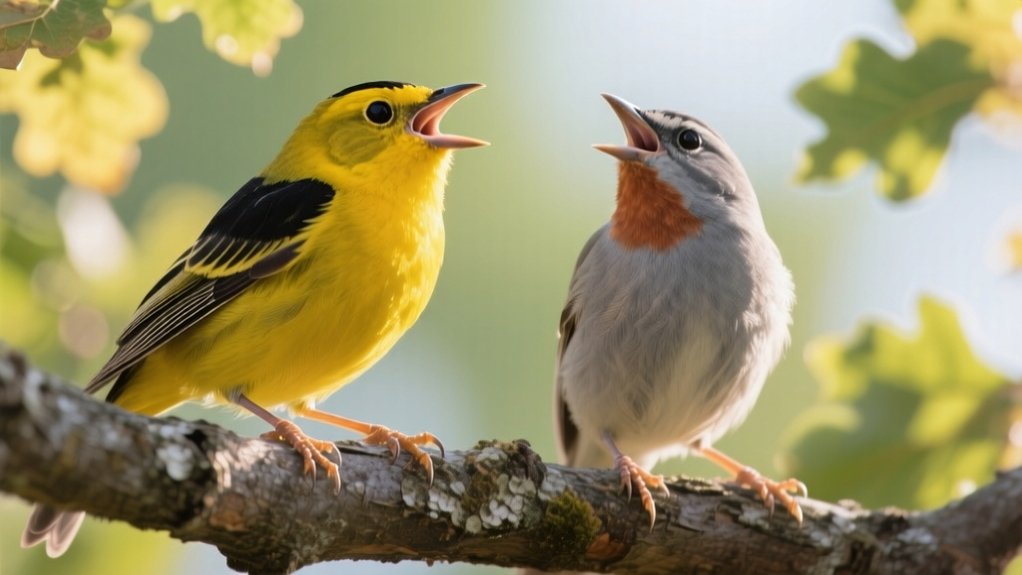
Calling birds are species known for distinct vocalizations used to communicate critical information like alarms, food locations, and social cohesion. These include corvids like crows, gamebirds such as quail, and waterfowl like geese. Each produces specific calls or songs that aid survival and mating.
Bird calls tend to be short and functional, while songs are complex and prolonged, often for territory or courtship. Exploring further reveals intricate vocal learning and varied call functions essential to their lives.
Origin and Meaning of the Term “Calling Birds”

Although you might be familiar with the phrase “calling birds” from the Christmas carol, its original term was “colly birds,” first recorded in the 1780 printed version of “The Twelve Days of Christmas.”
The word “colly” derives from an 18th-century English dialect meaning soot-covered or coal-black, directly associating these birds with the black coloration characteristic of the European Blackbird (Turdus merula).
“Colly bird” functioned as a descriptive compound naming blackbirds in England, reflecting their coal-black plumage.
Over time, unfamiliarity with “colly” led to mishearings, producing variants like “colley” and “coloured.”
The modern “calling birds” phrase emerged after Frederic Austin’s 1909 arrangement, standardizing the lyric.
This shift reflects linguistic evolution from a color-based term to a semantically transparent phrase, obscuring the original ornithological and etymological significance.
The twelve days mentioned in the carol were historically associated with festive celebrations presided over by figures such as the Lord of Misrule in England.
Distinction Between Bird Calls and Songs
You’ll notice that bird calls and songs serve different purposes. Calls are all about daily communication, like sounding alarms or keeping in touch with other birds.
On the other hand, songs mainly help birds defend their territory and attract mates.
When you listen closely, songs usually last longer and sound more complex. They often have structured patterns that make them stand out.
Calls, by contrast, are shorter, simpler, and tend to be more abrupt. Many species have a vocabulary of multiple calls, each serving a specific function, which shows the diversity of calls.
Knowing these differences really helps you understand how birds use their voices to get around their world and interact with each other.
It’s pretty fascinating once you start paying attention!
Calls Versus Songs
When distinguishing between bird calls and songs, it’s important to recognize their structural and functional differences. Calls are brief, simple sounds lasting just a few seconds, lacking the melodic and rhythmic complexity found in songs. Calls are often used for communication between mated pairs or flocks, serving as short bursts of sound.
Songs, by contrast, are longer, often exceeding ten seconds, featuring intricate combinations of trills, whistles, and varied pitches arranged in cyclical patterns. While calls sound like plain bursts, songs demonstrate structured rhythm and melody, although some species produce songs that to human ears may seem harsh or unmusical.
Calls occur year-round from both sexes, serving diverse communicative roles, whereas songs primarily emerge during breeding seasons, mainly from males.
These distinctions highlight the complexity and variability in bird vocalizations, reflecting species-specific ecological and social adaptations.
Functions of Bird Calls
Because bird calls serve a wide range of essential functions distinct from songs, understanding their roles illuminates how birds communicate in various ecological and social contexts.
Unlike songs, which often relate to mating or territory, calls perform immediate and diverse tasks critical for survival and social interaction. Birds use distinct vocalizations such as songs and calls, each with specialized purposes that enhance their communication. Murmuration, a coordinated group movement seen in certain bird species, is often facilitated by these calls to maintain flock cohesion and respond swiftly to environmental cues.
When you listen closely, you’ll notice calls can alert others to predators with high-pitched alarms that hinder predator localization. They also maintain flock cohesion and coordinate group movements during flight or foraging.
Calls signal food findings, improving collective feeding efficiency. They mediate aggression and dominance without physical conflict.
And they support reproductive and parental behaviors beyond courtship songs.
Recognizing these distinct functions helps you appreciate the complexity and precision of avian communication beyond melodious songs.
Acoustic Characteristics Differences
Although both bird calls and songs serve communication purposes, they differ markedly in their acoustic characteristics.
Songs are longer, complex vocalizations featuring multiple notes, rhythmic patterns, and syllabic diversity, often lasting several seconds. In contrast, calls are brief, simple sounds, usually under one second, with limited variation and narrow frequency ranges.
Songs exhibit wider pitch modulation, with rising, falling, or arch-shaped contours, and often sound melodious. Calls tend to be harsher and more abrupt.
Complexity in songs encodes fine information through subtle amplitude and frequency changes, which birds detect precisely. This complexity often reflects the bird’s fitness.
Habitat shapes these traits. Dense environments favor low-frequency, long notes and narrow bandwidths, whereas open habitats promote high-frequency, rapidly modulated sounds.
This acoustic differentiation enhances communication effectiveness in varying ecological contexts.
Major Groups Known as Calling Birds
Calling birds encompass diverse avian groups distinguished by their specialized vocal behaviors, which serve essential roles in communication, social interaction, and survival.
You’ll encounter major groups like gamebirds, corvids, waterfowl, and seabirds, each with unique calling patterns adapted to their environments. Among these, American crows are known for their “caw caw” sound that functions in warning, flock communication, and food announcements.
Consider these fascinating examples: Quail use covey calls and duet exchanges to maintain group cohesion and territorial defense. Many gamebirds, like the Northern Bobwhite Quail, have distinct calls such as the “Bob-white!” call made mostly by unmated males in spring distinctive seasonal calls.
American Crows produce alarm caws to coordinate predator mobbing socially.
Geese emit loud honks for flock coordination during flight.
Blue Jays mimic hawk calls, manipulating other birds’ vigilance.
Rails perform repetitive calls in dense marshes to maintain territories visually obscured.
Understanding these groups helps you appreciate the complexity behind calling birds’ communication systems.
Songbirds and Their Vocal Repertoires

You’ll find that songbirds produce a variety of call types, each serving specific functions like defending their territory, attracting mates, or signaling alarms. It’s pretty fascinating how these calls aren’t just random sounds but have clear purposes. Nighttime vocalizations are often crucial for territorial defense and communication, especially when environmental factors like artificial lighting or reduced ambient noise make these calls more effective.
Their vocal repertoires don’t just appear overnight. Instead, they develop through some pretty complex learning processes. There are sensitive periods when young birds are especially open to learning songs, and their brains have special neural mechanisms that help shape the structure and flexibility of their songs. Studies show that adult song plasticity plays a key role in the evolution of larger song repertoires in many species.
When you understand these elements, it really shows how songbirds adapt their calls to communicate effectively and survive in all sorts of different ecological settings. It’s a great example of how behavior and environment work hand in hand.
Songbird Call Types
Songbirds produce a diverse array of vocalizations, with many males exhibiting multiple distinct song types that range from just a few to hundreds of unique patterns. You’ll find these song types serve as fundamental units within a bird’s vocal repertoire, each composed of notes and syllables with species-specific acoustic structures.
By analyzing parameters like frequency, duration, and note number, scientists classify these complex vocalizations precisely. Consider these insights:
- Song repertoires vary widely, from about 4–13 types in Song Sparrows to hundreds in others.
- Syllables often consist of repeated notes forming characteristic trills.
- Larger repertoires indicate advanced vocal learning and complexity.
- Neural encoding in the HVC region is highly song-type specific.
- Machine learning aids in categorizing and analyzing song sequences.
Learning to mimic these calls can be approached by mastering pitch and rhythm, as well as using techniques like lip whistling to reproduce the subtle nuances of bird song. This intricate vocal diversity highlights songbirds’ remarkable communication skills. Additionally, vocal signals in birds are subject to strong selection pressures to ensure effective transmission across different behavioral contexts, emphasizing the importance of vocal communication in their social interactions.
Functions of Songbird Calls
Understanding the variety and structure of songbird vocalizations sets the stage for exploring their functional roles in communication. You’ll find that songbird calls serve key purposes: defending territory, attracting mates, deterring predators, and maintaining social cohesion.
Each call type carries specific acoustic features tailored to its function.
Clicking sounds, which are produced by some species through specialized beak mechanisms, serve additional roles such as subtle communication and territory marking.
| Function | Vocalization Characteristics |
|---|---|
| Territory defense | Long, repetitive songs; aggressive broadband calls |
| Mate attraction | Complex repertoires; courtship-specific softer songs |
| Anti-predator defense | High-pitched alarms; referential signals |
Vocal Learning in Songbirds
Although vocal learning in songbirds shares parallels with human speech acquisition, it unfolds through distinct developmental stages and specialized neural circuits. These circuits finely tune their vocal repertoires.
You’ll observe juveniles memorizing tutor songs during a vital sensory phase, followed by sensorimotor practice to perfect their vocal output. This process relies on neural pathways like the anterior forebrain pathway (AFP), which evaluates errors and adapts song structure.
Sensory feedback, including auditory and somatosensory inputs, continuously refines their performance. Recent studies demonstrate that non-auditory feedback through cutaneous stimulation can also drive vocal learning in adults. Social interactions with live tutors play an essential role, enhancing motivation and learning efficiency.
Early life sensitive periods restrict accurate tutor imitation. Neural circuits integrate multimodal feedback for error correction. Song develops from noisy subsong to stable crystallized structure.
Dopaminergic inputs reinforce adaptive vocal modifications. Social cues dramatically boost learning success and song complexity.
Vocal Communication Among Corvids

When you observe corvids, you’ll notice they rely heavily on vocal communication, employing dozens of distinct call types to navigate their social and ecological environments. These calls include alarm signals, contact calls, territorial displays, and food-associated sounds, each encoding information on sex, age, identity, and dominance.
Corvid vocalizations are context-dependent, adapting structurally to social dynamics and environmental demands. As oscine songbirds, corvids learn many calls through imitation, showing remarkable vocal flexibility and volitional control. Research has demonstrated that carrion crows can be trained to respond to visual cues by producing vocalizations on command, indicating a level of cognitive control over their vocal output.
For example, carrion crows can initiate or withhold calls on command, adjusting acoustic parameters to task requirements. In social groups, vocal signals maintain cohesion, coordinate activities, and manage conflict, with audience-sensitive modulation evident in species like ravens.
Alarm calls encode predator type and threat level, enabling precise antipredator responses among group members.
Parrots and Parakeets: Masters of Mimicry
You’ll find that parrots and parakeets have specialized neural structures that enable advanced vocal learning. This ability actually surpasses that of many other bird species. What’s really fascinating is how their complex mimicry supports social communication within their flocks. Studies show that vocal mimicry may enhance social bonding and cohesion among parrots. On top of that, they can replicate human speech with remarkable accuracy. When you understand these mechanisms, it becomes clear how their vocal flexibility serves both natural calls and adaptive social functions. It’s pretty amazing how these birds use their voices in such versatile ways! Their vocalizations and mimicry also play a role in territory defense and attracting mates, similar to how other birds use song for communication and social behaviors.
Vocal Learning Abilities
How do parrots and parakeets achieve their remarkable vocal mimicry? Their brains contain unique vocal learning “cores” surrounded by “shells,” neural circuits not found in other birds. These link sound imitation to precise motor control.
This specialized neurobiology enables lifelong learning and complex repertoire flexibility. Recent research shows that these nested core and shell structures have evolved at least 29 million years ago, highlighting their deep evolutionary roots.
You’ll be amazed by how they:
- Imitate diverse sounds with high acoustic fidelity, from human speech to environmental noises
- Continuously expand and rearrange their vocal repertoire throughout life
- Use learned sounds contextually, like greeting or requesting food
- Exhibit referential use of labels, showing advanced cognitive processing beyond mimicry
- Possess species-specific vocal learning capacities, with African grey parrots leading in repertoire size
These features reflect convergent evolution of vocal learning. They demonstrate how intricately their brain supports communication mastery.
Flock Communication Calls
Although parrots and parakeets are renowned for their vocal mimicry, their flock communication calls serve equally critical roles in maintaining group cohesion and safety. These calls function as short contact signals to track flock members during flight or foraging, reducing predation risk through coordinated vigilance. Parakeets often use a distinctive high-pitched shriek known as the “EEP!” contact call to keep in touch with flock members and avoid separation. You’ll notice alarm calls trigger immediate escape readiness, while calm chatter signals low threat levels. Socially, calls reinforce flock identity and strengthen bonds, often paired with affiliative behaviors. For parakeets, distinctive “EEP!” calls prevent separation in large, mobile flocks. Many of these calls feature high-pitched, repetitive qualities that make them stand out in noisy or dense environments.
| Call Type | Function | Behavioral Context |
|---|---|---|
| Contact Calls | Location tracking | Flight, foraging |
| Alarm Calls | Predator warning | Vigilance, escape |
| Social Calls | Bond reinforcement | Preening, greetings |
| Distress Calls | Separation signaling | Isolation, captivity |
Mimicry and Speech
When you observe parrots and parakeets, their remarkable ability to mimic human speech and other sounds stems from specialized neurological and anatomical features that distinguish them from most other birds.
Their syrinx allows complex sound modulation, controlled by a sophisticated brain “song system” including expanded shell regions. Recent research has shown that budgerigars’ brains encode vocalizations through discrete, repeatable neural pathways, similar to human speech processing.
Budgerigars’ anterior arcopallium functions like a “vocal keyboard,” enabling nuanced sound combinations. This neural architecture supports lifelong vocal learning, driven by social bonding and emotional salience.
Parrots share vocal learning traits with humans and songbirds. Budgerigars’ brain regions closely parallel human speech centers. Indian ringnecks can amass vocabularies exceeding 200 words.
Mimicry extends to household sounds beyond speech. Individual birds like Puck demonstrate exceptional vocabulary breadth.
You witness a rare convergence of brain, anatomy, and social context that crafts these avian orators.
Waterfowl Calls: Honks, Quacks, and Whistles
Because waterfowl rely heavily on vocal communication for social coordination, their calls—honks, quacks, and whistles—serve distinct functions across species and contexts.
Canada geese use loud, resonant honks to maintain flock cohesion, defend territory, and signal alarms. This is especially important during migration when coordination is critical.
Loud, resonant honks help Canada geese stay united, protect territory, and alert during critical migration moments.
Dabbling ducks like mallards produce decrescendo quacks that facilitate pair bonding and mediate courtship, alarm, and aggression. The female mallard’s recognizable “quack-quack-quack” call is among the most familiar duck vocalizations.
Females’ louder calls contrast with males’ softer responses. Whistles dominate in species such as wigeons and teal, whose breathy or metallic notes aid in flight communication and display.
All these sounds originate from the syrinx, allowing precise modulation.
Understanding these calls helps you interpret waterfowl behavior and social dynamics across diverse wetland habitats.
Non-Songbird Calling Species and Their Sounds
While non-songbird species may lack the complex melodies of songbirds, they rely on distinctive calls and sounds vital for survival and communication. Many of these calls are used to defend territory or attract mates, demonstrating how vocalizations are crucial for both reproduction and safety.
Raptors like Red-tailed Hawks use harsh “kreeeer” screams for territory defense. Owls emit hoots, screeches, or barks adapted to specific habitats and social functions. Their famous “who who who” calls are especially common at night, serving as both a warning and a means of locating mates in the dark.
Gamebirds produce booming sounds or clucks for courtship and alarms. Shorebirds use sharp whistles and trills to maintain flock cohesion and signal threats. The 11,250 extant bird species recognized include many such non-songbird callers, highlighting the diversity in avian vocal communication.
Hawks’ descending screams mark territory with urgency. Owls’ hoots and screeches vary by species and context, and some, like the Barred Owl, have rhythmic patterns that make them easier to distinguish in the wild.
Grouse create booming displays to attract mates. Turkeys employ clucks and yelps for group communication. Shorebirds use species-specific “peet” and “klee” calls during flight.
These calls reflect precise ecological adaptations, essential for survival.
Functional Roles of Bird Calls in Nature
You’ll notice that bird calls serve some really important purposes. For example, they act as alarm signals that alert other birds to predators using distinct sounds. It’s like their way of saying, “Watch out!”
But that’s not all. Bird calls also help keep the group together. They coordinate movements and social interactions within flocks, making sure everyone stays connected. Interestingly, many birds can discriminate extremely subtle variations in the fine structure of calls, which likely helps them recognize individual identities and specific messages within their social groups acoustic fine structure.
And there’s more—calls are key during courtship and territory defense. They convey individual identity and show off reproductive fitness, helping birds find mates and protect their space. Pretty fascinating, right?
Alarm Signals and Warnings
When predators approach, birds rely on alarm calls as immediate early-warning systems that alert nearby individuals before visual detection is possible.
These calls vary in pitch, duration, and repetition to encode threat type and urgency. For example, high-pitched “seet” calls warn of flying raptors, while louder mobbing calls target perched predators, recruiting others to collectively harass the threat.
Alarm calls trigger swift behavioral changes, like freezing or evasive flight, enhancing survival. The Chickadee’s alarm call is a well-studied example that conveys specific predator information through distinct alarm notes.
Hear the sharp “seet” signaling airborne danger overhead.
Sense urgency as chickadees increase “-dee” notes with rising threat.
Witness mixed-species flocks responding instantly to alarms.
Experience the forest buzzing with mobbing calls deterring predators.
Appreciate how multi-species networks amplify predator warnings rapidly.
Maintaining Group Cohesion
Because maintaining group cohesion is essential for survival, birds use specialized calls to coordinate movements, spacing, and social interactions within their flocks. Contact calls convey location and motivation, synchronizing decisions to continue or switch activities, especially in visually obstructed environments. These calls are often used in mixed-species flocks to maintain cohesion and share food information, enhancing survival through interspecies communication.
Adjusting call rates communicates movement speed and direction changes, enabling realignment without visual cues. Increased cohesion calls help separated individuals relocate and rejoin groups, with acoustic features adapting to distance for greater detectability.
During foraging, specific calls organize spacing to balance coordination and competition, while call rate reflects food availability and foraging urgency.
Vocalizations also synchronize behavioral states, allowing simultaneous shifts between resting, traveling, and feeding.
These precise acoustic mechanisms maintain spatial cohesion, optimize resource use, and stabilize social bonds, ensuring group survival and efficiency in complex habitats.
Courtship and Territory Defense
Although birds rely on vocalizations for various social functions, their calls play a particularly essential role in courtship and territory defense by facilitating mate attraction, signaling ownership, and mediating competitive interactions. Brood parasitism, where one species lays its eggs in the nest of another, can disrupt these vocal strategies by increasing competition for resources and parental care from hosts.
You’ll notice males use complex, energetically demanding songs to demonstrate fitness, while seasonal singing peaks during breeding maximize mating success. These songs also act as a physical advertisement for the singer’s quality and vitality, helping females select genetically compatible mates.
Territorial calls broadcast ownership, reducing physical conflicts, and residents often respond with countersinging to assert dominance. In some cases, territorial calls may also serve to warn of potential brood parasite threats, prompting increased vigilance around the nest site.
Paired birds coordinate through duets, enhancing bond strength and nest defense.
- Complex male songs signal genetic quality, attracting mates
- Territorial songs mark borders, preventing unnecessary fights
- Countersinging serves as graded aggression in rival disputes
- Duets synchronize reproduction and fortify pair bonds
- Call variations allow rivals to assess strength and avoid injury
Alarm Calls: Warning Signals in the Wild
Since survival often hinges on rapid communication, alarm calls serve as vital warning signals in the wild. They enable birds to convey predator presence with remarkable specificity.
You’ll find two main types: aerial alarms, which are high-frequency, quiet calls designed to warn others while minimizing detection by flying predators, and mobbing alarms, which are louder, broadband calls that recruit multiple birds to harass perched or ground threats. Research shows that these alarm calls can be wide-bandwidth and loud to attract more birds.
Birds encode predator type and urgency through variations in pitch, repetition, and call elements. For example, Black-capped Chickadees add more “-dee” notes to signal smaller, more threatening predators.
Alarm calls transmit swiftly. New Holland Honeyeaters respond within 100 ms, and the calls spread rapidly through mixed-species flocks, allowing you to witness a coordinated, community-wide response to danger.
Contact Calls and Maintaining Group Cohesion
When birds stay in groups, they rely heavily on contact calls to maintain cohesion during activities like foraging, traveling, and roosting.
These calls continuously update flock members on each other’s positions, especially when visual cues fail. This enables synchronized movement and rapid regrouping if separated. Contact calls are brief, species-specific notes, often high-pitched and soft. This minimizes predator detection while encoding individual identity. Additionally, some bird species have distinct high-pitched calls recognized specifically by mates, enhancing pair communication.
They help track location without visual contact in dense habitats. Birds also signal urgency when individuals become separated. Contact calls coordinate group departures and directional changes. They reflect social dynamics, such as dominance and affiliation.
Plus, birds adapt call rate and structure based on environmental complexity.
Begging Calls and Parental Care Interactions
Because nestlings can’t directly demand resources, they rely on begging calls as primary acoustic signals to solicit food and care from their parents. These calls vary in intensity, rate, and acoustic structure, reliably reflecting hunger level and body condition. You’ll notice that parents increase feeding rates when calls are more urgent, aligning care with offspring need in resource-rich environments. In harsher settings, parents weigh size and quality cues more heavily, sometimes discounting call intensity. This variation in parental responses has been observed in about 25% of species where begging calls are ignored. Begging calls also exhibit notable plasticity. Nestlings raised by foster species alter call pitch and structure, showing social learning influences. Furthermore, brood parasites use exaggerated begging to gain disproportionate care. This dynamic interplay balances honest signaling of need and quality with evolutionary pressures from parent–offspring conflict, ensuring efficient resource allocation while maintaining call reliability through physiological costs and predation risks.
Territorial and Courtship Vocalizations
Nestlings’ begging calls primarily communicate immediate needs within the family unit, but adult birds employ a broader range of vocalizations to manage interactions beyond offspring care.
Territorial songs, often complex and delivered from high perches, establish and defend boundaries by signaling owner quality and resource value. Courtship songs advertise physical fitness and genetic quality, influencing mate choice. These vocalizations can vary significantly across species and ecological contexts, reflecting a fluid categorization of bird voices that evolves with new observations and field studies fluid categorization. In some bird species, these vocal displays are especially pronounced in communal nesting sites, where group living amplifies both the variety and intensity of calls.
You’ll notice birds engage in countersinging to negotiate territory borders, reducing physical conflict. Duets and coordinated displays strengthen pair bonds and synchronize breeding efforts.
Dawn choruses amplify territorial claims through ideal sound transmission. Aggressive song-type matching signals confrontation readiness. Melodious courtship songs sway female preference.
Duetting pairs perform synchronized vocal and visual displays. Scolding calls warn intruders near nests or mates.
These vocalizations precisely regulate social interactions critical for survival and reproduction.
Fascinating Research and Adaptations in Calling Birds
Although calling birds rely heavily on vocal communication, their calls and songs exhibit remarkable flexibility and adaptation shaped by environmental pressures and social contexts.
In urban areas, songbirds adjust frequency, amplitude, and timing to counteract low-frequency traffic noise, often producing higher-pitched, shorter calls to improve detectability despite potential fitness costs.
Habitat structure further influences vocal traits; dense vegetation favors low-frequency, narrow-bandwidth calls to minimize attenuation, while open habitats select for higher frequencies and broader bandwidths.
Cultural evolution also plays a role. Dialects arise through learned vocalizations, affecting mating and territory dynamics.
However, species-specific learning constraints can limit plasticity, risking maladaptive changes after habitat shifts.
Importantly, conservationists harness these vocal adaptations via passive acoustic monitoring and playback to support population surveys and habitat restoration effectively.
Frequently Asked Question
How Do Environmental Factors Influence the Evolution of Bird Calls?
You’ll find that environmental factors shape bird calls by influencing frequency, tempo, and complexity. Dense forests favor lower-frequency, purer tones for better transmission, while open habitats select for higher-frequency, faster songs to stand out.
Climate affects body size, indirectly shifting pitch and tempo.
Anthropogenic noise pushes birds to raise frequencies and simplify songs. Developmental stress can reduce song complexity, altering cultural transmission, ultimately driving adaptive evolution in vocal traits.
Can Calling Birds Recognize Individual Human Voices?
Yes, many calling birds can recognize individual human voices, especially species like parrots and crows that interact closely with people.
Their advanced vocal learning and auditory processing let them distinguish unique acoustic features such as pitch, tone, and speech patterns in human voices.
You’ll notice they respond more to familiar voices linked to food or safety.
This recognition strengthens with repeated exposure and meaningful interactions, showing sophisticated neural mechanisms underpinning their auditory discrimination abilities.
What Role Do Calling Birds Play in Indigenous Cultures and Folklore?
You’ll find calling birds serve as spiritual messengers in many Indigenous traditions, linking humans to the spirit world through their songs.
Their calls symbolize natural forces like storms and fertility, while their songs encode creation stories, genealogies, and moral lessons.
In ceremonies, their feathers and vocalizations play essential roles in healing and social teaching.
They help you connect with ancestral knowledge and communal values encoded in bird symbolism and song cycles.
How Do Juvenile Birds Learn Different Call Types From Adults?
You gently guide juvenile birds to absorb adult calls during a sensitive window, shaping their vocal identity. They commence trial and error journeys from raw subsongs to refined melodies, mirroring adult tutors’ sounds.
Social cues, like subtle adult gestures, reinforce learning, while their flexible auditory neurons adapt to species-specific templates.
This careful mentorship guarantees juveniles develop accurate, functional calls, balancing innate predispositions with environmental feedback for survival and communication success.
Are There Any Endangered Species Known Specifically for Their Unique Calls?
Yes, you’ll find endangered species notable for unique calls, like the regent honeyeater whose culturally transmitted complex songs are degrading due to population collapse.
You’ll also see the yellow-crested cockatoo’s piercing screeches increase its capture risk.
Amazon parrots and African grey parrots have distinctive vocalizations that signal population health.
Meanwhile, island species like the New Zealand storm-petrel rely on calls for detection, making vocalizations essential for conservation efforts.
Conclusion
Now that you know calling birds use over 10,000 distinct vocalizations worldwide, you can appreciate how essential these sounds are for survival and social interaction. Whether maintaining group cohesion or defending territory, their calls serve complex purposes beyond simple communication.
Understanding these intricate vocal behaviors reveals how evolution shaped their adaptability and social structures. Next time you hear a bird call, remember it’s part of a sophisticated language indispensable to their daily lives and ecosystem balance.