
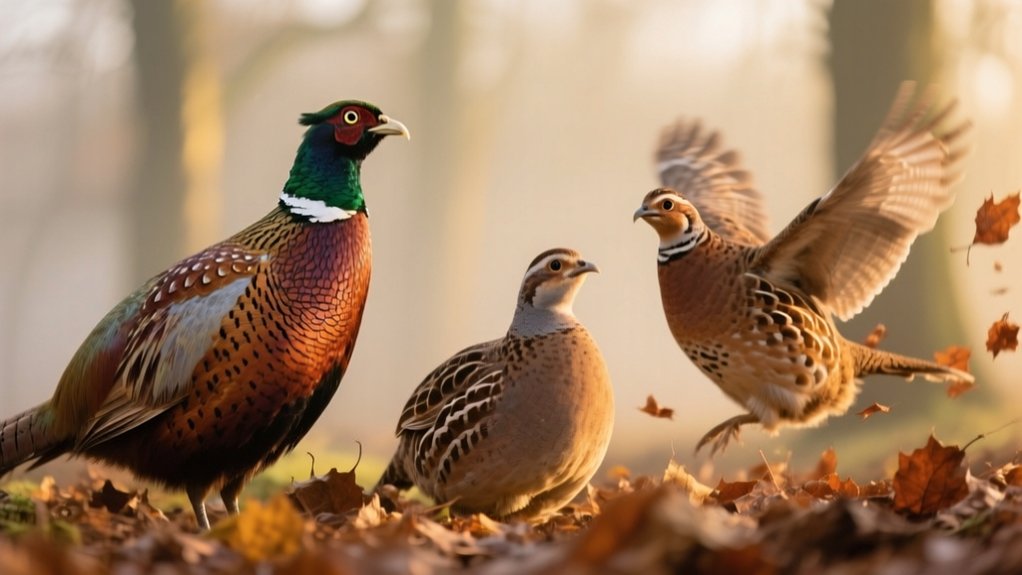
Game birds are federally protected species like pheasants, quail, and waterfowl that you can identify by their chunky bodies, short necks, and rounded wings. Males often display vibrant plumage, while females rely on camouflage to blend into habitats ranging from forests to grasslands.
These birds nest in shallow ground scrapes and have explosive flight patterns. You’ll also find they follow strict hunting seasons and conservation laws, ensuring populations remain stable. Keep exploring to uncover their social behaviors and habitat adaptations.
Legal Classification and Hunting Regulations
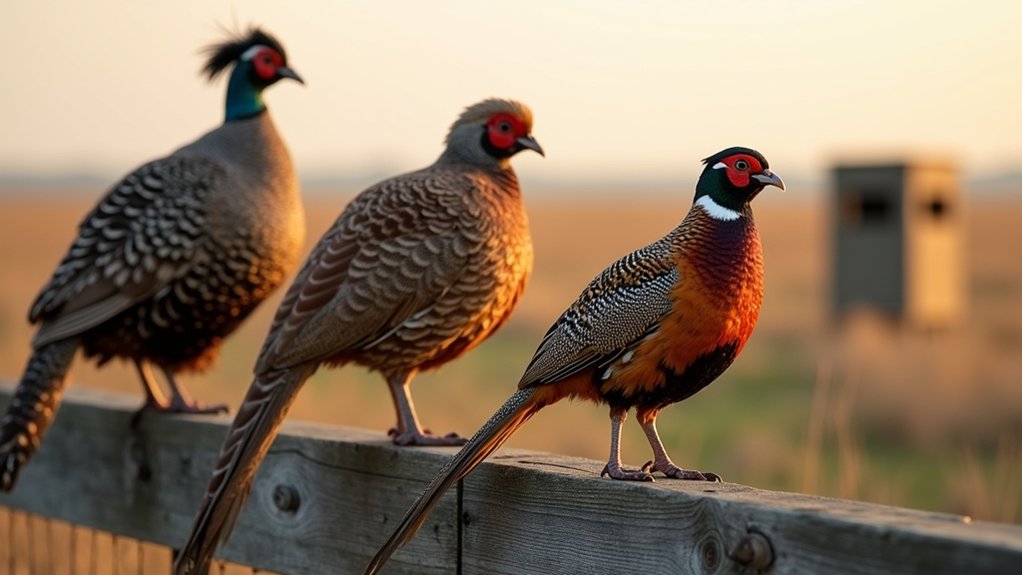
Although migratory birds benefit from federal protection under international treaties and the Migratory Bird Treaty Act of 1918, only a specific subset classified as migratory game birds may be legally hunted. This hunting must follow strict state and federal regulations.
Migratory birds are federally protected; only designated game species may be hunted under strict regulations.
You must consult Title 50 Code of Federal Regulations, Section 10.13, which lists protected species based on taxonomy and natural distribution. Hunting is permitted solely for species like ducks, geese, swans, doves, cranes, rails, and woodcock during designated open seasons.
You must adhere to possession limits, which cap the number of birds you can lawfully possess, either per species or aggregate across areas. These possession limits help ensure sustainable management of migratory bird populations.
Prohibited hunting methods include traps, rifles, and shotguns larger than 10 gauge.
Furthermore, you’re required to keep specific body parts attached to hunted birds for identification, ensuring compliance with federal regulations.
Common Species of Game Birds
You’ll come across a variety of popular game bird species in different habitats.
For example, waterfowl like mallards and Canada geese are common, but you’ll also find upland birds such as grouse, quail, and pheasants. Grouse species often feature feathered legs and nostril feathers, distinguishing them from similar birds like partridges.
Knowing where these birds are typically found can really help you plan your hunts better.
Each species tends to hang out in certain geographic areas, so understanding their distribution is key during hunting seasons.
And when it comes to identifying them, it’s all about paying attention to specific physical traits.
Look closely at their plumage patterns, size, and any distinctive markings—they all help you tell one species apart from another.
Popular Game Bird Species
When identifying popular game bird species, you’ll encounter a variety of birds distinguished by unique physical traits, behaviors, and habitats.
The Ruffed Grouse features brown and white barred feathers and short crests, blending into deciduous forests.
Ring-Necked Pheasants display vibrant copper bodies, long tails, and white neck bands, favoring agricultural edges.
Gray Partridges resemble plump chickens with gray bodies and horseshoe breast patches, inhabiting grain belt fields.
Northern Bobwhite Quails are small with striped faces and chestnut streaking, foraging in flocks in open pine forests.
American Woodcocks have mottled plumage, long bills, and large eyes positioned rearward, occupying shrubby woods while probing soil for insects. Many game bird species show sexual dimorphism, with males often larger and more colorful than females.
Each species’ morphology and behavior reflect adaptations to their specific environments and foraging strategies.
Geographic Distribution Patterns
Understanding the geographic distribution patterns of common game birds helps you identify their preferred habitats and regional populations.
For instance, grouse species concentrate mainly in western U.S. states like the Great Basin and Rockies, while ruffed grouse span northeastern forests to the Pacific Northwest.
Pheasants dominate North Central agricultural zones, and quail species occupy diverse desert and mountainous habitats in the American West.
Grouse populations cluster in western states, including sage and dusky varieties. Pheasants thrive across much of the U.S., especially in North Central grain belts.
Bobwhite quail inhabit eastern and central U.S. with strongholds in southern states. Gambel’s quail prefer brushy deserts of southwestern states. Bobwhite quail are shot in large numbers annually, reflecting their popularity among hunters.
Introductions of game birds have succeeded mainly in western U.S. and select international regions.
These patterns guide your understanding of game bird ecology and hunting regions.
Identification by Physical Traits
Physical traits provide essential clues for identifying common game birds, enabling you to distinguish species and sexes in the field. Most upland game birds have a chunky, chicken-like body with short necks, small heads, and rounded wings adapted for rapid, short-distance flight.
For example, ring-necked pheasants display strong sexual dimorphism. Males feature bright iridescent plumage, a white neck ring, and long barred tails, while females show cryptic mottled browns.
Grouse species differ by tail and ruff patterns; males often have conspicuous black bands and neck ruffs, unlike females. Additionally, the uropygial gland located above the caudal rump plays a role in feather maintenance, which can affect the birds’ plumage condition and appearance.
Partridges and quail exhibit distinctive coloration and markings, such as shoulder feather crossbars in females or contrasting facial stripes in quail males.
These physical markers, combined with size and wing shape, provide reliable identification cues in diverse habitats.
Biological Characteristics of Game Birds
Although game birds vary widely across species, they share several key biological traits that influence their survival and behavior. You’ll notice most build simple ground nests, laying large eggs within shallow scrapes lined with vegetation.
Game birds build simple ground nests with large eggs in shallow, vegetation-lined scrapes.
Their flight is characterized by short, explosive bursts aided by short, rounded wings. Plumage often serves as camouflage, with females exhibiting duller patterns for nesting concealment. Diets are omnivorous, supported by strong legs for scratching and bills adapted to ground foraging.
Socially, many form coveys outside breeding season, displaying dominance hierarchies and engaging in dust-bathing for feather maintenance. Many species demonstrate social flocking behavior outside the breeding season, which enhances their ability to detect predators.
Ground nests increase vulnerability to predators and habitat changes. Flight emphasizes rapid takeoff and maneuverability in dense cover. Cryptic plumage aids concealment; males show brighter breeding colors.
Omnivorous diet includes seeds, insects, and fibrous winter plant material. Social groups improve vigilance and survival during non-breeding periods.
Taxonomic Groups Within Game Birds
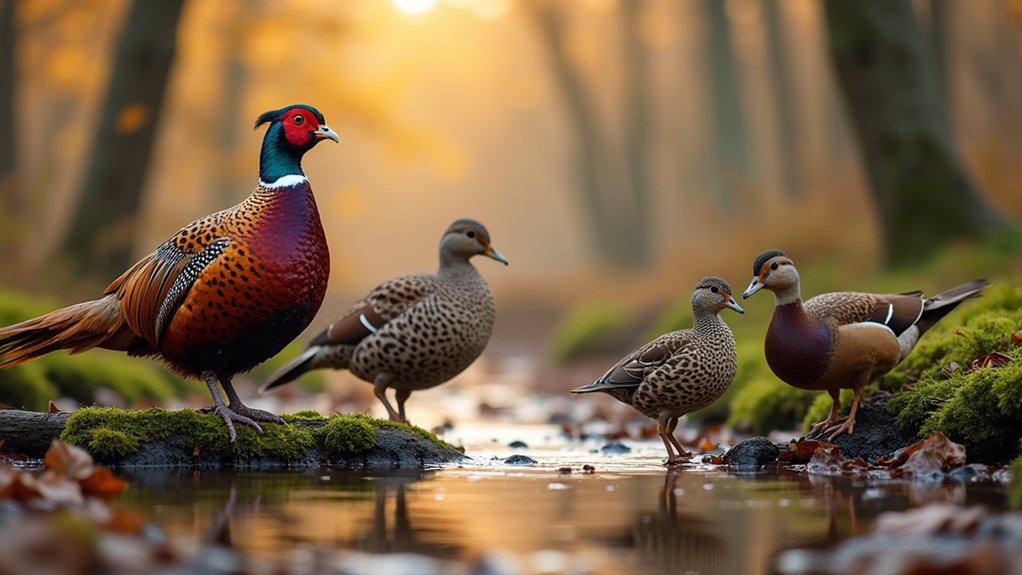
When you examine game birds more closely, you’ll find they belong primarily to the order Galliformes, which includes over 500 species across five distinct families.
The largest, Phasianidae, contains pheasants, grouse, turkeys, and chickens, characterized by blunt wings and saltatorial locomotion.
Cracidae includes chachalacas and curassows, notable for their broad tails and ornamental wattles, mainly in the New World tropics.
Tetraonidae, encompassing grouse and ptarmigan, is distinguished by feathered legs and nostrils, often with vivid bare skin patches.
Numididae, the guinea fowl family, features spotted plumage and bare heads, endemic to sub-Saharan Africa.
These families differ morphologically and geographically, confirmed by DNA and anatomical studies, reflecting deep evolutionary divergences within Galliformes.
Understanding these taxonomic groups improves accurate identification and comprehension of game bird diversity.
Nesting Habits and Habitat Preferences
Since nesting success depends heavily on concealment and accessibility, game birds construct simple ground nests that prioritize functionality over complexity. You’ll find these nests in shallow depressions lined sparsely with grasses, leaves, and feathers.
Nest sites are carefully selected near tall vegetation to shield eggs from predators.
Key nesting habits and habitat preferences include:
- Ground nests average 7 inches wide and 2.8 inches deep, located within half a mile of wintering areas.
- Spring roosting shifts to trees or dense shrubs for safety and visibility.
- Early nests appear along grassy roadsides, ditches, and fence lines; mid-season nests favor alfalfa fields.
- Clutches contain 7 to 15 eggs with consistent incubation periods.
- Dense, undisturbed grasslands provide critical cover during vulnerable nesting phases.
These strategies optimize survival amid varied seasonal landscapes.
Camouflage and Plumage Patterns
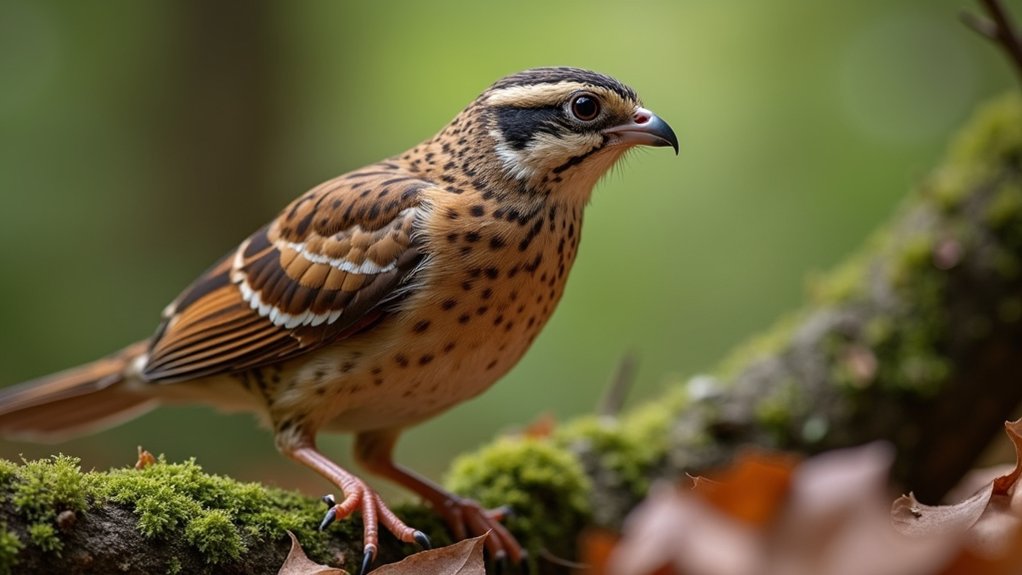
Because effective camouflage improves survival, game birds exhibit diverse plumage patterns that serve distinct functions in their environments.
You’ll notice irregular mottled patterns, especially in females and juveniles, provide static camouflage by blending with cluttered backgrounds like leaf litter. These heterogeneous patterns disrupt visual detection in dense habitats.
In contrast, regular barred or spotted patterns dominate open habitats, aiding camouflage during movement by exploiting predator vision. About 66% of birds display barring, the most common regular pattern, while spots and scales appear less frequently. Such visual patterns are often shaped by habitat openness.
Curiously, many game birds combine both pattern types, bimodal patterns, offering dual functions that improve survival and reproduction.
This evolutionary complexity reflects adaptation to various ecological niches, with pattern types distributed according to habitat structure and species behavior.
Physical Features for Identification
Although plumage patterns provide important clues, you’ll often rely on physical features like body size, leg structure, wing feathers, and distinctive markings to accurately identify game birds.
These details offer critical insights into species, sex, and age.
Body size varies: turkeys are large (20+ lbs), quail are small (<1 lb). Male pheasants have long spurs on sturdy legs; spur size indicates age.
Wing primaries (10 per wing) show wear patterns; young birds have pointed, fresh feathers.
Head markings differ: wild turkeys have colorful bare skin; ruffed grouse display crests and neck ruffs. The ruffed grouse is named for the black iridescent neck feathers called the ruff.
Tail shapes assist ID: wild turkeys fan broad tails; sharp-tailed grouse exhibit wedge-shaped tails with white edges.
Flight Patterns and Abilities
You’ll notice that flight duration varies quite a bit among game birds. This depends a lot on their wing shape and how they manage their energy while flying.
Some birds have rapid wingbeats, while others can soar with barely any flapping at all. These distinctive behaviors actually give you hints about which species you’re watching. Additionally, many game birds exhibit wing morphology adapted to their flight style, influencing speed and maneuverability.
Flight Duration Limits
When tracking flight duration limits of game birds, understanding their flight patterns and abilities is essential for accurate identification and effective hunting strategies.
Flight duration varies with species, environmental conditions, and migration demands. Ducks and geese can sustain long flights at altitudes up to 7,000 feet, adapting to wind and weather changes. Their flight activity peaks during regulated hunting hours, aligning with daily light cycles.
Migratory flights span multiple hours, influenced by terrain and atmospheric conditions. Flight altitudes fluctuate between low levels and thousands of feet during migration.
Hunting seasons and hours correspond to typical flight activity windows. Flyway-specific regulations reflect regional flight duration and abundance. Flight endurance supports seasonal migrations lasting days to weeks.
Understanding these limits improves species identification and optimizes timing for ethical harvests.
Distinctive Flight Behaviors
Understanding flight duration limits provides a foundation for recognizing how game birds behave in the air, but identifying species often depends on observing distinctive flight behaviors and patterns.
Many upland game birds use explosive “flush” takeoffs with rapid wingbeats and near-vertical launches, often accompanied by loud wing noise, as seen in pheasants and quail.
In flight, these birds favor low, fast, and erratic contour patterns, weaving through terrain and making abrupt direction changes. Their short, rounded wings enable quick acceleration and tight maneuvering rather than endurance. Observing a bird’s flight pattern can reveal important clues to its identity.
For example, quail perform short, straight flights before descending into cover, while pheasants cruise faster and may reach 60 mph when pressed.
Recognizing these flight profiles helps you accurately identify game bird species in diverse habitats.
Social Behavior and Vocalizations
Although game birds often appear as loosely organized flocks, their social behavior reveals complex dynamics driven by individual personality traits and interaction rules. Studies on species like Pheasants have shown that sexual segregation can influence group composition and interactions during different seasons.
When observing these birds, you’ll notice that personality influences flock roles and movement patterns. Reactive birds tend to stay centrally and maintain stable social bonds, while proactive ones investigate peripheries and initiate movements.
Vocalizations also play a strategic role in coordinating group foraging and recruiting allies. Key aspects include synchronous group behavior governed by simple interaction rules and consistent leader-follower roles shaped by personality.
There are also seasonal shifts in social network composition and sex-based dispersal. Non-breeding periods are marked by dynamic group membership and strategic calls.
Plus, gang foraging optimizes search efficiency and social status interactions. Understanding these facets helps you decode the sophisticated social systems in game birds.
Geographic Distribution and Seasonal Presence
You’ll find game birds in all sorts of places, from temperate woodlands to subtropical grasslands. Each region supports its own unique mix of species. They can inhabit diverse habitats including rainforests, deserts, and alpine meadows, even up to elevations of 5000 m above sea level.
And it’s not just about where they live—they move around too. Many game birds migrate seasonally, shifting locations depending on the weather and what food is available.
Knowing these movement patterns is really helpful. It lets you figure out the best times to go hunting or spot them in the wild.
Regional Habitat Ranges
When studying game birds, it’s crucial to recognize their distinct regional habitat ranges. These ranges reflect their geographic distribution and seasonal presence.
You’ll find these birds occupy varied ecosystems across North America, each adapted to specific conditions.
Ruffed grouse inhabit northeastern forests extending west to the Pacific and north into Canada. Prairie chickens dominate Great Plains states like Kansas and the Smoky Hills region, thriving in grassland habitats.
Dusky and sage grouse prefer mountainous and arid western ranges including the Rockies and Great Basin. Pheasants and bobwhite quail frequent agricultural zones and farmlands, benefiting from grain-rich environments.
Gambel’s quail and chukar partridges occupy brushy deserts and rocky hill country in the American West.
Understanding these habitat ranges aids accurate identification and ecological insight into game bird populations.
Seasonal Migration Patterns
Because seasonal migration shapes the geographic distribution and presence of game birds, understanding the environmental cues that trigger these movements is essential. You’ll find that photoperiod, temperature drops, and snow cover primarily initiate migration, pushing birds southward when northern habitats become inhospitable. Many waterfowl species follow established flyways that guide them to optimal feeding and resting areas during their journey, making knowledge of these migration routes valuable for hunters.
Waterfowl often fly at night, covering long distances along four major North American flyways. Upland game birds like woodcock migrate less predictably, driven by weather and habitat availability.
| Trigger | Effect on Migration |
|---|---|
| Photoperiod | Initiates seasonal movement |
| Cold fronts & snow | Accelerates southward migration |
| Wind (direction/strength) | Influences flight efficiency |
Recognizing these patterns helps you predict when and where game birds will be present, improving identification accuracy.
Hunting Season Timing
Although game bird species inhabit diverse regions, hunting seasons in California vary considerably by geographic zones and species. You’ll find that quail hunting is divided into zones Q1, Q2, and Q3, each with distinct start dates from September to mid-October. Other species follow specific statewide or regional schedules.
When planning your hunting, consider these key timing factors:
Pheasant season runs November 8 to December 21 statewide, with archery seasons extending from October to January.
Chukar general season spans October 18 to January 25, with an archery-only period starting mid-August.
Grouse season is brief, September 14 to October 14, with a daily bag limit of two.
Mourning pigeon seasons align with migration in September and late December.
Waterfowl seasons differ by zone, with some extending into late January or February. The California Department of Fish and Wildlife provides detailed hunting rules and bag limits that hunters should verify before heading out.
Conservation Status and Challenges
Given the significant declines in many game bird populations, understanding their conservation status and challenges is essential for effective management. Over one-third of U.S. bird species face high or moderate conservation concern, with 112 “Tipping Point” species losing over 50% of their populations since 1970. The State of the Birds Report 2026 highlights these alarming trends and underscores the importance of long-term monitoring through tools like the Breeding Bird Survey and eBird Trends.
Grassland birds have declined 43%, mainly due to habitat loss from intensive agriculture and reduced Conservation Reserve Program lands. Duck populations rose 24% since 1970 but recently dropped in key wetland areas, pressured by wetland loss and drought. The Prairie Pothole Region, known as North America’s “duck factory,” remains critical for breeding waterfowl, making conservation efforts there vital to reversing declines.
Grassland birds decline 43% from habitat loss; ducks up 24% since 1970 but face recent wetland drought pressures.
Aridland birds in desert regions suffer accelerating declines linked to drought, urban development, and energy projects. Species like the American woodcock require targeted monitoring, as their cryptic habits complicate population assessments. Collaboration between conservationists and agricultural producers is essential to develop win-win land use strategies that balance habitat preservation with economic realities.
Addressing these challenges demands precise habitat conservation and continuous population tracking.
Sustainable Hunting Practices and Ethics
When engaging in game bird hunting, you must adhere to sustainable practices and ethical standards to support conservation and guarantee responsible use of wildlife resources.
Ethical hunting involves fair chase principles and precise shot placement to minimize suffering. Managing populations through regulated quotas and habitat stewardship promotes ecosystem balance. Research conducted by GWCT highlights the importance of maintaining sustainable densities to minimize biodiversity loss.
Consider these key practices:
Follow fair chase by avoiding unfair advantages like vehicles or tracking technology.
Target essential areas for swift kills, confirming species identification before shooting.
Regularly practice marksmanship to improve accuracy and reduce wounding.
Observe stocking density limits in release pens to prevent biodiversity loss.
Comply with hunting quotas and bag limits to maintain healthy populations.
These measures collectively promote responsible hunting that supports biodiversity and long-term game bird conservation.
Frequently Asked Question
How Do Game Birds Impact Local Ecosystems Beyond Their Role as Prey?
You’ll find game birds affect ecosystems by trampling vegetation, altering soil composition, and reducing invertebrate populations through predation.
Their large biomass creates competition for resources, impacting native species.
They also support increased generalist predator numbers and lead to illegal raptor killings.
Habitat management for gamebird releases can benefit some wildlife, but released non-native species compete directly with natives, causing biodiversity loss and genetic dilution across multiple trophic levels.
What Are Common Predators of Game Birds in Various Habitats?
Imagine a web of hunters weaving through air, land, and water. Eagles, hawks, and owls use sharp eyesight and talons to catch game birds mid-flight.
On the ground, foxes, coyotes, and raccoons stealthily target nests and adults.
In water, predatory fish like northern pike leap to snatch swimming birds.
Even snakes and mantises exploit eggs and chicks.
Your game birds face a diverse array of predators, each adapted to their unique hunting tactics.
How Do Climate Changes Affect Game Bird Migration Patterns?
You’ll notice climate change shifts game bird migration patterns by causing earlier spring departures and later fall returns due to rising temperatures.
These shifts often disrupt food availability, leading to mismatches between arrival and peak resources, which threatens survival and reproduction.
Furthermore, you might see altered migration routes as birds seek suitable habitats, sometimes traveling farther.
This flexibility varies among species, with long-distance migrants facing greater challenges adapting to rapid environmental changes.
What Nutritional Benefits Do Game Birds Provide Compared to Other Wild Meats?
You’ll find game birds offer lower fat and calorie content than many wild meats, with high protein density and a richer nutrient profile.
They provide favorable fatty acid ratios, including omega-3s, supporting cardiovascular health.
Furthermore, game birds are rich in B vitamins, minerals like iron and selenium, and antioxidants.
These nutrients collectively improve metabolism, immune function, and reduce disease risk, making game birds a superior wild meat choice nutritionally.
Are There Cultural Traditions Uniquely Associated With Game Bird Hunting?
You’ll find that game bird hunting carries rich cultural symbolism, often representing rites of passage, community bonding, and respect for nature.
In Italy, pheasant hunts symbolize aristocratic heritage, while in South Dakota, opening weekend marks a multigenerational celebration.
Northern Europe frames it as a test of skill and ecological balance.
Central Asian falconry links hunting to ancient traditions and freedom, underscoring how these practices transcend mere sport to embody identity and stewardship.
Conclusion
So, next time you spot a game bird, don’t just assume it’s dinner unless you’re a law-abiding, ethically minded hunter with encyclopedic knowledge of their biology, behavior, and conservation status.
After all, they’re not just feathered targets; they’re complex creatures with intricate social lives and specific habitats. Understanding these details might save you from an embarrassing legal fine or worse, the wrath of Mother Nature’s very particular sense of humor.