
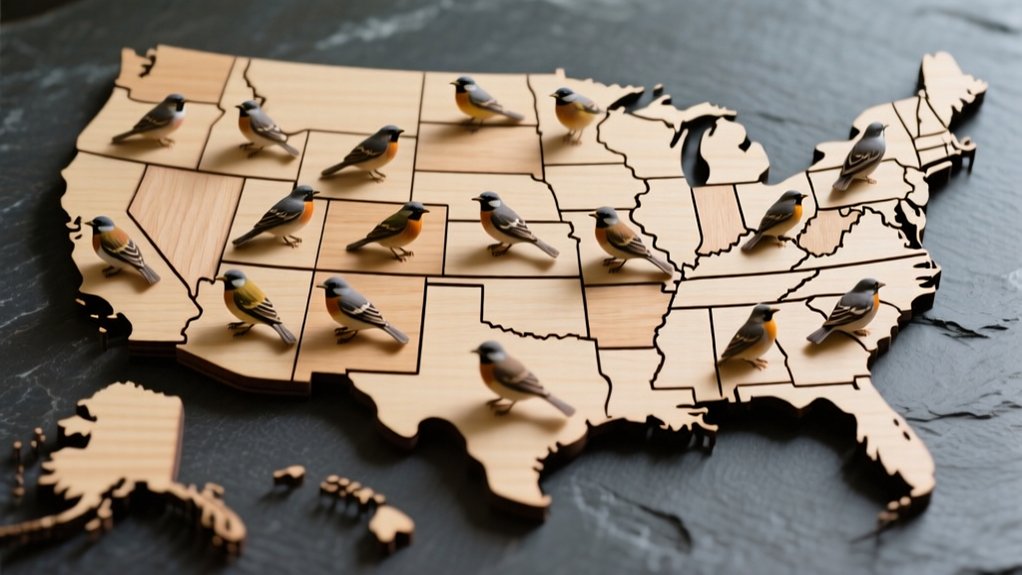
You’ll find each U.S. state honors a distinct bird symbolizing its ecology and culture, like Alabama’s Northern Flicker controlling insects or Alaska’s Willow Ptarmigan with seasonal plumage. Others include California’s California Quail, known for its distinctive plume, and Hawaii’s resilient Nēnē goose.
Many birds, such as the Northern Cardinal and Northern Mockingbird, serve multiple states yet reflect unique regional traits. Exploring further reveals fascinating adaptations and regional significance tied to these avian emblems.
Alabama State Bird
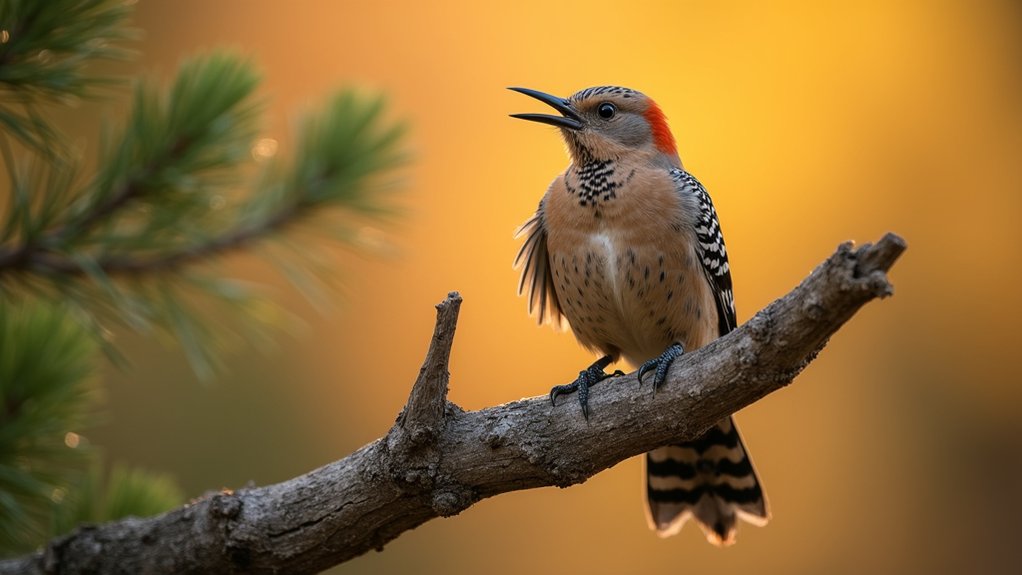
Although often called the “yellowhammer,” Alabama’s state bird is officially the northern flicker (*Colaptes auratus*), a medium-sized woodpecker designated in 1927. You’ll notice its brown-and-black barred back, buff breast with black spots, and a distinctive black necklace.
Alabama’s official state bird, the northern flicker, is a striking medium-sized woodpecker with a distinctive black necklace.
In Alabama, the yellow-shafted subspecies is common, showing bright yellow underwings and undertail, a gray crown, and a red nape patch. Measuring 11–14 inches long with a wingspan of 17–21 inches, this woodpecker weighs 3–6 ounces. Its name is historically linked to young cavalry soldiers from Huntsville who wore yellow fabric, leading to the nickname yellowhammer company.
Unique among woodpeckers, it forages primarily on the ground, using its slightly curved bill and sticky tongue to extract ants and insects.
Its presence helps control insect populations and provides nesting cavities for other species, making it an integral part of Alabama’s ecosystems and avifauna.
Alaska State Bird
The willow ptarmigan (*Lagopus lagopus*), Alaska’s official state bird since 1955, stands out for its remarkable adaptability to harsh northern environments.
You’ll notice it molts seasonally, shifting from brown summer plumage that camouflages among tundra rocks and vegetation to pure white winter feathers blending seamlessly with snow.
This circumboreal grouse breeds across Alaska’s birch forests and tundra, remaining year-round unlike migratory birds. It is the only state bird chosen by schoolchildren, as 6,000 Alaskan children voted for its selection.
Its social behavior varies; winter flocks feed closely together, while males fiercely defend territories during the summer breeding season.
Alaskan schoolchildren selected this bird for its recognizability and year-round presence, symbolizing local resilience.
The willow ptarmigan’s scientific classification places it in the Tetraonini tribe, reflecting its grouse lineage.
Arizona State Bird
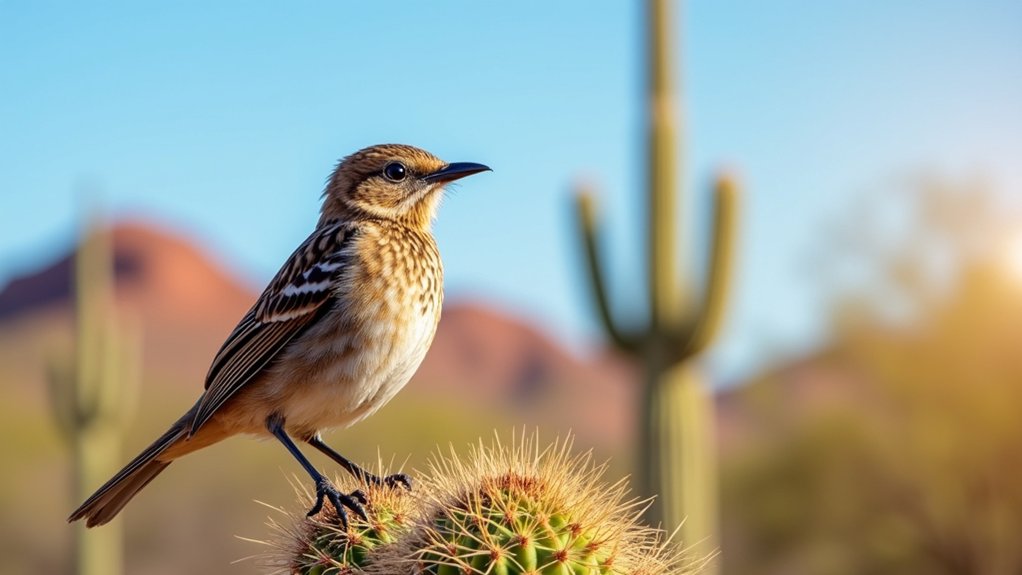
Arizona proudly designated the cactus wren (Campylorhynchus brunneicapillus couesi) as its state bird in 1931, recognizing its deep connection to the Sonoran Desert ecosystem.
This subspecies thrives across southern Arizona’s arid shrublands, favoring spiny cacti like cholla and saguaro for nesting and protection.
Measuring 7–9 inches with a curved bill adapted for probing, it displays brown, white-spotted plumage and a bold white eyebrow stripe.
You’ll find it actively defending year-round territories alongside its mate, building football-shaped nests within cactus spines to deter predators. Territories typically range from 1.3 ha to 1.9 ha in size, allowing pairs to maintain exclusive access to resources.
Primarily insectivorous, it supplements its diet with seeds and fruit.
The cactus wren’s robust presence and specialized desert adaptations embody Arizona’s distinctive environment, earning its status among official state symbols alongside the saguaro blossom and palo verde.
Arkansas State Bird
You’ll notice the Northern mockingbird, Arkansas’s state bird since 1929. It really stands out with its gray plumage and those distinctive white wing patches you can see when it’s flying.
What’s really amazing is its ability to mimic up to 200 sounds — from other birds to even mechanical noises. This impressive vocal talent has earned it a special symbolic status.
Plus, the bird’s resilience and how common it’s all across Arkansas played a big role in it being chosen. The campaign promoted by the State Federation of Women’s Clubs helped gain support for its adoption as the state bird. Local cultural values and advocacy from civic groups definitely helped make it the state bird.
Northern Mockingbird Traits
Recognizing a Northern Mockingbird involves noting its medium size, measuring approximately 20.5 to 28 cm in length with a wingspan between 31 and 38 cm. You’ll observe gray-brown upperparts contrasted by pale whitish underparts, along with distinct white wing patches and outer tail feathers visible during flight. Its long, slightly curved black bill and light green-yellow iris further aid identification.
Key traits include exceptional vocal mimicry, with a repertoire exceeding 39 songs and 50 call notes, often expanding throughout life. They also show strong territorial behavior, with pairs defending breeding and feeding areas year-round and aggressively warding off intruders. Northern Mockingbirds can recognize individual humans and adjust their behavior based on learned threat assessments.
Northern Mockingbirds are habitat generalists, frequenting open or semi-open areas including urban environments. They feed omnivorously on insects and fruits.
These features make the Northern Mockingbird both adaptable and conspicuous across its range.
Symbolism and History
The northern mockingbird earned official status as Arkansas’s state bird on March 5, 1929. This happened when the Forty-seventh General Assembly passed House Concurrent Resolution No. 22. At first, some saw it as a joke, but the resolution actually recognized the bird’s ecological and cultural importance.
The Arkansas Federation of Women’s Clubs led the effort. They pointed out how the bird helps control pests and aids in seed dispersal. These roles benefit agriculture in the state.
| Aspect | Detail |
|---|---|
| Official Designation | March 5, 1929, House Concurrent Resolution No. 22 |
| Advocacy | Led by Arkansas Federation of Women’s Clubs |
| Ecological Role | Controls pests; aids seed dispersal |
| Cultural Symbolism | Represents innocence, resilience, freedom |
You’ll find the mockingbird embodies Arkansas’s natural and cultural heritage through this rich symbolism.
California State Bird
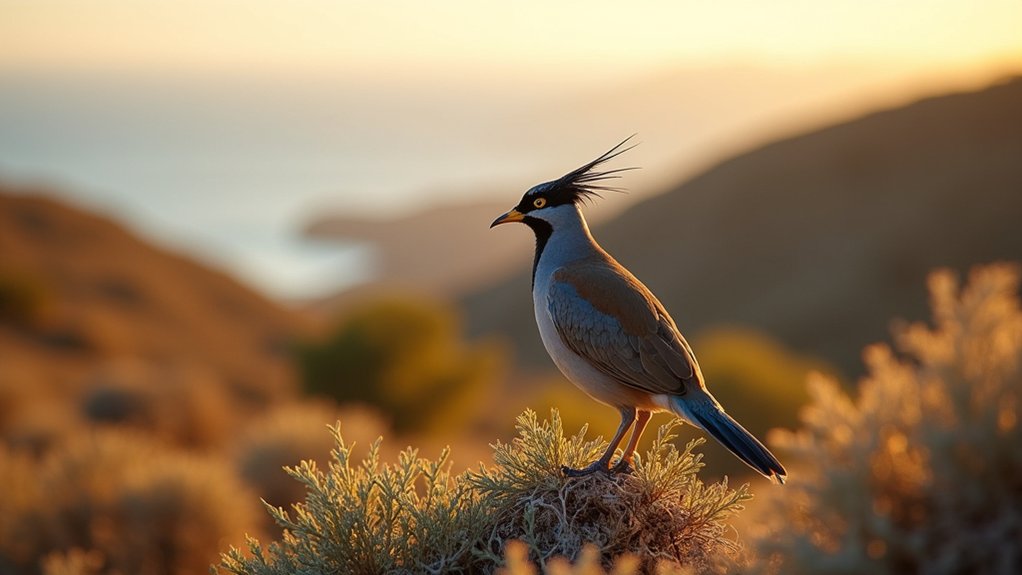
California claims the California quail (*Callipepla californica*), also known as the California valley quail or California partridge, as its official state bird.
California proudly honors the California quail as its official state bird.
This plump, ground-dwelling bird measures about 10 inches long and sports a distinctive forward-curving black plume.
You’ll notice males have striking black-and-white facial patterns, while females display muted browns for camouflage.
Key characteristics include:
- Social behavior: Forms coveys of 30 to 300 birds outside breeding season, breaking into smaller family groups for nesting.
- Habitat: Thrives in brushy foothills, chaparral, and suburban edges with dense cover and open ground.
- Vocalization: Recognizable “chi-ca-go” call, aiding in covey communication and identification.
Designated by law in 1931, the quail symbolizes California’s diverse ecosystems and adaptability to urban landscapes. The official designation was established through legislation signed by Governor James Rolph, Jr., reflecting the state’s commitment to wildlife conservation and recognition of the quail as the official avifaunal emblem.
Colorado State Bird
Colorado honored the lark bunting (*Calamospiza melanocorys*) as its state bird on April 29, 1931, through Senate Bill No. 251. This medium-sized American bunting exhibits remarkable seasonal plumage changes: breeding males display jet black feathers with white wing markings, while winter plumage shifts to gray-brown, resembling females’ consistent coloring.
Unique among sparrows, it alone undergoes this dramatic transformation. You’ll find these birds across Colorado’s grasslands and Great Plains, especially in Pawnee National Grasslands. Males perform aerial courtship flights, pairing complex warbling and trilling songs to attract mates. The lark bunting is an important symbol of Colorado’s natural heritage.
Despite its widespread presence, lark buntings faced a 2.5% annual population decline from 1966 to 2003 due to prairie habitat loss.
Conservation efforts focus on preserving these essential grassland ecosystems to stabilize their numbers.
Connecticut State Bird
You’ll notice the American Robin, *Turdus migratorius*, really stands out with its vibrant orange breast and melodious song.
It’s been Connecticut’s state bird since 1943. This thrush species does well in all kinds of places—from urban parks to woodlands.
It’s pretty adaptable, changing how it nests and looks for food depending on where it is. Plus, the robin symbolizes renewal and resilience, which fits perfectly with Connecticut’s seasonal rhythms and cultural identity. The American Robin was chosen in part because it is found in urban, suburban, and rural areas, symbolizing unity across the state.
American Robin Overview
The American robin (*Turdus migratorius*), a member of the thrush family Turdidae, serves as the official state bird of Connecticut since 1943.
This thrush displays a distinctive reddish-orange breast contrasting with its gray-brown back and darker head, and a yellow bill with a broken white eye-ring. You can identify males by their slightly brighter plumage and larger size compared to females.
Key characteristics include: length of 23–28 cm with a wingspan of 31–41 cm and body mass averaging 77 g. There are seven subspecies exhibiting regional variation in size and breast color intensity.
They have a widespread North American distribution, with many individuals remaining in Connecticut through winter. They adapt well to both natural and human-modified habitats. The American robin is also recognized as the state bird of Michigan and Wisconsin, further emphasizing its significance in multiple states.
These traits illustrate the robin’s ecological versatility and prominence in Connecticut’s avifauna.
Symbolism and Habitat
Although you may primarily notice the American robin as a harbinger of spring, its symbolism extends deeply into themes of hope, renewal, and resilience that resonate throughout Connecticut’s cultural and natural landscapes.
Its reddish breast symbolizes liveliness, while its cheerful song signals optimism and new beginnings. The American robin is easily recognized by its red-orange chest, brown back, and dark head, making it a favorite among bird watchers.
Historically, the robin’s arrival marks spring’s start, embodying happiness and good fortune in local traditions.
You’ll find robins thriving across Connecticut in suburban lawns, parks, and woodlands, adapting well to human-altered environments.
During winter, they shift diet from invertebrates to berries, roosting in evergreen swamps for shelter.
This broad ecological tolerance allows robins to persist year-round, making them a familiar and scientifically significant emblem that bridges natural cycles with cultural identity in Connecticut.
Delaware State Bird
Delaware honors the Blue Hen Chicken as its state bird, a designation officially adopted on April 14, 1939, by the Delaware General Assembly.
This bird isn’t a formal breed but is named for the steel-blue coloring of its feathers. It was selected more for its Militant War significance than natural prevalence. The Blue Hen has come to symbolize Delawareans’ courage and fighting spirit, reflecting its historic role in inspiring troops during the Revolutionary War.
Delaware soldiers earned the nickname “Blue Hen’s Chickens” for their tenacity. This is linked to fighting gamecocks bred by Captain Jonathan Caldwell.
You’ll note these key characteristics:
- Steel-blue plumage with a contrasting red comb
- Compact size, weighing up to 6 pounds, with sturdy legs for mobility
- Symbol of courage and resilience, welcomed statewide in sports and culture
This bird’s history and appearance embody Delaware’s proud military heritage and local identity.
Florida State Bird
When you observe Florida’s avian life, you’ll notice the Northern mockingbird (*Mimus polyglottos*) stands out as a year-round resident renowned for its vocal mimicry and territorial behavior. Designated Florida’s state bird in 1927, it thrives across varied habitats, from urban yards to rural landscapes. The selection was influenced by the bird’s prevalence, vocal talents, and its symbolic association with vigilance.
Its gray and white plumage and complex song repertoire, often exceeding 200 imitations, serve both communication and defense. You’ll find it aggressively protecting territories, especially during breeding.
| Feature | Description |
|---|---|
| Size | 8–10 inches long; 12–14 inch wingspan |
| Vocalization | Mimics 200+ sounds; nocturnal singing |
| Habitat | Open areas, shrubs, urban to rural |
| Diet | Insects, fruits, seeds |
| Legal Status | Protected under Migratory Bird Treaty Act |
Georgia State Bird
You’ll notice the Brown Thrasher’s song is pretty complex. It features a wide variety of repeated phrases, which makes it one of Georgia’s most distinctive bird voices.
This bird really thrives in dense shrubbery and along woodland edges all across the state. It loves habitats that offer plenty of cover for foraging and nesting.
Unlike the Brown Thrasher, the northern cardinal is a common resident in Georgia, easily recognized by its vibrant red plumage and strong, cone-shaped beak.
Brown Thrasher Song
The Brown Thrasher’s song stands out for its remarkable complexity and variety. It boasts one of the largest repertoires among North American songbirds with up to 2,000 distinct song types.
You’ll notice its song features paired short phrases, “singing in doublets,” with rich, flute-like tones that resemble mockingbirds but with less repetition.
Its vocalizations carry strongly across wooded areas, shifting smoothly between whistles, chatters, and warbles. As a Mimidae family member, it incorporates mimicry of other birds and environmental sounds, creating a dynamic and highly variable song. The Brown Thrasher also plays a role in local ecosystems as an insectivore.
Key features include:
- Paired phrase structure with couplet-like patterns
- Incorporation of diverse imitations and mechanical sounds
- Seasonal peak in spring, mainly sung by males to defend territory and attract mates
Habitat and Range
Although found across various environments, the Georgia State Bird favors dense low growth like thickets, brush, and shrubbery near woodland edges and swamps. You’ll find it occupying semi-open habitats with substantial groundcover, including forest edges, shrubby fields, and suburban areas rich in small trees and brush piles. Its distinctive long tail and vivid yellow eyes make it easily recognizable in these habitats.
Its range covers all of Georgia, benefiting from mixed-use landscapes such as farms and rural homesteads. Breeding occurs in dense vegetation 2 to 7 feet above ground, providing cover for nesting and foraging.
Seasonal movements include permanent residency in the southeast, with northern birds migrating south.
| Habitat Type | Key Characteristics |
|---|---|
| Woodland Edges | Dense thickets, shrubbery |
| Semi-open Fields | Shrubby, substantial groundcover |
| Suburban Areas | Brush piles, small trees |
| Breeding Sites | Dense low shrubs, 2 to 7 ft elevation |
| Range | Throughout Georgia, southeastern US |
Hawaii State Bird
When you observe Hawaii’s native fauna, you’ll notice the Nēnē (*Branta sandvicensis*), a medium-sized goose endemic to the islands and officially designated as the state bird in 1957.
This species, unique to Hawaii, features a black head and legs, buff cheeks, and a barred neck pattern that camouflages well against volcanic terrain.
Unlike other geese, the Nēnē’s feet are only half-webbed, which helps it move easily on rocky surfaces.
Key traits include:
- Soft, melodic calls replacing typical honks
- Herbivorous diet focused on native shrubs and ‘ōhelo berries
- Strong monogamous bonds with protective parenting
Once nearly extinct, the Nēnē now thrives due to dedicated conservation, with populations recovering from fewer than 30 birds in the 1950s to over 3,000 today thanks to successful captive breeding.
It symbolizes resilience and the deep Hawaiian connection to ʻāina.
Idaho State Bird
You’ll find the mountain bluebird thriving in Idaho’s open grasslands and high-elevation meadows.
It relies on scattered perches and nest cavities to breed successfully.
This bird’s vivid cerulean plumage not only marks the arrival of spring but also symbolizes the state’s rugged natural beauty and spirit of renewal. The Mountain Bluebird is a member of the thrush family (Turdidae), species Sialia currucoides, which contributes to its distinctive appearance and behavior.
Watching it appear each season gives you a glimpse into the ecological balance and cultural identity that the mountain bluebird represents in Idaho.
Mountain Bluebird Habitat
Because the Mountain Bluebird thrives in varied terrains, its habitat spans open country across western North America, including Idaho, where scattered trees and shrubs provide essential nesting and foraging sites.
You’ll find them breeding at elevations up to 12,500 feet, favoring meadows, sagebrush flats, and alpine hillsides. The Mountain Bluebird typically raises 2 broods per year, demonstrating its reproductive adaptability.
During winter, they migrate to lower elevations, occupying pinyon-juniper woodlands and open grasslands. They nest in tree cavities, old woodpecker holes, and sometimes cliff crevices or artificial nest boxes.
Key habitat features include:
- Nest sites near scattered trees, especially aspen groves with perches nearby
- Open landscapes with short grasses for prey hunting
- Adaptation to human-altered areas like clear-cut forests and fire-burned zones
These factors guarantee adequate shelter, food, and breeding success for the Mountain Bluebird.
Symbolic Significance
Symbolism shapes how you understand the Mountain Bluebird beyond its physical traits, revealing its deep cultural and spiritual roles, especially in Idaho. Native American traditions regard it as a messenger bridging spiritual and physical domains, with its song believed to carry prayers and blessings.
Its vivid blue plumage symbolizes freedom, imagination, and boundless possibilities, while its cheerful presence universally represents joy and good fortune. The bird’s return each spring marks renewal, resilience, and hope, underscoring adaptability in harsh environments. Male Mountain Bluebirds feature vibrant blue feathers that shimmer in sunlight, enhancing their symbolic connection to the sky.
As a monogamous species, it embodies loyalty, love, and familial harmony. Its literary and folkloric presence reinforces this symbolism, with the phrase “bluebird of happiness” representing contentment.
Idaho’s adoption of this bird in 1931 reflects its embodiment of freedom and the vast natural landscape.
Illinois State Bird
The northern cardinal, designated as Illinois’ state bird in 1929, stands out with its bright red plumage and distinctive crest. This makes it easily identifiable across the state’s varied habitats. As with other urban-adapted bird species, cardinals thrive in proximity to people due to their tolerance of human presence and flexible nesting habits.
You’ll find this songbird year-round throughout Illinois, thriving in urban, suburban, and rural environments. The species is listed as population stable and is not endangered, reflecting its successful adaptation to diverse environments.
The cardinal’s prominence was cemented by a statewide student vote, reflecting its cultural and ecological significance.
Key traits of the northern cardinal include:
- Males exhibit vivid red feathers and a prominent crest; females show muted reddish-brown tones.
- The species expanded into Illinois in the late 1800s, aided by suburban development and bird feeders.
- It plays a crucial role in ecosystem balance via seed dispersal and insect control.
Protected under the Migratory Bird Treaty Act, the cardinal remains a symbol of Illinois’ natural heritage.
Indiana State Bird
While Illinois honors the northern cardinal as its state bird, Indiana shares this distinction, officially adopting the same vibrant species in 1933. You’ll recognize the male cardinal by its brilliant scarlet plumage and black facial mask, a striking contrast against the female’s buffy-brown with reddish highlights.
This medium-sized songbird, *Cardinalis cardinalis*, thrives across Indiana’s rural and urban habitats. Males aggressively defend territories about four acres wide, often attacking red objects mistaken for rivals. Their clear, whistled songs resonate almost year-round, marking their presence vividly. The northern cardinal is one of seven states’ official birds, underscoring its widespread popularity across the eastern U.S. seven states. As a member of the order Galliformes, the cardinal demonstrates the diversity and adaptability found within fowl birds.
Protected under the Migratory Bird Treaty Act, cardinals benefit from abundant backyard feeders, supporting stable populations.
Symbolically, their bright red feathers symbolize liveliness, featured in Indiana’s state emblems and tourism, making the northern cardinal a scientifically significant and culturally cherished bird in Indiana.
Iowa State Bird
Iowa proudly designated the Eastern Goldfinch as its state bird on March 21, 1933, following a unanimous selection by the Iowa Ornithologists’ Union the previous year.
You’ll notice the male goldfinch’s bright yellow body contrasted with black wings and crown, while females show a duller olive-yellow.
This bird’s year-round presence across Iowa made it an obvious choice, favored over alternatives like the robin and bluebird. The decision was influenced by the bird’s reputation for being beneficial to farmers, as it consumes weed seeds and pests such as cankerworms and beetles, highlighting its agricultural value.
Key features include:
- Diet mainly of seeds from native plants such as dandelions and sunflowers
- Seasonal plumage shifts, with males adopting duller colors in winter
- Non-migratory habits, allowing consistent observation throughout the year
This species exemplifies Iowa’s natural environment and has stood as a symbol of the state’s avifauna for nearly a century.
Kansas State Bird
Following the Eastern Goldfinch’s role as Iowa’s emblem, Kansas honors the Western Meadowlark as its state bird, a designation officially made in 1937. The bird was selected after a contest in 1925 conducted by the Kansas Audubon Society, where schoolchildren voted among top candidates including the bobwhite quail, cardinal, and robin.
This medium-sized songbird, chosen by Kansas schoolchildren in 1925, stands out with its vivid yellow breast marked by a distinct black “V,” and a brown, streaked back that blends with prairie grasses.
You’ll often spot adults with black-and-white striped heads and bright yellow cheeks perched on fence posts across Kansas grasslands. Its clear, flute-like song, spanning 7 to 10 notes, carries over open fields, signaling territorial presence and attracting mates.
Although widespread across western North America, habitat loss threatens its survival, making prairie conservation critical for sustaining this species emblematic of Kansas’s natural heritage.
Kentucky State Bird
Because Kentucky was the first state to officially designate a state bird, the Northern Cardinal holds a unique place in both local heritage and conservation history. Officially recognized in 1926 under Kentucky Revised Statute 2.080, this medium-sized songbird displays sexual dimorphism: males boast brilliant red plumage, while females exhibit pale brown with reddish tinges. The Kentucky cardinal (Cardinalis cardinalis) was specifically selected as the state bird for being a native species of Kentucky.
Cardinals remain year-round residents, singing rich notes continuously and illustrating territoriality through aggressive behaviors toward perceived rivals. The Northern Cardinal’s diet includes seeds such as safflower and sunflower, which are often found in high-quality bird seed mixes that attract a variety of backyard birds. The Northern Cardinal’s distinctive jet-black mask and reddish-orange bill aid in identification.
Protection under the Migratory Bird Treaty Act safeguards birds, nests, and eggs. Kentucky’s designation fosters conservation partnerships, enhancing habitat preservation.
You’ll find that understanding these traits deepens appreciation for this emblematic species central to Kentucky’s biodiversity and environmental education.
Louisiana State Bird
You know the brown pelican? It’s been Louisiana’s state bird since 1966. What makes it really stand out is its dark feathers and this amazing way it feeds—diving right into the water to catch fish. Pretty cool, right?
But things weren’t always great for the brown pelican. Back in the day, they almost disappeared from the area because of DDT, a harmful chemical that messed with their ability to reproduce. It was a tough time, and the bird was on the brink of local extinction.
Luckily, starting in the late 1960s, people stepped in with reintroduction programs and conservation efforts. The state transported Florida fledglings as part of these efforts to help the population recover. Thanks to those actions, the brown pelican made a strong comeback.
Now, you can see them thriving along Louisiana’s coast. They’re not just birds; they’re a symbol of hope and successful recovery.
Brown Pelican History
Although many birds symbolize regional identity, the brown pelican distinctly embodies Louisiana’s history, culture, and ecology. The species has long represented charity and protection, first appearing on the state seal in 1902 and later on the flag in 1912.
You’ll notice the brown pelican’s symbolism reflects resilience and nurturing, traits early settlers admired. Designated Louisiana’s official state bird in 1966, it reinforces the nickname “Pelican State.” The brown pelican is known for building well-built platforms of sticks lined with grass or leaves for nesting.
Key historical points include:
- 1800s adoption of pelican imagery as emblematic of sacrifice and care
- 1963 extirpation from Louisiana’s coast due to environmental pressures
- 1968 to 1980 reintroduction efforts restoring breeding populations on coastal islands
This history marks the brown pelican as both a cultural icon and ecological indicator in Louisiana.
Conservation and Recovery
The brown pelican’s emblematic status in Louisiana is matched by a complex history of population collapse and recovery. You should know that pesticide DDT caused eggshell thinning, leading to near extinction by the 1960s. Louisiana’s population vanished for nearly a decade.
After DDT’s 1972 ban, biologists reintroduced 767 chicks from Florida between 1968 and 1976, primarily on Queen Bess Island. This sparked recolonization with 11 nests by 1971. The brown pelican typically has a wingspan of six to seven feet, which aids its impressive fishing technique.
The species was federally endangered in 1970 but delisted nationwide in 2009 following population rebounds exceeding 650,000. Queen Bess Island peaked at 4,000 nests in 2008 but faces habitat loss due to subsidence, prompting restoration projects.
Despite recovery, threats like the 2010 BP oil spill highlighted ongoing conservation challenges. This underscores the delicate balance you must maintain to protect this iconic bird.
Maine State Bird
When you observe Maine’s forests or even glance at the state license plate, you’ll notice the black-capped chickadee, officially designated as the state bird in 1927. This minuscule, non-migratory songbird, known for its black-and-white coloring and complex vocalizations, thrives year-round across Maine. It is a member of the titmouse family, which also includes the tomtit and dickybird. Despite debates, Maine hasn’t specified the species beyond “chickadee,” although two species live there, the black-capped and boreal chickadee.
Key characteristics include:
- Omnivorous diet with insects and cached seeds, supporting winter survival
- Distinctive “chick-a-dee” calls conveying varied messages
- Adaptability to both deep forests and suburban habitats
You’ll find this cheerful, resilient bird paired with Maine’s white pine, symbolizing the state’s natural heritage and ecological balance. It is known for its food caching behavior, storing food in tree bark crevices and under leaves to retrieve later.
Maryland State Bird
Moving from Maine’s resilient black-capped chickadee, you’ll find Maryland celebrates a bird likewise rich in history and symbolism: the Baltimore Oriole. Officially designated in 1947, its male’s striking black and golden-orange plumage mirrors the Calvert family coat of arms, inspiring its name and early colonial moniker, “Baltimore-Bird.” The Baltimore Oriole has been protected since 1882 through special provisions recognizing its importance.
Females, with muted brownish-olive feathers, exhibit sexual dimorphism so distinct they seem a different species. You’ll notice these orioles breed in Maryland’s parks and suburbs, migrating to tropical regions in winter.
Their insectivorous diet relies on robust insect populations, but pesticide exposure and habitat loss have caused declines since 1966. Maryland’s early legal protections, predating federal laws, underscore efforts to conserve this emblematic species amid ongoing environmental threats.
Massachusetts State Bird
Massachusetts proudly recognizes the black-capped chickadee (Poecile atricapillus) as its state bird, a designation made official on March 21, 1941, by the Massachusetts General Court.
You’ll notice this small bird, measuring four to five inches, sporting a distinctive black cap and pale yellowish margins. It remains active year-round, thriving through harsh New England winters without migrating. The black-capped chickadee is also notably monogamous, pairing for life, which is relatively rare among small birds.
When observing this species, consider these key traits:
- Exhibits vocal complexity with “chick-a-dee” calls varying by context and alarm.
- Occupies diverse habitats throughout Massachusetts, from forests to suburban areas.
- Demonstrates agile, acrobatic foraging behavior, using its compact body to navigate vegetation.
As a hardy, sociable bird, the black-capped chickadee offers accessible observation opportunities for both novice and experienced birdwatchers alike.
Michigan State Bird
You’ll find the American robin (*Turdus migratorius*) holds special significance as Michigan’s state bird. It was officially adopted in 1931 after a statewide vote organized by the Michigan Audubon Society. Nearly a quarter of nearly 190,000 ballots favored this thrush.
It’s recognized for its distinctive orange breast and clear, melodious song, which signals the arrival of spring. The robin is also known for its ability to produce three successful broods in one year.
If you spend time observing Michigan’s habitats, you’ll notice just how widespread the robin is. That’s part of why it’s considered the “best known and best loved” bird in the state.
American Robin Significance
The American Robin holds a prominent place in Michigan’s cultural and ecological landscape, symbolizing the arrival of spring through its early return from migration in late winter.
You’ll often notice its bright orange breast and hear its melodious song in neighborhoods, signaling renewal after harsh winters.
Its adaptability allows it to thrive in diverse habitats, from woodlands to urban yards, making it an essential part of Michigan’s ecosystems. The robin was designated as Michigan’s state bird in 1931 after winning a popular contest, highlighting its status as the best known and best loved bird in the state.
Consider these key points about its significance:
- Represents hospitality and optimism, featured historically on Michigan promotional pins.
- Controls insect populations and aids seed dispersal via an omnivorous diet.
- Serves as a bio-indicator species reflecting environmental and climate shifts.
Michigan Bird Selection
Although many birds inhabit Michigan, the American robin was chosen as the state bird through a highly participatory process led by the Michigan Audubon Society in 1929.
Over 190,000 residents cast votes via letters and postcards, with the robin and chickadee emerging as the final contenders. The robin received nearly a quarter of all votes, reflecting its prominence.
On April 8, 1931, the Michigan legislature officially adopted the robin through House Concurrent Resolution 30, acknowledging it as “the best known and best loved” bird in the state. The robin is also notable for its colorful and cheery presence, often seen as a symbol of spring.
Despite ongoing challenges from chickadee advocates and brief legislative efforts to replace it, the robin remains Michigan’s emblematic bird, recognized for its widespread presence and cultural significance.
This selection highlights both public engagement and scientific observation in state symbol designation.
Minnesota State Bird
Minnesota honors the common loon (Gavia immer) as its state bird, officially adopting it in 1961 through legislation signed by Governor Elmer L. Andersen.
This elegant waterbird, with its white-spangled black plumage and Morocco red eyes, reaches three feet in length and a five-foot wingspan.
Known for haunting calls echoing across northern lakes, the loon embodies Minnesota’s rich aquatic ecosystems. You’ll find about 12,000 loons here each summer, second only to Alaska. The common loon is recognized as a symbol of Minnesota, representing the state’s northern lakes.
Key traits include:
- Expert underwater plungers, reaching depths of 90–200 feet while holding breath up to one minute
- Distinctive torpedo-shaped bodies and long black bills aiding swift aquatic pursuit
- Vocalizations comprising cries, wails, and yodels unique to their environment
Their conservation faces threats from rising temperatures, mercury toxicity, and habitat loss.
Mississippi State Bird
Mississippi proudly recognizes the northern mockingbird (Mimus polyglottos) as its state bird, a designation secured in 1944 after a successful campaign by the Women’s Federated Clubs of Mississippi.
This gray bird, about 10–11 inches long, displays distinctive white patches on wings and tail, visible during flight.
It inhabits all Mississippi regions, favoring open areas with dense shrubs, including urban yards and woodland edges. The mockingbird is Mississippi’s official state bird, a choice that was met with unanimous approval by the Mississippi Legislature.
Territorial and omnivorous, it feeds on insects, fruits, and berries.
Assertive and adaptable, it thrives on a varied diet of insects, fruits, and berries.
Known for mimicking up to 200 distinct sounds, from other birds to mechanical noises, it sings loudly from raised perches, especially in breeding season.
Non-migratory and aggressive in nest defense, it symbolizes Mississippi’s bold and cheerful spirit.
Its stable population and widespread presence underscore its ecological and cultural significance.
Missouri State Bird
You’ll notice the Eastern bluebird, which has been Missouri’s state bird since 1927.
It’s pretty interesting how the males are bright and vibrant, while the females have more subtle colors. When you listen closely, you can hear its rich, melodic song. Plus, it’s quite adaptable and can often be seen in urban parks.
These traits really help it survive and thrive. This bird isn’t just common across Missouri—it also stands as a symbol of happiness, showing how much the state appreciates its native wildlife. The Eastern bluebird is a medium-sized songbird known for its beautiful warbling whistle, often described as “Tu-wheet-tudu.”
Eastern Bluebird Overview
The Eastern bluebird (*Sialia sialis*), Missouri’s state bird, enchants observers with its vibrant plumage and distinctive song. This small thrush measures 16–21 cm long with a wingspan of 25–32 cm. Males display bright blue heads and rusty-orange breasts, while females are paler gray-blue. You’ll notice their plump bodies, large eyes, and short bills.
Their rich, warbling whistle, often described as “Cheer cheerful charmer,” signals territorial claims and pair communication starting in late winter.
Key features include:
- Nesting in cavities lined with fine materials, with males performing a unique “Nest Demonstration Display.”
- Seasonal presence mainly during spring and summer in Missouri, with migration beginning in fall.
- Their clear song culturally symbolizes happiness and the arrival of spring.
Eastern Bluebirds are popular bird species alongside the Cardinal and are known for their striking colors and social behavior.
Habitat and Behavior
Appreciating the Eastern bluebird’s vibrant plumage and song leads naturally to understanding where and how it lives. You’ll find this bird in Missouri’s open grasslands, meadows, farmland, and woodland edges where short ground cover and scattered trees provide ideal foraging and nesting sites.
It relies on a combination of open spaces for hunting insects by sitting on low perches and nearby tree cavities or nest boxes for breeding. Eastern Bluebirds are skilled insect hunters; they often perch on branches or fence posts to scan for prey, making use of perch hunting techniques. Outside breeding season, it forms large flocks and maintains feeding territories, often using anthropogenic habitats like parks and suburban lawns.
During warm months, its diet consists mainly of insects captured from the ground or mid-air, shifting to fruits and berries in winter. The Eastern bluebird’s precise habitat use and territorial behavior reflect its adaptation to both natural and human-altered landscapes.
Symbolic State Significance
Although many birds could represent Missouri, lawmakers chose the Eastern bluebird in 1927 because it was common across the state and symbolized happiness. This choice aligned Missouri’s identity with a native songbird emblematic of rural landscapes and positive cultural motifs.
You’ll notice the bird’s bright blue plumage and melodic song evoke joy and hope, reflecting Missouri’s outdoor character. The Eastern bluebird is typically found in open fields, parks, and orchards throughout Missouri.
Key symbolic aspects include:
- Representation of Missouri’s rolling countryside and traditional farm life
- Embodiment of happiness, hope, and renewal through visual and auditory cues
- Cultural links to the “bluebird of happiness” motif and seasonal optimism
Montana State Bird
Symbolizing Montana’s open landscapes, the western meadowlark (*Sturnella neglecta*) earned its status as the state bird through a 1930 statewide vote by schoolchildren, followed by legislative designation in 1931.
This medium-sized icterid features bright yellow underparts with a bold black “V” on its chest and mottled brown upperparts, camouflaging it in grasslands.
You’ll often spot it perched on fenceposts or shrubs, singing a rich, flute-like song distinct from its eastern relative. Its long, pointed bill probes soil for insects and seeds, reflecting its ground-foraging behavior in Montana’s prairies and agricultural fields. The bird’s diet consists largely of insects such as beetles, cutworms, and grasshoppers, which make up about 65-70% of its food.
Remarkably recorded by Meriwether Lewis near Great Falls in 1805, the western meadowlark remains a common, migratory species integral to Montana’s ecological and cultural heritage.
Nebraska State Bird
The western meadowlark (*Sturnella neglecta*) serves as Nebraska’s official state bird, a designation enacted by the Nebraska Legislature in 1929 under statute Nebraska Revised Statute 90‑107.
This medium-sized songbird is notable for its bright yellow breast marked by a bold black “V” and black-and-white striped head.
It thrives in Nebraska’s open grasslands and agricultural fields. You’ll often spot it perched on fence posts, singing a clear, flute-like song that defines the prairie soundscape. The western meadowlark is known for singing a distinct 7-10 note melody, which makes it easily recognizable.
Key characteristics include ground nests concealed in grasses, reflecting adaptation to prairie habitats.
The western meadowlark’s diet consists of insects and seeds, foraged primarily on the ground. It shares state bird status with five other states, which underscores its regional importance.
Its presence symbolizes Nebraska’s natural heritage and rural landscapes with scientific precision.
Nevada State Bird
You’ll notice the Mountain Bluebird thriving in Nevada’s high-elevation meadows and open woodlands. Its vivid azure plumage really stands out against the sagebrush and pinyon pine.
This bird is more than just a pretty sight—it symbolizes Nevada’s natural heritage and even appears in state emblems. That shows how important it’s both ecologically and culturally.
When you watch it hover and listen to its distinctive “chur chur” song, you’re seeing some unique behaviors that help it forage across the western landscape. The Mountain Bluebird is also officially recognized as Nevada’s state bird, highlighting its significance to the state’s identity.
Mountain Bluebird Habitat
Although mountain bluebirds roam widely across western North America, their habitat preferences in Nevada reveal distinct patterns tied to elevation and vegetation.
You’ll find them breeding mostly in high-elevation open meadows, sagebrush flats, and alpine edges up to 12,500 feet. These birds favor grassland-like and savannah-like areas with scattered trees, avoiding densely forested regions.
During winter, they shift to lower elevation grasslands and woodlands like pinyon-juniper and oak-juniper stands.
Key habitat features include:
- Open terrain with scattered trees, reducing nesting competition
- Natural cavities and old woodpecker holes for nesting, requiring 1.5–2 inch entrance diameters
- Abundant insect prey in open fields, supplemented by berries in colder months
Symbolism and Importance
Since 1967, when Nevada’s Legislature officially designated the mountain bluebird as the state bird, this species has symbolized more than just native wildlife.
You’ll find its azure plumage embodies sacredness and sky in Southwestern Native American traditions, particularly among the Navajo, who see it as a herald of sunrise and renewal.
This symbolism extends to Nevada’s identity, representing hope, happiness, and expansive open skies, aligning with the state’s upland habitats and ranching heritage. The mountain bluebird is a member of the thrush family, which highlights its ecological role in Nevada’s diverse ecosystems.
You might notice its prominence in public art and tourism narratives, reinforcing place-based storytelling.
Ecologically, the mountain bluebird serves as a stewardship emblem, reflecting land-use changes and benefiting from conservation efforts like nest-box programs.
Its stable populations and cultural resonance make it an essential link between Nevada’s natural environment and community values.
Identification and Behavior
When observing the mountain bluebird, you’ll notice distinct differences between males and females that aid in identification. Males sport bright turquoise-blue feathers on top and lighter blue underneath with a white belly. Females show duller blue wings and tail paired with grey on the breast, crown, throat, and back. The average weight of these birds is about one ounce, making them lightweight and agile.
You’ll find these birds in open western habitats, often at elevations between 5,000 and 12,000 feet during breeding season.
Their feeding behavior is similarly distinctive. They hover or launch from perches to catch insects like grasshoppers and beetles. In winter, their diet shifts to berries and seeds, commonly junipers.
Vocalizations include thin “few” calls and warbled “chur chur” songs used for territory and mating.
These traits help you identify and understand their behavior across Nevada’s landscapes.
New Hampshire State Bird
The purple finch (Carpodacus purpureus) stands as New Hampshire’s official state bird, a designation made by state law in 1957. Males show raspberry-red plumage on the head, breast, and back, while females are brown with heavy streaking and a distinct whitish eyebrow stripe.
New Hampshire’s state bird since 1957, the purple finch displays vivid raspberry-red males and streaked brown females.
Measuring about 5.5–6.3 inches long, the finch has a short, conical bill suited for seed consumption. Breeding primarily in northern and higher-elevation coniferous forests, it remains a year-round resident, exhibiting irruptive movements linked to seed availability. This designation reflects the state’s commitment to preserving natural symbols.
You’ll often find it feeding on seeds, buds, and insects, frequently visiting feeders. It displays social dominance over goldfinches but yields to chickadees.
Although populations declined mid-20th century due to competition from house finches, they’ve stabilized, and the species currently faces no conservation listing in New Hampshire.
New Jersey State Bird
Brightly colored and unmistakable, the eastern goldfinch (Carduelis tristis) earned its status as New Jersey’s official state bird in 1935, during the challenging years of the Great Depression.
You’ll notice males flaunting vibrant yellow plumage with black wings and head markings in breeding season, while females show more subdued olive-yellow tones.
Their nesting behavior is unique. They delay breeding until late summer to align with seed abundance.
Key traits include a diet focused on dandelion, sunflower, and ragweed seeds.
They prefer habitats like open fields and suburban wild patches across New Jersey. Their breeding is synchronized with peak seed production to optimize offspring survival.
Observing these patterns reveals the species’ remarkable adaptation to its environment. This bird also symbolizes New Jersey’s commitment to preserving wildlife.
New Mexico State Bird
You can identify New Mexico’s state bird, the greater roadrunner (*Geococcyx californianus*), by its distinctive streaked brown and buff plumage, shaggy crest, and long tail often carried upright for balance.
Measuring about 24 inches, it has strong legs and a long bill, adapted for swift ground pursuit.
You’ll find this permanent resident mostly at lower elevations up to 7,000 feet, favoring desert scrub, arroyos, and open woodlands.
Though capable of flight, it prefers running, reaching speeds over 15 mph to catch prey like snakes, lizards, and insects. It exhibits territorial behavior, especially during the breeding season.
Known as the “snake killer,” it plays a crucial ecological role controlling small vertebrates in arid habitats.
Recognized since 1949, the greater roadrunner remains an enduring symbol of New Mexico’s unique landscape.
New York State Bird
You’ll notice the Eastern Bluebird, New York’s official state bird since 1970, really stands out with its bright cobalt-blue upperparts and rusty red breast. It’s pretty easy to spot because of those vibrant colors.
What’s cool is that it prefers open habitats like orchards and meadows, which makes sense if you think about where you might see one fluttering around. Preferred habitats include open areas with sparse ground cover, such as orchards and meadows, which suit their nesting and feeding habits.
Plus, the Eastern Bluebird mainly eats insects, so it plays an important role in the local ecosystem by keeping insect populations in check.
Beyond just its looks and diet, this bird carries rich symbolism too. People often see it as a sign of spring’s arrival and a symbol of rural tranquility, thanks to its melodic warble and vivid plumage.
It’s kind of like a little ambassador of nature’s beauty and calm.
Eastern Bluebird Traits
The Eastern Bluebird, New York’s state bird, exhibits distinct physical traits that aid in its identification and classification as a medium-sized thrush. Measuring 16–21 cm in length with a 25–32 cm wingspan, it has a chunky body, large round head, short tail, and a short black bill.
You’ll notice males display bright blue heads and backs with reddish-orange breasts, while females are duller, showing grayish-blue tones and paler breasts. Juveniles bear spotted chests and backs, gradually acquiring adult colors.
Key traits include sexual dimorphism in plumage intensity and coloration. Its vocal repertoire features rich, musical warbles and contact calls.
The Eastern Bluebird’s foraging strategy relies on perch-and-sally hunting of insects and seasonal diet shifts.
These characteristics define its unique ecological niche.
Symbolism and Habitat
Although New York was the last state to officially designate a state bird, the Eastern Bluebird’s symbolism and habitat have long held significant cultural and ecological importance. You’ll find it represents hope, renewal, and optimism, often called the “bluebird of happiness” and linked to the state’s colonial heritage.
Historically common across New York’s open landscapes like farms, orchards, and meadows, it prefers lowland areas with scattered trees and natural cavities for nesting.
However, habitat loss from farm abandonment and forest regrowth caused population declines during the 20th century.
You can now observe the species thriving again thanks to conservation efforts like nest-box programs that restore breeding sites.
Its presence in rural and urban green spaces highlights both its adaptability and the ongoing importance of habitat conservation in New York.
North Carolina State Bird
North Carolina honors the Northern cardinal (*Cardinalis cardinalis*) as its official state bird, a designation established by the General Assembly in 1943 after a popular vote involving over 23,000 participants.
This medium-sized songbird displays sexual dimorphism: males boast vivid red plumage, while females show brownish tones with reddish accents. Both sexes feature a stout, reddish-orange bill and a distinctive pointed crest.
You’ll find these year-round residents thriving in suburban gardens, forest edges, and urban parks across North Carolina. Their notable behaviors include vocalizing complex, whistled songs such as “cheer, cheer, cheer.”
They build concealed nests in dense shrubs, with females brooding hatchlings. Their diet consists primarily of seeds, fruits, and insects, which supports local ecosystems.
The Northern cardinal’s adaptability and striking appearance make it a familiar and cherished symbol statewide.
North Dakota State Bird
Just as North Carolina celebrates the vivid Northern cardinal, you’ll find that North Dakota honors a songbird likewise emblematic of its landscape: the Western Meadowlark (*Sturnella neglecta*).
Designated in 1947, this medium-sized bird measures roughly 9.5 inches, with a bright yellow belly marked by a distinctive black “V.”
The Western Meadowlark, North Dakota’s emblem since 1947, boasts a bright yellow belly with a bold black “V.”
You’ll spot it primarily in native grasslands, where it perches on fence posts to sing during its March to October presence.
Despite a large North Dakota population estimated at 5.6 million, the species faces a steady annual decline around 1.3%, largely due to habitat loss from agriculture and energy development.
Conservation efforts recommend protecting native prairie, controlling woody encroachment, and timing mowing to preserve breeding success and sustain this cherished state symbol.
Ohio State Bird
You’ll notice the Northern cardinal’s vibrant red plumage and distinctive crest—they really make it easy to spot across Ohio’s diverse habitats.
It’s a medium-sized songbird that sticks around all year, holding onto its territory no matter the season.
If you listen closely, you’ll hear its clear, repeated whistles coming from high perches.
Watching what it eats is pretty interesting too—it mostly munches on seeds and hunts for insects, which helps support the local ecosystem.
Plus, it’s pretty adaptable, thriving in urban, suburban, and rural areas alike.
Northern Cardinal Overview
The vibrant Northern Cardinal, scientifically known as *Cardinalis cardinalis*, stands out as Ohio’s official state bird since 1933.
You’ll recognize the male by its brilliant scarlet red plumage, black facial mask, and prominent crest, while females display more subdued grayish-brown tones with reddish highlights. This species exhibits strong sexual dimorphism and a distinctive thick, cone-shaped bill.
Key facts about the Northern Cardinal include:
- Size ranges from 21–23 cm in length with a wingspan of 25–31 cm and weight around 42–48 g.
- Its song is a series of clear, whistled phrases like “what-cheer-cheer-cheer,” sung nearly year-round by both sexes.
- Despite its widespread presence, it maintains a stable population and is listed as Least Concern by the IUCN.
You’ll find the Northern Cardinal’s vivid colors and persistent song emblematic of Ohio’s natural heritage.
Habitat and Behavior
Although Northern Cardinals adapt well to various environments, they show clear preferences for habitats offering dense cover and abundant food sources. You’ll find them thriving in Ohio’s woodlands, shrublands, and suburban yards with thick bushes that provide ideal nesting and foraging grounds.
During winter, cardinals rely heavily on evergreen trees like pines and spruces for shelter against predators and harsh weather. Males establish and fiercely defend territories around four acres, placing nests 3-10 feet high in dense shrubs or low trees.
Their foraging involves hopping through low branches or near the ground, shifting from territorial pairs in breeding season to large flocks in winter.
Year-round, males sing extensively to defend territory and attract mates, using a variety of distinctive whistles and calls.
Cardinals also play a valuable role in pest management and seed dispersal, helping maintain balanced ecosystems in the habitats they occupy.
Oklahoma State Bird
When you observe Oklahoma’s official state bird, the scissor-tailed flycatcher (*Tyrannus forficatus*), you’ll notice its distinctive long, forked tail that can measure up to 12 inches, creating a remarkable silhouette during flight.
This slender songbird, about one foot long, displays soft gray plumage with black wings and pinkish-red underwing patches.
Males typically sport longer tails than females, enhancing their aerial acrobatics. The species is known for its insectivorous diet, capturing prey midair, which aids agriculture by controlling pests.
Key features include:
- Extraordinary tail morphology with a deep fork resembling scissors
- Complex courtship “sky dance” involving high-altitude somersaults and calls
- Central nesting range focused on Oklahoma’s open prairies and roadside habitats
Designated in 1951, this bird distinctively represents Oklahoma’s natural heritage.
Oregon State Bird
You’ll notice the western meadowlark by its bright yellow underparts marked with a sharp black “V” across the breast.
Plus, it has this distinctive, flute-like melody that usually has 7 to 10 notes. It’s pretty easy to recognize once you hear it!
This bird really loves Oregon’s open grasslands and prairies.
You’ll often spot it perched on fence posts, singing its familiar song.
Knowing where it likes to hang out and how it sounds can really help you identify this iconic state bird.
Western Meadowlark Traits
The Western Meadowlark, Oregon’s state bird, displays distinctive physical traits that aid in its identification and survival. You’ll notice its bright yellow underparts highlighted by a bold black “V” across the breast, especially vivid during breeding.
Its mottled brown, black, and white upperparts provide excellent camouflage in grasslands. The striped black-and-white head with yellow cheeks and a pointed bill equips it well for probing soil.
Key traits include:
- Medium size (7.5–11 in) with white outer tail feathers flashing in flight for easy identification
- Ground-foraging behavior, walking through grasses and using a specialized bill to extract insects
- Polygynous mating system, with males defending territories and singing from raised perches
These features make the Western Meadowlark a remarkable grassland specialist.
Habitat and Song
Oregon’s Western Meadowlark inhabits a range of open-country environments statewide, from coastal areas and western valleys to the expansive shrub-steppe and grasslands of eastern Oregon.
You’ll find it in open grasslands, prairies, and lightly grazed pastures, favoring dense but low vegetation for nesting concealment.
It nests on the ground, crafting domed grass nests in small depressions, balancing cover with access for foraging insects in soil and litter layers.
Though widespread, its highest breeding densities occur in western valleys like Rogue Valley.
Habitat loss from agriculture and development fragments these areas, especially west of the Cascades.
The meadowlark’s song, a clear, flute-like series of whistles, projects well from fence posts and shrub perches.
This helps with territory defense and mate attraction across these open landscapes.
Pennsylvania State Bird
Pennsylvania designated the ruffed grouse (Bonasa umbellus) as its official state bird in 1931, recognizing its ecological and cultural significance. This medium-sized grouse weighs about 1 to 1.65 pounds and has distinctive ruffed black neck feathers with two color morphs: gray and brown.
You’ll find it in young to mid-successional forests across Pennsylvania, where it thrives during cold, snowy winters. Males perform a unique “drumming” display by beating their wings to produce a low-frequency thump, especially during spring mating.
The bird’s plumage features rich brown and white barred patterns with a broad black tail band. It feeds on dormant flower buds, catkins, and a varied diet including insects and small amphibians during snow-free seasons.
Its shy behavior and forest habitat link deeply to Pennsylvania’s natural heritage.
Rhode Island State Bird
Rhode Island Red, a robust domestic chicken breed, became Rhode Island’s official state bird on May 3, 1954, through Public Law 1954, ch. 3402, §1. You’ll find this designation codified in RI Gen. Laws §42‑4‑5, recognizing the breed’s importance.
The bird emerged from late 19th-century crosses of Oriental “Shanghai” cocks with Plymouth Rocks and Brown Leghorns in Little Compton. Its plumage ranges from rich red-brown in roosters to golden-buff or deep mahogany in hens.
Originating in late 19th-century Little Compton, this breed combines Oriental, Plymouth Rock, and Leghorn traits with distinctive plumage.
Significantly, hens mature at six months and lay 200–300 brown eggs annually. The Rhode Island Red symbolizes local agricultural heritage, selected through a 1954 statewide election sponsored by conservation and civic groups.
Its hardiness and productivity underscore its value, reflecting Rhode Island’s poultry history and identity with scientific precision.
South Carolina State Bird
You’ll find the Carolina wren all over South Carolina, whether it’s in dense forests or right in suburban backyards. It really shows how adaptable it is.
If you listen carefully, you’ll catch its unique “tea-ket-tle” song—it’s pretty loud and can be heard day and night, no matter the season.
When you watch one, you’ll probably notice its tail sticking straight up and how it’s always around. It’s definitely a constant presence in the state’s many different environments.
Carolina Wren Habitat
Although the Carolina Wren’s range spans much of the eastern United States and parts of Mexico, its habitat preferences remain consistent and well-defined. You’ll find this species favoring dense, shrubby environments where cover is abundant. It thrives in both natural and human-modified areas, showing notable adaptability.
Key habitat characteristics include:
- Riparian forests, brushy edges, and overgrown farmland with tangled undergrowth
- Suburban yards and parks rich in thick shrubs and trees, often using man-made structures
- Nesting sites in cavities or crevices 1 to 3 meters above ground, including unusual locations like mailboxes or flower pots
Understanding these habitat choices helps explain how the Carolina Wren maintains stable populations despite environmental pressures and seasonal fluctuations.
Song and Behavior
The Carolina Wren’s choice of dense, sheltered habitats provides an ideal setting for its remarkable vocal behavior.
Males boast a large song repertoire, averaging 32 distinct song types, each lasting about two seconds and often rendered as a rolling “tea-kettle” whistle.
You’ll hear these loud songs year-round, from dawn to dusk, with peak activity in spring and late summer. Males repeat a single song type up to 15 times, or even 200 times if unpaired, to defend territory or attract mates.
Only males sing; females contribute chatter and “pip” calls.
Young males learn songs by copying neighbors, sharing about 66% of song types locally. Male song also forms vocal duets with female calls, reinforcing pair bonds and signaling territory occupancy.
South Dakota State Bird
South Dakota honors the Ring-necked Pheasant (Phasianus colchicus) as its state bird, a distinctive species introduced from Asia rather than native to North America. Officially designated in 1943, this bird thrives across the state’s open upland habitats.
You’ll notice males with iridescent plumage, a green head, and a white neck ring, while females appear mottled brown for camouflage. The species plays a crucial economic and cultural role, especially in hunting traditions.
Key features include ground-foraging behavior with a diet of grains, insects, and berries. They also have loud “khaaaa-cack” calls during breeding, signaling territorial claims.
The economic impact is significant, with over 1 million annual harvests fueling local economies. This pheasant exemplifies South Dakota’s rural heritage and outdoor lifestyle.
Tennessee State Bird
You’ll find the Northern mockingbird (*Mimus polyglottos*) proudly designated as Tennessee’s state bird since 1933, following an election by the Tennessee Ornithological Society.
This medium-sized songbird has gray upperparts, a paler underside, and distinctive white wing patches visible in flight.
Belonging to the mimic thrush family, it’s renowned for its extensive vocal repertoire, capable of imitating up to 200 different songs, reflecting Tennessee’s rich musical heritage.
Both males and females sing, sometimes at night, delivering repeated phrases and diverse imitations.
The mockingbird’s bold, territorial behavior symbolizes vigilance and resilience, traits valued in Tennessee’s identity.
Common in suburban gardens and edge habitats statewide, it thrives in human-modified landscapes, often defending the same territory across seasons.
This assertive bird embodies the state’s spirited character and natural diversity.
Texas State Bird
Tennessee shares its admiration for the Northern mockingbird with Texas, where this species holds an even earlier distinction as the first officially designated state bird in the United States.
Texas chose the Northern mockingbird in 1927, recognizing its presence across all habitats and seasons, symbolizing resilience and territorial defense.
You’ll notice its slender gray body, white wing patches, and long tail, traits aiding agile foraging and flight.
This bird’s vocal prowess is remarkable; it mimics up to 200 sounds, earning the title “King of Song.”
As you observe this species in Texas, note:
- Its year-round residency and territorial aggression protect nesting sites.
- Its adaptability to urban and wild environments.
- Its cultural symbolism of strength and ingenuity.
Like many omnivorous songbirds, the Northern mockingbird thrives in both natural and urban habitats due to its varied diet and resourcefulness.
Utah State Bird
You’ll find that Utah’s state bird, the California gull (*Larus californicus*), holds unique ecological and historical importance.
Back in 1848, these gulls played a critical role by gobbling up huge numbers of crop-threatening crickets. This event is famously known as the “Miracle of the Gulls.”
Because of their help, the pioneer harvests were saved, and the gull became a symbol of resilience and deliverance in Utah’s heritage.
It’s pretty amazing how nature stepped in just at the right time!
California Gull Significance
The California gull plays a crucial ecological and cultural role in Utah, especially around the Great Salt Lake, where it supports local agriculture by controlling insect populations.
You’ll notice its medium size, white head, and distinctive black wingtips with white spots as it nests colonially on remote islands.
This gull’s foraging versatility enables it to consume insects, fish, and carrion, adapting seasonally between inland and coastal diets. Its presence helps balance ecosystems by reducing pest numbers naturally.
Key features include:
- Ground nesting in dense colonies primarily on Great Salt Lake islands
- Opportunistic diet with specialized insect foraging techniques
- Year-round residency in Utah, unlike most migratory populations
Through these behaviors, the California gull exemplifies ecological resilience and agricultural significance in Utah’s environment.
Historical Crop Protection
When Mormon pioneers settled in the Salt Lake Valley in 1848, they encountered a severe threat to their crops from an overwhelming invasion of Mormon crickets (Anabrus simplex).
These insects devastated beans, corn, wheat, peas, squash, and millet, with fields described as “literally alive” with crickets.
The infestation threatened the settlers’ survival, prompting warnings to Brigham Young.
In June, flocks of California Gulls (Larus californicus) arrived, feeding intensively on the crickets and greatly reducing their numbers.
Observers noted gulls regurgitated indigestible parts to continue feeding, a behavior critical for controlling the infestation.
This natural intervention, supplemented by pioneer efforts, saved much of the harvest.
The event, memorialized as the “Miracle of the Gulls,” cemented the gull’s role as a symbol of divine protection and survival in Utah’s history.
Vermont State Bird
Vermont honors the hermit thrush (*Catharus guttatus*) as its official state bird, a designation made by the state legislature in 1941. This came after careful consideration of alternative candidates like the crow and blue jay.
This medium-sized songbird features gray-brown upperparts, a white underside with buff breast, and distinctive chestnut tail markings. You’ll find it across Vermont’s deciduous and mixed forests, especially during the summer breeding season.
Key characteristics include ground foraging behavior using its narrow bill to flip leaves for insects and fruits. Its flute-like, ethereal song begins with a clear high note followed by descending trills.
It prefers solitary, quiet habitats, reflecting its “hermit” namesake. Its stable population and musical presence make it a fitting Vermont symbol.
Virginia State Bird
Although many states share this distinction, Virginia proudly recognizes the northern cardinal (*Cardinalis cardinalis*) as its official state bird since 1950.
You’ll find this medium-sized songbird year-round in Virginia’s wood edges, gardens, and suburban areas.
The male’s brilliant scarlet plumage contrasts with the female’s buffy body and subtle red accents.
Both sexes sing distinctive whistles, common from March to July during their breeding season. Cardinals form monogamous pairs, with males defending territories aggressively.
Their strong, cone-shaped bills efficiently crack seeds and sunflower kernels, a key dietary trait.
Protected by federal law, they thrive across Virginia’s diverse physiographic regions. You’ll often spot them at feeders, contributing to their popularity.
With a stable population, the northern cardinal remains a vivid symbol of Virginia’s avian diversity.
When considering a pet bird, it’s important to remember that different species have unique care requirements, personalities, and lifespans, much like the northern cardinal’s own specialized traits.
Washington State Bird
The willow goldfinch, also known as the American goldfinch (*Spinus tristis*), serves as Washington’s official state bird, a designation made by the state legislature in 1951.
You’ll notice males display bright yellow plumage with black wings and cap during breeding, shifting to a subdued grayish-yellow in winter.
This finch favors open habitats like fields and meadows, often forming flocks with an undulating flight pattern. Its seed-based diet focuses on thistles, dandelions, and sunflowers, reflecting its strict vegetarian habits.
Key characteristics include:
- Small size: 4.3–5.5 inches length, 7.5-inch wingspan
- Distinctive vocalizations: long, high, sweet song and flight calls
- Seasonal plumage changes between bright breeding and drab non-breeding colors
This bird symbolizes cheerfulness and Washington’s agricultural landscapes.
West Virginia State Bird
One of West Virginia’s most recognizable symbols is the northern cardinal (*Cardinalis cardinalis*), officially adopted as the state bird on March 7, 1949.
This selection followed a statewide vote involving public school pupils, civic groups, and bird study organizations.
The cardinal surpassed ten other species by over 11,000 votes.
Male cardinals are distinguished by vibrant scarlet plumage with a black mask, while females and juveniles show more muted tones.
You’ll find these birds year-round across West Virginia, thriving in diverse habitats from woodlands to suburban areas.
They search for insects, seeds, and fruit, displaying strong territorial behavior.
Classified as Least Concern by the IUCN, their population remains stable.
The northern cardinal is also the state bird of six other states, underscoring its widespread appeal.
Wisconsin State Bird
While the northern cardinal holds iconic status in West Virginia, Wisconsin honors a different avian symbol: the American robin (*Turdus migratorius*). Officially designated in 1949 after a statewide schoolchildren vote, the robin is a familiar, widespread thrush known for its brick-red breast and distinctive white eye ring.
You’ll find it across diverse habitats in Wisconsin, from woodlands to urban yards.
Key attributes include:
- Its early spring arrival and loud, musical dawn song signal seasonal change.
- It forages on lawns for earthworms and insects, exhibiting an upright posture.
- Nests are open cups made with mud and grass, placed on branches or ledges.
This bird symbolizes Wisconsin’s natural cycle and engages youth in civic education.
Wyoming State Bird
Wyoming proudly recognizes the western meadowlark (*Sturnella neglecta*) as its state bird, a designation that dates back to 1927. This medium-sized songbird measures 8–11 inches with a 14–16 inch wingspan and features a bright yellow breast marked by a distinctive black “V.”
Its striped black and white head and brown, buff-streaked plumage provide excellent camouflage in Wyoming’s grasslands. You’ll find western meadowlarks inhabiting open prairies and pastures, where they nest on the ground under grassy cover.
Their diet consists mainly of insects, spiders, seeds, and grains. Males sing melodious flute-like songs from low perches to defend territory and attract mates.
Protected under state and federal laws, this species symbolizes Wyoming’s grassland ecosystems and remains a year-round resident in much of the state.
Frequently Asked Question
Which State Has the Most Unique State Bird Species?
You’ll find Hawaii has the most unique state bird species with the Nene, a goose endemic only to the Hawaiian Islands.
Unlike other states, Hawaii’s choice isn’t shared or duplicated anywhere else, making it biologically distinct.
Alaska’s Willow Ptarmigan also stands out due to its Arctic specialization.
Are Any State Birds Also Endangered Species?
Yes, some state birds are endangered or threatened species. For example, Hawaii’s state bird, the Hawaiian Goose (Nēnē), is federally listed as threatened.
California’s state bird of prey, the California Condor, remains critically endangered despite recovery efforts.
While others like the Bald Eagle were once endangered but now delisted, many face ongoing conservation challenges.
You should note that these statuses highlight the importance of habitat protection and species recovery initiatives.
How Are State Birds Officially Chosen or Designated?
Choosing a state bird is like weaving a thread of identity through nature’s fabric.
You’ll find that proposals come from legislators, local groups, schoolchildren, and bird clubs.
Decisions rely on criteria like native status, song quality, and population significance.
Scientific data, such as eBird’s breeding-season stats, support selections.
Ultimately, state legislatures pass formal designations, sometimes influenced by public votes or expert recommendations, ensuring the bird truly symbolizes its state.
Do Any States Share the Same Official State Bird?
Yes, several states share the same official state bird.
You’ll find the Northern cardinal designated by seven states, including Illinois and Virginia.
The Western meadowlark represents six states, like Kansas and Montana.
The Northern mockingbird is official in five states, such as Texas and Florida.
Moreover, the American robin and American goldfinch each serve as state birds for three states.
These overlaps reflect ecological and cultural commonalities across regions.
Are There States With Multiple Official State Birds?
Yes, some states designate multiple official birds: a primary state bird, a game bird, and sometimes a waterfowl.
You’ll find Tennessee naming the Northern Mockingbird as its state bird and the Northern Bobwhite as its game bird.
Likewise, Alabama honors the Yellowhammer and the Wild Turkey.
These distinctions reflect ecological, cultural, and hunting traditions.
Your understanding deepens when you observe how these layered symbols coexist within a single state’s identity.
Conclusion
Now that you’ve investigated each state bird, you understand how they reflect regional habitats, behaviors, and histories. You’ve seen how Alabama’s Yellowhammer sings as boldly as Alaska’s Willow Ptarmigan adapts, how California’s Quail gathers as efficiently as Wisconsin’s Robin forages.
Recognizing these birds sharpens your appreciation of biodiversity, deepens your knowledge of ornithology, and connects you to the ecological tapestry woven across all 50 states. Keep observing, keep learning, and keep valuing these avian symbols.