

You can’t expect birds to move their eyeballs much because their eyes sit snugly in rigid bony orbits reinforced by a sclerotic ring, an ossified structure that stabilizes eye shape and limits rotation to about 10–20°. This design prioritizes visual stability over mobility.
So, birds rely on swift, precise head movements to shift their gaze. Their eye anatomy reflects evolutionary trade-offs balancing protection, optical performance, and gaze control.
It’s interesting to investigate how these adaptations shape avian vision and behavior.
Anatomy of the Avian Eye and Orbit
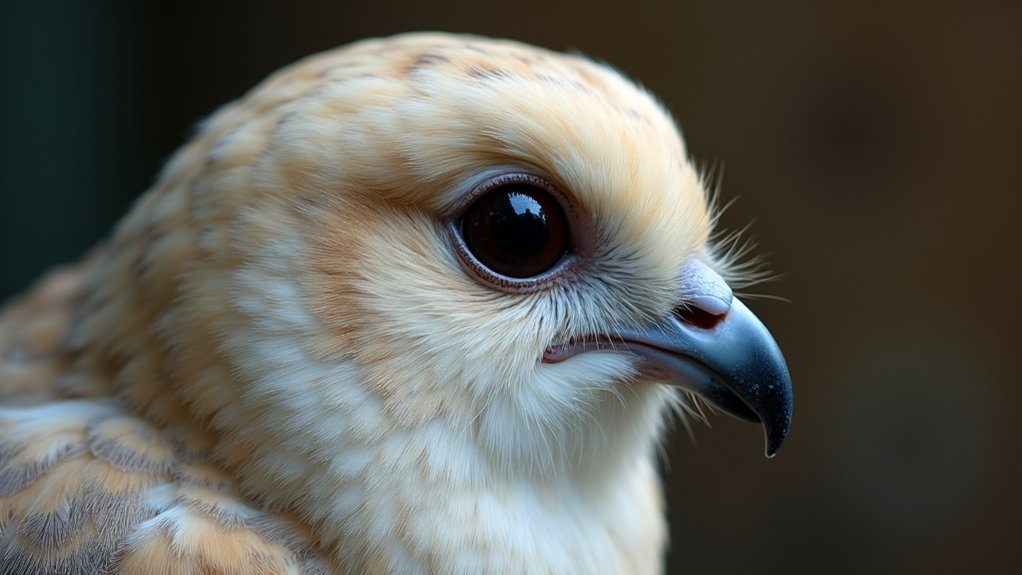
Although birds possess a standard set of extraocular muscles similar to other vertebrates, their ability to move their eyes is considerably constrained by the unique anatomy of the avian globe and orbit.
You’ll find the globe extremely large relative to cranial volume, often occupying much of the skull mass, and it deviates from a spherical shape, commonly tubular or aspheric.
The orbit itself is only slightly larger than the globe, creating a snug fit that restricts ocular excursions to typically 10–20°.
The orbit’s architecture, dominated by the globe with minimal soft tissue and a thin interorbital septum, forms a rigid complex reinforced by cartilaginous and bony elements.
This rigidity, combined with the large, aspheric globe, reduces the mechanical advantage of extraocular muscles, limiting rotation despite their presence. Perfect ocular health is essential for survival in free-ranging avian species, highlighting the importance of even limited eye movement for environmental awareness and predator avoidance importance of ocular health.
The Role of the Sclerotic Ring in Eye Stability
You’ll find that the sclerotic ring is a rigid, ossified structure embedded in the sclera. It’s essential for stabilizing the eye’s shape and limiting deformation during rapid head movements. This bony ring not only protects delicate ocular tissues from mechanical stress but also maintains the optical aperture, which influences visual performance. Together, these functions create a semi-rigid framework that restricts eyeball mobility while optimizing eye stability and vision. Birds typically have between 12-18 ossicles in their scleral rings, with 14 being the most common.
Structure and Function
The sclerotic ring, a series of small overlapping ossicles embedded in the anterior sclera, plays an essential role in stabilizing the avian eye.
You’ll find it encircling the base of the cornea at the cornea-sclera junction, composed of lamellar bone and cartilage that provide stiffness with minimal mass.
This bony frame preserves the globe’s shape against deformation when extraocular muscles contract, effectively limiting torsional and lateral eyeball rotations.
You rely on this rigidity, as it anchors the ciliary and corneal muscles responsible for accommodation, enabling rapid, precise focus adjustments.
By maintaining a fixed relationship between cornea, lens, and retina, the ring guarantees consistent focal length and optical axis alignment.
This structural support is crucial because most birds have proportionally large eyes, which require additional stability.
Ultimately, this structure prioritizes optical precision and supports high-acuity vision over extensive eyeball mobility.
Protection and Rigidity
Beyond preserving optical alignment, the sclerotic ring acts as a rigid brace that protects the avian eye from mechanical stress and deformation.
You’ll find this bony or cartilaginous ring particularly robust in fast-flying birds, where it resists aerodynamic pressures and impact forces.
It encircles the corneal limbus, anchoring the anterior eye segment and stabilizing the globe’s orientation, which limits torsional wobble during rapid head or body movements.
Because the ring isn’t fused to the skull, it functions as a self-contained support, directly reinforcing the eye rather than the orbit.
This rigidity is critical for tubular and non-spherical eyes, like those of owls, maintaining their elongated shape under dynamic loading.
Additionally, the large size of bird eyes relative to their brain size necessitates such support to maintain eye stability during intense activity.
Ultimately, the sclerotic ring shields delicate ocular tissues and preserves eye stability despite extreme mechanical demands.
Optical Performance Benefits
Although bird eyes face constant mechanical challenges during flight and rapid head movements, the sclerotic ring plays an essential role in preserving optical performance. It does this by maintaining the eye’s stable shape and precise geometry. This stability guarantees minimal optical distortion and sharp focus.
Here’s how it benefits you as a bird observer or researcher:
- The ring maintains fixed corneal curvature, preventing refractive errors during motion.
- It anchors ocular muscles firmly, enhancing accommodation speed and accuracy for shifting focus.
- It supports extreme eye shapes like tubular or globose forms, allowing high magnification and resolution without structural compromise.
Limited Eyeball Mobility Compared to Mammals
You might’ve noticed that birds have large, rigid eyeballs that fit snugly within their bony eye sockets. This tight fit actually limits how much their eyes can rotate compared to mammals, whose eyes are more flexible.
The bird’s eye socket is pretty rigid, thanks to extra support from things like scleral ossicles and cartilage.
Because of this, the muscles that move their eyes don’t get as much of an advantage, so their eyes can’t move around as much. Instead of rotating their eyes a lot, birds make up for it by quickly and precisely moving their heads to shift their gaze. This is necessary because birds have limited ocular excursions compared to mammals.
It’s a neat way they adapt to their eye structure!
Anatomical Constraints on Movement
Because avian eyeballs occupy nearly the entire orbital cavity, their capacity for movement is considerably restricted compared to mammals.
You’ll find that several anatomical factors limit their mobility:
- Globe shape and fit: Bird eyes are large, often tubular or cone-shaped, fitting tightly within orbits only slightly larger than the globes themselves. This snug fit restricts rotation and lateral movement.
- Extraocular muscle mechanics: Although birds have six extraocular muscles like mammals, the elongated eye shape reduces mechanical advantage, limiting effective torque for large rotations. Additionally, birds rely heavily on head movements rather than eye rotation to track visual targets.
- Scleral reinforcement: A continuous hyaline cartilage layer and ossicles stiffen the eyeball, preventing deformation but also restricting subtle rotational adjustments.
These constraints mean birds rely on rapid head movements rather than eye rotation to track visual targets.
Orbital Structure Rigidity
Orbital structure plays a critical role in limiting eyeball mobility in birds compared to mammals. You’ll find their tubular or conical orbits tightly house large globes, leaving little room for rotation. The rigid bony orbit and ossified scleral ring brace the eye, restricting deformation and lateral movement. Additionally, the avian eye is supported by a ring of scleral ossicles, which maintains its shape and further limits flexibility in movement, contributing to the overall orbital rigidity.
Extraocular muscles have short mechanical arms, designed for precision rather than broad gaze shifts.
| Feature | Effect on Eye Mobility |
|---|---|
| Tubular orbit shape | Constrains lateral globe rotation |
| Ossified scleral ring | Stabilizes but restricts torsional movement |
| Short extraocular muscles | Limits torque, favors small corrective movements |
This architectural rigidity prioritizes visual stability and optical performance over extensive ocular motility.
Head Movement Compensation
Although birds possess limited eyeball mobility compared to mammals, they compensate effectively through dominant head movements to stabilize their gaze.
Unlike mammals, which rely on eye rotations for about 80% of gaze stabilization, birds use head rotations to achieve 80–90% compensation during free head movement. Studies show that head movements are more common than eye movements during gaze shifts in birds, highlighting their reliance on head rotation for visual tracking.
This strategy involves:
- Head-free gaze responses that surpass the vestibulo-ocular reflex (VOR) gain seen in fixed-head conditions.
- Neck-driven head stabilization, aided by vestibular, visual, and proprioceptive feedback, maintaining near-perfect head orientation against rotations.
- Reduced eye-in-head motion amplitude, shifting the stabilization burden to head movements.
This head dominance reflects avian anatomy and behavior, enabling precise gaze control despite restricted eyeball mobility.
Head Movements as a Visual Strategy
When birds move, their heads play an essential role in maintaining clear vision despite limited eye mobility. You’ll notice that birds stabilize their heads to compensate for body motions, using vestibulo-ocular and vestibulo-collic reflexes to keep their gaze fixed in space, preventing motion blur. For example, pigeons exhibit fore–aft head-bobbing: a hold phase keeps the head nearly stationary, enhancing image stability, while the thrust phase moves it forward. Recent research using a motion capture system has enabled precise tracking of pigeons’ head movements to better understand how they reconstruct their visual perspective during natural behavior. Some birds also use wing spreading and body posture for purposes like thermoregulation, camouflage, and feather maintenance, strategies that work alongside head movements to optimize their interaction with the environment. You also rely on head movements to scan your environment; yaw and roll shifts redirect your wide lateral visual fields to survey surroundings actively.
Small but Significant Eye Movements in Birds

While bird eyes don’t move as freely as mammalian eyes, they still make small but vital adjustments within their limited range. You’ll notice these micro-movements are significant for precise visual tasks despite the mechanical constraints imposed by large, tightly packed globes and scleral ossicles. Among birds, owls and woodpeckers are especially known for having immobile eyeballs, which makes these subtle adjustments even more important for their vision.
Birds make subtle eye movements crucial for sharp vision despite their limited mobility.
Here are key points to understand:
- Birds perform coordinated counter-rotations, where one eye moves in one direction while the other moves oppositely. This helps maintain spatial stability between visual fields.
- Small saccades reposition the fovea onto targets, allowing high-acuity inspection without major head shifts. The density of photoreceptor cells in bird retinas greatly enhances the effectiveness of these precise eye movements.
- One eye typically focuses monocularly on a target while the other monitors the environment. This enables simultaneous detailed and panoramic vision.
These subtle ocular adjustments optimize avian vision and compensate for restricted eyeball mobility.
Visual Field Configurations and Their Impact
Because birds rely heavily on vision for survival, their visual field configurations have evolved to meet diverse ecological demands.
You’ll find variations such as Type 1 with lateral eyes and narrow frontal binocular fields ideal for ground-foraging passerines, and Type 2 with wide binocular fields in owls, optimizing prey capture.
These configurations balance binocular regions for precise tasks like bill placement with broad monocular lateral fields that support predator detection and navigation.
When you consider the trade-offs, expanding frontal binocular vision often reduces rear or dorsal coverage. Hummingbirds, for example, have a binocular field of approximately 30°, extending above and behind the head, which enhances visual coverage to nearly 98%.
Ecological roles shape these adaptations: sit-and-wait predators have downward-extended binocular fields to monitor prey near their feet, while aerial insectivores emphasize large lateral coverage.
Understanding these visual fields explains why birds depend on head movements rather than eye mobility to explore their environment effectively.
Optical Adaptations Favoring a Stable Eye
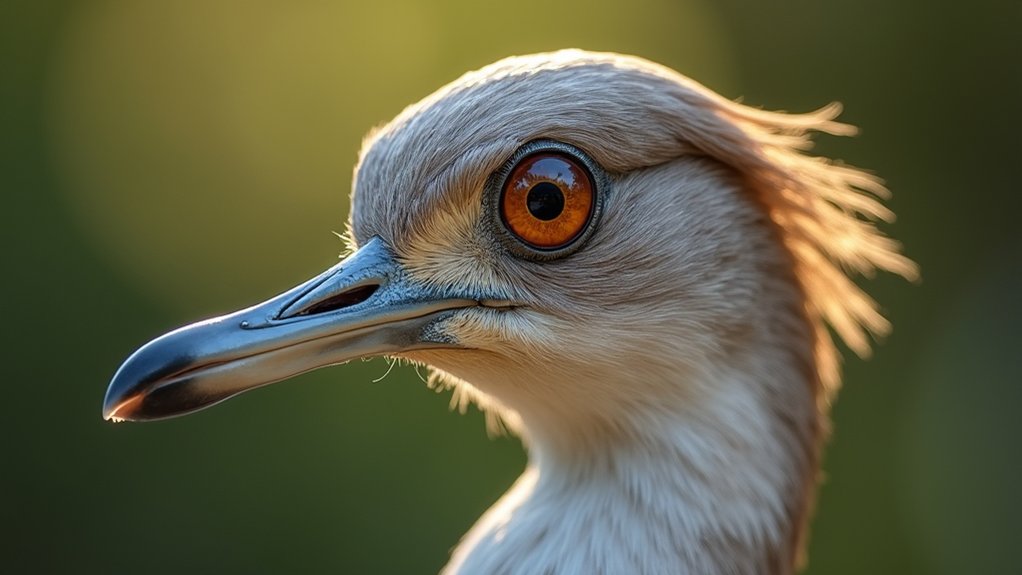
Visual field configurations in birds demand stable, precise imaging despite frequent and rapid head movements. To achieve this, birds exhibit specialized optical adaptations that favor a stable eye rather than one capable of extensive rotation.
You’ll notice that:
- The relatively large, rigid eyeball occupies much of the skull, its shape reinforced by a sclerotic ring and hyaline cartilage. This minimizes deformation and wobble during abrupt motions. Additionally, birds in dark environments tend to have larger eyes to capture more light and navigate effectively, enhancing their visual capabilities.
- Tight anatomical fit between the eye, scleral ring, and orbit mechanically restricts extraocular rotation. This ensures constant alignment of optical components.
- Rapid focus adjustments occur via striated ciliary muscles altering lens shape. This allows birds to maintain sharp images without moving their eyes. Birds also possess a unique color vision system with tetrachromatic cone cells, allowing them to perceive a broader spectrum including ultraviolet, which is crucial for foraging and navigation.
This combination of structural rigidity and fine neuromuscular control optimizes visual acuity while stabilizing the retinal image during dynamic activities.
Evolutionary Trade-Offs Between Vision and Movement
Although large, immobile eyes demand significant developmental and metabolic investment, birds have evolved this trait to optimize visual performance within spatial and energetic constraints.
You’ll find that birds’ eyes often occupy up to half the cranial volume, limiting extraocular muscle development and eye rotation.
Instead, evolution favors an “agile neck” strategy, where head mobility compensates for restricted eyeball movement. This trade-off maximizes panoramic vision with lateral eye placement, essential for predator detection.
Raptors with frontal eyes maintain fixed globes but use rapid head turns for binocular tracking, preserving optical acuity. Moreover, neural lateralization enforces stable eye orientation, coordinating both eyes to maintain visual constancy.
Consequently, the evolutionary balance prioritizes large, stable eyes and efficient head movement over flexible, energy-costly ocular rotations. This balance is also reflected in the common visual pathways found across birds, reptiles, and mammals, emphasizing the conserved neural mechanisms supporting visual processing despite differences in eye mobility.
Behavioral Adaptations to Restricted Eye Motion
When birds can’t rotate their eyes extensively, they’ve developed remarkable behavioral strategies to compensate. You’ll notice they rely heavily on their hyper-flexible necks, allowing head rotations up to 270°, effectively shifting gaze without moving their eyes. This flexible neck is essential because many birds have a sclerotic bone that limits eye movement.
Furthermore, birds use independent eye movements; one eye may focus forward while the other monitors the rear, enhancing environmental awareness.
Finally, they adjust posture and head pitch to optimize visual field alignment, refining binocular overlap for precise tasks like prey capture.
- Exploit extensive cervical vertebrae for rapid, precise head rotations.
- Utilize non-conjugate eye movements for simultaneous monitoring of multiple visual sectors.
- Fine-tune binocular vision through strategic head and body positioning.
These adaptations guarantee spatial orientation and gaze stabilization despite restricted ocular mobility.
Frequently Asked Question
How Do Birds Clean Their Eyes Without Blinking Frequently?
You clean your eyes using the nictitating membrane, a thin, semi-transparent third eyelid that sweeps horizontally across the cornea.
It spreads tear fluid from the Harderian gland evenly, removing dust and debris efficiently.
Instead of frequent full blinks, you rely on rapid phasic blinks for routine cleaning and slower tonic blinks during rest.
This membrane maintains eye moisture and oxygenation without considerably interrupting your vision.
What Types of Predators Rely on Head Movement Rather Than Eye Movement?
You’ll find that avian predators and many mammals without pronounced foveas rely heavily on head movements rather than eye movements.
Birds, constrained by limited ocular motility, compensate by rapidly turning their heads to scan and detect prey.
Likewise, small terrestrial mammals and ambush predators, like small felids and vipers, minimize eye shifts to avoid detection.
Instead, they use deliberate head turns or subtle adjustments to maintain precise visual focus and depth perception.
Can Bird Eye Movement Patterns Change With Age or Species?
You might find it intriguing that bird eye movement patterns aren’t set in stone but can exhibit subtle shifts across species and potentially with age.
While direct evidence on age-related changes is scarce, developmental maturation in retinal specializations suggests gradual adaptations in how juveniles employ head and eye movements.
Species differences are well documented, reflecting ecological needs and visual strategies.
This reveals a nuanced orchestration of ocular and head coordination tailored to each bird’s lifestyle.
How Do Diving Birds Protect Their Eyes From Water Pressure?
You protect your eyes from water pressure by relying on reinforced sclera with cartilage and scleral ossicles that maintain the globe’s shape.
Your eye’s shape, whether tubular or globular, optimizes strength and field of view.
The scleral venous sinus balances intraocular pressure during rapid depth changes.
Furthermore, your softer, deformable lens and powerful sclerocorneal muscles adjust focus underwater, reducing strain and preserving visual acuity despite high pressure conditions.
Do Birds Experience Eye Strain From Limited Eyeball Mobility?
You might be surprised that birds can rotate their eyes only about 10–20°, yet they rarely suffer eye strain. This limited mobility actually protects their eye muscles by keeping them within ideal tension ranges.
Instead, their extremely flexible necks handle gaze shifts, reducing muscular fatigue.
Plus, their high receptor density and rapid accommodation minimize visual effort.
Conclusion
You might find it surprising, but birds can’t wiggle their eyeballs like you do, thanks to their rigid sclerotic ring and specialized orbit structure. Instead, they rely on swift head movements to scan their environment, turning their entire head as a finely tuned periscope.
This evolutionary trade-off prioritizes eye stability and optical precision, ensuring sharp vision during flight. So, while their eyes stay mostly still, their heads do all the talking in the avian visual world.