

You can figure out Woodstock’s bird type by examining his origins, traits, and Snoopy’s classification attempts. He’s a small, yellow bird with spiky feathers, named after the 1969 Woodstock festival.
Snoopy tries imitating known bird calls but finds no match, highlighting Woodstock’s ambiguous species. Fans suggest goldfinch or hybrid origins, yet Schulz never specified, emphasizing cartoon personality over taxonomy.
Understanding these factors offers insight into Woodstock’s unique avian identity and cultural symbolism.
Origins and Design of Woodstock
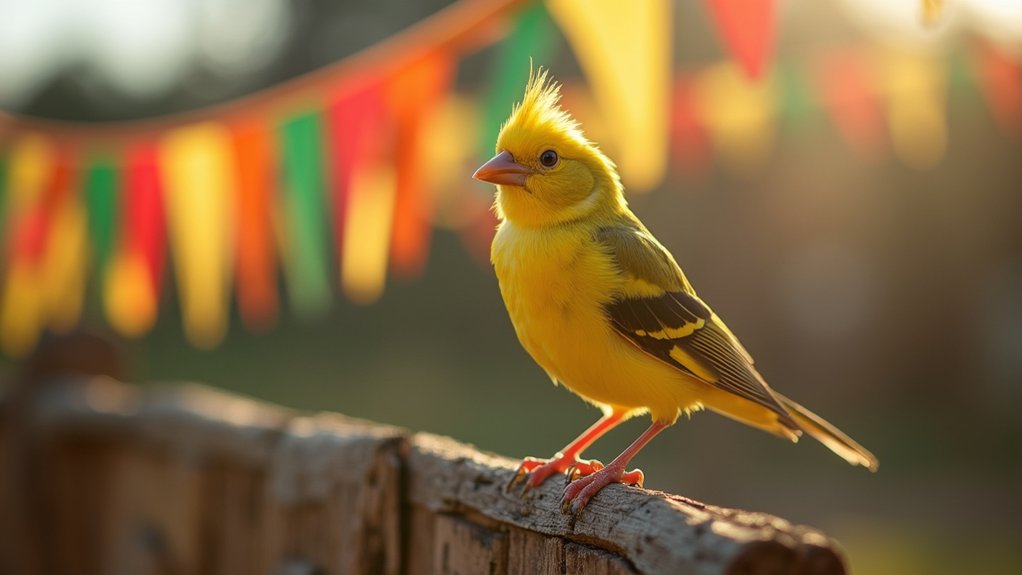
Although Woodstock first appeared as an unnamed small bird in mid-1960s *Peanuts* strips, his character solidified through a gradual evolution that culminated in his official naming on June 22, 1970.
Initially, he was depicted as a tiny bird building a nest on Snoopy’s stomach in a 1966 strip, later becoming Snoopy’s close companion.
Woodstock first appeared as a tiny bird nesting on Snoopy’s stomach before becoming his loyal companion.
Peanuts Worldwide records his official first appearance as April 4, 1967, though he remained unnamed and sporadic until integrated into recurring storylines.
Visually, Woodstock is a small, round-headed, spiky-feathered yellow bird with minimalist line work distinct from realistic species.
His speech consists of “chicken scratch” marks readable only by Snoopy, symbolizing generational gaps.
The design guaranteed high recognizability and ease of reproduction in print and merchandise. Woodstock’s name was inspired by the 1969 Woodstock music festival, reflecting the era’s cultural influence.
Characteristics Displayed in the Comic Strip
| Trait | Description | Implication |
|---|---|---|
| Flight Ability | Erratic, low altitude, poor flyer | Species-level limitation |
| Communication | “Chicken scratch” marks only Snoopy understands | Unique language form |
| Strength & Endurance | High relative to body size | Comedic exaggeration |
Woodstock is known for his distinctive role as Snoopy’s skilled canine helicopter pilot, despite his poor flying abilities.
Snoopy’s Species Imitation Experiment
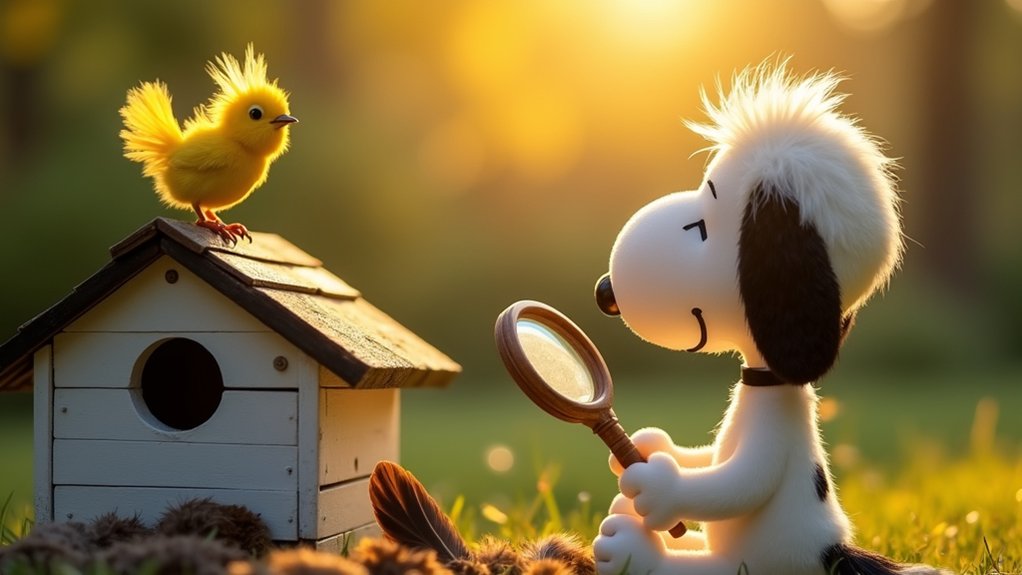
Understanding Woodstock’s unique traits naturally leads to examining Snoopy’s efforts to classify him through vocal imitation.
You observe Snoopy using a field guide as a systematic tool, presenting multiple species’ calls—American bittern, Carolina wren, rufous-sided towhee, yellow-billed cuckoo, Canada goose, and warblers—for Woodstock to mimic.
Despite these precise attempts, Woodstock’s vocalizations fail to align with any known species. His unique communication style, represented by “chicken scratch” marks, makes traditional identification difficult.
Woodstock’s unique calls remain unmatched, defying classification despite Snoopy’s careful imitations.
Snoopy’s frustration culminates in suggesting Woodstock might be “a duck,” which emotionally distresses Woodstock, highlighting the challenges of misidentification.
This experiment underscores communication barriers, as Woodstock’s “chicken scratch” speech and nonverbal cues hinder definitive classification.
You see that Snoopy’s methodical but inconclusive imitation approach reveals the deliberate ambiguity surrounding Woodstock’s species, reflecting the comic’s narrative choice to maintain mystery rather than provide scientific resolution.
Common Fan Theories and Speculations
How do fans interpret Woodstock’s elusive identity? One popular theory identifies him as an American Goldfinch or a similar small songbird, citing his yellow plumage, small size, and tufted head feathers as key traits. This theory also draws on similarities with certain tit birds, which share Woodstock’s vibrant colors and expressive features.
Another perspective proposes Woodstock represents a unique, fictional species, given his friends’ identical appearance and a combination of features from multiple real birds, making biological classification impossible. This view aligns with Charles Schulz’s own admission that Woodstock is likely a unique hybrid species.
A composite hypothesis suggests Schulz combined traits from species like the Cedar Waxwing, Yellow Warbler, and Great Curassow to create Woodstock’s distinctive silhouette and erratic flight.
Finally, some scholars argue Woodstock functions symbolically as a “bird hippie,” embodying 1960s youth counterculture rather than a literal bird species.
These theories illustrate the diverse, interpretative approaches fans take to explain Woodstock’s nature.
Canonical Status and Interpretative Approach

Although fans have proposed numerous theories about Woodstock’s species, Charles M. Schulz never specified it in the Peanuts canon. He consistently referred to Woodstock simply as “a bird,” avoiding any taxonomic classification.
Official merchandise and style guides echo this generic description as a “small yellow bird,” with no in-universe origin or species explanation. Schulz designed Woodstock for comic contrast and personality, not ornithological accuracy, evolving the character into a stylized icon with exaggerated features and symbolic behaviors.
When you analyze canonical sources, prioritize original strips and Schulz-supervised media, as they hold the highest interpretative authority. Secondary and tertiary materials, along with fan theories, lack canonical weight.
Consequently, your interpretative approach should recognize Woodstock as a cartoon construct, emphasizing expressive design over zoological fidelity. Unlike real birds such as the Common Snipe, which has intricate plumage patterns and distinctive behaviors, Woodstock’s design is intentionally simplified for narrative effect.
Frequently Asked Question
What Inspired Charles M. Schulz to Create Woodstock’s Character?
You’ll find Charles M. Schulz inspired Woodstock’s character through a blend of cultural symbolism and artistic experimentation.
He drew from the 1969 Woodstock festival’s peace ethos and the youthful spirit of the era.
Schulz also integrated post-impressionist techniques influenced by van Gogh and Picasso’s abstraction ideas.
This fusion allowed him to express complex emotions via abstract forms, making Woodstock his most significant character achievement and a symbol of generational communication challenges.
Has Woodstock Appeared in Any Peanuts Animated Specials?
Yes, Woodstock has appeared in multiple Peanuts animated specials.
You’ll find him in “Snoopy Come Home” (1972), where he performs “Woodstock’s Samba,” and in “You’re Not Elected, Charlie Brown” (1972).
He also stars in “A Charlie Brown Thanksgiving” (1973) and “It’s a Mystery, Charlie Brown” (1974), which centers on his stolen nest.
His consistent presence highlights his integral role alongside Snoopy in the Peanuts universe.
Does Woodstock Have a Family or Other Bird Friends in the Strip?
You’ll notice Woodstock doesn’t have a defined family in the Peanuts strip. Instead, he forms social bonds with other small birds, often seen flocking together during migrations or group activities.
These relationships emphasize camaraderie rather than biological kinship.
While real American Woodcocks are solitary, Woodstock’s interactions highlight friendship and group identity. He plays a social, loyal companion role alongside Snoopy and unnamed bird friends within the narrative context.
What Is the Significance of Woodstock’s Name?
You might think of Woodstock’s name as a gentle nod to peace and music, evoking a harmonious flutter in your mind.
Scientifically, his name references the iconic 1969 music festival symbolizing counterculture and freedom.
Charles M. Schulz chose “Woodstock” to subtly align the character’s quirky, free-spirited nature with that era’s ideals.
This embeds cultural significance into a small, yellow avian figure that defies traditional classification.
How Does Woodstock Communicate With Snoopy Despite No Human Understanding?
You understand Woodstock’s communication with Snoopy happens through a unique “chicken scratch” script, visually represented in the comics and aurally as high-pitched honks in animation.
Only Snoopy deciphers these marks into meaningful language, maintaining a closed communicative loop.
This exclusivity arises from shared semantics, syntax, and nonverbal cues like punctuation and gestures, enabling precise interspecies dialogue that remains unintelligible to humans within the story world.
Conclusion
You might think pinpointing Woodstock’s exact species is impossible due to his cartoonish design, but that uncertainty actually enriches his charm. By examining his origins, behaviors, and fan theories, you gain a clearer understanding of his unique traits without needing a definitive label.
Embracing this ambiguity lets you appreciate Woodstock as a symbol of creativity and friendship, highlighting the intentional blend of fantasy and reality that makes him so endearing in the Peanuts universe.