
Zazu is a red-billed hornbill, a bird native to the African savanna, known for its prominent long, curved red bill and contrasting black-and-white plumage. You’ll spot sexual dimorphism, with males larger and sporting more robust bills.
These hornbills thrive in semi-arid woodlands, forage mainly for insects, and use vocal calls for communication. Their distinctive bill and striking colors make identification straightforward.
Investigate further to uncover Zazu’s behavior, habitat, and ecological significance.
Species Classification of Zazu
Zazu, commonly identified as a red-billed hornbill, belongs to the family Bucerotidae within the order Bucerotiformes, which encompasses all hornbill species.
You’ll find that the Bucerotidae family contains about 60 species, with red-billed hornbills placed in the subfamily Bucerotinae, alongside most other hornbill taxa.
Traditionally, hornbills were classified under Coraciiformes, but modern taxonomy separates them distinctly.
Zazu’s genus, Tockus, includes ten species primarily distributed across Africa and represents smaller-sized hornbills compared to other genera.
The International Ornithologists’ Union formally recognizes 62 extant hornbill species, including Zazu’s, reinforcing its accepted taxonomic status.
This classification excludes hybrids and extinct forms, reflecting a refined and settled framework based on ongoing scientific research within Bucerotidae and Bucorvidae families. Population and range information are crucial for conservation efforts.
Physical Traits of the Red-Billed Hornbill
You’ll recognize the Red-Billed Hornbill by its distinctive long, curved red bill. Interestingly, the bill’s color and size can differ between males and females.
When you look at its plumage, you’ll notice a striking black-and-white pied pattern. The head and body show a nice contrast between pale and dark areas.
Also, males tend to be larger and have more robust bills compared to females, so size differences and sexual dimorphism are pretty clear. The Red-Billed Hornbill is native to sub-Saharan Africa, where it plays a significant role in local ecosystems.
Distinctive Curved Red Bill
A hallmark of the red-billed hornbill is its distinctly curved red bill, a feature that immediately sets it apart from other avian species. This downward-pointing bill, constructed from keratin, the same material as nails and hair, combines a hollow upper mandible for lightweight strength with a smooth surface devoid of casque structures found in related hornbills. Its coloration shifts from bright red on the upper beak to orange on the lower, both terminating in dark orange tips, enhancing visual identification. Functionally, you’ll see it expertly manipulate food with the bill tip before swallowing via a backward head flick. It also aids in nest building and territorial combat. The Red-billed Hornbill’s bill resembles a red chili, a distinctive trait that helps in species identification. Significantly, females have smaller, proportionally scaled bills with identical coloration, enabling sex determination through size observation without compromising functionality.
Plumage Color Patterns
Beyond the unmistakable curved red bill, the red-billed hornbill’s plumage offers likewise distinctive markers critical for identification. Its pied plumage features a stark black and white contrast, creating a bold pattern across the wings and body.
White splotches scatter over the wings, contrasting sharply with darker feathers, aiding field identification. The tail feathers show white edges without a central white line, supporting flight balance.
Facial plumage includes red or blue skin patches near the eyes and neck, varying by subspecies. These colors, combined with black legs and pale-gray body feathers in some subspecies, provide reliable identification cues. The red-billed hornbill is approximately 35 cm in length, making size another helpful characteristic for identification size: approximately 35 cm.
| Feature | Description | Identification Use |
|---|---|---|
| Wing Pattern | White splotches on black feathers | Distinguishes Tockus species |
| Tail Feathers | White-edged, no central white line | Aids species recognition |
| Facial Plumage | Red/blue skin patches vary by subspecies | Key subspecies differentiation |
Size and Sexual Dimorphism
Although the red-billed hornbill ranks as a medium-sized bird within general avian populations, it remains one of the smaller species among hornbills, measuring 19 to 24 inches (42 to 50 centimeters) in length. Males are typically larger and heavier, weighing between 4.5 to 7 ounces, while females are lighter.
Sexual dimorphism is evident in bill morphology: males possess larger, thicker bills with distinct red or red-orange coloration, accounting for about one-sixth of their body length. Females have smaller, less pronounced bills.
Both sexes share off-white head plumage and similar eye coloration, but males’ bills exhibit more vivid patterns across subspecies.
Anatomical adaptations, such as fused cervical vertebrae, support the large bill, facilitating ground-foraging behaviors essential to the species’ ecological niche. The bill is red, with males showing yellow near the base, a key identifying trait of the red-billed hornbill.
Geographic Range and Natural Habitat
You’ll find the red-billed hornbill primarily across the African savanna, spanning East, Central, and Southern regions.
It tends to prefer semi-arid savanna and woodland habitats where there are scattered trees and bushes, rather than dense forests.
Zazu, the majordomo to the Lion King, is portrayed as a red-billed hornbill, reflecting his role as a knowledgeable advisor in the Pride Lands.
African Savanna Distribution
When you examine the African savanna distribution of the red-billed hornbill, you’ll find its range firmly rooted across East Africa, particularly within Kenya’s acacia woodlands and scattered tree savanna ecosystems. This species inhabits tropical and subtropical zones from Sudan southward, occupying East African highlands, lowlands, and semi-arid savannas.
Its distribution is confined to sub-Saharan Africa, isolated from other hornbill populations in Asia or Australia. You’ll notice the bird favors open grasslands with intermittent tree clusters, riverine corridors, and forest edges dominated by acacia. In popular culture, Zazu is characterized as a hornbill, commonly identified as a Red-billed Hornbill.
Populations concentrate in resource-rich valleys, plateaus, and Ethiopian highlands, establishing territories year-round without migration.
The red-billed hornbill’s presence correlates strongly with specific tree densities and elevation gradients, reflecting its adaptation to the mosaic landscapes characteristic of the African savanna ecosystem.
Preferred Habitat Types
Because the red-billed hornbill occupies a broad geographic range across sub-Saharan Africa, its preferred habitats vary from semi-arid thornveld to open woodlands and bushlands.
You’ll find it in regions spanning Kenya, Tanzania, and South Africa, favoring landscapes with scattered trees that provide essential nesting cavities.
Semi-arid thornveld offers ideal conditions, balancing food availability with predator visibility.
Open woodlands and bush habitats support feeding, roosting, and breeding behaviors, with large tree cavities critical for nesting success. Hornbills exhibit curiosity and intelligence, which helps them adapt to different environments.
The species adapts well to habitat variations, shifting feeding strategies between forest edges and savannahs as needed.
However, environmental pressures like agricultural expansion and climate change are impacting habitat stability, making mature trees and vegetation cover near nesting sites increasingly important for maintaining stable populations.
Behavioral Patterns and Ecological Role

Although red-billed hornbills exhibit diverse behavioral patterns, their vocal communication stands out as a vital mechanism for maintaining social hierarchies and coordinating group engagements. You’ll notice their call structures adapt dynamically to context, addressing mate attraction, territorial defense, and threat alerts.
Their vigilance behavior bolsters group survival; upon detecting predators, they issue rapid warning calls that alert both flock members and other species. The tail shape of red-billed hornbills, while not as pronounced as the forked tails found in swallows and terns, also plays a role in their communication and balance during flight.
Ecologically, you’ll find they control insect populations through consistent foraging and aid seed dispersal by consuming fruits, influencing vegetation patterns.
Their role extends into ecosystem monitoring, supporting biodiversity and food web dynamics.
Understanding these behavioral and ecological functions helps you appreciate how red-billed hornbills serve as keystone species in African savannas, their presence essential for habitat and species conservation. Recently, a Red-billed Hornbill sighting near East Coast Parkway in Singapore has sparked public interest, showing the bird’s potential to adapt beyond its native range.
Distinctive Anatomical Features
You’ll notice Zazu’s signature curved red bill right away. It’s a key anatomical marker that sets him apart within the hornbill family.
If you look closer, you’ll see the unique structure of his neck vertebrae. These give him exceptional flexibility and support, especially when he’s foraging or flying.
Also, the coloration of the skin around his eyes isn’t just for show—it provides subtle but important identification cues in his natural habitat.
Signature Curved Red Bill
The signature curved red bill of the red-billed hornbill stands out as a defining anatomical feature, measuring up to one-sixth of the bird’s total body length. You’ll notice its bright red coloration shifts to a yellow base, lacking the casque found in many hornbill species.
This elongated, keratin-composed structure serves multiple functions: it aids in foraging by extending reach into dense vegetation, facilitates food transport, and plays a role in territorial defense and mate attraction. Red-billed hornbills are native to Africa and have a diet that consists of insects, fruits, and seeds, which they access using their distinctive beaks native to Africa.
Males possess noticeably larger bills than females, reflecting sexual dimorphism that supports competitive displays.
Compared to other hornbills, the red-billed hornbill’s bill is smaller and lacks ornamental head structures, yet its pronounced curvature aligns with family traits.
Disney’s Zazu exaggerates this bill feature, preserving biological accuracy while enhancing character expressiveness.
Unique Neck Vertebrae
Beyond the distinctive curved red bill, red-billed hornbills exhibit specialized adaptations within their cervical vertebrae that accommodate the demands imposed by their sizable bill. Remarkably, the first two cervical vertebrae (C1 and C2) fuse, forming a rigid foundation that supports the bill’s considerable weight. This fusion improves structural stability at the cranio-cervical junction, reducing upper neck mobility while preventing anterior bill displacement during feeding and vocalization. The fused vertebrae efficiently transfer mechanical stress through the cervical column without overloading other skeletal components.
Complementing this, robust neck muscles attach mainly to these vertebrae, distributing forces and preventing fatigue during prolonged bill use. Although the hollow upper mandible reduces overall weight, vertebral fusion remains essential. The large, yellow bill is a prominent feature that the neck vertebrae must support.
The trade-off limits rotational flexibility in the upper neck but maintains necessary head positioning via unfused lower cervical segments.
Eye Skin Coloration
Certain distinctive features in the eye orbital region play an essential role in identifying red-billed hornbills and differentiating them from other species.
You’ll notice black markings encircling the ocular area, forming a partial mask that extends posteriorly across the facial structure. This pattern arises from concentrated melanin deposits, creating a contrasting periocular mask unique to the species.
The bare skin surrounding the eye, or eye-ring, displays a red-orange pigmentation whose intensity varies by subspecies and age, aiding further classification.
Unlike the yellow eye-rings seen in African grey hornbills, red-billed hornbills maintain consistent hue across their range, facilitating reliable identification.
These pigmentation patterns highlight eye placement and improve facial expressiveness, serving as primary anatomical markers for species recognition and taxonomic differentiation within hornbill populations. Additionally, the heavy bill and casque are distinctive physical traits that complement eye-region features in confirming species identity.
Variations Among Red-Billed Hornbill Species
Although red-billed hornbills share a common genus, you’ll find significant variations across the five recognized species: northern, western, Tanzanian, southern, and Damara. Each is adapted to distinct geographic ranges within sub-Saharan Africa.
These species differ morphologically, behaviorally, and ecologically, reflecting specialized adaptations. Key variations include geographic distribution, with the northern species widely spread and others localized.
Distinct morphological, behavioral, and ecological traits highlight each red-billed hornbill species’ unique adaptations.
You’ll notice differences in bill size and facial plumage coloration that distinguish subspecies. Eye skin color varies too, with blue in Abyssinian types and red in southern species.
Habitat preference ranges from savannas to arid thorn-scrub, and some live at elevations up to 2,100 meters. They thrive in semi-arid conditions with scattered trees, which are crucial for nesting.
Diet composition shifts as well, with West and East African populations consuming more vegetable matter.
Understanding these distinctions helps you accurately identify which red-billed hornbill species you observe.
Sexual Dimorphism in Hornbills
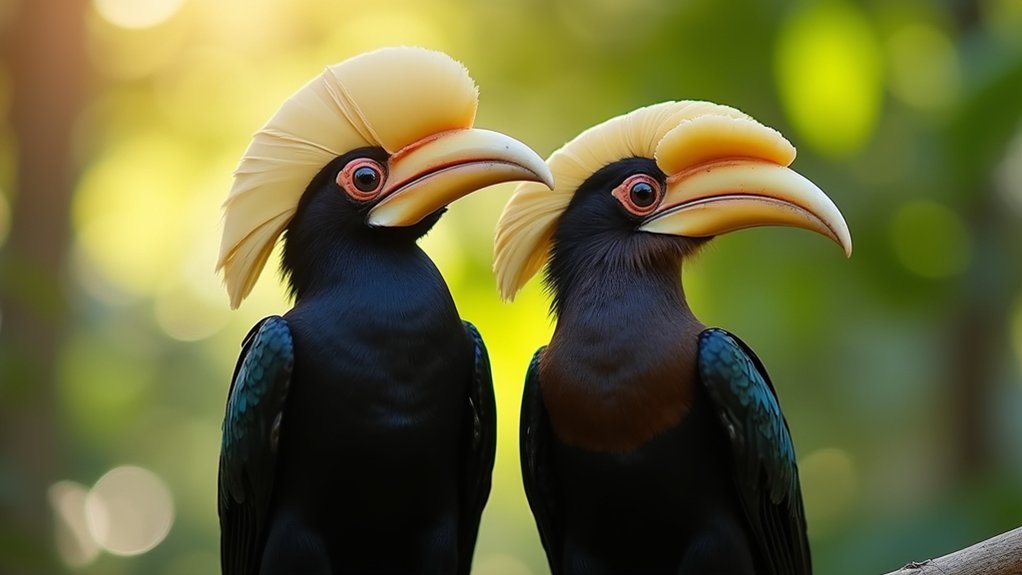
Understanding the variations among red-billed hornbill species sets the stage for examining how sexual dimorphism manifests across hornbills. Males are consistently larger, with body mass differences ranging from 1% to 17%, such as southern ground hornbill males weighing up to 6180 g compared to females at 4580 g. This size disparity improves resource acquisition and breeding survival.
You’ll notice males exhibit more vibrant plumage. Wreathed hornbill males show bright yellow throats, while females remain blue. Casque development also differs. Males possess larger, more pronounced horn-like casques correlating with sexual maturity.
Although bill length varies little, casque prominence is a key secondary sexual trait. These adaptations support reproductive success but increase predation risk through conspicuous coloration and male combat. This ensures offspring inherit robust genetics crucial for population sustainability.
Diet and Feeding Habits
When you observe red-billed hornbills in their natural habitat, you’ll notice they rely heavily on insects, especially termites, beetles, and caterpillars, as their primary food source.
Their distinctive curved bills allow precise extraction of insects from soil, leaf litter, and crevices.
Although Zazu in film is shown eating only insects, real hornbills exhibit omnivorous tendencies. They supplement their diet with fruits and small vertebrates.
Ground foraging dominates their feeding behavior, enhancing efficiency in the savanna ecosystem.
Zazu’s role in the Pride Lands often involves alerting others to threats, reflecting his function in maintaining environmental awareness.
Key diet and feeding traits include:
- Primary diet: termites, beetles, caterpillars
- Specialized curved bills for probing soil and bark
- Ground-based foraging with systematic leaf litter investigation
- Opportunistic consumption of small vertebrates and fruits
- Seasonal dietary flexibility depending on habitat and resource availability
Conservation Status and Threats
Since the red-billed hornbill maintains a wide distribution across sub-Saharan Africa, the International Union for Conservation of Nature (IUCN) currently classifies it as “Least Concern.” This status reflects the species’ adaptability to diverse ecosystems and its population resilience despite ongoing environmental pressures.
However, you should recognize that habitat loss from agricultural expansion and deforestation fragments territories and reduces cavity tree availability, limiting nesting sites.
Habitat loss through agriculture and deforestation fragments territories and decreases nesting tree availability for red-billed hornbills.
Furthermore, climate change alters precipitation and temperature patterns, impacting nesting success and food sources.
Human activities, including illegal pet trade and traditional medicine harvesting, further threaten local populations. Settlement expansion increases predation risks and competition.
Conservation efforts focus on habitat preservation, community engagement, and protected reserves to mitigate these threats, ensuring the red-billed hornbill continues to play its ecological roles in seed dispersal and insect population control.
Cultural Impact and Media Representation
Although Zazu is a fictional character, his portrayal in media has profoundly influenced public awareness of the African red-billed hornbill and savanna ecosystems.
You’ll find that Zazu’s presence extends beyond entertainment, serving as a bridge to ornithological education and wildlife appreciation.
His consistent depiction across multiple media formats has reinforced cultural recognition and scientific curiosity.
Key contributions include:
- Introducing audiences worldwide to authentic African bird species
- Enhancing interest in savanna habitat conservation through storytelling
- Featuring prominently in both animated and live-action adaptations
- Inspiring educational materials and merchandise tied to real wildlife
- Sustaining relevance as a culturally iconic figure across generations
- Highlighting unique behaviors such as the red-billed hornbill’s nest sealing with mud and fruit pulp, which fascinates viewers and educates about bird reproduction.
Frequently Asked Question
How Long Do Red-Billed Hornbills Typically Live in the Wild?
Red-billed hornbills typically live around 15 years in the wild.
Depending on the subspecies, their lifespan ranges from 15 to 20 years. Northern Red-billed Hornbills sometimes reach up to 20 years, while Southern variants usually live closer to 15 years.
You should note that predation, habitat quality, and food availability all influence their survival.
In captivity, their lifespan can extend up to 25 years due to controlled conditions and veterinary care.
Can Red-Billed Hornbills Be Kept as Pets?
Keeping red-billed hornbills as pets is like owning a delicate piece of wild art. You can, but it demands specific care.
You’ll need to replicate their natural diet rich in insects and high-fat seeds, maintain low iron levels to prevent disease, and provide raised perches and vegetation for safety.
Their bill requires constant maintenance, and health monitoring is essential.
Without expert knowledge and commitment, their wellbeing could quickly decline.
What Are the Breeding Habits of Red-Billed Hornbills?
You’ll find red-billed hornbills breed annually during rainy seasons, forming monogamous pairs. They choose tree cavities, often abandoned nests, at high elevations to avoid predators.
The female lays 3-6 eggs with six-day intervals, then seals the nest using mud and droppings, leaving a small slit for feeding. Incubation lasts 23-25 days; the male feeds the female frequently.
After hatching, the female leaves around day 16, with both parents continuing care.
How Loud Is a Red-Billed Hornbill’s Call?
You’ll find that a red-billed hornbill’s call reaches around 70 decibels, comparable to a vacuum cleaner’s noise. This loud, piping vocalization serves crucial communication purposes, especially in dense scrublands.
Its distinctive jig-like quality carries well, allowing males to broadcast territory and attract mates effectively.
Recordings often capture these calls clearly without amplification, highlighting their natural audibility in savanna environments, typically between 600 to 900 meters elevation.
Do Red-Billed Hornbills Migrate Seasonally?
Red-billed hornbills don’t engage in long-distance seasonal migration, but you’ll notice regional movement variations.
In arid zones, they display nomadic behavior during dry seasons, forming large flocks to access food and water.
During breeding, they maintain territorial residency in small family groups.
Your observations of local movements will depend on environmental triggers like food availability, rainfall, and dry season conditions influencing their flocking and dispersal patterns.
Conclusion
You might think Zazu’s vibrant appearance means he’s an exotic or rare bird, but he’s actually a red-billed hornbill, common across sub-Saharan Africa.
By noting his distinctive curved bill, sexual dimorphism, and characteristic behaviors, you can accurately identify him in the wild.
Understanding these precise traits helps you appreciate his ecological role and conservation needs beyond his animated portrayal, grounding your knowledge in scientific observation rather than just media representation.