
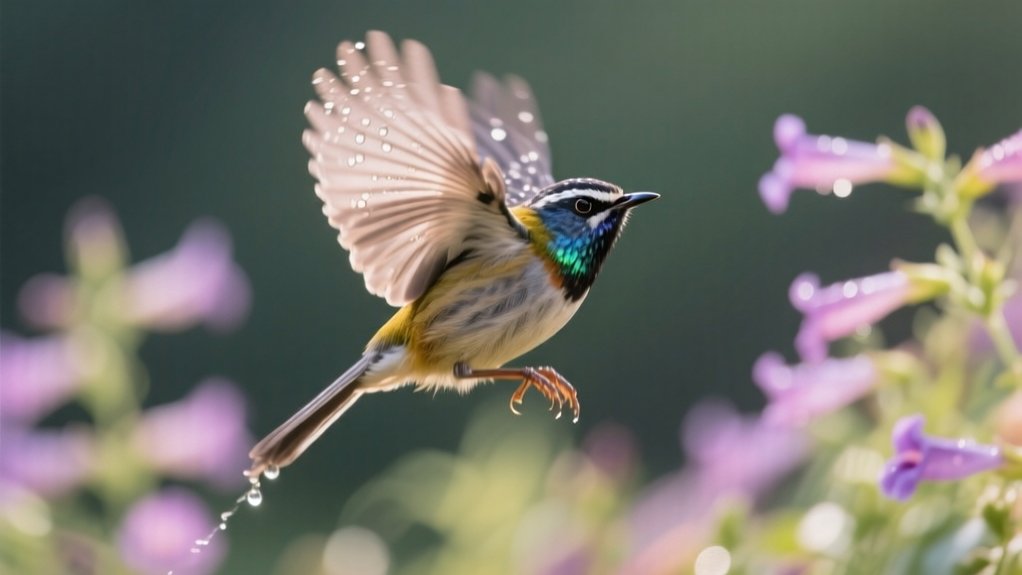
If you spot a tiny bird moving backward with deliberate control, you’re likely observing a hummingbird, the only bird capable of sustained backward flight. Check for its iridescent feathers, rapid wingbeats moving in a figure-eight pattern, and hovering behavior near flowers.
Other birds like warblers or herons only briefly back up. They lack the specialized ball-and-socket wing joint hummingbirds have.
By understanding wing mechanics and feeding behaviors, you’ll soon recognize what truly distinguishes these exceptional aerial acrobats.
Understanding Backward Flight in Birds
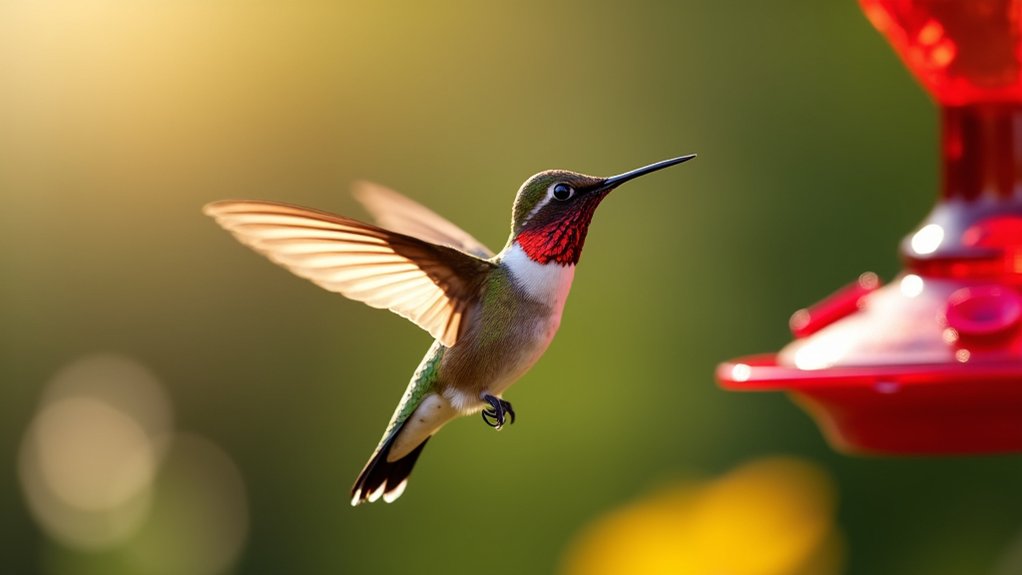
Although many birds can momentarily move backward, only hummingbirds can sustain backward flight due to their specialized wing anatomy and ball-and-socket joints that enable multi-directional wing movement.
When hummingbirds fly, they execute a distinct figure-eight wing pattern, generating lift on both the downstroke and upstroke. This mechanism allows continuous hovering and swift directional changes, including steady backward movement.
While species like warblers, egrets, and herons may briefly fly backward, these actions serve defensive purposes and lack the endurance seen in hummingbirds. Their backward flight primarily facilitates nectar feeding, enabling them to maintain position near flowers efficiently.
Though some insects, such as hummingbird moths, mimic this motion, true sustained backward flight is exclusive to hummingbirds.
Understanding these dynamics helps you accurately identify birds capable of genuine backward flight.
Unique Wing Structures Enabling Reverse Flight
The ability of hummingbirds to sustain backward flight hinges on their distinctly adapted wing anatomy. Their unique wing structures include a ball and socket joint, or rotator cuff, that grants multi-directional wing movement, enabling precise control.
Unlike typical birds that flap wings vertically, hummingbirds move their wings in a figure-eight pattern, generating lift on both forward and backward strokes. This specialized configuration provides a greater range of motion, allowing rapid directional changes essential for nectar feeding.
While some birds like warblers and herons can fly backward briefly, their wing mechanics lack these unique adaptations and serve mainly defensive purposes. In contrast, hummingbirds’ wing flexibility is essential for reversing flight direction without losing control, setting them apart from nearly all other bird species.
The Exceptional Flight Abilities of Hummingbirds
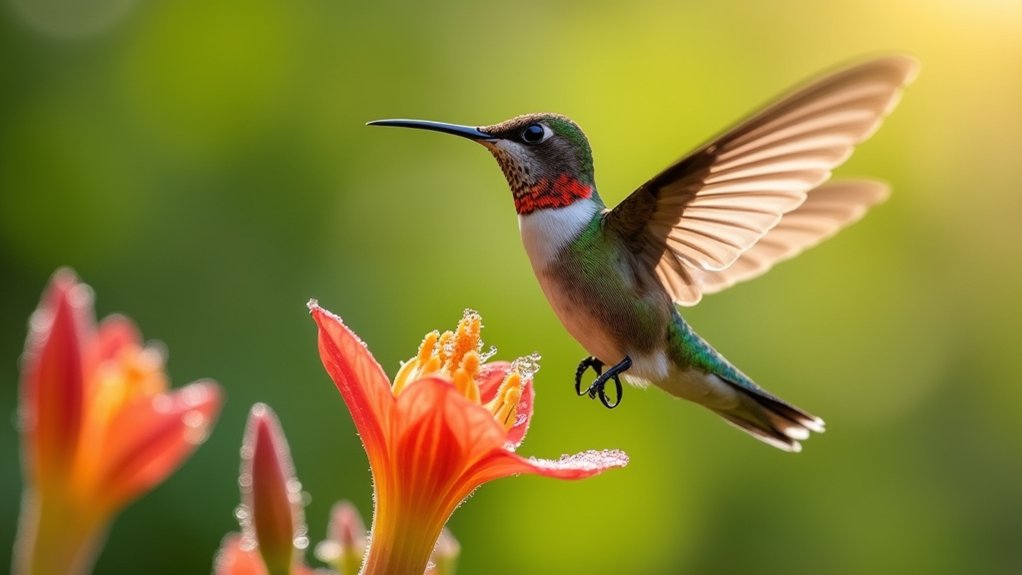
When you observe a hummingbird in flight, you’ll notice its unparalleled ability to hover, dart, and even fly backwards with remarkable precision.
Hummingbirds achieve sustained backward flight thanks to a unique wing structure and a ball-and-socket joint at the shoulder that permits multi-directional wing movement.
Their wings move in a figure-eight pattern, generating lift on both strokes, which enables efficient hovering and swift directional changes.
Unlike other birds that only briefly reverse as a defensive tactic, hummingbirds maintain backward flight for extended periods, enhancing their ability to access nectar from complex floral structures.
This exceptional flight capability, paired with their high metabolism, demands frequent feeding, making their backward flight essential for energy acquisition and survival.
Understanding hummingbirds’ flight mechanics highlights their singular status among avian species.
Observing Flight Patterns During Feeding
How do hummingbirds manage such intricate flight patterns while feeding? Their wing structure allows rapid, precise movements essential for nectar foraging.
When observing hummingbirds during feeding, focus on these key flight behaviors:
- Wingbeat frequency: They flap up to 80 times per second, producing a rapid figure-eight motion that generates lift on both strokes.
- Hovering ability: This lets you see them remain stationary mid-air, an adaptation unique to hummingbirds enabling close flower access.
- Backward and sideways movement: Unlike other birds, hummingbirds sustain backward flight to reposition efficiently without interrupting feeding.
These flight patterns demonstrate hummingbirds’ specialized physiology, supporting their unique foraging strategy.
Watching these behaviors in detail confirms their status as the only birds capable of sustained backward flight during feeding. This remarkable skill is possible due to adaptations for flight that include lightweight bones and efficient respiratory systems, which are also seen across various bird species but are uniquely specialized in hummingbirds.
Other Birds Exhibiting Brief Backward Flight
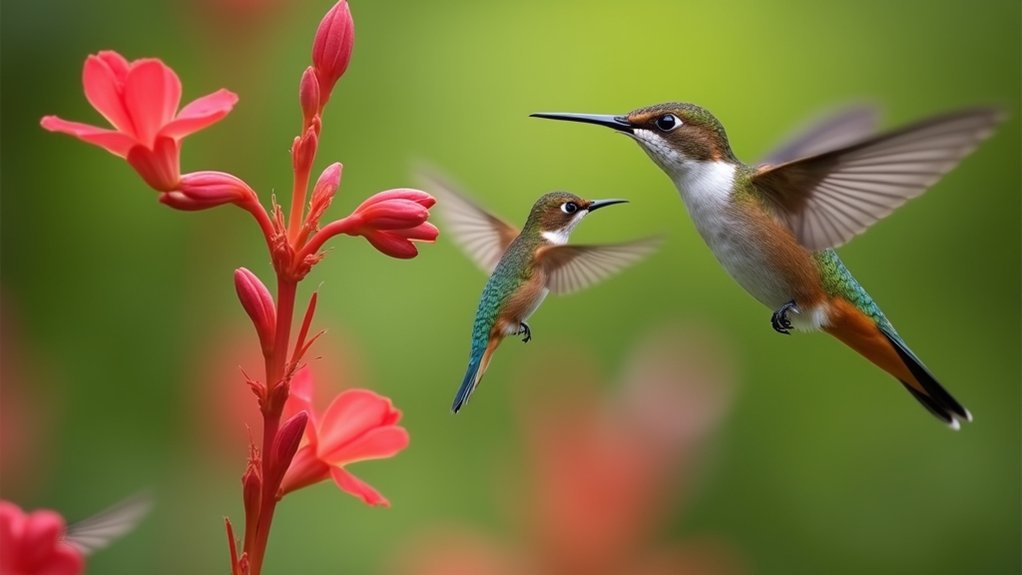
You’ll notice that while hummingbirds can sustain backward flight, other birds like warblers, egrets, and herons only manage brief backward fluttering.
They mostly do this as a defensive move. It helps them dodge predators or navigate tight spots, but it’s not as smooth or efficient as what hummingbirds do.
Brief Backward Flight Examples
Although hummingbirds hold the unique ability to sustain backward flight, several other bird species like warblers, egrets, and herons can perform brief backward movements.
You should note these examples of backwards flight, which typically last only a few seconds:
- Warblers often move backwards to reposition quickly when foraging or avoiding obstacles in dense foliage.
- Egrets use brief backward flight as a defensive response, retreating from potential threats while maintaining visual contact.
- Herons exhibit short backwards flights when maneuvering tight spaces near water or evading predators.
Unlike hummingbirds, these birds lack specialized wing mechanics for controlled, sustained backwards flight.
Instead, their brief backward movements serve immediate survival functions, such as predator evasion or spatial adjustment.
Understanding these distinctions helps you accurately identify true backward flying birds.
Defensive Flight Behavior
When threatened by predators, birds like warblers, egrets, and herons instinctively engage in brief backward flight as a rapid defensive maneuver. Unlike hummingbirds, which sustain flying backwards, these species exhibit this behavior only momentarily, primarily as a reflexive response to danger.
This short-duration backward flight enables them to quickly retreat from threats, often traversing tight spaces or avoiding obstacles with agility. Though limited, their capacity for flying backwards highlights an adaptive flight strategy enhancing survival.
This defensive flight behavior isn’t a habitual pattern but an emergency tactic triggered by immediate predatory threats. Observing such birds, you’ll notice that their brief backward motion serves as a critical escape mechanism, emphasizing the evolutionary advantage of even minimal backward flight capability in non-hummingbird species.
Species With Limited Reverse
Because sustained backward flight requires specialized wing anatomy, only hummingbirds achieve it consistently.
However, several other species like warblers, egrets, and herons demonstrate brief backward flight in response to immediate threats.
Unlike hummingbirds, these birds lack the ball and socket joint that enables continuous reverse movement. Their backward flight is limited and primarily serves as a rapid defensive maneuver.
When observing such species, note that the backward flight appears as a quick flutter or retreat, not sustained or controlled.
This behavior occurs mainly during predator evasion or territorial disputes.
Forward flight remains their dominant mode for navigation and feeding.
Recognizing these distinctions improves your ability to identify birds exhibiting limited reverse flight versus those capable of sustained backward movement.
Distinguishing Hummingbirds From Similar Species
You can tell hummingbirds apart from similar species by paying close attention to their size, feather colors, and how they move their wings.
One cool thing to watch for is their unique figure-eight wing pattern—that’s what lets them fly backward for longer periods, which other birds or insects usually can’t do.
Also, think about where they live and how they feed; hummingbirds are known for darting quickly between flowers, which is a big clue to who they are.
Size and Appearance Differences
Size plays a critical role in distinguishing hummingbirds from other birds capable of brief backward flight, such as warblers and herons, which are noticeably larger and more robust.
When identifying hummingbirds, focus on these three key size and appearance differences:
- Dimensions: Hummingbirds measure between 3 to 5 inches, markedly smaller than warblers or herons.
- Plumage: Their iridescent, vibrant feathers differ sharply from the duller colors of similar-sized species like hummingbird moths.
- Wing and Foot Structure: Hummingbirds possess a unique ball-and-socket wing joint for extensive motion and have weakly developed feet, relying almost exclusively on flight.
These precise morphological traits make hummingbirds unmistakable compared to other birds that may briefly fly backward.
Flight Pattern Comparison
Although several bird species can fly backward briefly, only hummingbirds sustain this motion through a highly specialized flight pattern. You’ll notice hummingbirds employ a unique figure-eight wing stroke, powered by a ball and socket joint in the rotator cuff, enabling multi-directional wing movement.
This contrasts sharply with birds like warblers, egrets, and herons, whose backward flight is fleeting and limited to defensive maneuvers. The hummingbird’s ability to fly backwards stems from this distinct wing kinematics, allowing it to hover and execute precise directional changes.
When observing a bird flying backwards with smooth, sustained motion, its wingbeats will be rapid and continuous, unlike the brief, awkward reversals seen in other species.
This flight pattern comparison is key to distinguishing true backward flyers from those with only momentary ability to fly backwards.
Habitat and Behavior Clues
Because hummingbirds depend on nectar to fuel their exceptionally high metabolism, you’ll often find them in habitats rich with flowering plants, including urban gardens and natural meadows.
When distinguishing a bird that can fly backwards like a hummingbird, pay close attention to habitat and behavior clues:
- Frequent Feeding: Hummingbirds engage in rapid, repeated visits to flowers, relying on nectar, unlike similar species that feed on insects or fish.
- Flight Style: Notice the unique hovering and figure-eight wing motion, enabling sustained backward flight, unlike warblers or herons that briefly retreat defensively.
- Habitat Preference: Hummingbirds thrive in nectar-rich environments, while other birds capable of brief backward flight prefer wetlands or wooded areas.
Unlike the tit bird family, which includes species such as the Great Tit and Blue Tit that primarily forage in woodlands and urban parks, hummingbirds are uniquely adapted for sustained hovering and true backward flight.
Habitats Where Backward-Flying Birds Are Found
When you investigate the habitats of birds capable of flying backwards, you’ll find that hummingbirds dominate a wide range of environments across the Americas. These range from tropical rainforests and mountainous regions to arid deserts.
Hummingbirds thrive in diverse American habitats, from rainforests and mountains to deserts.
These birds exploit areas abundant in flowering plants, essential for their nectar-based diet. You’ll also find them thriving in urban gardens rich in nectar sources, which makes close observation easier.
While true backwards flight is primarily a hummingbird trait, other birds like warblers and egrets occasionally exhibit brief backward movements. They inhabit overlapping wetlands and wooded zones.
Although hummingbirds aren’t native to the UK, similar species such as hummingbird hawkmoths appear in suitable garden habitats.
Protecting these natural ecosystems is critical to sustain the delicate balance that supports backwards flight in these specialized birds.
Tips for Documenting and Identifying Backward Flight
To accurately document and identify backward flight, you need to focus on the distinctive wing mechanics of hummingbirds. These birds achieve sustained backward movement through figure-eight wing strokes enabled by their ball-and-socket wing joints.
Here are three tips to help you observe this phenomenon:
- Watch for the continuous, precise figure-eight wing motion, which allows hummingbirds to hover and reverse smoothly.
- Observe feeding behavior; hummingbirds often fly backwards when withdrawing from flowers after nectar extraction.
- Use high-speed cameras to capture wing flexibility and motion range, distinguishing hummingbirds from other birds that only flutter backward briefly.
Frequently Asked Question
Can Birds Fly Backwards for Long Distances or Only Short Bursts?
You’ll find that only hummingbirds can truly fly backwards for long distances, thanks to their unique wing joints and muscle control.
Most birds can only manage short backward bursts, mainly for defense. Their wing structure limits sustained backward flight, so they quickly return to forward motion.
If you watch closely, hummingbirds’ precise backward flight helps them access nectar with remarkable agility, unlike other species whose backward movement remains brief and situational.
Do Juvenile Birds Demonstrate Backward Flight Differently Than Adults?
Juvenile hummingbirds demonstrate backward flight differently than adults, with only about 30% of their wingbeats contributing to controlled backward motion compared to 70% in adults.
You’ll notice their backward flight is shorter and less stable because their muscles and coordination are still developing.
This limited control means juveniles use backward flight mainly for quick evasive moves rather than sustained movement, gradually improving as they gain strength and master wing kinematics.
How Does Weather Affect a Bird’s Ability to Fly Backwards?
You’ll find that weather notably impacts a bird’s ability to fly backwards. Strong winds and heavy rain disrupt stability and control, especially for species like hummingbirds that need precise wing movements.
Facing headwinds demands more energy, which limits their backward flight. During calm conditions, they perform this maneuver more effectively.
Moreover, changes in atmospheric pressure and temperature can alter muscle performance and wing aerodynamics, further influencing their capacity for complex flight patterns.
Are There Any Nocturnal Birds That Can Fly Backwards?
No, you won’t find any nocturnal birds that can fly backwards like hummingbirds.
Their wing structure and flight mechanics don’t support sustained backward flight.
While some birds might flutter briefly backward defensively, nocturnal species lack this ability.
The unique hovering and backward flight of hummingbirds rely on specialized muscle control and metabolism, which nocturnal birds don’t possess.
They evolved different adaptations for night hunting and navigation.
What Predators Are Most Affected by Birds’ Backward Flight Abilities?
You’ll find that hawks and other raptors are most affected by birds’ backward flight abilities, with hummingbirds evading capture up to 90% of the time due to their agility.
Their rapid backward and lateral movements disrupt the predator’s attack trajectory, forcing quick recalculations.
This aerial acrobatics confounds these predators, reducing strike success and increasing the birds’ survival rates in their natural habitats.
Conclusion
Now that you know hummingbirds’ unique wing structure lets them sustain true backward flight, can you spot these remarkable flyers in action? Remember, while a few other birds may dart briefly backward, only hummingbirds exhibit consistent reverse movement.
By observing their precise wingbeats and feeding behaviors in specific habitats, you’ll confidently identify genuine backward flight. Keep your focus sharp and your documentation detailed to truly appreciate this extraordinary avian capability.