

You’ll find that birds like ospreys specialize by plunging shallow to snatch fish with sharp talons, while herons rely on patience and quick reflexes to spear prey in shallow waters.
Eagles use rough soles and swift descents to grip fish tightly, and pelicans scoop with stretchy throat pouches. Puffins grasp multiple fish with spiny bills.
Cormorants and loons plunge deep using powerful feet, mergansers employ serrated bills, and egrets use stealth tactics in tidal zones. Exploring their diverse hunting styles reveals fascinating adaptations.
Osprey
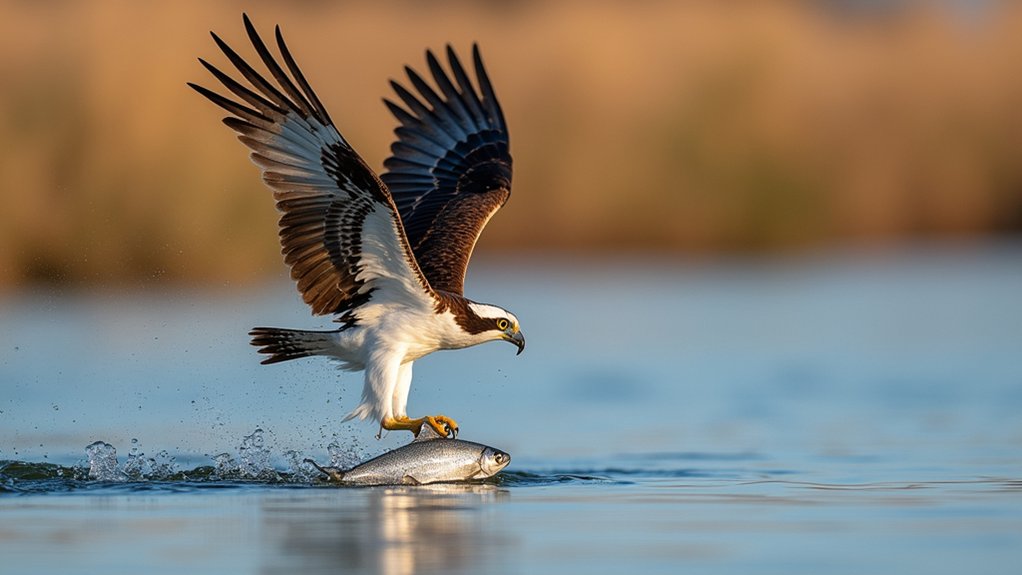
The osprey, often called the “sea hawk,” relies almost exclusively on fish for its diet, with about 99% of its food coming from aquatic prey.
When you observe an osprey hunting, you’ll notice it hovering above shallow water, scanning keenly for fish just below the surface. Their eyesight is remarkably sharp, enabling them to detect fish from considerable heights.
Once a target is spotted, the osprey plunges swiftly but only penetrates the water up to three feet deep, using its talons to snatch the fish. This hunting method is highly specialized, as ospreys can’t plunge deeper.
Herons
You’ll notice herons use sharp reflexes and strong beaks to catch fish. They often wait patiently in shallow waters before striking with their long necks.
It’s pretty impressive to watch.
But their diet isn’t just limited to fish. They also eat reptiles, amphibians, insects, and even other birds.
This shows how adaptable they are.
That said, this wide-ranging appetite can sometimes cause problems, especially in ornamental ponds. Herons might reduce fish populations quite a bit, which can be frustrating for pond owners.
Hunting Techniques
Herons’ hunting success relies on a combination of quick reflexes and specialized behaviors that maximize their efficiency in capturing fish.
You’ll notice them standing motionless in shallow water, patiently waiting for prey to approach. Once a fish nears, they strike rapidly with their sharp beaks to catch fish before it escapes.
Some species, like the Green Heron, even use tools, baiting fish with insects to lure them closer.
The Black Heron uses a unique “umbrella technique,” spreading its wings to create shade. This shade attracts fish into a cooler zone, making them easier to catch.
Egrets, close relatives, disturb shallow water by stirring with their feet, flushing out fish for capture.
These methods highlight the herons’ adaptability and precision in exploiting their watery habitats.
Diet Variety
Beyond their impressive hunting techniques, herons display remarkable dietary flexibility that supports their survival across diverse environments. When you observe herons eating fish, you’ll notice they rarely consume just one type of prey. This variety improves their adaptability.
Herons catch and eat fish at a time but supplement their diet with reptiles and amphibians, ensuring nutritional balance. Insects and smaller birds also figure into their diet, demonstrating opportunistic feeding behavior.
Different species employ unique methods like tool use or the umbrella technique to boost success rates across various prey types. This dietary variety enables herons to thrive in multiple habitats, adjusting their feeding strategies based on prey availability and environmental conditions.
Pond Impact
Although herons primarily hunt fish in shallow waters with remarkable precision, their presence can considerably affect pond ecosystems, especially in residential areas. When you observe herons, you’ll notice their patience: they remain motionless, waiting for fish to swim within striking distance.
This hunting strategy efficiently reduces fish populations, particularly smaller species, which can alter the pond’s ecological balance. Furthermore, herons consume amphibians, reptiles, and insects, further impacting pond biodiversity.
If you maintain a garden pond, you might experience conflicts as herons prey on your fish stock, potentially disrupting your pond’s intended ecosystem.
Understanding herons’ role helps you manage pond health, balancing their natural predation with preserving fish populations in your aquatic environment.
Eagles
Eagles demonstrate remarkable adaptability in their diets, with bald eagles primarily feeding on fish while also hunting rabbits and crabs.
When you observe bald eagles, you’ll notice their feet have rough soles, giving them a superior grip to hunt fish effectively. This specialized adaptation allows them to plunge into water and seize slippery prey with precision.
Consider these key points about eagles:
- Bald eagles use their powerful feet to catch fish, employing a dynamic hunting technique involving swift descents.
- They can endure several days without food, showing resilience during scarce periods.
- Golden eagles, although less fish-focused, expand their diet by hunting seals, reflecting dietary versatility.
Pelicans
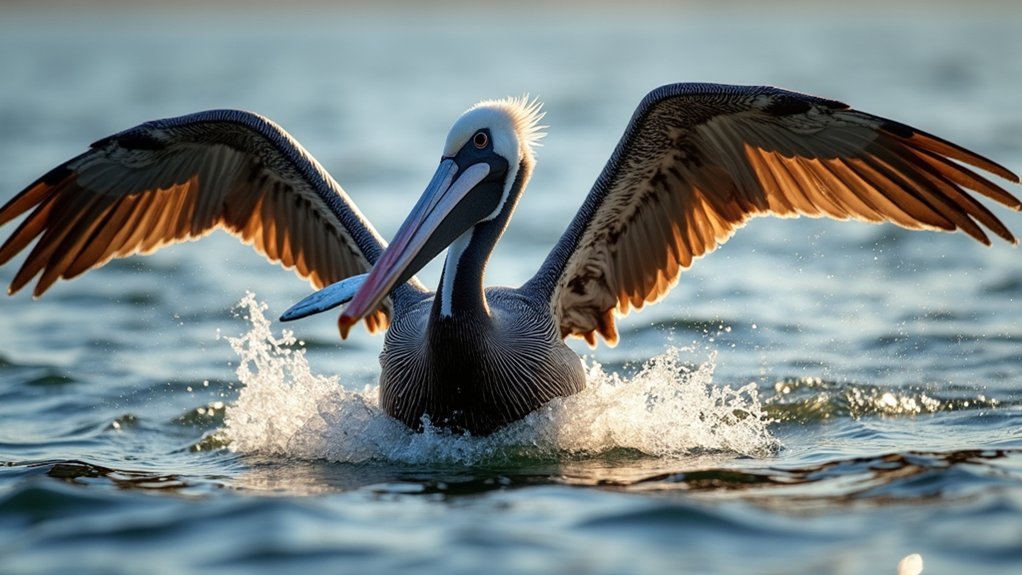
You’ll notice that pelicans really depend on their big beaks and those stretchy throat pouches to catch fish efficiently.
Take the American white pelican, for example—it scoops up both water and fish, then drains the water out before swallowing the catch.
It’s pretty clever how their specialized beak and pouch team up to make sure they grab as much prey as possible, no matter the hunting situation.
Unique Hunting Techniques
When pelicans hunt, they use a variety of specialized techniques that maximize their efficiency in capturing fish. Their surface feeding method uses hooked beaks to scoop prey from the water without plunging deeply.
Here are three unique hunting techniques pelicans use:
- Surface Scooping: American white pelicans glide over water, dipping their hooked beaks to scoop fish near the surface. They can capture multiple fish at once in their large beak pouch.
- Aerial Plunging: Brown pelicans dive from heights up to 65 feet, using precise aerial control to plunge into the water and snatch fish.
- Cooperative Herding: Groups work together, corralling fish into shallow water where they’re easier to catch.
These methods highlight pelicans’ adaptability in exploiting various aquatic environments efficiently.
Beak and Pouch
A pelican’s beak and throat pouch form a remarkable adaptation tailored for efficient fishing. As Fish-Eating Birds, pelicans use their specialized beak with serrated edges to catch and hold slippery fish securely.
Their expansive throat pouch can hold nearly three gallons of water, allowing you to scoop up fish with precision. When feeding, you’ll notice pelicans drain excess water from their pouch, ensuring only the fish remain before swallowing.
The American white pelican cooperates with others to herd fish into shallow waters, while the brown pelican performs dramatic plunges from heights up to 65 feet to catch prey.
These features highlight how the beak and pouch work in concert, optimizing pelicans’ ability to capture and consume fish efficiently in diverse aquatic environments.
Atlantic Puffins
The Atlantic puffin exhibits remarkable adaptations for its fish-based diet, primarily preying on smaller species such as sand lance, herring, and cod.
You’ll notice these birds are highly specialized to eat fish, especially small fish, which they catch efficiently underwater. Their large, colorful bills aren’t just for show. They can grasp multiple fish simultaneously.
Here’s what makes their feeding strategy unique:
- Their bills have spines on the roof of the mouth that secure prey while diving.
- They target small fish species that are abundant and easy to catch.
- During breeding season, puffins gather on Maine’s islands, where they hunt fish to feed their chicks.
Kingfishers
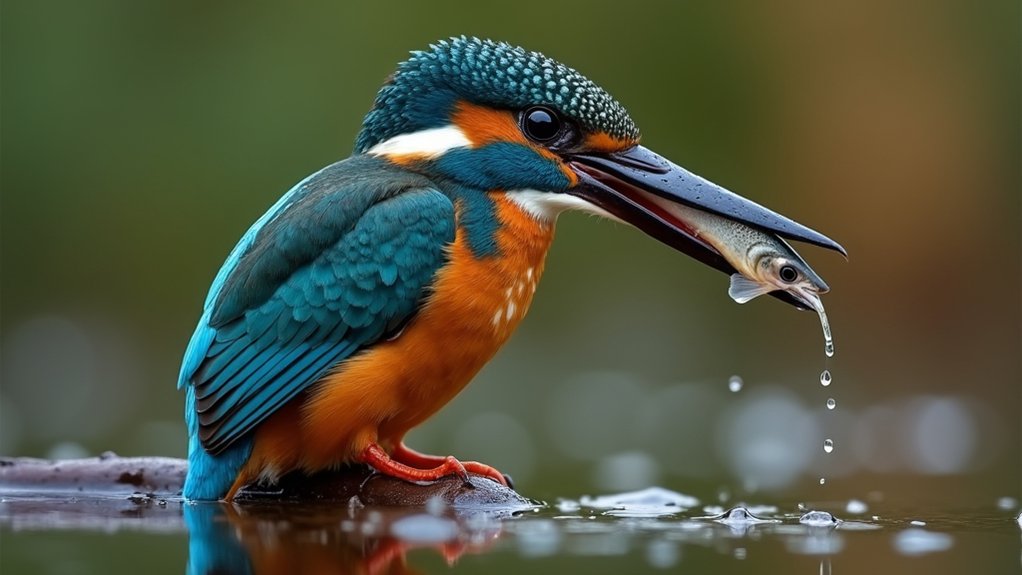
Although kingfishers often appear still as they perch above water, they exhibit remarkable hunting agility when plunging to catch fish near the surface. You’ll often see them poised on low branches or hovering briefly before they leap into the water, targeting fish close to the surface.
Their long, dagger-like bill is perfectly adapted for spear fishing, enabling them to catch and consume smaller freshwater fish, including trout.
Young kingfishers face the challenge of compensating for light refraction underwater, a skill they master to improve hunting accuracy.
Many species display vibrant plumage, but their true marvel lies in their precise, swift plunges.
Observing a kingfisher’s leap into the water reveals an impressive combination of patience, keen eyesight, and refined hunting technique.
Cormorants
Cormorants rely on powerful webbed feet to propel themselves efficiently underwater. They chase fish with remarkable agility.
When you observe these birds, you’ll notice how their hooked beaks securely grip prey, enabling them to catch sizable fish, including eels.
They plunge deeply and forage near the bottom of ponds or lakes, exploiting aquatic environments skillfully.
Key features include:
- Webbed feet that provide propulsion beneath the water’s surface.
- Less water-repellent feathers, which reduce buoyancy and assist in plunging.
- Frequent wing-drying behavior after surfacing to maintain feather condition.
Loons
Moving from the cormorants’ adept underwater pursuits, loons demonstrate likewise impressive aquatic hunting skills. You’ll notice loons diving beneath the surface of the water, using their powerful webbed feet to navigate with precision. Their sharp, pointed bills allow them to grasp slippery fish efficiently.
Unlike white pelicans that scoop fish from the surface, loons chase and capture prey underwater with agile pivoting. Their black-and-white plumage provides camouflage against the dappled light, aiding stealth. Loons’ haunting calls echo across northern lakes during breeding, marking territory.
| Feature | Loons | White Pelicans |
|---|---|---|
| Hunting Method | Diving underwater | Surface scooping |
| Locomotion | Webbed feet propulsion | Large wings for soaring |
| Bill Shape | Sharp, pointed | Broad, flat |
Mergansers
When you observe mergansers hunting, you’ll notice their distinctive serrated beaks gripping slippery fish with remarkable efficiency.
You often see these specialized ducks plunging in freshwater lakes and rivers, using their webbed feet to propel themselves underwater in pursuit of prey. Their hunting technique makes catching fish relatively easy despite the fish’s slippery nature.
Key observations include:
- Males can swallow fish up to 1 foot long, showing their ability to handle sizable prey.
- Red-breasted mergansers perform 250 to 300 plunges daily to catch 15 to 20 fish, demonstrating high energy expenditure.
- Their serrated bills act like saws, securing fish firmly during capture.
Egrets
Egrets, closely related to herons, stand out with their elegant white plumage that provides camouflage in aquatic environments where they hunt.
You’ll notice egrets often forage in shallow waters, using stealth and patience to capture fish.
They employ specific techniques like foot-stirring to disturb sediment, flushing out prey.
The Snowy Egret, distinguished by yellow lores and feet, typically hunts fish in tidal channels and lagoons during early morning or evening.
Beyond fish, egrets adapt their diet to include amphibians, reptiles, and insects, reflecting their opportunistic feeding behavior.
If you have a pond, you might find egrets troublesome, as they skillfully extract fish from man-made water bodies.
Observing their precise, adaptive hunting methods reveals their role as effective aquatic predators.
Similar to many coastal birds, egrets rely on habitats near the water’s edge, where their specialized feeding strategies allow them to thrive.
Frequently Asked Question
How Do Birds Digest Fish Bones Safely?
You digest fish bones safely because your stomach acid is highly acidic, breaking down small bones efficiently.
Your strong gizzard grinds harder materials, preventing damage to your digestive tract.
If you swallow fish whole, digestive enzymes steadily dissolve bones over time.
Your powerful beak and robust digestive system work together to handle larger bones without harm.
This combination guarantees you extract nutrients safely while avoiding internal injury.
What Adaptations Help Birds Catch Slippery Fish?
You’ve got to appreciate nature’s clever tools that help birds secure their slippery meals.
Specialized beaks provide a firm yet gentle grip, while textured feet prevent escape.
Some birds scoop with expandable pouches, increasing their catch capacity.
Agile diving with webbed feet lets them pursue prey underwater.
Inventive hunting strategies, like shading water to lure fish, improve success.
These adaptations work together, ensuring you witness efficient, skillful fishing in action.
Do Fish-Eating Birds Migrate Seasonally?
Yes, you’ll find that many fish-eating birds migrate seasonally to optimize their access to prey.
You might observe species like herons and egrets shifting locations with the seasons, tracking abundant fish populations.
When winter reduces fish availability or water bodies freeze, birds such as bald eagles relocate.
You’ll also notice Atlantic puffins moving offshore during non-breeding times, seeking rich feeding grounds.
Migration depends heavily on regional climate and prey presence, so patterns vary widely.
How Do Fish-Eating Birds Impact Fish Populations?
You might imagine a medieval knight observing fish-eating birds, yet their impact is very modern: these birds control fish populations by preying on specific species and sizes, preventing overpopulation.
You’ll notice they maintain ecological balance, but if predation’s too intense, fish numbers can decline sharply.
You should also consider that removing these birds often causes fish overabundance, disrupting aquatic ecosystems and altering species distribution and water quality.
Can These Birds Eat Other Types of Food?
Yes, these birds can eat other types of food. You’ll find that many species adapt their diets based on availability.
For example, herons and egrets include reptiles, amphibians, and insects alongside fish.
Bald eagles switch to rabbits or crabs when fish are scarce.
Omnivorous birds like gulls scavenge or consume diverse foods, and species such as American crows incorporate fruits and seeds, showcasing their dietary flexibility and ecological adaptability.
Conclusion
You might be surprised to learn that ospreys can plunge from heights of up to 30 meters to catch fish with a success rate of nearly 70%. This precision highlights how specialized these birds are in their fishing techniques.
Observing such adaptations across species like herons, eagles, and pelicans reveals the incredible evolutionary paths that enable them to thrive in aquatic environments. Understanding these behaviors deepens your appreciation for their ecological roles and survival strategies.