
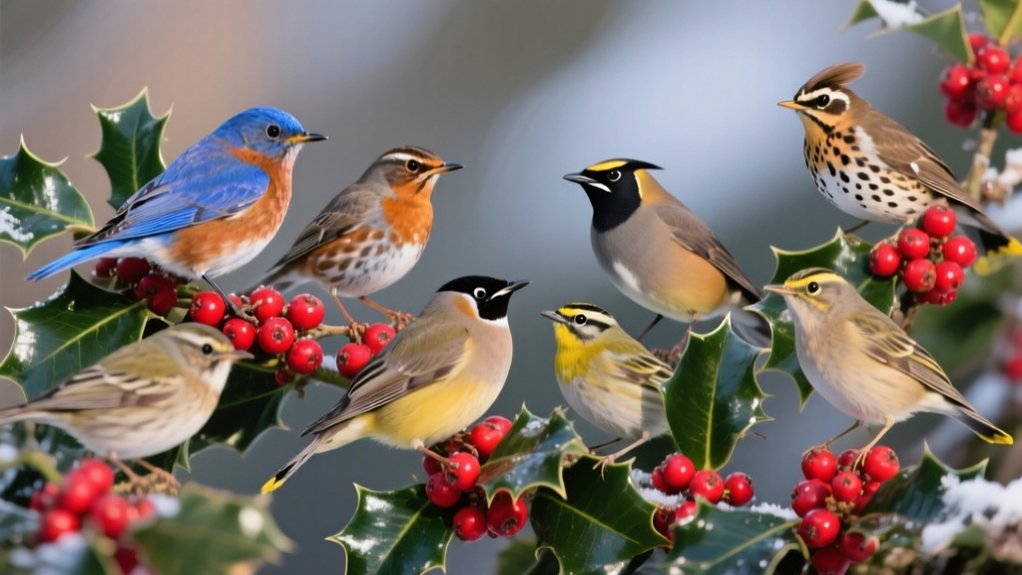
You’ll notice birds like the American Robin and Cedar Waxwing rely on holly berries during winter when insects dwindle. Northern Cardinals supplement their seed diet with these berries, while Northern Mockingbirds aggressively defend berry patches.
Brown Thrashers, Bluebirds, and various Thrushes turn to holly for sustenance in harsh months. Less common visitors like Townsend’s Solitaire and Pine Grosbeak also partake. Observing these species reveals fascinating survival strategies and ecological roles tied to holly berries.
American Robin
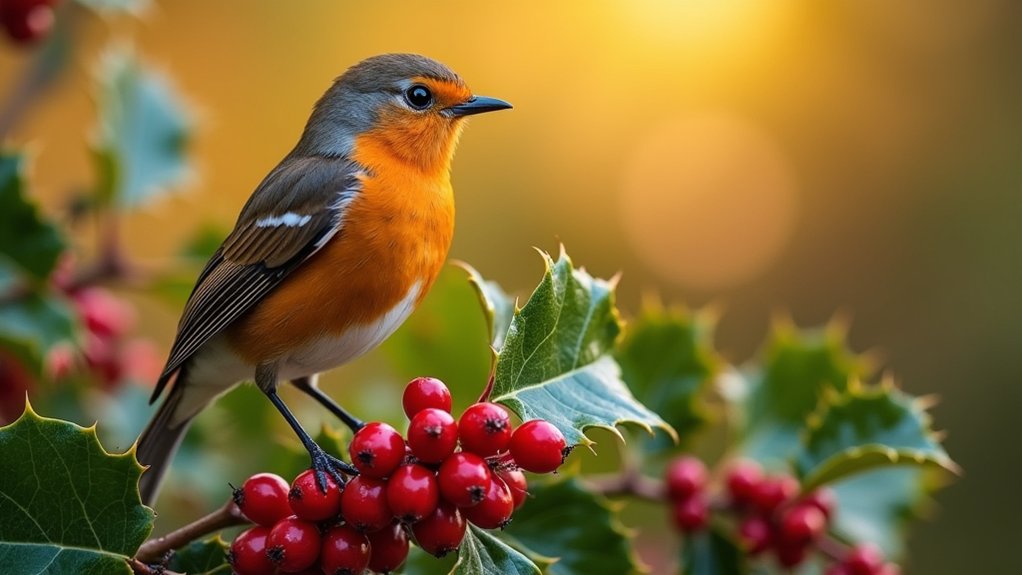
Although American robins primarily feed on worms and invertebrates during warmer months, you’ll often see them flocking to holly bushes in January to consume large quantities of holly berries.
In winter, American robins flock to holly bushes, feasting on berries when insects are scarce.
When insects become scarce in winter, these birds shift their diet, relying heavily on holly berries as an essential energy source.
You’ll notice how quickly American robins can strip a holly bush bare, often within days of arrival.
The berries’ sweetness intensifies after freezing and thawing, which boosts their appeal to robins as early spring approaches.
This seasonal dietary adaptation guarantees American robins maintain necessary caloric intake during harsh conditions, illustrating their flexible feeding behavior and dependence on holly berries when other food options are limited.
After fledging, robins do not return to the nest, instead focusing on exploring their environment and learning to forage—making winter berry sources like holly even more crucial for their survival.
Cedar Waxwing
You’ll notice cedar waxwings move in tight flocks. This really helps them be more efficient when they’re searching for food.
They seem to have a clear favorite—sweet holly berries, especially in the winter months. They rely a lot on these and other similar berries during that time.
Their social feeding habits mean they can quickly find and eat the calories they need to make it through the cold season.
Flocking and Feeding Behavior
How do cedar waxwings efficiently locate and consume holly berries during winter? These birds eat holly berries primarily by foraging in flocks, which improves their ability to quickly find and consume food.
Their social behavior reduces predation risk and allows rapid depletion of berry patches, meeting nutritional demands. Cedar waxwings swallow berries whole, aiding seed dispersal.
This flocking and feeding behavior exemplifies adaptive strategies for winter survival.
| Behavior Aspect | Description | Benefit |
|---|---|---|
| Social Foraging | Feeding in flocks | Efficient berry location |
| Whole Berry Ingestion | Swallowing berries with seeds | Seed dispersal |
| Predator Vigilance | Group alertness | Improved safety |
| Seasonal Diet | Focus on holly berries in winter | Nutritional adaptation |
| Rapid Resource Use | Quick depletion of berry patches | Sustained energy intake |
Preferred Berry Sources
When cedar waxwings search for food during winter, they focus on a variety of berry-producing plants that meet their nutritional needs. You’ll find them favoring holly berries alongside juniper, crabapple, hawthorn, and mountain ash.
Their specialized digestive system efficiently processes the waxy coating of these berries, extracting essential energy in cold months.
Observing them, you’ll notice their striking plumage and yellow-tipped tails as they forage in social flocks, which boosts foraging efficiency.
This group behavior enables them to consume large quantities swiftly, sometimes depleting local holly berry supplies.
Understanding these preferred berry sources helps you appreciate how cedar waxwings adapt their diet seasonally, relying heavily on holly berries to sustain themselves when other food is scarce.
Northern Cardinal
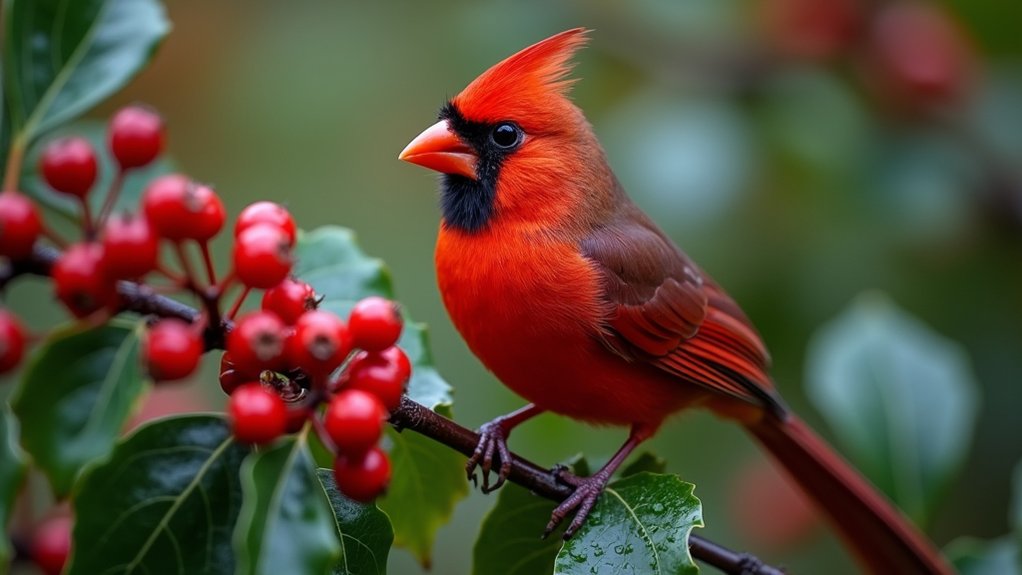
Although Northern Cardinals primarily eat seeds, they readily supplement their diet with holly berries during winter when insects become scarce.
You’ll notice these birds, especially males with their vivid red coloration, perched among holly bushes, consuming the bright red berries.
Their feeding not only sustains them but also aids in seed dispersal, benefiting the local ecosystem.
When observing Northern Cardinals in winter, focus on their preference for holly berries as a reliable food source.
Notice the contrast of their red plumage against green holly leaves and their role in maintaining healthy shrubbery by spreading seeds.
Northern Mockingbird
You might notice Northern Mockingbirds really go all out defending holly berry patches. They get pretty aggressive to make sure they keep their food supply safe.
But they’re not just about holly berries—they actually eat a bunch of different kinds of berries, especially in winter when food can be hard to find.
Plus, their complex songs aren’t just for show; these vocalizations help them establish dominance and let others know they’re around in their feeding areas.
Territory Defense Behavior
Because holly berries provide an essential food source during winter, Northern mockingbirds aggressively defend territories that include these bushes.
When you observe them, you’ll notice their territory defense centers around securing access to these critical food resources.
They establish and maintain territories that often encompass several holly bushes, ensuring a steady supply of berries.
Key behaviors include:
- Chasing away intruders through loud calls and physical displays
- Dominating berry-rich areas to minimize competition
- Vigilantly monitoring their territory to protect holly berries from other frugivores
Berry Preferences Variety
How do Northern mockingbirds choose among the variety of berries available in their habitat? You’ll notice they consume holly berries but often prefer other types, such as bittersweet and viburnum berries, which provide a richer food source.
Their dietary adaptability allows them to utilize multiple berries as well, increasing their survival chances during scarce winter months. When you observe their foraging, they tend to select berries based on nutritional value, favoring those that sustain them more efficiently.
Despite holly berries being abundant, mockingbirds don’t prioritize them unless other options are limited. This selective behavior reflects an evolved strategy to maximize energy intake from diverse berries as well as maintain competitive dominance over prime feeding areas, especially during winter when food sources become limited.
Vocalization and Communication
While foraging around holly bushes, you might notice Northern mockingbirds filling the air with a complex array of sounds. Their vocalization is highly diverse, featuring up to 200 distinct songs. These birds use their repertoire to communicate effectively in their environment.
Key aspects include mimicking other bird species and mechanical noises to bolster territorial claims. They sing persistently during breeding season and winter, especially near holly berries. They also use songs to deter competitors from feeding on berry-rich plants.
Northern mockingbirds’ vocalization not only attracts mates but also secures crucial feeding grounds. Observing these intricate communications gives insight into their behavioral ecology, highlighting their role as both vocal performers and territorial defenders near holly patches. Mockingbirds occasionally incorporate mechanical clicking sounds into their complex vocalizations, a behavior shared by certain other bird species for communication and territorial purposes.
Brown Thrasher
When winter reduces available food sources, brown thrashers turn to holly berries as an essential nutrition option. You’ll notice these birds foraging solo in brushy, native shrub habitats where holly berries are abundant, providing both sustenance and shelter.
Their keen eyesight helps them efficiently locate these bright red berries amid dense foliage. Unlike more aggressive species, brown thrashers exhibit polite behavior at feeding sites, often allowing other birds access to berry resources without conflict.
You can also identify them by their distinctive, melodious songs as they move through thickets.
This solitary feeding strategy combined with their preference for holly berries improves the brown thrasher’s winter survival, demonstrating their adaptability in colder months when insect prey is scarce.
Gray Catbird
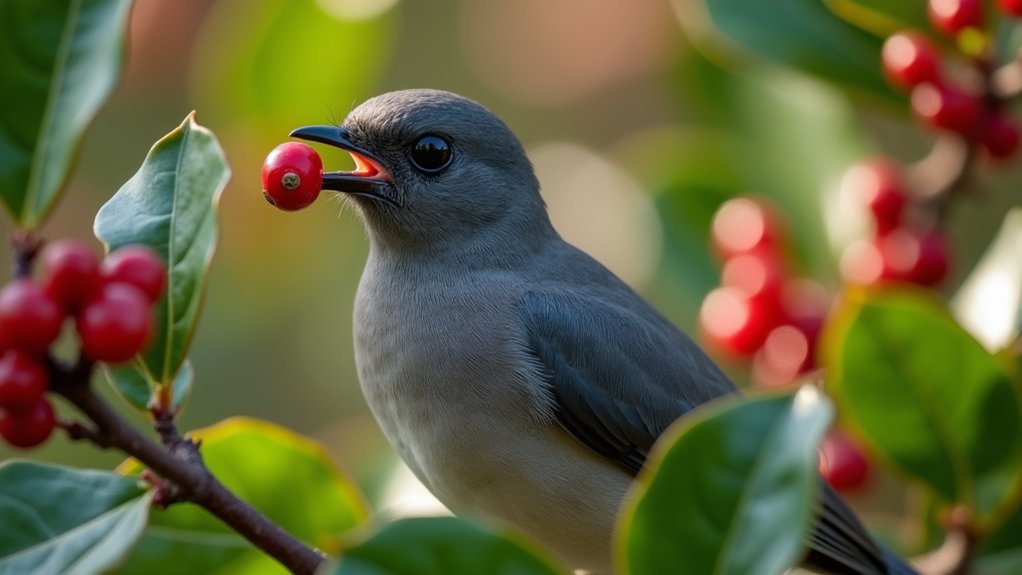
The gray catbird exhibits a diverse diet, favoring sweet fruits such as dogwood and serviceberry. This makes holly berries an important food source during winter months.
Primarily insectivorous, the gray catbird shifts to berries like holly berries when insect availability declines with colder weather.
You’ll often hear its distinctive cat-like call while observing it search for food in gardens or shrubby habitats rich in berry-producing plants.
Key observations about the gray catbird include:
- It actively consumes holly berries alone or in small groups, aiding seed dispersal.
- It displays territorial behavior around berry-abundant areas despite its generally social nature.
- It relies on holly berries especially during winter as a critical energy source when insects are scarce.
Bluebird
Because insects become scarce during winter, bluebirds turn to berries like holly to meet their nutritional needs.
You’ll notice bluebirds, with their vivid blue plumage, frequently visiting holly bushes, especially in late winter when alternative foods dwindle.
These birds actively forage in small flocks, selecting ripe holly berries that provide essential energy and nutrients during colder months.
Bluebirds gather in small flocks to feast on ripe holly berries, fueling their winter survival.
Observing a bluebird consume holly berries reveals their adaptability as they shift from an insect-based diet to one reliant on fruit.
Holly berries not only sustain bluebirds through harsh conditions but also influence their habitat preferences, drawing them to berry-rich areas.
Thrushes
You’ll notice several thrush species, like American robins and hermit thrushes, feeding on holly berries during winter.
These birds usually forage alone, sticking to berry-rich plants when other food sources are hard to find.
It’s pretty interesting to watch their solitary behavior and see how they pick their berries—it really shows how they adapt to the changing seasons in their habitat.
Thrush Species Variety
Although thrushes often forage alone, you can observe several species, such as American robins and hermit thrushes, relying on holly berries as an essential winter food source.
These thrush species depend on the nutritional value of holly berries to sustain themselves during colder months when other food is scarce.
Particularly, American robins flock to holly bushes in spring, attracted by berries that become sweeter after freezing and thawing.
Varied thrushes also utilize holly berries in specific regions.
Key observations about thrush species and holly berries include:
- Thrush species consume holly berries primarily in winter for sustenance.
- American robins exhibit seasonal flocking behavior around holly bushes.
- The melodic songs of holly berry feeding thrushes enrich their winter habitats.
Solitary Foraging Behavior
When thrushes like robins and hermit thrushes forage, they often do so alone, seeking out holly berries and other winter fruits in quiet, secluded spots.
This solitary foraging behavior reduces competition and lowers the risk of predation, allowing you to observe them cautiously moving through underbrush.
As they eat the berries, their vigilance keeps them less conspicuous, blending careful feeding with an acute awareness of their surroundings.
Though holly berries are part of their diet, thrushes prioritize a variety of winter berries, adapting to availability.
Their solitary nature also means you might hear their melodic songs echoing softly, a reminder of their presence even when out of sight.
This combination of cautious feeding and silent observation exemplifies the thrushes’ efficient winter foraging strategy.
Winter Berry Preferences
Since insects become scarce during winter, thrushes like American robins and hermit thrushes depend heavily on berries, particularly holly berries, to meet their nutritional needs.
You’ll notice robins flocking in groups, efficiently consuming large quantities of holly berries.
Hermit thrushes, in contrast, forage alone but still rely on these winter berries alongside other available fruits.
Understanding their preferences helps you recognize their role in winter ecosystems.
Key observations include:
- American robins exhibit gregarious behavior, often feeding in flocks on holly berries.
- Hermit thrushes maintain solitary foraging habits but prioritize holly berries for sustenance.
- Thrush presence correlates strongly with the availability of berry-producing plants during winter.
Townsend’s Solitaire
Townsend’s solitaire relies heavily on juniper and mistletoe berries, especially during winter months when other food sources are scarce. You’ll notice these birds guarding berry-laden trees, a territorial behavior ensuring their survival.
Unlike holly berries, which some birds prefer, Townsend’s solitaire focuses on high-fat mistletoe berries to supplement energy during lean years. Their presence signals a healthy habitat rich in berry-producing plants, essential for winter foraging.
| Berry Type | Preference Level | Nutritional Benefit |
|---|---|---|
| Juniper | High | Moderate energy |
| Mistletoe | Very High | High fat content |
| Holly | Low | Limited consumption |
Observing these solitaires gives insight into ecosystem health and berry availability during harsh winters.
Pine Grosbeak
The pine grosbeak stands out as a rare winter visitor in northern regions, where it targets berry-rich shrubs like holly for sustenance.
You’ll notice their vibrant plumage contrasts sharply with snowy backgrounds, making them distinct among winter birds.
These birds feed primarily on fruits and seeds, showing a strong preference for holly berries.
Observing their behavior, you’ll find they often forage in small groups, enhancing their efficiency in accessing food.
Important characteristics include:
- Preference for holly and mountain ash berries, essential for their diet.
- Role in seed dispersal, aiding in the propagation of berry-producing plants.
- Group foraging behavior, which optimizes food gathering during scarce winter months.
Understanding these behaviors helps you appreciate the pine grosbeak’s ecological role during winter.
Frequently Asked Question
Are Holly Berries Toxic to Birds or Just to Humans?
Holly berries aren’t toxic to many wild birds because their digestive systems tolerate certain toxins that harm humans. You’ll find species like thrushes and blackbirds safely eating these berries, gaining essential energy during winter.
However, you shouldn’t assume all birds can handle them; domestic birds might react differently.
How Do Holly Berries Affect Bird Migration Patterns?
Like a magnet pulling iron filings, holly berries influence bird migration patterns by offering essential nourishment.
When you observe robins or cedar waxwings feasting on these berries, you’ll notice they often delay their journey, savoring the energy-rich food.
This abundance can lead to larger flocks gathering, altering timing and routes.
Weather affecting berry production further shapes these patterns, showing how closely food availability and environmental cues govern migratory behavior.
Can Holly Berry Consumption Impact Bird Health or Behavior?
Yes, holly berry consumption can impact bird health and behavior.
You should know that while birds tolerate the berries’ mild toxins, eating too many may cause digestive distress or toxicity.
Behaviorally, you might notice increased territoriality as birds compete for limited holly berry resources, especially in winter.
Furthermore, the berries’ nutritional value after freezing can influence feeding patterns, affecting energy levels and social interactions during scarce food periods.
Do Birds Prefer Ripe or Unripe Holly Berries?
You’ll find that birds prefer ripe holly berries over unripe ones because ripening increases sweetness and nutritional value.
As berries freeze and thaw, their sugars concentrate, making them more palatable.
Unripe berries, while occasionally eaten, generally lack the flavor and energy benefits birds seek.
This preference becomes especially apparent during late winter and early spring when birds rely on these ripe fruits for sustenance amid scarce food sources.
How Does Holly Berry Availability Influence Bird Population Dynamics?
You’ll notice that holly berry availability directly shapes bird populations by providing essential winter nourishment.
When berries are abundant, you’ll see increased survival and larger flocks, especially among species like robins and waxwings.
Scarcity, however, forces birds to compete more intensely or relocate, causing population fluctuations.
Additionally, berry quality after freeze-thaw cycles influences feeding timing and migration patterns, so shifts in berry production can cascade through local avian community dynamics.
Conclusion
You might be surprised to learn that up to 90% of holly berries consumed by birds like the American Robin and Cedar Waxwing are dispersed effectively. This helps holly plants reproduce.
Observing these ten species, you’ll notice their selective feeding habits and how holly berries provide essential winter nutrition. This mutually beneficial relationship highlights the intricate balance in ecosystems.
Even small actions by birds play a significant role in sustaining plant populations and biodiversity.