
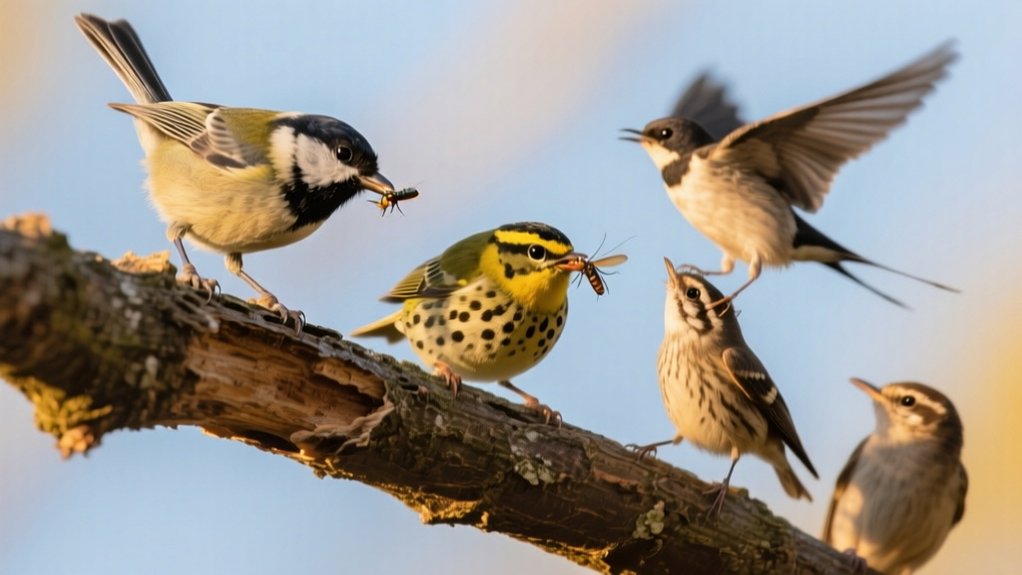
If you want to know which birds eat insects, many species excel at pest control. Barn Swallows and Common Swifts catch flying insects midair with exceptional agility.
Eastern Phoebes hunt wasps and dragonflies, adjusting their diet seasonally. Ground-foragers like American Robins and Pacific Wrens flip through leaf litter for invertebrates.
Cavity nesters like Downy Woodpeckers glean bark for larvae. Plunging into these birds reveals diverse foraging strategies and critical ecological roles you won’t want to miss.
Barn Swallow
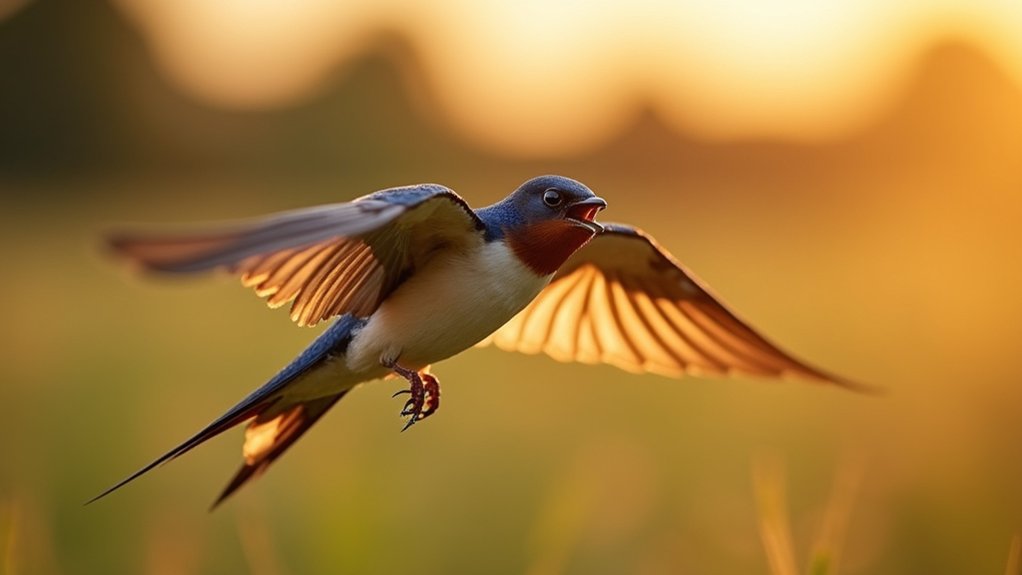
The barn swallow primarily feeds on a diverse array of flying insects, with flies making up the bulk of its diet throughout the year.
Flies dominate the barn swallow’s diet year-round among a variety of flying insects.
You’ll notice it captures food almost exclusively in flight, foraging low over water and fields, often skimming close to surfaces. It is a migratory species, wintering in southern Africa and South America.
It targets single large insects rather than swarms, including beetles, wasps, bees, ants, and true bugs.
Winged insects such as damselflies, moths, butterflies, stinkbugs, leafhoppers, and plant lice are common prey.
In cold weather, you’ll see barn swallows pluck sluggish or dead insects from the ground or barn walls.
They also follow farm implements and livestock to catch flushed insects.
Though primarily insectivorous, they occasionally consume small amounts of berries, seeds, grit, and calcium sources like eggshells.
Common Swift
Common swifts rely exclusively on aerial insects and spiders for sustenance, consuming over 300 species identified through extensive dietary surveys. You’ll find hoverflies as their most common prey, while they instinctively avoid stinging females like bees and wasps, targeting only stingless male drone bees. They tend to avoid larger insects such as bigger butterfly species, focusing instead on smaller, non-stinging prey.
Swift hunting occurs at speeds up to 25 mph, typically between 50 to 100 meters altitude, but they can reach 2,300 meters, accessing prey unavailable to most insectivores. Their diet includes dragonflies, flies, mosquitoes, and flying ants, especially during migration.
They never feed on land, lacking talons for gripping prey. Swifts store up to 1,000 insects in a saliva-bound bolus in their throat to feed nestlings, which require tens of thousands of insects daily.
Weather influences their foraging altitude and insect availability. They also drink on the wing by skimming water surfaces, mirroring their feeding behavior.
Eastern Phoebe
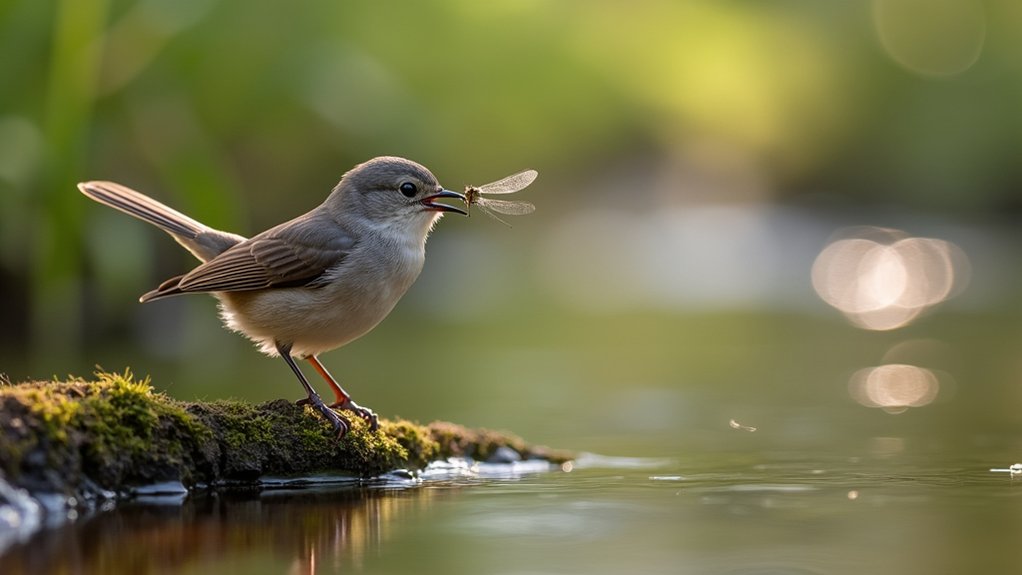
You’ll notice the Eastern Phoebe mainly catches flying insects like wasps, beetles, and dragonflies. It does this by aerial hawking and sallying from low perches—pretty neat, right? They often return to the same perches after catching insects, making them easier to observe. As the seasons change and insects become harder to find, it switches things up by adding seeds and small aquatic prey to its diet. One cool way to spot this bird is by watching its characteristic tail twitching, which shows it’s really focused on hunting.
Hunting Techniques
Eastern Phoebes employ a variety of precise hunting techniques to capture insects efficiently. You’ll notice they perch strategically on shrubs or trees, selecting vantage points near water during migrations, maintaining vigilance for extended periods. They are known for their gentle tail-wagging behavior that often helps birdwatchers identify them.
When an insect appears, they dart swiftly into the air, executing rapid, precise aerial maneuvers to snatch prey mid-flight, then promptly return to their original perch. This hawking behavior repeats multiple times throughout their foraging sessions.
Physically, their sharp vision and forceps-like bill, aided by bristly feathers near the mouth, optimize insect capture. Moreover, they employ alternative methods like gleaning insects from foliage or ground surfaces and briefly hovering near vegetation.
Throughout daylight hours, especially during breeding, they forage continuously, increasing catch attempts to meet their energetic demands. Their diet primarily consists of insects, including small wasps, bees, and beetles, with some berries consumed in winter to supplement nutrition.
Preferred Insect Diet
The preferred insect diet of the Eastern Phoebe centers on a diverse range of flying and terrestrial arthropods that provide essential nutrients, especially during breeding season.
You’ll find this bird consuming Hymenoptera such as small wasps, bees, and sawflies, which supply high protein vital for reproduction.
Flying insects dominate its diet, with flies, dragonflies, and midges regularly caught mid-air, often near wetlands.
Moths represent the largest Lepidoptera portion, captured efficiently during flight, while caterpillars are gleaned from foliage.
On the ground, beetles, grasshoppers, and true bugs form a significant part of the summer diet, with cicadas eaten seasonally.
Moreover, spiders and ticks supplement protein intake, and occasional millipedes are taken during ground foraging.
This insectivorous variety guarantees the Eastern Phoebe meets its nutritional demands year-round, and its feeding habits contribute significantly to pest control and pollination in its habitat.
Seasonal Feeding Patterns
Building on its diverse insect diet, the Eastern Phoebe adjusts feeding behaviors to match seasonal fluctuations in food availability. In spring, limited insect abundance challenges you to employ a brood-survivalist strategy, maximizing offspring survival despite resource scarcity. This species is diurnal, actively foraging during daylight hours to find sufficient prey.
You’ll note increasing egg mass and higher productivity in spring broods due to gradually improving food supply.
By summer, increased insect availability prompts a change to a brood reductionist strategy, with larger eggs but reduced brood productivity.
As fall approaches, you shift from primarily flying insects to incorporating small fruits, prepping for winter.
During winter, you rely on seeds, berries, and occasional mollusks or amphibians when insects vanish.
Your hunting efficiency peaks during breeding, exceeding 70 prey items per hour to meet chick nutritional demands, reflecting adaptive seasonal foraging patterns.
American Robin
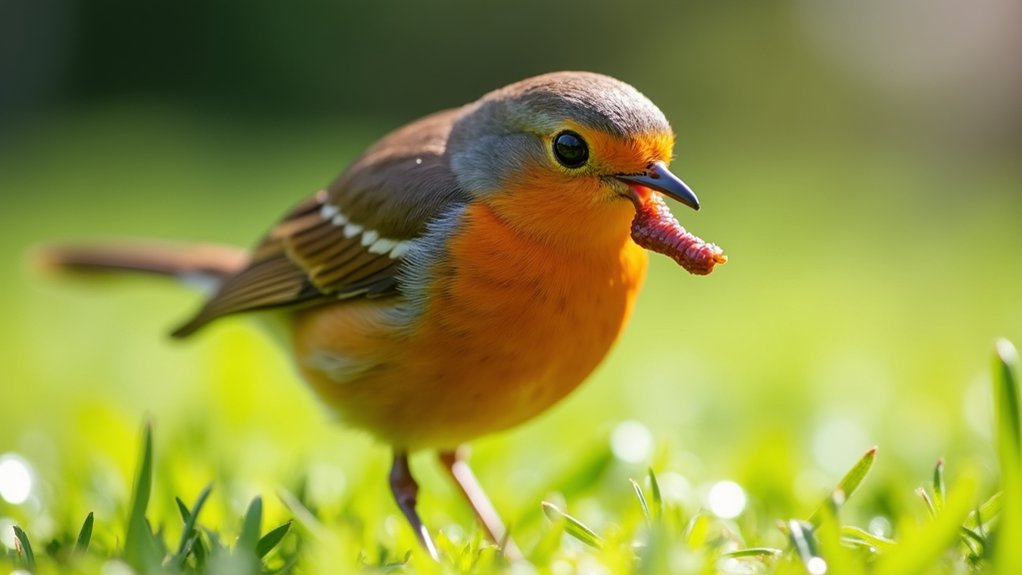
American Robins exhibit an omnivorous diet, primarily consuming insects and earthworms, which form the bulk of their intake during spring and summer. You’ll find them searching on the ground, running several steps, then pausing to visually locate earthworms by cocking their heads and using each eye independently. They are well-known for their upright stance while foraging.
Early mornings focus on earthworm consumption, while afternoons shift toward insects like snails and spiders. During winter, their diet changes; about 60% consists of fruit from juniper, holly, and sumac as insect availability declines. Like many birds, robins may show erratic behaviors when environmental changes affect their food sources.
Robins eat earthworms in the morning and insects in the afternoon, switching to fruits in winter.
Nestlings rely mainly on earthworms and soft invertebrates fed by both parents.
Robins search in flocks outside nesting periods and inhabit diverse habitats across North America. Their precise searching behavior and seasonal dietary shifts illustrate their adaptation to fluctuating food resources.
Pacific Wren
You’ll find that the Pacific Wren mainly eats small invertebrates like beetles, caterpillars, ants, and spiders.
It also includes a bit of plant matter in its diet during the nonbreeding season.
When it forages, it stays low in dense vegetation, carefully checking out leaves, bark, and decaying wood.
Its pointed beak helps it pick out prey from these spots.
This special diet and careful foraging habits help the Pacific Wren do well in forest ecosystems, where it plays a key role in keeping insect populations in check.
The bird’s habitat includes arroyos, canyons, forests, woodlands, high mountains, shrublands, savannas, and thickets, providing diverse areas for foraging.
Diet Composition
Although the Pacific Wren primarily consumes a protein-rich diet of various insects such as beetles, caterpillars, ants, flies, and native bees, it also incorporates secondary invertebrates like spiders, mites, ticks, and millipedes to meet its nutritional needs.
This diverse intake guarantees a balanced supply of essential proteins and fats necessary for sustaining its rapid metabolism and high energy demands. Wrens are known to be bold, noisy, and highly active birds, which contributes to their need for a nutrient-rich diet.
You’ll observe seasonal dietary shifts where, during colder months or insect scarcity, the wren supplements its diet with juniper berries, seeds, and other plant materials.
Its small body mass, typically 10-12 grams, requires a high volume of nutrient-dense prey.
The wren’s diet reflects adaptations to fluctuating insect availability and climatic conditions, allowing it to maintain consistent energy intake year-round through a combination of animal and opportunistic plant-derived nutrients.
Foraging Behavior
When foraging, the Pacific Wren selects coniferous forests, especially spruce and fir stands, as its primary habitat. It focuses on ground and near-ground vegetation to locate insects. You’ll notice it prefers dense thickets and low-growth areas, often near streams during salmon migrations when insect abundance peaks. It employs slow, deliberate hopping and uses direct picking, probing decaying bark, and gleaning from substrates to extract prey. Its short, swift flights between bushes produce a distinctive whirring sound, enabling efficient movement without sustained flight. The wren targets crevices, decaying wood, and upturned roots to find concealed arthropods. This methodical, low-to-ground strategy maximizes prey detection while conserving energy. It really shows a refined adaptation to its environment and insect prey availability. At night or during harsh weather, Pacific Wrens often roost in snug holes or old nests, sometimes gathering in parties for warmth.
Eastern Bluebird
Because the Eastern Bluebird relies heavily on insects during its breeding season, its diet and foraging behaviors reveal specialized adaptations for capturing ground-dwelling prey.
You’ll observe it perching 16 to 65 feet above ground on branches or fenceposts, scanning for insects like beetles, caterpillars, grasshoppers, and spiders.
It swoops down to seize prey, often consuming smaller insects immediately or bringing larger ones back to a perch to soften. While primarily a ground hunter, it occasionally catches flying insects during warm periods.
Outside breeding season, its diet shifts to fruits and berries, including dogwood and hawthorn.
Both parents feed insect-rich meals to nestlings, emphasizing protein needs. Young are fed by both parents and sometimes older siblings, ensuring high survival rates.
This precise hunting strategy and dietary shift reflect the Eastern Bluebird’s adaptation to seasonal resource availability.
White-crowned Sparrow
The White-crowned Sparrow displays a diverse diet that immerses seasonally, highlighting its adaptability in foraging strategies. You’ll notice it primarily consumes seeds from weeds and grasses in winter, shifting to a diet rich in caterpillars, wasps, beetles, and spiders during summer. This species employs ground hopping and scratching to uncover food, occasionally catching insects mid-air or hawking from perches. You’ll see it foraging in flocks outside the breeding season, when it adopts a more solitary approach. The sparrow supplements its diet with grains, fruits like elderberries, and seasonal vegetation such as buds and willow catkins. When raising young, parents feed mostly insects, ensuring protein-rich nourishment. Additionally, the White-crowned Sparrow’s winter flocks forage on ground near thickets and perch in bushes when approached, demonstrating their social behavior during colder months. Geographic variation influences fledging timing and song dialects, reflecting complex ecological adaptations within the species.
House Sparrow
A House Sparrow thrives on a varied diet dominated by seeds from cereals and weeds, supplemented considerably by insects such as beetles, caterpillars, dipteran flies, and aphids.
You’ll find that these birds exploit diverse foraging techniques to optimize insect intake. They:
- Capture insects mid-flight or pounce from perches.
- Follow lawnmowers to access exposed prey.
- Scavenge dead insects from surfaces like car radiators and spider webs.
During nesting, young sparrows rely heavily on insects, especially grasshoppers and crickets, for essential protein.
While their primary diet remains seeds year-round, insect consumption spikes in summer to meet offspring nutritional demands. House sparrows are also known to require grit for digestion, often selecting rough grains or shells to aid this process.
Urban populations adapt readily, consuming commercial birdseed and opportunistically feeding on human refuse.
This ecological flexibility supports their widespread distribution across Eurasia, northern Africa, and introduced regions like North America.
Black-capped Chickadee
Black-capped Chickadees adjust their diet sharply according to seasonal insect availability, consuming up to 90% animal matter, mainly caterpillars, during spring through fall.
You’ll notice them gleaning bark and leaves, targeting eggs, larvae, and pupae of caterpillars, beetles, moths, and spiders. About 58% of their prey comes from bark.
During winter, their diet shifts to roughly 50% animal matter, supplemented by cached seeds and berries to survive insect scarcity.
They forage primarily in trees and seldom on the ground. Plus, they cache food in crevices for later use.
In breeding season, both parents intensively feed nestlings high-protein insects for over two weeks. The female also selects and excavates the nesting cavity, where a cup-shaped nest lined with soft materials like rabbit fur is built. Nest excavation
At feeders, chickadees prefer black oil sunflower seeds and high-energy items but mainly rely on natural prey for 80% of their energy needs.
Tufted Titmouse
Distinctive gray crests and rust-colored flanks identify the Tufted Titmouse, a small perching bird found throughout eastern United States woodlands and backyards.
You’ll notice it foraging actively among branches, often hanging upside down to find its insect prey.
Insects make up about two-thirds of its diet yearly, especially caterpillars in summer.
Besides insects, it also includes spiders and snails in its diet, supplementing with seeds and nuts in colder months.
Here’s what makes the Tufted Titmouse fascinating:
- It holds seeds with its feet and cracks them using its sharp bill.
- It caches food in fall and winter to survive lean times.
- It participates in mixed-species flocks, aiding insect population control.
- Tufted Titmice often nest in tree cavities or old woodpecker holes, sometimes using nest boxes for breeding. Nest sites
You’ll find this bird both in forests and your backyard feeders.
Yellow Warbler
When you watch the Yellow Warbler, you’ll see it using gleaning and brief hovering to catch insects from leaves and twigs. It mainly goes after caterpillars, midges, and beetles.
In the summer, their diet is almost entirely insect-based because they’ve high metabolic needs to meet. But come fall and winter, they start adding berries and fruits to their meals since insects become less available.
These changes in diet make sense because their habitat and food sources shift throughout the year across where they live. Unlike many other warblers, Yellow-rumped Warblers are commonly found in backyards, making them easier to observe during migration and winter.
Insect Hunting Techniques
Yellow Warblers employ at least four primary insect hunting techniques: gleaning, hawking, fly-catching, and hover gleaning. Each is adapted to capture prey in different contexts.
You’ll notice they systematically scan vegetation, often perched, to glean insects from leaves and branches. They also execute short flights called hawking to catch airborne prey before returning to their perch.
Fly-catching involves active aerial foraging, intercepting insects mid-flight with agile maneuvers. Hover gleaning lets them remain suspended near foliage, accessing prey unreachable from perches. Observations reveal that Yellow Warblers can catch tiny, energy-intensive prey such as aphids, which they carefully extract from leaf clusters using their specialized feeding methods insect feeding behavior.
Key techniques include:
- Gleaning: Stationary examination of plant surfaces for insects.
- Hawking: Rapid flights from a perch to snatch flying insects.
- Hover Gleaning: Mid-air hovering to pick prey from raised foliage.
These methods reflect the warblers’ dynamic foraging strategy and energy-efficient prey capture.
Preferred Insect Types
Although insect availability varies seasonally, warblers rely heavily on a specific set of prey to meet their nutritional needs.
You’ll find that caterpillars form their primary insect staple due to their high protein and fat content, essential for energy and metabolism.
Beetles and midges also feature prominently, providing dietary variety. Leafhoppers and wasps serve as opportunistic targets, expanding nutrient diversity.
Warblers primarily forage in tree canopies, gleaning leaf-clinging and branch-dwelling insects, using hovering and short flight techniques.
They prefer small-bodied, soft-exoskeleton prey for efficient capture. Foraging typically occurs along slender branches of shrubs and small trees.
This focus on diverse, nutrient-rich insects guarantees diet stability, especially during breeding periods when energy demands increase.
Understanding these preferences reveals how Yellow Warblers optimize foraging to meet precise nutritional needs in their habitat.
Seasonal Diet Changes
The diet of warblers shifts considerably throughout the year to align with changing energy demands and resource availability.
During spring and summer, you’ll see them focus on caterpillars, beetles, flies, and scale insects, primarily in the canopy. This helps meet the protein needs for breeding and chick-rearing. Yellow-rumped Warblers, for example, often dart out from perches to catch insects, showcasing their agile feeding behavior in these seasons feeding behavior.
As fall approaches, they change to consuming more wild berries, increasing fat reserves for migration.
In winter, their diet becomes almost exclusively berry-based. They rely on wax myrtle, juniper, bayberry, and poison ivy fruits to sustain energy when insects are scarce.
- Spring/Summer: Insect-rich, protein-focused for reproductive success
- Fall: Mixed diet with increasing berry intake for fat accumulation
- Winter: Fruit-dominant diet supporting energy needs in cold conditions
This precise seasonal flexibility maintains a constant protein intake despite macro-nutrient shifts.
Blue Tit
Blue Tits exhibit a highly varied diet that shifts with seasonal demands, relying chiefly on insects and spiders during their breeding season to meet nutritional needs for chick development. You’ll find them consuming up to 100 caterpillars per chick daily, supplemented by fruits, seeds, and nectar outside breeding months. Their acrobatic feeding involves hanging upside down to probe buds and peel bark on outer branches. Their distinctive acrobatic feeding habits showcase their agility and adaptability in foraging. Many backyard enthusiasts can attract Blue Tits by providing high-quality seeds in feeders, especially after the breeding season when their diet becomes more seed-based.
| Food Type | Seasonal Importance |
|---|---|
| Insects & Spiders | Primary during breeding |
| Caterpillars | High consumption |
| Seeds | Post-breeding |
| Fruits & Nectar | Supplemental |
| Pollen & Nuts | Occasional |
This dietary flexibility supports their survival across deciduous woodlands and gardens, ensuring ideal nutrition year-round.
Rose-breasted Grosbeak
You’ll notice that the Rose-breasted Grosbeak’s diet is made up of more than half invertebrates, like beetles, caterpillars, and spiders.
These provide essential protein, especially during breeding season.
When it comes to foraging, they’ve a few tricks up their sleeve—they glean insects from leaves, hover near bark, and even hawk in mid-air.
This shows just how versatile their hunting strategies are.
Understanding these feeding habits really helps us see how this species adapts to seasonal changes in prey availability.
They typically forage in shrubs and trees, making use of various forest and woodland habitats to find their food.
Diet and Prey
More than half of a Rose-breasted Grosbeak’s diet during the breeding season consists of insects, making them an essential protein source, especially for growing chicks.
You’ll find their insect intake includes a wide variety, ensuring balanced nutrition. Here’s what they primarily consume:
- Beetles, including the Colorado potato beetle, along with sawflies, ants, butterflies, moths, and bees.
- Caterpillars, grasshoppers, true bugs, spiders, and even snails, providing diverse invertebrate prey.
- A seasonal shift toward fruits and seeds occurs outside breeding, but insects remain critical during chick development.
You can appreciate how this insect-rich diet supports their reproductive success and overall health, emphasizing their role as natural pest controllers in their ecosystems. Rose-breasted Grosbeaks also forage both in forest canopies and on the ground, which allows them to access a wide range of insect prey in their preferred mixed woodlands.
Foraging Habits
Although the Rose-breasted Grosbeak forages primarily in the forest canopy, it adapts its search to dense foliage and branches within shrubs and trees. You’ll observe it systematically gleaning insects among timber and shrubs, using hovering maneuvers to snatch prey from foliage or bark. It also hawks mid-air, capturing flying insects with precision. Typically, it remains above ground level, avoiding the forest floor when alternatives exist. During breeding season, it intensifies insect consumption, while in fall migration, it shifts toward berries and nectar, demonstrating seasonal dietary adaptation. Its strong beak structure supports seed cracking, complementing insectivory. This species maintains foraging efficiency across varied habitats, including forest openings, river edges, and overgrown fields, showing remarkable versatility in both vertical and horizontal feeding strategies. The Rose-breasted Grosbeak is also noted for its presence in mixed forests, where it nests and forages effectively.
Northern Cardinal
The Northern Cardinal exhibits a mainly granivorous diet supplemented by a diverse array of insects, especially during the nesting period when nestlings require high-protein nourishment.
You’ll find it feeding mostly on seeds and fruits like dogwood, mulberry, and black oil sunflower seeds. But insects such as beetles, crickets, and leafhoppers become vital protein sources for young birds. Feeders stocked with sunflower seeds may aid their northward spread.
Here’s what makes their insect diet remarkable:
- Nestlings receive mainly insect-based meals to guarantee proper growth.
- Adults forage chiefly on the ground, covering 77% of their feeding time there.
- Seasonal diet shifts reduce insect consumption to about 25% in winter, increasing in summer.
Understanding these behaviors helps you appreciate how Northern Cardinals balance their nutritional needs across seasons.
Eastern Wood-Pewee
While Northern Cardinals rely heavily on seeds, they also turn to insects to meet protein demands, especially during nesting.
The Eastern Wood-Pewee (Contopus virens), a small tyrant flycatcher about 6 inches long, specializes in hawking insects.
You’ll find it perching on dead branches around 11 meters high, then swooping down to catch flies, beetles, wasps, and caterpillars midair. It averages 36 sallies per hour, increasing to 68 when feeding young.
Besides flying prey, it gleans spiders and insects from foliage and bark. Its olive-brown plumage and distinct “pee-a-wee” call help you identify it. The species breeds across southern Canada and the eastern United States, favoring mature mixed-wood forests.
Both parents share feeding duties, provisioning nestlings with regurgitated insects until fledging.
This species also consumes small amounts of berries and seeds, supplementing its mainly insectivorous diet.
Wood Thrush
Wood Thrushes balance their diet between insects and fruits, adapting intake based on seasonal availability and nutritional needs.
You’ll notice they forage primarily on the forest floor, flipping leaf litter with their bills to uncover soil invertebrates like beetles, caterpillars, and spiders. They are known for their distinctive ground foraging behavior, which helps distinguish them from other thrushes.
During spring and summer, insects make up 65-95% of their diet, providing essential protein for breeding.
As fall approaches, their diet shifts to lipid-rich fruits such as spicebush and elderberry, accounting for 77% of intake to fuel migration.
- Ground foraging targets leaf-litter invertebrates, not aerial prey.
- Seasonal diet shifts prioritize protein in breeding and lipids pre-migration.
- Key fruit sources include black cherry, dogwood, and pokeweed.
This precise strategy optimizes their nutritional requirements year-round.
Common Nighthawk
Although you might spot Common Nighthawks most often at dawn and dusk, they actively hunt insects throughout day and night by flying at altitudes up to 175 meters.
They use their wide, gaping mouths to scoop airborne prey. Their diet primarily includes beetles and hymenopterans such as wasps, ants, and bees, while they significantly avoid flies despite their abundance.
With long wings and a cavernous mouth, they maneuver adeptly through the air. They rely on improved night vision from their tapetum lucidum to detect prey in low light. Males create a loud booming noise during breeding by manipulating air through primary feathers, which is a unique behavior among aerial insectivores.
Common Nighthawks forage in open spaces, often circling as they descend, taking advantage of insects drawn to artificial lights. Their nests vary widely, from bare ground to rooftops.
Both parents feed insect prey to their young. Populations are declining, highlighting the need for conservation efforts.
Purple Martin
Purple Martins exhibit exceptional aerial foraging skills, capturing nearly all their food mid-flight. As North America’s largest swallow, you’ll notice they hunt at altitudes surpassing 150 feet, sometimes exceeding 500 feet, feeding on nearly 100% flying insects.
Here’s what you should know about their diet and behavior:
- They consume diverse insects: wasps (23%), flies (16%), beetles (12%), and various bugs, totaling over 41,000 insects yearly.
- Despite their aerial prowess, they occasionally land to pick ants or mealworms but primarily feed during daylight in pairs. They also drink mid-air by skimming water with their beaks, which is essential for hydration during flight drinks mid-air.
- Weather heavily influences their foraging success, as they rely exclusively on aerial insects and ingest small gravel to aid digestion.
Understanding these details highlights the Purple Martin’s precision and adaptability in insect predation.
Tree Swallow
You’ll notice that tree swallows are really good at catching insects while flying—they dart and weave through the air with impressive agility. They mainly hunt in places where insects are plentiful. During the summer, they eat mostly flying insects, but as it gets colder, they start adding berries and seeds to their diet. It’s pretty interesting how their feeding habits change with the seasons, showing how adaptable they’re to different environments. Tree swallows often forage low over water or fields, picking insects from the water surface while in flight.
Aerial Insect Hunting
When you observe Tree Swallows hunting, you’ll notice they employ a hawking method, capturing insects during continuous mid-air flight through acrobatic twists and turns.
These birds utilize their long wings and sleek bodies to execute rapid, energy-intensive maneuvers both high above and low over meadows.
They often form large aggregations, sometimes tornado-like, at dawn and dusk, increasing hunting efficiency.
Key features include:
- Diverse prey: dragonflies, flies, bees, moths, and even spiders and mollusks.
- Foraging altitude: typically less than 40 feet, near water bodies and marshes.
- Flight endurance: sustained gliding and rapid aerial turns enable continuous insect capture throughout daylight hours.
This precise aerial hunting strategy allows Tree Swallows to capitalize on concentrated insect swarms effectively while facing ecological challenges from declining insect populations. Additionally, their unique eye anatomy enhances visual acuity, improving their ability to catch prey in flight enhanced visual acuity.
Seasonal Diet Variations
Although Tree Swallows primarily consume insects, their diet shifts seasonally to meet changing nutritional demands and environmental conditions.
In early spring, when insects are scarce, you’ll notice them supplementing with berries, like bayberry. This aids survival during cold snaps and supports breeding. Many other oviparous animals also adapt their diet in response to seasonal changes and food availability.
As temperatures rise in summer, their diet shifts dramatically to flying insects. Flies alone make up 40% of adults’ intake, with beetles and other orders filling significant portions. Nestlings receive a protein-rich bolus dominated by Diptera and Hymenoptera, reflecting their preference for flying insects.
Nestlings receive a protein-rich bolus dominated by Diptera and Hymenoptera.
Proximity to wetlands influences reliance on aquatic-emergent insects, which can constitute up to 75% of their diet.
During fall, diminished insect availability drives a return to plant matter, increasing berry and seed consumption to build fat reserves for migration.
This dietary adaptability guarantees survival across diverse habitats and seasons.
Red-eyed Vireo
Because the Red-eyed Vireo relies heavily on insects during its breeding season, understanding its diet reveals key adaptations for insect capture and foraging behavior.
You’ll notice it primarily consumes caterpillars, which make up about 50% of its summer diet, alongside beetles, wasps, and spiders.
Its foraging strategy involves gleaning insects from leaf surfaces and hovering briefly to snatch prey in the tree canopy. This bird is one of the most numerous summer birds in eastern woods, making its feeding habits ecologically significant summer bird.
The vireo’s short, stout, slightly hooked beak efficiently grasps and manipulates small invertebrates.
Key points to evaluate include:
- Dietary shifts: high insect intake in spring and summer, increasing fruit consumption in fall and winter.
- Foraging techniques: methodical hopping and hovering within upper foliage.
- Morphological adaptations: specialized beak and cryptic plumage for efficient insect capture and camouflage.
This precise combination supports its insectivorous lifestyle effectively.
Black-and-white Warbler
While primarily insectivorous, the Black-and-white Warbler specializes in foraging on tree bark, targeting moth and butterfly larvae as its main prey during spring migration and breeding seasons.
You’ll observe it creeping methodically along trunks and thick limbs, probing bark fibers with its forceps-like bill to extract caterpillars, pupae, wood-boring beetles, ants, and spiders. Its nest is a round, open cup-shaped structure made from dry leaves, bark strips, grass, and pine needles, lined with moss and horsehair for insulation.
Unlike other warblers, it forages vertically, horizontally, and diagonally, resembling nuthatches or creepers. It supplements its diet by capturing insects attracted to sapwells made by Yellow-bellied Sapsuckers.
This species inhabits diverse forests and tropical overwintering habitats, arriving early at breeding grounds due to its bark-gleaning specialization. The clutch size typically ranges from 4-6 eggs, with incubation lasting 10-12 days.
Gray Catbird
You’ll find that the Gray Catbird’s diet mainly includes ants, beetles, caterpillars, and moths.
But come fall and winter, it tends to shift more toward eating fruit.
When it’s foraging, this bird is pretty methodical—it flips over dead leaves and pokes around dense vegetation with its bill to uncover hidden insects.
It really prefers habitats filled with thick shrubs and young trees, which makes it easier to find its insect prey.
The Gray Catbird is known to prefer fruits like dogwood and holly during non-breeding seasons.
Diet Composition
When examining the Gray Catbird’s diet composition, you’ll find that insects form the cornerstone of its nutritional intake, especially during the breeding season. Ants serve as the primary protein source, supplemented by beetles, grasshoppers, midges, and caterpillars. This varied insect diet guarantees adequate protein for reproduction and fledgling development.
Moreover, the Gray Catbird incorporates a wide range of arthropods, including true bugs, spiders, and aphids, enhancing dietary diversity. Similar to findings on bluebirds in vineyards, many birds consume significant quantities of herbivorous insects, which can help reduce pest populations in agricultural systems herbivorous insect control.
Key insect components include:
- Ants and beetles dominating early and peak summer stages
- Caterpillars and moths providing supplementary protein
- Herbivorous pests like leafhoppers and gypsy moth larvae aiding pest control
This omnivorous balance shifts seasonally, with insects prevailing in spring and summer before fruit intake rises.
Foraging Behavior
Although the Gray Catbird primarily forages close to the ground within dense vegetation, it skillfully uses its bill to flick aside leaves and twigs to uncover hidden insects. You’ll notice it often flips dead leaves during short-distance flights between perches, staying mostly within dense shrub centers. This behavior aligns with its preference for thickets of shrubs and vines, which provide essential cover and foraging opportunities.
While ground-level foraging is its main method for insect capture, targeting beetles, ants, caterpillars, and spiders, it also accesses treetop zones for berries.
Seasonal shifts influence its behavior; in early summer, it focuses on insects, employing precise bill manipulation to extract prey like gypsy moth larvae during infestations.
During breeding, pairs aggressively defend foraging territories, intensifying ground and low-canopy feeding to nourish nestlings.
This combination of vertical and horizontal foraging strategies guarantees efficient exploitation of available insect prey throughout the year.
Habitat Preferences
Understanding where Gray Catbirds choose to forage helps clarify their broader habitat preferences. These birds depend on dense, low-growth shrubby vegetation, favoring thickets of poplar, dogwood, wild rose, and willow. They avoid coniferous woodlands, preferring semi-open areas with dense, low vegetation both in breeding and wintering grounds. Gray Catbirds are also known for their distinctive nasal, cat-like mew call, which can often be heard in these dense habitats.
Key habitat features include:
- Woodland edges, shrubby swamps, and overgrown fields providing dense cover and nesting sites.
- Human-modified areas like suburban forests, gardens with thick shrubbery, and abandoned farmland.
- Seasonal shifts favoring berry-rich thickets near water in winter, with nesting typically 3–15 feet above ground in shrubs or small trees.
You’ll find Gray Catbirds primarily in habitats offering dense undergrowth, essential for feeding, nesting, and protection year-round.
House Wren
Because the House Wren relies on a diet composed almost entirely of insects, you’ll find it actively foraging at multiple levels, from the ground to low branches.
It uses a gleaning technique to pluck beetles, spiders, caterpillars, and other arthropods from various surfaces. You’ll observe it flipping leaf litter and probing bark crevices to capture beetles, true bugs, grasshoppers, crickets, moths, flies, spiders, millipedes, snails, earwigs, and daddy longlegs.
Its sharp beak enables it to grab, spear, and mash prey efficiently. While insects constitute about 95% of its diet, you might also see it consuming berries, fruit pulp, and seeds in fall when insects are scarce. The House Wren is known for its very active foraging behavior, always searching for insects in a variety of microhabitats active foraging behavior.
Parents feed their nestlings mashed insects, ensuring a high-protein intake essential for rapid chick development.
Downy Woodpecker
The Downy Woodpecker, North America’s smallest woodpecker species, inhabits eastern regions extensively while steering clear of arid southwestern areas. You’ll encounter it commonly in towns, parks, and suburban areas, where it frequents backyard feeders year-round.
Its black-and-white plumage and tiny size, just larger than a White-breasted Nuthatch, make identification straightforward. As a member of the perching bird group, it shares the anisodactyl toe arrangement that allows for secure gripping on tree trunks and branches.
Consider these key aspects of its insectivorous habits: It consumes over 75% invertebrates, targeting bark beetles, ants, caterpillars, and agricultural pests.
Foraging involves probing, tapping, and excavating wood and bark to extract larvae inaccessible to larger woodpeckers. Seasonal shifts occur from surface gleaning in summer to larvae extraction from dead wood in winter. It also joins mixed flocks of chickadees and nuthatches in winter, which aids in finding food and avoiding predators mixed flocks in winter.
Understanding these behaviors highlights the Downy Woodpecker’s ecological role controlling insect populations year-round.
Brown Creeper
A Brown Creeper spirals upward along tree trunks in a distinctive zigzag pattern, starting at the base and working systematically toward the top. You’ll notice it hops with both feet simultaneously, causing its head to bob rhythmically.
It never descends but flies to the bottom of another tree to repeat this methodical foraging. Its slender, downcurved bill probes bark crevices, extracting insects and larvae like beetles, bark beetles, and moths, as well as spiders and aphids.
Brown Creepers prefer mature conifer stands with deeply furrowed bark, which harbor abundant prey. In winter, they supplement their diet with seeds and suet. They often nest in hidden bark crevices, making their nests difficult to find.
Their long, stiff tail and curved claws provide climbing support, while camouflaged plumage aids concealment. These adaptations optimize their insectivorous feeding in complex arboreal habitats.
Frequently Asked Question
How Do Insectivorous Birds Impact Agricultural Pest Control Economically?
You benefit economically from insectivorous birds because they greatly reduce pest populations, lowering crop damage and boosting yields.
Their predation cuts pest abundance by 33-80%, depending on species and crops, which translates into fewer losses and higher profits.
By supporting bird habitats, you improve natural pest control, reducing reliance on chemicals and associated costs.
This biological service sustains pest populations below economic thresholds, ensuring more stable and profitable agricultural production.
What Adaptations Help Birds Catch Insects During Different Seasons?
You’ll notice birds adapt their jaw and beak structures seasonally to optimize insect capture.
In warmer months, flexible mandibles and wide mouths help catch abundant flying insects mid-air.
When insects dwindle in colder seasons, birds shift diets, relying less on insect prey and more on seeds or fruits.
Their acute vision and specialized bristles aid in precise hunting.
Geographic and seasonal changes drive their behavioral strategies, ensuring survival year-round.
Which Bird Species Refuse to Eat Spiders and Why?
You might spot a blue jay hopping nearby yet skipping a spider dangling in its web.
Curiously, no bird species strictly refuse spiders; instead, they avoid large or toxic ones, like tarantulas, due to size or potential harm.
This avoidance isn’t about preference but survival.
Birds assess spider size, venom, and energy return before eating.
How Do Bird Diets Shift With Insect Availability and Nesting Cycles?
You’ll notice birds shift diets seasonally; during nesting, they rely heavily on protein-rich insects, especially caterpillars, to nourish their growing young.
When insects become scarce in winter, non-migratory species switch to berries and seeds.
Migratory birds relocate to areas abundant in insects for breeding.
Their foraging strategies also adapt. Some catch prey mid-flight, others peck in trees or on the ground, ensuring they meet the nutritional demands of each nesting cycle.
What Ecological Roles Do Insect-Eating Birds Play in Urban Environments?
You mightn’t realize it, but insect-eating birds are essential urban ecosystem engineers.
They naturally regulate pest populations, preventing outbreaks that could devastate plants and spread diseases.
By preying on harmful insects, they reduce the need for chemicals, promoting healthier environments.
Their role extends to supporting breeding success by maintaining insect availability, which sustains urban biodiversity and ecological balance.
Without them, urban ecosystems would face severe instability.
Conclusion
You might think these birds are just fluttering nuisances, but they’re actually nature’s tiny exterminators, tirelessly snatching insects you’d rather avoid. From the Barn Swallow’s acrobatics to the Downy Woodpecker’s precise pecking, each species plays a critical role in controlling pest populations.
So next time you see a Gray Catbird or a Pacific Wren, remember they’re not just birds. They’re the ecosystem’s frontline defense against insects, armed with beaks sharper than you’d ever expect.