
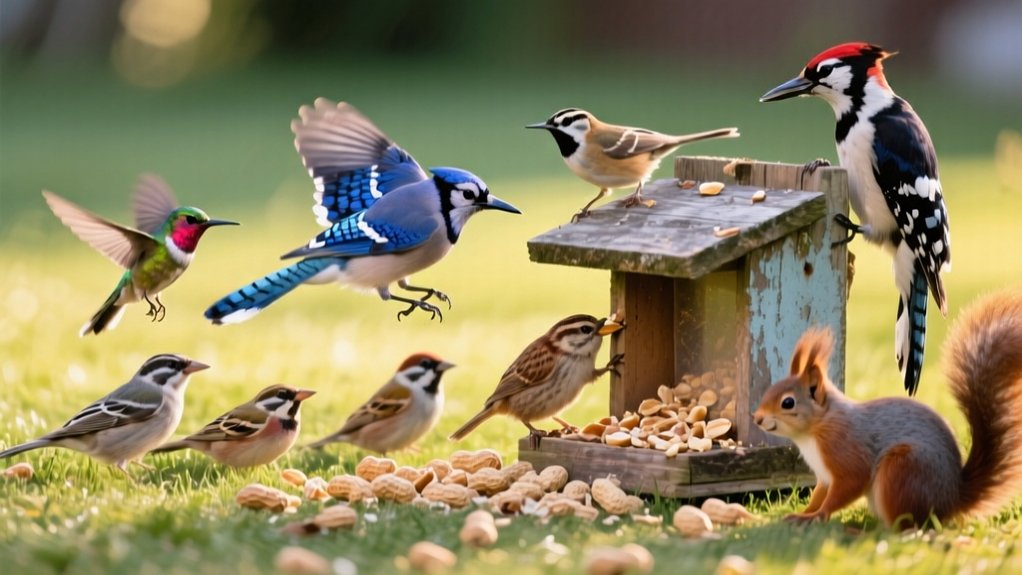
You’ll see diverse backyard birds eating nuts like peanuts and acorns if you offer them at feeders. Blue Jays and Acorn Woodpeckers store nuts, using their strong bills and social behaviors to cache food.
Black-capped Chickadees, Tufted Titmice, and Dark-eyed Juncos rely on nuts for high energy, especially in cold months. American Robins, Common Grackles, and Eastern Towhees forage nuts alongside insects.
Steller’s Jays show dietary flexibility. Investigate their unique habits and how they interact with your feeders.
American Robin
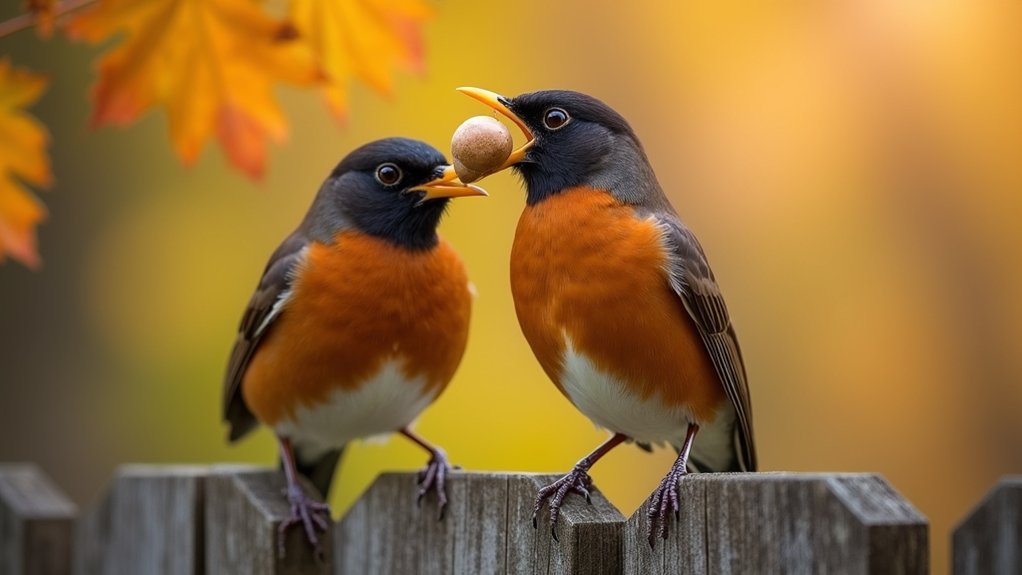
The American Robin (Turdus migratorius) measures between 7.9 and 11.0 inches long and weighs about 2.7 to 3.0 ounces, with a wingspan spanning 12.2 to 15.8 inches.
American Robins range from 7.9 to 11 inches long, weighing 2.7 to 3 ounces, with a wingspan up to 15.8 inches.
As a common backyard bird throughout the U.S., you’ll notice the American Robin exploring mainly on the ground, especially in spring and summer.
While its diet primarily consists of insects and fruits, you can also attract these birds by offering peanuts during backyard bird feeding.
They readily feed on nuts such as peanut kernels, which provide a valuable energy source.
Observing the American Robin enjoying peanuts at your feeder offers insight into their adaptable feeding habits, highlighting their role in backyard ecosystems and the diversity of birds that benefit from supplemental feeding.
When providing nuts for birds like American Robins, it’s important to select raw, unsalted varieties to ensure their health and safety.
Acorn Woodpecker
Although you might spot various woodpecker species in your backyard, the Acorn Woodpecker (Melanerpes formicivorus) stands out with its striking black and white plumage and vivid red cap. This bird measures 7.5 to 9.1 inches long and features a wingspan of 13.8 to 16.9 inches.
You’ll notice its social behavior, often living in family groups or colonies in oak woodlands. Acorn Woodpeckers primarily eat nuts, especially acorns, which make up about half their diet, along with Brazil nuts and walnuts.
They’re famous for creating “granaries” by storing acorns in tree trunks. Here are three intriguing facts about them:
- They weigh between 2.3 to 3.2 ounces.
- Their acorn storage supports survival during scarce periods.
- Their social groups cooperate in collecting and guarding nuts.
Just like other social birds, Acorn Woodpeckers thrive in cooperative groups and display strong social bonds that influence their feeding and nesting behaviors.
This unique behavior makes the Acorn Woodpecker a fascinating subject for nut-eating backyard bird enthusiasts.
Dark-eyed Juncos
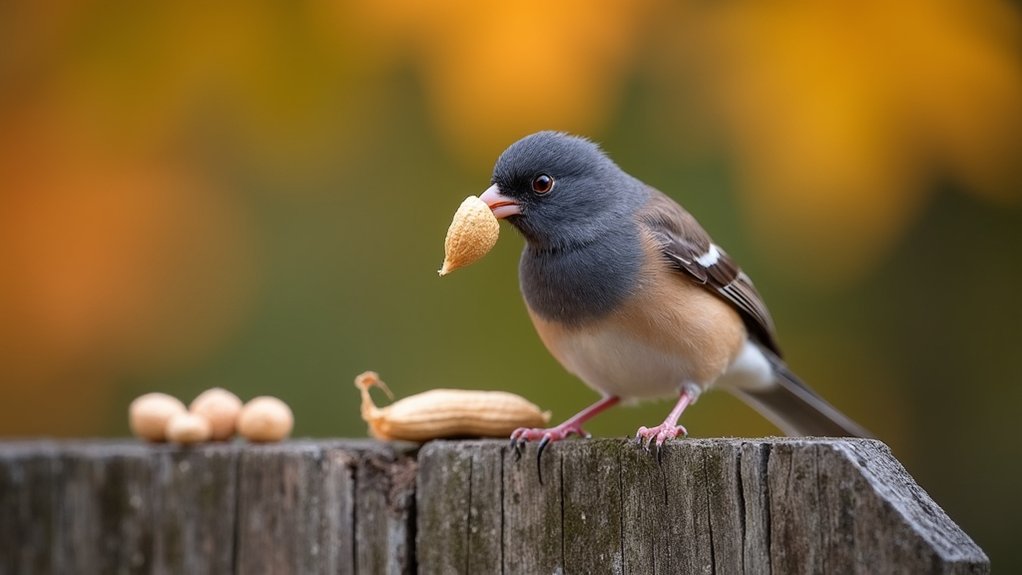
You’ll notice Dark-eyed Juncos prefer foraging on the ground. They often pick through fallen leaves to find seeds and insects.
Plus, they readily accept shelled and crushed peanuts at backyard feeders, which adds some nice variety to their diet.
Watching their flocks in winter can really enrich your birdwatching experience, and it helps support their nutritional needs too.
Diet Preferences
When winter limits natural food availability, Dark-eyed Juncos turn to high-energy options like shelled and crushed peanuts to sustain themselves.
These birds exhibit specific diet preferences that help them endure harsher conditions. You’ll notice their feeding choices focus on:
- Peanuts and other nuts, which provide essential fats and calories.
- Various seeds, offering carbohydrates and nutrients.
- Insects, supplying proteins essential for muscle maintenance.
Dark-eyed Juncos adapt their diet based on seasonal availability, favoring peanuts during colder months to meet energy demands.
Their small size and agility allow them to efficiently forage on the ground and at backyard feeders.
Understanding these diet preferences is important if you want to attract and support Dark-eyed Juncos in your yard, especially through winter’s scarcity.
Offering high-quality seeds alongside peanuts can help meet the nutritional needs of Dark-eyed Juncos and attract a greater variety of birds to your feeder.
Feeding Habits
Dark-eyed Juncos display distinct feeding habits that align closely with their dietary preferences. You’ll notice these small songbirds, measuring 5.5 to 6.3 inches, frequently visit bird feeders, especially when peanuts are available.
Their feeding behavior often involves foraging on the ground, where they pick up shelled or crushed nuts with agility. Feeding birds like Dark-eyed Juncos rely on peanuts during winter, benefiting from the high energy and nutritional content.
They adapt by forming flocks, which improves their ability to locate and share food sources at feeders. When you offer nuts at your feeder, you provide an important resource that supports their survival and energy needs in colder months.
This highlights their specialized feeding habits within your backyard ecosystem. Similar to how cattle egrets provide pest control for livestock, Dark-eyed Juncos contribute to the balance and health of your backyard environment by consuming seeds and nuts.
Backyard Attraction
Several small songbird species, including juncos measuring 5.5 to 6.3 inches, frequently visit suburban backyards, especially when high-fat foods like peanuts are offered.
Dark-eyed Juncos, recognizable by their dark heads and white tail feathers, find backyard feeders stocked with shelled nuts particularly attractive.
If you want to improve your backyard birdwatching experience, consider these factors:
- Provide crushed or shelled peanuts to supply essential fats and energy.
- Place feeders near ground cover, as juncos forage primarily on the ground.
- Maintain feeders during winter months when juncos form flocks and food is scarce.
Offering a variety of foods, such as nutritious vegetables, can also attract a wider range of backyard birds while supporting their overall health.
Blue Jays
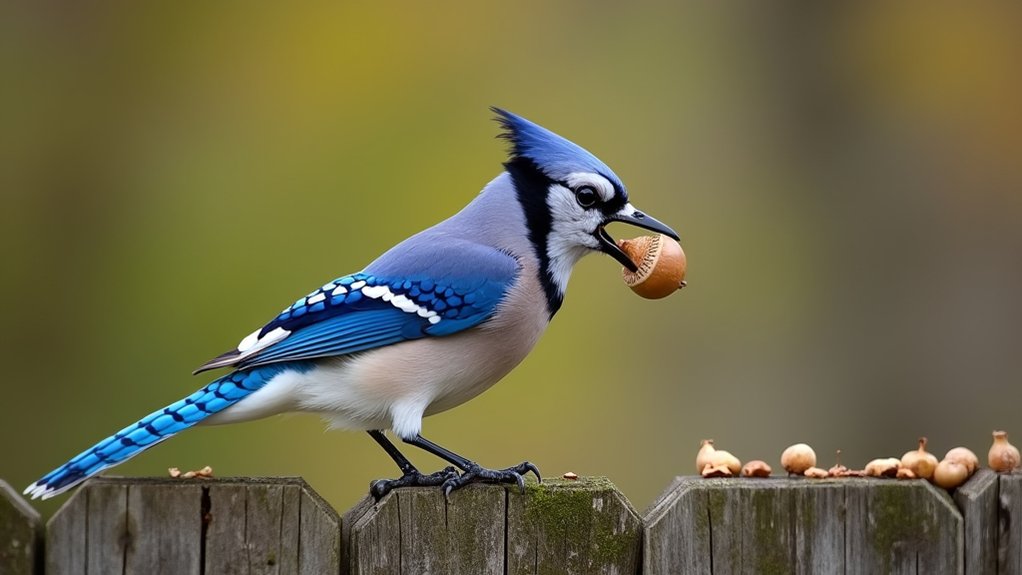
Because Blue Jays measure between 9.8 and 11.8 inches and weigh around 2.5 to 3.5 ounces, you can easily observe their striking blue plumage and distinctive calls in your backyard.
These North American birds are adept at spotting peanuts from a distance, often choosing to eat peanuts still in the shell.
You’ll notice their behavior of caching, where they store whole nuts, especially peanuts and acorns, to consume during scarce periods. This caching habit is a strategic adaptation that supports their survival through seasonal changes.
When feeding, Blue Jays use their strong bills to crack open nuts, showcasing their specialized foraging skills.
Observing these birds provides insight into their ecological role as both consumers and dispersers of nuts, integral to their woodland habitats and your backyard ecosystem.
To help keep your bird seed attractive to Blue Jays and other wildlife, consider using airtight containers to prevent bug infestations and preserve seed quality.
Black-capped Chickadee
While Blue Jays impress with their size and bold blue feathers, the Black-capped Chickadee offers a smaller, yet comparably fascinating presence in your backyard. This tiny bird, measuring 4-6 inches with a 6-8 inch wingspan, weighs only 0.5 to 0.7 ounces and features a distinctive black cap and bib.
You’ll often spot them at bird feeders, especially when peanuts are available.
Here’s what makes the black-capped chickadee unique:
- They prefer high-fat foods like peanuts, essential for energy, especially in colder months.
- Their clever behavior includes caching nuts and seeds, storing food for later use.
- They adapt well to diverse habitats, frequently visiting your backyard year-round.
Observing these behaviors offers insight into their survival strategies and nutritional needs. If you’d like to supplement their diet, always offer raw, unsalted almonds broken into small pieces, as these are safest for chickadees and other small wild birds.
Carolina Wren
The Carolina Wren, Sylvia ludoviciana, captures attention in your backyard with its warm brown plumage and distinctive loud song. Measuring 4.7–5.5 inches long and weighing 0.6–0.8 ounces, this small bird sports a wingspan of about 11–12 inches and a long, curved tail.
While primarily insectivorous, the Carolina Wren supplements its diet with nuts, especially peanuts, during colder months. You’ll often see these bold, curious birds visiting peanut feeders in your backyard, foraging energetically.
Their adaptability to human environments makes them common backyard visitors. Observing their feeding habits reveals their reliance on nuts as a crucial energy source in winter, highlighting their role in the backyard ecosystem.
The Carolina Wren’s presence enriches your backyard bird diversity and offers fascinating behavioral insights. When attracting wrens and other birds, it’s important to consider bird-safe essential oils if using aromatherapy or scented products around your feeders, since birds have sensitive respiratory systems that can be affected by strong scents.
Tufted Titmouse
You’ll notice the Tufted Titmouse really likes high-fat nuts like sunflower seeds and peanuts. It uses its strong beak to crack them open with ease.
And here’s something interesting—watch how it often carries shelled nuts away to stash for later. That’s some clever, strategic feeding behavior right there.
Plus, this social bird frequently visits backyard feeders, so if you’re a nut enthusiast, you can count on seeing it regularly.
If you want to attract titmice and keep your seed safe, consider using a feeder with weight-activated mechanisms that help keep squirrels away.
Nut Preferences
Because Tufted Titmice rely heavily on high-energy foods to sustain their active lifestyles, they show a strong preference for various nuts such as sunflower seeds, peanuts, beechnuts, and acorns.
When you offer nuts at backyard feeders, you’ll notice these birds often choose:
- Peanuts in the shell, which they skillfully crack open using their feet to access the nut inside.
- Nut pieces, including shelled sunflower seeds and chopped tree nuts, providing quick energy.
- Whole tree nuts like beechnuts and acorns, which they cache for later use.
This selection reflects their need for dense calories and their versatile feeding habits.
Feeding Behavior
Understanding the nut preferences of Tufted Titmice sets the stage for observing their distinctive feeding behavior. When you watch a Tufted Titmouse at backyard feeders, you’ll notice it often selects peanuts, then flies to a nearby perch to skillfully crack the shell open.
This behavior reflects their methodical approach to feeding, allowing them to consume nuts efficiently while minimizing exposure to predators.
Furthermore, Tufted Titmice cache food by hiding peanuts in crevices or bark, ensuring a reliable supply during scarce periods.
By storing and retrieving these nuts, they demonstrate remarkable spatial memory and adaptability.
Observing this feeding behavior reveals how the Tufted Titmouse balances immediate consumption with strategic food storage, making them a fascinating species to study in your backyard.
Backyard Attraction
Although small in size, the Tufted Titmouse commands attention at backyard feeders with its distinctive tufted crest and striking gray and rusty-orange plumage.
When you set up your bird feeders, this species becomes a notable backyard attraction. Here’s why the Tufted Titmouse stands out:
- It skillfully uses its feet to hold peanuts while cracking them open, demonstrating impressive dexterity.
- This bird favors peanuts among other nuts, making your feeder a prime spot for observing feeding behavior.
- Tufted Titmice are social birds, often visiting in pairs or small flocks, enhancing the dynamic of your backyard birdwatching.
While they enjoy nuts, offering a varied diet for optimal health helps ensure your backyard birds thrive throughout the seasons.
Common Grackle
The Common Grackle, Quiscalus quiscula, stands out in your backyard with its iridescent plumage and sizeable wingspan of 14.2 to 18.1 inches. Measuring 11.0 to 13.4 inches long and weighing 2.6 to 5.0 ounces, these social birds often gather in large flocks.
You’ll notice them frequently visiting backyard feeders where they eat nuts, especially whole peanuts, acorns, and walnuts. Their strong bills allow them to handle these tough foods efficiently.
Observing their behavior, you’ll see Common Grackles using their size and social nature to dominate feeding stations, often outcompeting smaller birds. Their preference for high-energy nuts makes them a common visitor.
It contributes to the dynamic interactions at your feeders as they forage with others in groups.
Stellers Jay
With striking blue and black plumage, Steller’s Jays (Cyanocitta stelleri) measure between 11.8 and 13.4 inches in length and weigh 3.5 to 4.9 ounces.
They feature a wingspan of 13.4 to 16.9 inches.
These birds frequently visit backyard feeders, drawn by various nuts such as shelled peanuts, acorns, and pine nuts.
Their notable intelligence enables them to detect food sources from afar and devise methods to access hidden caches.
When observing Steller’s Jays, note these behaviors:
- They actively seek and consume a variety of nuts, including peanuts, demonstrating dietary flexibility.
- Their intelligence manifests in strategic food caching, storing nuts for future use.
- Their ability to remember cache locations highlights their advanced spatial memory.
You’ll find Steller’s Jays are both resourceful and enchanting visitors to any backyard feeder.
Eastern Towhee
If you spot a bird with black upperparts and rust-colored flanks foraging near leaf litter, you’re likely observing an Eastern Towhee (Pipilo erythrophthalmus). Measuring 6.8 to 8.2 inches and weighing 1.1 to 1.8 ounces, this species is visually distinctive and commonly visits backyards with overgrown borders.
Eastern Towhees forage primarily on the ground, searching carefully through leaf litter for acorns, small nuts, and peanut pieces. In winter, they especially appreciate peanuts, which provide essential high-fat nutrition to sustain their energy.
To attract Eastern Towhees to your backyard, scatter peanuts or other nuts near dense vegetation where they can safely forage. Observing their methodical ground searching and distinctive plumage makes the Eastern Towhee a rewarding addition to any birdwatcher’s backyard experience.
Frequently Asked Question
What Types of Nuts Are Safest for Backyard Birds?
You should offer unsalted, raw nuts like peanuts, almonds, pecans, walnuts, and pistachios to backyard birds.
These nuts provide essential fats and proteins without harmful additives.
Make sure the nuts are free from coatings, flavorings, and oils, as these can be toxic. Offering organic options further reduces exposure to pesticides.
Whole in-shell peanuts attract larger birds, while shelled nuts cater to smaller species, supporting diverse bird populations securely.
How Should I Store Nuts to Keep Them Fresh for Birds?
You should store nuts in airtight containers to block moisture, which promotes mold and spoilage.
Keep them in a cool, dark spot like a pantry or refrigerator to slow oxidation and maintain freshness.
Vacuum-sealed bags work well for long-term storage by minimizing air exposure that leads to rancidity.
Regularly inspect nuts for off smells or discoloration, and discard compromised ones.
Buying smaller amounts guarantees you use nuts before they degrade.
Can Feeding Nuts Attract Unwanted Wildlife to My Yard?
Feeding nuts is like ringing a dinner bell for your local wildlife, inevitably attracting more than just birds.
Squirrels, chipmunks, raccoons, and even bears may join the feast, competing for your offerings. These animals are drawn by the high-energy content of nuts, increasing activity and potential disturbances in your yard.
To manage this, use squirrel-proof feeders or place nuts in raised spots, minimizing unwanted visitors while still supporting bird populations effectively.
Should Nuts Be Shelled Before Offering to Birds?
You should offer both shelled and unshelled nuts to attract diverse bird species.
Shelled nuts are easier for smaller and ground-feeding birds to consume and reduce waste.
Unshelled nuts appeal to larger birds like Blue Jays who enjoy extracting the kernels themselves.
Make sure nuts are unsalted and additive-free to maintain bird health.
Monitor unshelled nuts closely to prevent mold and aflatoxin buildup, which pose risks to avian consumers.
Are There Seasonal Considerations for Feeding Nuts to Birds?
Yes, you should adjust feeding nuts seasonally. In winter, birds rely more on high-energy nuts since natural food is scarce.
In fall, many species cache nuts, which means they visit feeders more often.
During spring and summer, birds prefer insects but still eat nuts if they’re available.
Keep in mind that squirrels compete for nuts year-round.
Also, nuts can spoil quickly in warm, moist conditions, so check their freshness to ensure safe feeding throughout the year.
Conclusion
You’ll notice American Robins pecking at fallen acorns, Acorn Woodpeckers drilling into bark, and Blue Jays cracking nuts with precision. Dark-eyed Juncos forage quietly on the ground, while Black-capped Chickadees and Tufted Titmice skillfully stash their finds.
Common Grackles and Steller’s Jays compete boldly, and Eastern Towhees scratch leaf litter in search of hidden treasures. Observing these behaviors reveals a dynamic, nut-driven ecosystem thriving right in your backyard.