
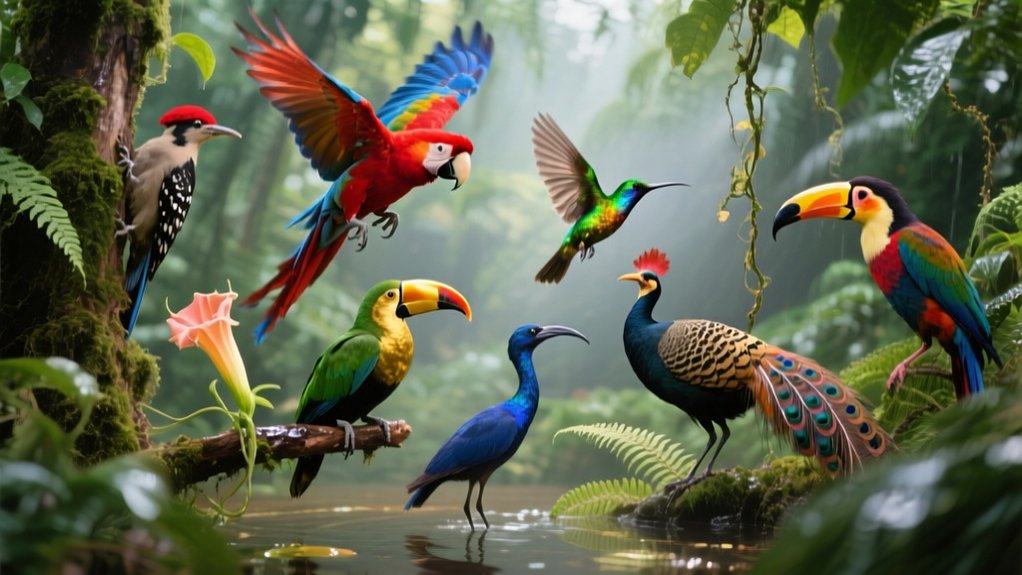
If you investigate the jungle, you’ll spot iconic birds like the Scarlet Macaw with its vivid red and blue feathers, and the Harpy Eagle, a massive apex predator with powerful talons. The Toco Toucan’s large, colorful bill helps it thrive in the canopy, while the Hyacinth Macaw stands out as the largest parrot.
You’ll also notice the rare Great Green Macaw, ancient Hoatzin, and agile Red-throated Caracara, each with unique ecological roles, behaviors, and adaptations vital to their habitats. Uncovering their traits reveals much about jungle biodiversity.
Scarlet Macaw: The Vibrant Amazonian Icon
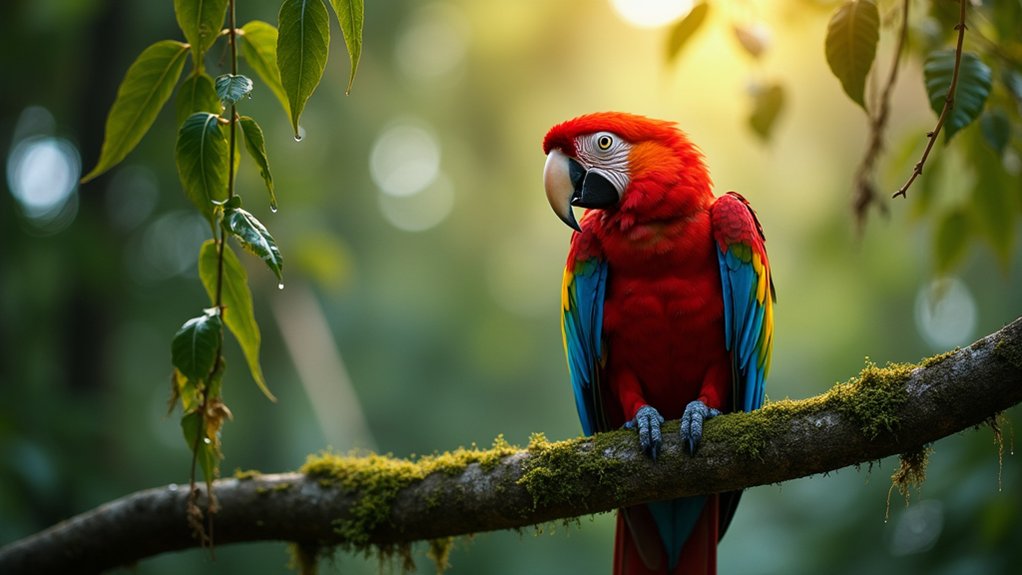
The Scarlet Macaw dazzles the Amazon rainforest with its vivid red, yellow, and blue feathers, making it one of the most recognizable birds in tropical ecosystems. When you observe Scarlet Macaws, you notice their vibrant red plumage stands out vividly against the dense greenery.
These social birds often gather in noisy flocks, communicating through loud calls that echo throughout the forest canopy. You’ll find them foraging on seeds, nuts, and fruits, occasionally consuming clay from riverbanks to balance their diet.
However, habitat destruction threatens their numbers, as deforestation fragments their natural homes. Conservation efforts focus on protecting remaining habitats and curbing illegal trade to sustain wild populations.
Harpy Eagle: The Jungle’s Apex Predator
You’ll notice the Harpy Eagle’s massive size—it has a wingspan that can reach up to two meters!
Plus, it has powerful talons that are perfect for gripping prey. It hunts silently through dense canopies, sneaking up on sloths, monkeys, and iguanas with incredible agility.
When you look at its physical traits along with its specialized diet, it’s easy to see why it reigns as the jungle’s apex predator.
Physical Characteristics
Standing over a meter tall with a wingspan reaching up to 2 meters, the Harpy Eagle commands attention as one of the jungle’s largest and most powerful raptors.
You’ll notice its striking black and white plumage, a sharp contrast that accentuates its presence in dense foliage.
The distinctive double crest atop its head shifts with its mood, a subtle but telling feature of this apex predator.
Its physical adaptations are impressive:
- Large feet equipped with powerful talons capable of gripping prey as heavy as the eagle itself
- Robust musculature supporting silent, agile flight through thick canopy
- Imposing size that deters competitors and establishes dominance within its habitat
These traits make the Harpy Eagle a formidable symbol of jungle strength and precision.
Hunting and Diet
Although it soars silently above the canopy, the Harpy Eagle relies on keen eyesight and powerful talons to capture its prey, which mainly consists of medium-sized mammals like sloths and monkeys.
As the apex predator of the rainforest, its hunting strategy involves stealthy flight through dense forest canopies, enabling precise ambushes.
With a wingspan reaching up to two meters, it maneuvers skillfully to secure its diet.
However, habitat loss threatens these hunting grounds, reducing prey availability and nesting sites.
Conservation efforts focus on protecting large tracts of forest to maintain the Harpy Eagle’s ecological role.
Understanding its hunting behavior and dietary needs is essential for preserving this formidable raptor and ensuring the rainforest’s biodiversity remains balanced.
Toco Toucan: The Rainforest’s Most Recognizable Bill
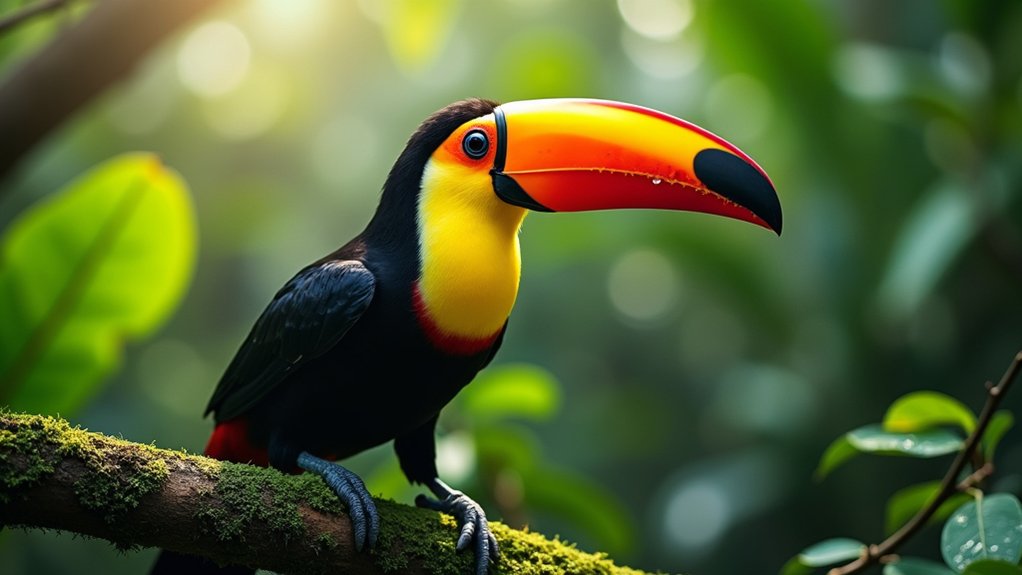
The Toco Toucan’s massive, colorful bill immediately draws attention, showcasing a lightweight structure made of a honeycomb-like composition. As you observe this bird in the South American rainforests, you’ll notice its vibrant plumage—bright orange and yellow set against a sleek black body.
This iconic bill serves multiple purposes beyond its striking appearance:
- Enables efficient seed dispersal by grasping various fruits, supporting forest regeneration
- Regulates body temperature through vascular adjustments within the bill’s structure
- Facilitates feeding in dense foliage, allowing access to food sources others can’t reach
While the Toco Toucan’s population remains stable, habitat destruction threatens its survival.
You can appreciate how this bird’s colorful bill isn’t just a visual marvel but a crucial adaptation for thriving in its complex ecosystem.
Hyacinth Macaw: The Gentle Giant of the Canopy
When you spot a Hyacinth Macaw soaring through the canopy, its vibrant cobalt-blue feathers and impressive size immediately capture your attention. As the largest parrot in the world, it measures up to 40 inches and weighs around four pounds.
This gentle giant inhabits the rainforest, where it uses its powerful beaks to crack open tough palm nuts, its primary food source.
Unfortunately, habitat loss and illegal pet trade have reduced its numbers to about 4,300 individuals in the wild, making the species vulnerable.
Conservation efforts focus on preserving rainforest habitats, supporting breeding programs, and educating the public about the Hyacinth Macaw’s ecological importance.
Observing this bird reveals not only its striking beauty but also the urgent need to protect its fragile environment.
Sun Parakeet: The Golden Jewel of the Jungle
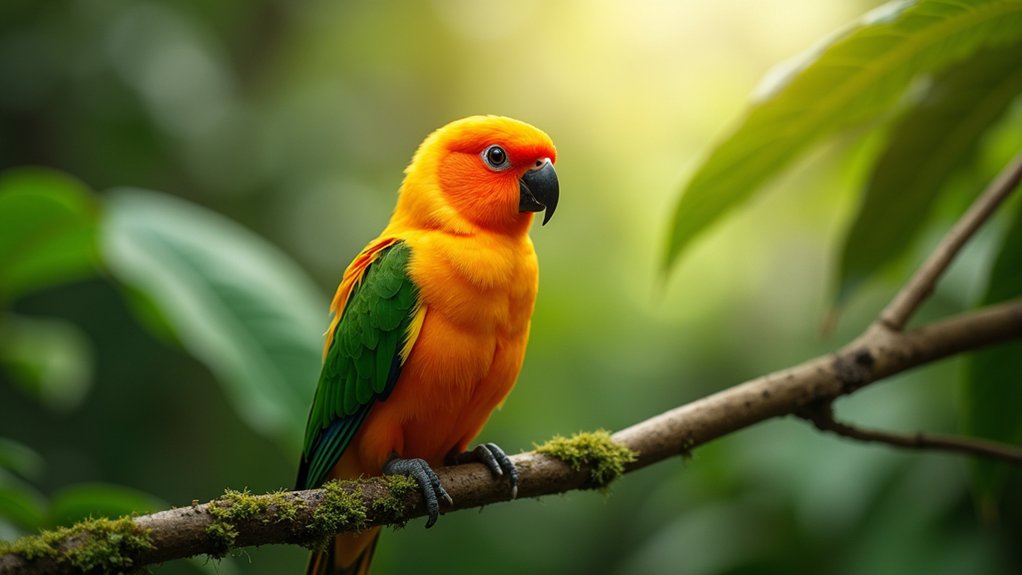
Spotting a Sun Parakeet amidst the treetops instantly draws your eye with its radiant gold feathers tinged with fiery orange, resembling sunlight piercing the jungle canopy.
This vibrant bird thrives in the upper rainforest canopy, where flocks of 20-50 communicate through complex vocalizations.
You’ll notice their role in maintaining the ecosystem by dispersing seeds as they feed on fruits, flowers, and young leaves.
Key observations about the Sun Parakeet include:
- Endangered status due to habitat loss and illegal pet trade
- Essential seed dispersers supporting rainforest regeneration
- Conservation efforts focus on habitat protection and awareness
Blue-and-Yellow Macaw: The Iconic Amazonian Parrot
You’ll notice the Blue-and-Yellow Macaw’s vibrant blue wings and yellow underparts make it unmistakable in the Amazonian canopy.
These parrots tend to stick together in close-knit social groups, often hanging out near rivers and wetlands. That’s because their diet—fruits, nuts, and seeds—not only keeps them going but also helps the forest regenerate.
When you watch them use their powerful beaks to crack open tough shells, it’s clear just how important they are. They play a big role in maintaining the ecological balance in their primary forest habitats.
Distinctive Appearance Traits
The Blue-and-Yellow Macaw enchants with its vibrant plumage, featuring striking blue wings contrasted by a vivid yellow chest. This distinctive appearance not only dazzles but also aids camouflage within the tropical forests’ colorful foliage.
When you observe this bird, you’ll notice how its coloration blends seamlessly with the environment, offering protection from predators despite its brightness.
Key traits include:
- A strong, curved beak specialized for cracking hard seeds and nuts, essential to its diet.
- Bright feathers that play a role in social signaling and courtship within its natural habitat.
- Vulnerability to habitat destruction, which threatens its populations despite its visual allure.
Understanding these traits helps you appreciate the Blue-and-Yellow Macaw’s ecological niche and the urgent need for conservation.
Social Behavior Patterns
Although their striking colors catch your eye, it’s the Blue-and-Yellow Macaw’s complex social behavior that truly defines its presence in the Amazon. These birds form strong bonds with mates and flock members, communicating through diverse vocalizations like squawks and whistles.
You’ll observe playful behaviors such as climbing and swinging, which reinforce social cohesion. Both parents share parental care duties, nurturing their young and strengthening pair bonds. Their intelligence further enriches social dynamics through problem-solving and mimicry.
| Social Behavior Patterns | Description | Purpose |
|---|---|---|
| Strong Bonds | Close pair and group connections | Maintain flock cohesion |
| Playful Behaviors | Branch climbing and swinging | Social interaction and learning |
| Vocalizations | Squawks, whistles, mimicry | Communication and coordination |
Dietary Preferences and Habitat
Countless tropical forests across South America provide the Blue-and-Yellow Macaw with ideal conditions for nesting and feeding, especially in primary forest areas rich in biodiversity.
This macaw thrives in the Amazon Basin, where its habitat supports a diverse diet essential for survival and ecosystem roles.
You’ll notice these birds rely heavily on fruits, nuts, and seeds that supply vital nutrients and help with seed dispersal.
Primary forests offer safe nesting sites and abundant food resources. They often forage socially in pairs or small groups, which boosts feeding efficiency.
Understanding their dietary preferences helps you appreciate how conservation efforts focus on protecting habitats to maintain macaw populations.
Great Green Macaw: The Rare Jewel of the Rainforest
When you spot a Great Green Macaw (Ara ambiguus) in the dense rainforest canopy, its vibrant green feathers, highlighted by flashes of red and blue, immediately draw your attention. This great green macaw’s vibrant green plumage camouflages it among the leaves, while its striking colors signal its presence.
You’ll notice these birds form strong pair bonds, often seen in pairs or small groups, communicating through loud, distinctive calls.
Critically endangered due to habitat loss and illegal trade, they depend on undisturbed rainforest for survival.
Ecologically, you can’t overlook their role in seed dispersal; by consuming fruits and nuts, they help regenerate the rainforest by spreading seeds of key tree species.
Observing them reveals both their beauty and essential function within this complex ecosystem.
Hoatzin: The Ancient Bird of the Amazon
You’ll notice the Hoatzin’s digestive system is uniquely adapted to ferment leaves, which actually produces a manure-like smell—something pretty rare among birds.
It’s kind of fascinating, right?
And when you watch the juveniles, you’ll see they’ve these wing claws that help them climb trees.
It’s a primitive trait, but it really helps them survive in their environment.
In the dense Amazon habitat, these behaviors and adaptations really show how the Hoatzin manages to thrive.
It’s a cool example of nature’s creativity.
Unique Digestive Adaptation
Although most birds rely on a simple digestive system, the Hoatzin has evolved a remarkable adaptation that sets it apart: its crop functions like a ruminant’s stomach, fermenting the tough leaves, flowers, and fruits it consumes.
This unique digestive system allows you to digest fibrous leaves efficiently, a rare trait among birds. The fermentation process produces a strong odor, earning the Hoatzin the nickname “Stinkbird.” Furthermore, its low metabolic rate suits its leaf-heavy diet, conserving energy in its arboreal habitat.
When observing this ancient bird, note:
- Its specialized crop hosts bacteria that break down cellulose.
- The Hoatzin’s slow digestion contrasts with the rapid systems of other birds.
- Its odor signals active fermentation, a byproduct of its unique diet.
This adaptation highlights the Hoatzin’s evolutionary niche in the Amazon rainforest.
Juvenile Claw Function
Because juvenile hoatzins possess unique claws on their wings, they can skillfully climb through dense branches in the Amazon rainforest, enhancing their mobility and survival.
These claws represent an evolutionary adaptation, vestiges of the hoatzin’s ancient lineage, allowing young birds to grasp branches firmly as they navigate their arboreal environment.
This climbing ability provides the juvenile hoatzin with an essential advantage against predators, enabling rapid, stable movement where flight is limited. As you observe these birds, you’ll notice how their claws aid in balancing and securing themselves among complex branch networks.
However, these claws disappear once juveniles mature and develop full flight capability, marking a significant change in their life cycle and ecological role within the rainforest ecosystem.
Habitat and Behavior
While many birds rely on flight and varied diets, the Hoatzin thrives in the dense wetlands of the Amazon rainforest by specializing in folivory, digesting leaves through a unique fermentation process in its enlarged crop.
This adaptation produces a distinctive odor, setting it apart from other folivorous birds.
The Hoatzin’s behavior and habitat reveal its status as a living fossil with ancient traits still evident today.
You’ll notice:
- Hoatzins emit loud calls, whistles and grunts, that coordinate flock activity.
- They inhabit swampy, riverine forests where dense vegetation supports their leaf-based diet.
- Their slow flight and strong climbing abilities help them navigate thick foliage and avoid predators.
Understanding the Hoatzin’s habitat and behavior highlights its unique evolutionary niche in the Amazon ecosystem.
Black-capped Donacobius: The Marsh Singer
The Black-capped Donacobius enchants observers with its distinctive black cap and clear, melodious calls that resonate through wetlands and marshes across Central and South America.
The Black-capped Donacobius captivates with its striking black cap and melodic calls echoing through lush wetlands.
As you watch, you’ll notice this species often appears in pairs or small groups, their vocalizations serving as key communication in dense vegetation near water.
The black-capped donacobius primarily feeds on insects and small invertebrates, actively helping control pest populations within these fragile ecosystems.
You’ll find their nests carefully constructed in thick, marshy plants, providing shelter and easy access to food sources.
Despite habitat pressures, their conservation status remains Least Concern, reflecting stable populations.
However, this stability hinges on the continued health of wetland habitats, which you can appreciate as essential for the survival of this remarkable marsh singer.
Like many other ecologically important fowl, the donacobius plays a vital role in maintaining the balance of its ecosystem.
Red-throated Caracara: The Forest’s Agile Hunter
When you spot the Red-throated Caracara, its vivid red throat and sleek dark feathers immediately stand out against the forest backdrop. This agile hunter thrives in diverse forest ecosystems, relying on healthy habitats near water sources.
You’ll notice it often hunts in groups, showcasing remarkable adaptability. Its diet includes insects, small mammals, and carrion, emphasizing its essential scavenging role.
Key observations about the red-throated caracara include:
- Utilizes multiple foraging techniques to locate prey efficiently
- Sensitive to habitat changes, which impact survival rates
- Benefits from targeted conservation efforts ensuring habitat preservation
The Red-throated Caracara is especially vulnerable to habitat loss, which can drastically reduce its available nesting and hunting grounds and threaten its long-term survival.
Understanding these points helps you appreciate how conservation efforts sustain this species, maintaining ecological balance and biodiversity within its forest home.
Frequently Asked Question
How Do Jungle Birds Contribute to Seed Dispersal?
You’ll find that jungle birds play an essential role in seed dispersal by eating fruits and nuts, then carrying the seeds away from parent plants. Their digestive systems often don’t break down these seeds, so when they excrete them elsewhere, they help new plants grow.
Birds like toucans and macaws use their specialized bills to reach various fruits, effectively spreading seeds across vast areas and promoting biodiversity in the ecosystem.
What Threats Do Jungle Birds Face From Deforestation?
You face significant challenges from deforestation, which destroys your nesting and feeding habitats.
As forests shrink, you’re forced into smaller, isolated patches. This increases competition and reduces genetic diversity.
This habitat fragmentation disrupts your hunting territories, especially for large raptors like the Harpy Eagle.
With fewer resources and territories, your populations decline.
Without urgent conservation, you risk extinction, especially if you’re already near threatened or endangered.
How Do These Birds Communicate Within Dense Jungle Environments?
You might think dense jungles would silence birds, but they actually turn up the volume. They use vibrant calls that travel far through thick foliage, like the Scarlet Macaw’s piercing squawks.
Some, like the Harpy Eagle, prefer silent flight paired with subtle visual cues. Others, such as Toco Toucans, combine unique sounds with bill movements.
These adaptations let you observe a complex, multimodal communication network thriving despite nature’s noisy chaos.
What Role Do Jungle Birds Play in Controlling Insect Populations?
You’ll find jungle birds actively control insect populations by preying on various insects and small invertebrates.
Their diets, rich in insects, help reduce pest numbers naturally, maintaining ecological balance.
When these birds feed, they prevent outbreaks that could harm plant health and biodiversity.
How Do Jungle Birds Adapt to Seasonal Changes in the Rainforest?
You’ll find that many jungle birds shift their feeding habits seasonally, capitalizing on fruiting cycles. Up to 75% of their diet changes with seasons.
During the high-water months, you’ll notice them foraging along waterways, then moving to exposed areas as water recedes.
Some, like the Harpy Eagle, time breeding with prey peaks, ensuring their chicks thrive.
You’ll also see changes in vocalizations and plumage to boost mating success during specific seasons.
Conclusion
You’ve just scratched the surface of the jungle’s avian universe, where each bird seems to hold the entire ecosystem on its vibrant wings. Imagine the Scarlet Macaw’s feathers as nature’s own neon lights, or the Harpy Eagle’s talons capable of crushing prey like a hydraulic press.
These creatures aren’t just birds; they’re living, breathing marvels of evolution, perfectly tuned to survive and dazzle in one of Earth’s most complex habitats. You’re witnessing pure natural engineering.