
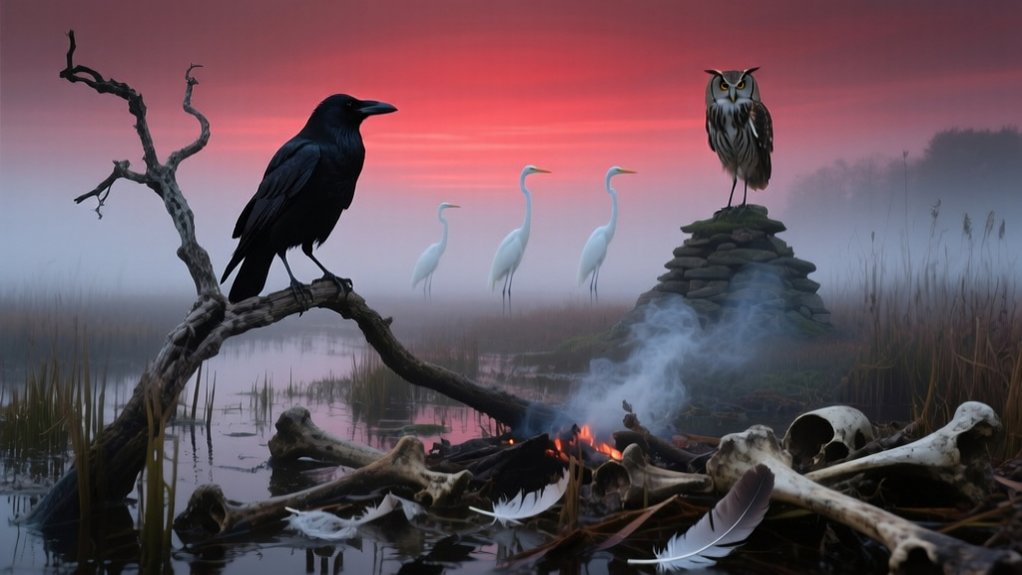
To decode which birds symbolize death in myth and culture, focus on their roles as psychopomps and omens across traditions. Ravens, crows, and owls often act as intermediaries between life and death in European, Native American, and Slavic lore.
Their black plumage, scavenger habits, and eerie calls link them to mortality and the spirit world. Understanding these patterns helps you interpret cultural symbols of death, with deeper layers revealing how birds connect to life cycles, afterlife beliefs, and spiritual guidance.
Ravens and Crows in European Folklore
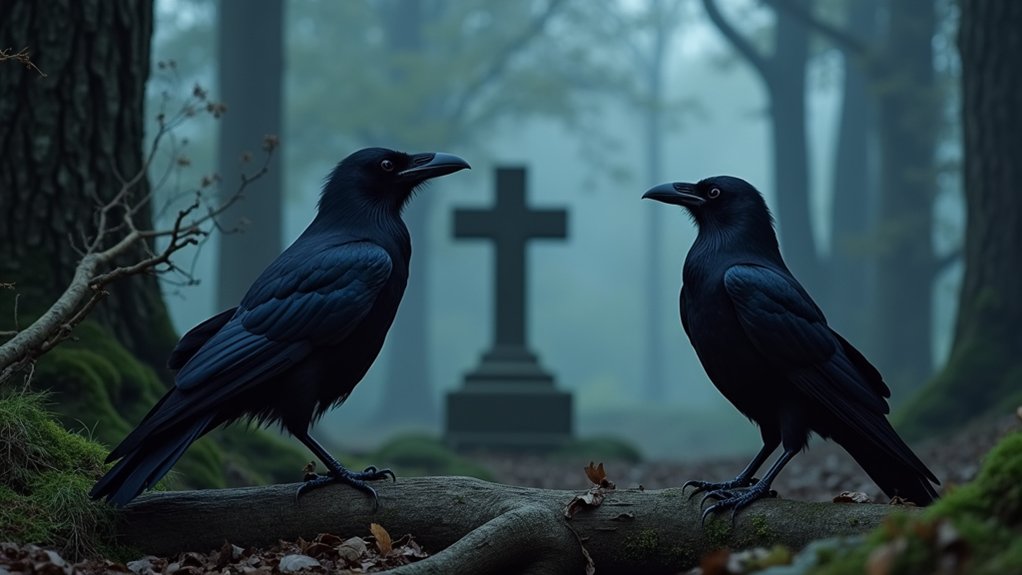
Although ravens and crows appear across many cultures, their role in European folklore, especially within Celtic and Insular traditions, stands out for its deep connection to war, death, and the Otherworld.
You’ll find these birds linked to battle goddesses like the Morrígan and Badb, who shapeshift into ravens to select the slain and foretell slaughter. In Norse legend, Odin’s ravens Huginn and Muninn gather knowledge and insight, highlighting their role as keepers of thresholds.
In Welsh lore, Bran the Blessed’s raven-associated name and prophetic severed head symbolize protection beyond death.
You might notice banshees taking raven form, signaling imminent death.
Even English tombstones dubbed “ravenstones” reflect this link to mortality.
This symbolism extended into Christian-era Europe, where ravens were demonized yet paradoxically retained protective roles.
Their presence on battlefields and near corpses reinforces their status as mediators between life and death, embodying both ominous and ancestral significance in European myth.
Norse Mythology and the Significance of Ravens
You probably know Odin’s ravens, Huginn and Muninn, right? They’re pretty important—they fly all over the Nine Spheres, gathering knowledge.
Think of them as the embodiment of thought and memory.
Now, when it comes to battlefields, ravens take on a whole new meaning. They’re symbols of both death and victory.
You might spot them acting as psychopomps, which means they guide fallen warriors to Valhalla.
So, their role isn’t just about intelligence or war alone. It’s a mix of both, plus a bit of spiritual transformation.
This really shows how the Norse saw life and death in a complex, interconnected way.
Across various cultures, ravens are considered sacred animals symbolizing intelligence and adaptability.
Odin’s Raven Messengers
Odin’s Raven Messengers
Ravens Huginn and Muninn serve as Odin’s indispensable messengers, flying daily across the Nine Domains to gather intelligence that sustains his near-omniscient awareness.
You can understand their significance through four key points:
- Huginn (“thought”) and Muninn (“memory”) symbolize the fusion of intellect and recollection, essential to Odin’s wisdom.
- Their daily flights, chronicled in the *Poetic* and *Prose Edda*, highlight a model of divine surveillance rather than brute force. They first appear in these foundational texts, which anchor their mythological importance in Norse tradition.
- Whispered reports into Odin’s ear represent direct knowledge transfer, positioning the ravens as extensions of his mind.
- Raven imagery in Viking artifacts signals Odin’s authority and the cultural valuation of foresight and learned experience. Warriors often carried images of ravens seeking Odin’s blessing and as reminders to think ahead, reflecting their symbolic significance in Viking culture.
This evidence-based perspective reveals that Odin’s ravens embody cognitive power, underscoring knowledge’s central role in Norse cosmology.
Ravens on Battlefields
Odin’s ravens Huginn and Muninn symbolize knowledge and insight, but their presence on battlefields takes on a more visceral meaning tied to death and valor.
In Norse culture, ravens are primary scavengers, with “raven-feed” kennings depicting piles of slain warriors, linking their presence directly to carnage.
You’ll find battle scenes poetically described as “tables of slain men” for ravens, wolves, and eagles, reinforcing the birds’ association with death.
Ravens circling battlefields confirmed the scale and ferocity of conflict, while feeding ravens became a metaphor for warrior glory.
The raven banner, carried by leaders like Ragnar Loðbrók, symbolized divine favor and inspired troops, blending victory with the ominous fate of the bearer.
This imagery ties ravens deeply to both death and martial honor. The Saga of Hrafnkell highlights the cultural significance of ravens in names and practices, underscoring their deep-rooted role in Norse society as cultural symbols.
Ravens as Psychopomps
Although often seen merely as scavengers, ravens hold a profound role as psychopomps in Norse mythology, acting as intermediaries between life and death. They bridge Midgard and other domains, symbolizing the soul’s passage and communicating between worlds.
Odin’s ravens, Huginn and Muninn, extend this role, embodying thought and memory while gathering knowledge about fate.
You can appreciate this significance through four key points:
- Ravens function as “mediator animals,” linking the living and the dead. This mediating role aligns with Claude Lévi-Strauss’s proposition that ravens symbolize the connection between life and death, bridging worlds.
- Huginn and Muninn mirror the soul’s journey by flying daily across cosmic domains.
- Literary sources, like *Hrafnsmál*, depict ravens understanding hidden languages, emphasizing their psychopomp abilities.
- Their association with prophecy and omens underscores their role in death’s passage.
Thus, ravens serve as crucial guides in Norse cosmology’s understanding of death and the soul.
Celtic Legends: The Morrigan and Bran the Blessed
In Celtic mythology, the Morrigan stands out as a powerful embodiment of war and death, often manifesting through ominous bird forms like crows or ravens that signal impending doom on the battlefield.
You’ll find she shapeshifts into a “hoodie” crow, symbolizing not only death but the chaos of slaughter. This bird form acts as a tangible omen, its shriek and presence foretelling bloodshed and fate, especially during Samhain, the festival of the dead.
The Morrigan’s triple-goddess aspect, including Badb and Macha, intensifies this symbolism, linking birds to both destruction and cosmic cycles of life and death. As a member of the Tuatha D Danann, she holds a supernatural status that deepens her influence in these myths.
Through narratives where she perches on fallen heroes or washes armor of the doomed, you see how these avian symbols concretize her role as a death harbinger and sovereign of battle’s outcome.
Owls as Death Omens in Native American Traditions
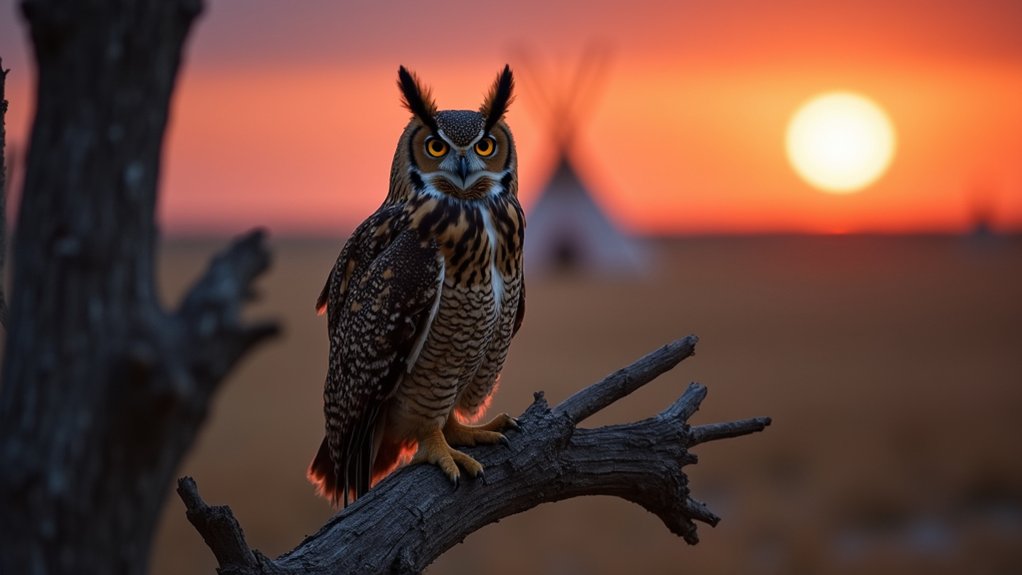
You’ll find that different owl species carry distinct meanings across Native American tribes. For example, the Great Horned Owl is known to signal sudden death in Choctaw tradition.
It’s pretty fascinating how owls often serve spiritual roles, acting as messengers between worlds or warning of impending danger. This is especially true in Apache and Navajo beliefs. Their eerie calls and nocturnal nature really reinforce those warnings and disciplinary lessons. Owls’ unique silent flight and exceptional night vision, due to their fringelike wing feathers, make them especially suited to these roles.
Owl Species and Meanings
When you investigate Native American traditions, owls emerge as potent symbols of death and the spirit world, with specific species carrying distinct meanings. You’ll find that:
- The Cree link the Boreal Owl’s whistle to a summons to the spirit world, marking changes like serious illness or imminent death.
- Among Navajo and Apache, hooting owls forewarn death or destruction, influencing decisions such as delaying journeys or avoiding conflict.
- Southeastern tribes like the Choctaw assign species-specific death omens. Great Horned Owls signify sudden death, while Screech Owls signal the death of a child.
- Pueblo and Southwestern peoples connect owls with death deities and spirits, viewing silent flight as a metaphor for death’s stealth. Pueblo link owls to Skeleton Man, the god of death and spirit of fertility.
Analyzing these associations reveals owls as liminal beings bridging life and death across diverse Native cultures.
Spiritual Roles and Warnings
Although owls appear as mysterious creatures in many cultures, their role as death omens holds a particularly strong place in Native American traditions. You’ll find that many tribes interpret owl hoots at night as warnings of impending death or misfortune. This often causes communities to delay travel or avoid conflict, as seen among the Apache and Navajo.
Owls are frequently linked directly to the spirit world, embodying the souls of the dead or serving as messengers attempting communication. Some tribes view owls as bearers of bad omens or harbingers of doom, emphasizing their connection to death and the underworld.
Additionally, several Southeastern tribes associate owls with witches or harmful sorcery, viewing their calls as supernatural warnings of broken taboos.
This complex spiritual symbolism reflects a culturally embedded system where owls enforce moral and social order through fear and caution. It reinforces communal values around death and the unseen.
The Role of Birds in Slavic Afterlife Beliefs
Because the Slavic worldview separates the soul (duša or nav) from the body, you’ll find that birds play an important role in symbolizing the soul’s journey after death. During the 40-day liminal period, the soul often appears as a bird near the home or grave, embodying change and connection to the afterlife.
Key points include:
- Souls travel as birds, often storks or nightjars, toward the paradisiacal Vyraj, where they roost in a cosmic tree under Veles’s protection.
- Ravens and crows represent souls or messengers from Nav, linking winter and the underworld.
- Storks function as psychopomps, carrying souls to Vyraj and returning them to newborns, symbolizing reincarnation.
- Bird migration mirrors cyclical life, death, and rebirth, integrating ancestor veneration with Slavic mythic geography. This idea resonates with the belief that birds represent souls of the deceased, visible during the 40 days post-death.
These beliefs reveal birds as crucial mediators between worlds.
Symbolism of Birds in Eastern European Cultures
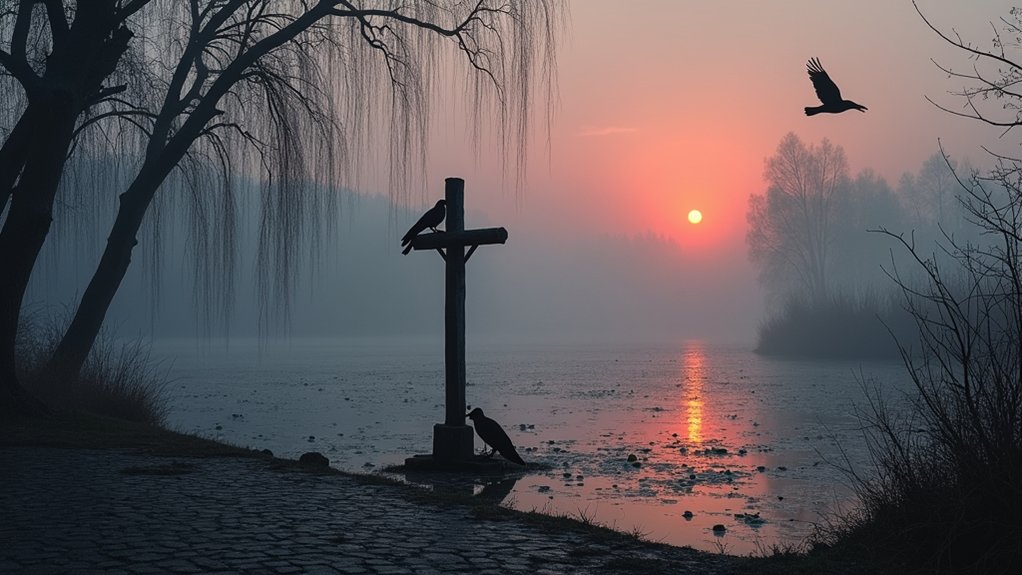
You’ll notice that in Eastern European cultures, birds like crows and ravens are often seen as carriers of souls after death. Their presence is closely linked to spiritual changes, which is pretty fascinating.
Then there are storks and cranes, whose seasonal movements symbolize the cyclical nature of life and death. This really reflects deep-rooted beliefs about the soul’s journey. In many cultures, the stork also symbolizes good fortune and life, reinforcing its connection to fertility and renewal.
Bird Souls After Death
When exploring Eastern European cultures, you’ll find that birds hold a profound symbolic role as carriers or embodiments of souls after death, especially within Slavic belief systems.
Human souls were thought to linger near the body for about 40 days, often manifesting as birds. These avian forms served as links between the living world and Navia, the domain of the dead.
Significantly:
- Ravens and crows acted as messengers from Navia, especially associated with ancestral spirits and warriors.
- Storks symbolized the full life cycle by carrying souls of newborns and the deceased.
- Nightjars and owls represented wandering souls or harbingers of death. In many cultures, owls are viewed as omens of death, reinforcing their connection to the afterlife.
- Sparrows embodied human souls, with taboos against harming them reflecting fears of disturbing the dead.
These beliefs shaped funeral customs and reinforced respect for birds near death sites.
Seasonal Bird Omens
Building on the understanding that birds often embody souls after death, Eastern European cultures also interpret avian behavior through the lens of seasonal cycles. You’ll notice that spring and autumn migrations mark liminal times when the boundary between life and death thins, making bird omens especially potent. Owls, in particular, have long been feared and revered as omens of death in many cultures due to their nocturnal habits and eerie calls.
For example, migratory birds like cranes and storks signify ancestral souls departing or returning, while unseasonal silence warns of misfortune. Night birds in winter, particularly owls, amplify death symbolism through their calls, which are perceived as direct spirit messages.
| Season | Bird Species | Symbolism | Omen Type | Cultural Context |
|---|---|---|---|---|
| Spring Arrival | Swallows, Storks | Souls returning to otherworld | Renewal, fertility | Post-winter death rites |
| Autumn Departure | Cranes, Wild Geese | Souls carried away, end of cycle | Misfortune, death | Harvest and life cycles |
| Midwinter Night | Owls, Nightjars | Warnings from otherworld | Illness, death | Cold season, witchcraft fears |
| Unseasonal | Various | Disrupted life cycles | Poor harvest, death | Folk weather and fate beliefs |
| Winter Presence | Owls on crossroads | Heightened dead activity | Fatal sickness | Taboo and spirit interaction |
Crows and Ravens
Although crows and ravens often evoke fear due to their dark associations, Eastern European cultures reveal a more complex symbolism tied to death and the supernatural.
In Romanian folklore, crows and ravens act as death personified and oracular birds linked to ancestor spirits and omens.
Slavic traditions view ravens as boundary guardians between life and death, embodying protection and wisdom rather than pure doom.
Consider these key aspects:
- Romanian ravens symbolize female death figures and funerary messengers, with harming them causing communal misfortune.
- Slavic ravens mediate life–death transitions and guard seasonal boundaries.
- Christian overlays intensified ravens’ evil reputation but didn’t erase protective beliefs surrounding nests.
- Battlefield scavenging tied ravens to warriors’ souls and war omens, reinforcing their death symbolism.
This nuanced view challenges a simplistic association of crows and ravens with death alone. Their remarkable intelligence and adaptability further enrich their cultural significance, highlighting traits beyond mere omens of death.
Japanese Birds as Psychopomps in Ancient Traditions
Because Japanese beliefs align closely with broader Asian psychopomp traditions, birds play a significant role in guiding souls to the afterlife rather than judging them.
In Buddhist Pure Land imagery, paradisal birds sing the Dharma, symbolizing spiritual guidance. Shinto traditions likewise depict birds or hybrid beings ushering souls, reflecting a regional pattern where animals mediate between worlds.
The three-legged crow Yatagarasu exemplifies this role, functioning as a divine guide who leads safely through existential changes, embodying yang energy and solar symbolism. This symbolism is echoed in Norse mythology, where birds also serve as important mythological figures, as detailed in “The Prose Edda” by Snorri Sturluson.
Yatagarasu, the three-legged crow, serves as a divine guide embodying yang energy and solar power.
While crows and owls can serve as omens of death, their primary function remains as messengers or guides rather than agents of doom.
You can see how Japanese psychopomp bird symbolism emphasizes passage and protection, aligning with cross-cultural themes of birds as facilitators of safe journeying to the afterlife.
The Peacock’s Association With Immortality in Greek and Christian Thought
When you investigate ancient Greek mythology, the peacock emerges as a potent symbol of immortality closely linked to Hera, the queen of the Olympian gods.
Its eye-patterned tail recalls Argus Panoptes’ hundred eyes, symbolizing cosmic vigilance and divine omniscience. Hera’s placement of Argus’s eyes on the peacock’s tail feathers serves as a tribute to Hera’s watchfulness.
This bird’s annual molting and regrowth further reinforced ideas of renewal and unending life.
The peacock’s symbolic power evolved into Christian iconography, representing resurrection and the soul’s immortality.
Consider these key points:
- Greek belief in the peacock’s incorruptible flesh suggested biological immortality.
- Its feathers’ cyclical renewal symbolized rebirth and eternal life.
- Roman and Christian adoption transformed it into a funerary emblem of hope.
- Christian art reinterpreted the “eyes” as God’s all-seeing presence and divine vision.
Māori Mythology and the Hokioi Bird
You’ll find the Hōkioi bird deeply embedded in Māori spirituality.
It’s often seen as a nocturnal omen of death and disaster. When you hear its eerie wing sounds at night, it’s believed to signal impending conflict or mortality. The Hōkioi is sometimes linked with the native bat, or pekapeka, which similarly holds symbolic significance related to death and the spiritual realm.
This connection links the bird to underworld domains and ancestral spirits.
Hokioi’s Death Omen
Although the hokioi remains unseen in Māori tradition, its presence resonates powerfully through ominous sounds and legendary associations that mark it as a harbinger of death and disaster.
You’ll find the hokioi linked with night, darkness, and mortality, especially through its mysterious calls heard but never seen. It was said to descend only at night from the heavens, emphasizing its connection with the dark and the unknown sacred bird of Raka-maomao.
Consider these key points to understand its death omen role:
- Its rare appearances and eerie sounds traditionally signal impending death or disaster.
- The hokioi shares symbolic darkness with pekapeka (bats), reinforcing ill omens.
- Its calls evoke fear, described as a two-part sound with a disyllabic call followed by a roaring noise from great height.
- Hearing the hokioi historically presaged war, extending the omen from individual fate to collective calamity.
This evidence cements hokioi’s place as a supernatural death symbol in Māori culture.
Nocturnal Bird Legend
Since the hokioi features prominently in Māori myth, its portrayal as a nocturnal, mountain-dwelling bird of prey reveals much about its symbolic and ecological significance.
You’ll notice its solitary, stealthy hunting aligns with behaviors suited to dark or clouded upland environments, reinforcing its apex predator role.
Its distinctive cry, lending its name, marks it as an auditory presence in night or twilight, heightening its eerie reputation.
Coupled with dramatic wingbeats and rapid ascents “racing the hawk to the heavens,” the hokioi’s legend reflects the ecological niche once occupied by Haast’s eagle, a massive, rare raptor specialized in ambushing large prey like moa. Scientific research has linked the hokioi legend directly to the Haasts eagle, which became extinct about 500 years ago.
This context grounds the hokioi as both a powerful natural force and a culturally resonant symbol linked to remote, high-altitude domains.
Māori Spiritual Beliefs
Māori spiritual beliefs raise the Hōkioi, or Hakawai, to a sacred status deeply intertwined with cosmology and omens. This mythological bird is linked to Raka‑maomao, the wind god, and is considered a tapu (sacred) messenger from the heavens.
You’ll find it associated with death and disaster through its nocturnal presence and eerie sounds.
Key points to understand include:
- The Hōkioi is described as a gigantic bird of prey, comparable to the extinct moa or Haast’s eagle, emphasizing its extraordinary mana.
- Its distinctive wing sounds, often mechanical-like, inspired fear and signaled impending war or misfortune.
- It symbolizes death and disaster, reinforcing its role as an omen in Māori culture. The bird’s enormous size and powerful talons also reflect its role as a fearsome predator that could snatch humans, as in the Pouākai legend.
- Ethnobiological links suggest connections to extinct raptors and nocturnal snipe species, explaining its elusive nature.
Hornbills as Death Messengers in African Cultures
When you explore Southern and East African cultures, you’ll find the southern ground hornbill holds a complex role as a harbinger of death and misfortune. In South Africa, Zimbabwe, and Malawi, its presence, especially perched on roofs, signals impending death or severe bad luck for households. This large bird, reaching up to four feet in length, is easily recognizable by its striking red throat in males and deep violet-blue in females, making its ominous presence unmistakable.
This perception extends into Tanzania and Zambia, where the hornbill serves as a messenger between the living and dead, sometimes carrying souls or ancestral voices. Ethnobiological surveys reveal ambivalence: it’s viewed both as a bearer of evil and a protector with rain-bringing powers.
Cultural taboos against killing hornbills, like among the Ndebele and AmaXhosa, stem from fears of fatal retribution, illustrating the bird’s spiritual potency. Yet in other communities, killing the hornbill aims to repel misfortune, highlighting diverse, context-dependent attitudes toward this ominous bird.
The Tower of London Ravens and National Fate
Although ravens are often linked to ominous symbolism, the Tower of London’s ravens have evolved into potent guardians of national fate. Their presence ties directly to a legend stating that if the ravens ever leave, both the Tower and the kingdom will fall.
This belief merges monarchy, state continuity, and the physical Tower into a prophetic symbol rooted in Celtic and European traditions of ravens signaling fate.
Consider these key points:
- Charles II decreed at least six ravens must reside in the Tower, institutionalizing their protection.
- Mythic ties to Bran the Blessed and Celtic sovereignty link ravens to national defense.
- Modern management keeps seven ravens to maintain the magical minimum. The ravens are cared for by the Ravenmaster and housed in a luxurious aviary near the Bloody Tower, consuming about a tonne of meat annually to sustain their health modern care.
- During WWII, ravens’ survival was critical for symbolic resilience.
This illustrates how a scavenger bird transformed into a national talisman.
Birds of Prey and Their Connection to Tribal Afterlife Beliefs
Because birds of prey often occupy liminal spaces between earth and sky, many Indigenous tribes have imbued them with roles that bridge the living world and the afterlife.
You’ll find that Plains and Southwestern tribes use eagle and hawk feathers in war bonnets and burial regalia to signify spiritual protection and ongoing warrior status beyond death. In Cherokee culture, the golden eagle, known as awâhïlï, is especially revered as a sacred symbol of war.
Circling raptors over battlefields symbolize souls departing and being guided to the spirit dimension, while their skyward flight parallels the soul’s ascent.
Meanwhile, owls occupy a darker role; various tribes regard them as messengers or embodied spirits of the dead, their calls signaling imminent death or illness.
This duality, with daytime raptors as noble guides and nocturnal owls as death omens, reveals a complex cosmology linking birds of prey to transformations between life and afterlife.
Seasonal Interpretations of Bird Omens in Slavic Cultures
As you investigate Slavic cultures, you’ll notice that bird omens closely align with seasonal cycles, reflecting a rich symbolic framework connecting life, death, and rebirth.
Winter crows and ravens symbolize the domain of the dead, intensifying death omens during nature’s dormancy. These birds are often linked to the land of the dead, which in Slavic mythology is depicted as a realm guarded by mythical creatures and deeply connected to the ancestors.
Spring migratory birds, like swallows, signal ancestral gates reopening and nature’s resurrection.
Summer storks and nightjars serve as messengers bridging the living and the dead during active communication periods.
Key points include:
- Winter corvids represent souls lingering on earth, tied to underworld symbolism.
- Spring birds mark the shift from death to fertility, opening heavenly pathways.
- Summer birds mediate ancestral messages, with behavior forecasting community fate.
- Swallows embody the agricultural year’s life-death rhythm, their arrival and departure signaling nature’s cycles.
Bats and Nocturnal Spirits in Pacific Islander Beliefs
Birds often symbolize the boundary between life and death, but in Pacific Islander beliefs, bats take on a comparably profound role within nocturnal spiritual domains. You’ll find bats represent ancestral spirits and liminal messengers, their silent flight linking human and spirit worlds.
Their nocturnal appearances near villages often signal omens tied to death, warfare, or taboos, not always negative but deeply significant. Bats also embody transformation and rebirth, emphasizing their connection to life’s transitions.
| Symbolism | Emotional Tone | Cultural Context |
|---|---|---|
| Ancestral spirits | Reverence | Melanesian, Southeast Asia |
| Omens of death | Foreboding | Oceanic night travel |
| Night messengers | Mystery | Boundaries between worlds |
| Soul passage | Reflection | Ritual respect for life |
| Spirit guides | Guidance | Shamanic death journeys |
Understanding these roles helps you grasp bats’ spiritual depth beyond mere wildlife.
Common Themes: Black Birds as Universal Symbols of Death
When you consider why black birds have become universal symbols of death, several key factors emerge from cultural and natural observations.
Their dark plumage naturally associates them with night, void, and the unknown, linking them symbolically to death and the afterlife. In many cultures, black birds are also seen as natural indicators of environmental changes, reflecting their strong connection to the cycles of life and death.
Black birds’ dark feathers evoke night and mystery, symbolizing death and the journey beyond life.
Furthermore, scavenger species like crows and ravens frequent battlefields and graveyards, reinforcing their role as omens.
Cultures also tie black coloration to mourning and misfortune, transferring these meanings onto black birds.
Finally, their liminal nature, flying between earth and sky, positions them as intermediaries between life and death.
In many mythologies, blackbirds are seen as guardians of boundaries between worlds, further emphasizing their connection to death and rebirth.
Key themes include:
- Association with darkness and the unknown
- Scavenger behavior near human mortality sites
- Cultural linkage to mourning and bad omens
- Role as psychopomps guiding souls between worlds
Frequently Asked Question
How Do Cultural Bird Death Omens Vary With Urban Versus Rural Settings?
You’ll notice cultural bird death omens differ sharply between urban and rural settings.
In cities, you’ll often interpret pigeons, crows, or sparrows as death symbols, influenced by gothic media and limited natural soundscapes.
Out in rural areas, you’ll associate barn owls, vultures, and whip-poor-wills with death.
This is bolstered by quieter nights and visible bird behaviors near farms or graveyards.
Your beliefs also shift with local traditions, exposure, and modernization levels.
Are There Bird Species Associated With Death Omens Outside of Black or Nocturnal Birds?
You’ll find that not only black or nocturnal birds carry death omens; vultures, eagles, and even hornbills play their part in the shadowy dance of superstition.
For example, vultures’ scavenging nature links them directly to death in many cultures, while eagles sometimes signal impending demise.
Southern Ground Hornbills and certain hornbills, with their odd-numbered groups or roof landings, are also seen as bad omens, proving that death symbolism spans diverse species and colors.
What Role Do Bird Colors Other Than Black Play in Death Symbolism?
You’ll find that bird colors beyond black carry rich death symbolism tied to cultural meanings.
Reds often evoke blood, sacrifice, or violent death but can also signify spiritual messages or rebirth cycles, like with the phoenix.
Whites tend to symbolize peaceful change, purity, and souls’ release, offering comfort rather than fear.
Fiery, multicolored birds frequently represent death entwined with renewal, highlighting transformation instead of finality in myth and culture.
How Have Modern Interpretations of Death-Related Bird Symbols Evolved?
You might think modern views on death-related birds still cling to doom, but they’ve evolved dramatically.
Now, instead of mere harbingers of death, these birds symbolize grief, transformation, and spiritual connection.
Contemporary culture reframes them as complex metaphors for loss, resilience, and hope, influenced by cross-cultural traditions and psychological insights.
You’ll find death-related bird symbols embodying rebirth and ongoing bonds, rather than just ominous warnings, reflecting a richer, more nuanced understanding.
Do Any Cultures Use Bird Songs or Calls Specifically to Predict Death?
Yes, many cultures use bird songs or calls to predict death.
You’ll find this in European traditions where raven or owl calls at night signal misfortune or mortality.
Native American folklore links whip-poor-will calls to soul-stealing and impending death.
In India and Africa, owl hoots commonly foretell death.
These societies interpret unusual nocturnal bird sounds as omens, integrating them into divination systems that actively read nature’s signals to anticipate death.
Conclusion
When decoding which birds symbolize death, you’ll notice black birds like ravens and crows consistently appear across cultures, from Norse mythology to Slavic beliefs. Owls and bats also serve as nocturnal omens tied to the afterlife, showing a universal pattern.
Remember, “Don’t judge a book by its cover.” These birds aren’t just harbingers of death but connectors to deeper spiritual dimensions, reflecting humanity’s complex relationship with mortality and the unknown.