

If you picture a bird without feathers, you’d see a streamlined body with a lightweight, fused skeleton designed for flight. Its long, flexible neck separates a small skull from a rigid, laterally compressed ribcage anchored by a keeled sternum.
The wings reveal specialized fused bones, the carpometacarpus and reduced digits, optimized for maneuverability. The pelvic limbs show a stable, stiff framework from the synsacrum fusion. Beneath the exterior lies an intricate design, balancing strength and lightness to power flight.
Investigate further to uncover more about these unique adaptations.
Skeletal Structure and Bone Composition
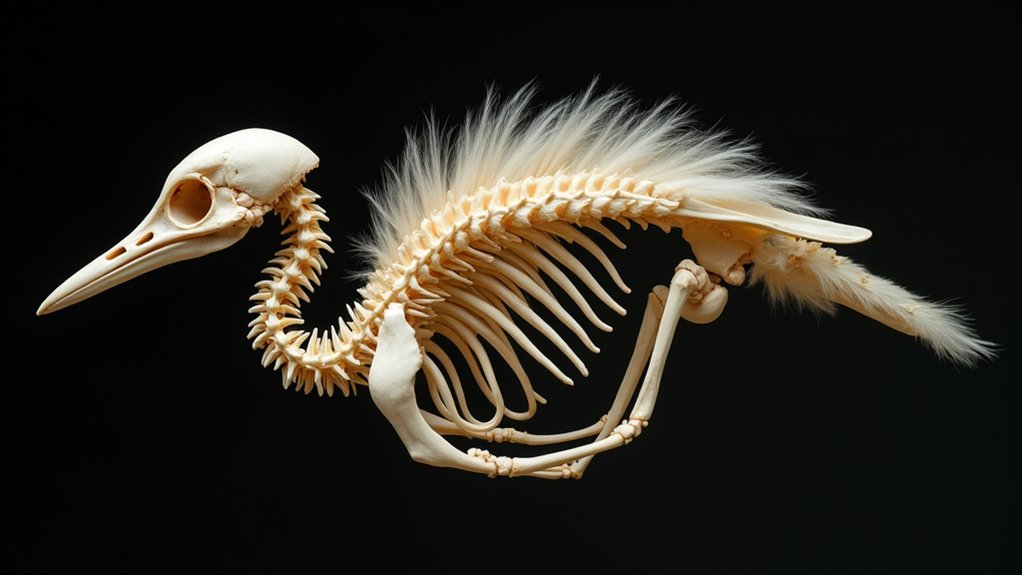
Although birds have evolved to minimize weight for flight, their skeletal structure remains remarkably robust and specialized. You’ll notice their skulls weigh about 1% of total body mass, featuring extensive cranial bone fusion that forms a rigid protective case with minimal sutures.
Bird skulls weigh just 1% of body mass, fused for strength yet ultra-light for flight.
Large orbits, encased by bony sclerotic rings, give birds disproportionately large eyes when feathers are absent. Their toothless, keratin-covered beaks replace heavy jaws, anchored to light premaxillary and mandibular bones, defining the head’s streamlined profile.
Internally, honeycomb-like air spaces with delicate bony struts reduce skull weight while enhancing strength. Many bones, including the humerus and parts of the pelvis, are pneumatic, containing internal trabecular struts that stiffen thin walls. The bird skeleton accounts for about 5% of total body weight, reflecting an overall lightweight but strong framework.
This architecture balances density and lightness, enabling efficient flight without compromising skeletal integrity.
Spine and Rib Cage Architecture
You’ll notice that the number of vertebrae varies to balance flexibility and rigidity in the spine.
The uncinate processes actually link the ribs mechanically, which helps stiffen the rib cage against the stresses of flight.
Along with the fused synsacrum and the keeled sternum, these parts come together to form a strong, integrated framework.
This setup is essential not just for respiration but also for muscle attachment.
Many of the bird’s bones are hollow and contain air spaces, contributing to a lightweight structure.
Vertebrae Count Variation
Vertebral count in birds exhibits remarkable variation, primarily driven by differences in the cervical (neck) region, which ranges from 11 to 25 vertebrae depending on species. Overall, birds possess between 39 and 63 vertebrae, with the cervical series dominating total count and flexibility.
Long-necked birds increase their cervical number rather than vertebral length for improved reach, while short-necked species maintain fewer vertebrae for a compact spine. Birds have a varying number of neck vertebrae (13 to 25) for enhanced mobility.
Thoracic vertebrae vary from 3 to 10, often fused anteriorly into a notarium, and posteriorly into a synsacrum that integrates with the pelvic girdle.
Cervical vertebrae have saddle-shaped joints (heterocoelous), allowing flexibility without dislocation. Synsacrum fusion stabilizes hindlimb support and body weight.
Thoracic vertebrae bear paired ribs, essential for ribcage rigidity and respiratory mechanics.
Uncinate Process Function
Bony projections called uncinate processes play an essential role in the cervical spine’s architecture and function. These hook-shaped structures on the superior lateral edges of vertebrae C3–C7 form uncovertebral joints by articulating with the vertebra above.
They guide and limit lateral flexion, preserving intervertebral foramina integrity and preventing excessive vertebral translation. By increasing load distribution surface area and providing secondary articulation, they improve segmental stability, especially in the mid-to-lower cervical spine. The uncovertebral joints are positioned more posterolaterally in the lower cervical spine, with the basal width of the uncinate process increasing at lower levels, which may expose these joints to higher mechanical stress and potential degenerative changes (posterolateral location and basal width).
Their morphology influences endplate angles, affecting stiffness and motion control during flexion, extension, and axial rotation.
Furthermore, uncinate processes define the anteromedial border of intervertebral foramina, where hypertrophy or osteophyte formation can compress nerve roots, leading to clinical symptoms.
Understanding their function clarifies spinal biomechanics and potential pathological changes.
Synsacrum and Sternum
The synsacrum and sternum form critical components of the avian spine and rib cage architecture, providing structural rigidity and muscle attachment essential for flight and bipedal locomotion.
The synsacrum results from fusion of multiple vertebrae, creating a rigid platform that transmits forces during landing and stabilizes the trunk during wing beats. It is formed by the fusion of thoracic, lumbar, sacral, and caudal vertebrae, making it a compound vertebral structure.
Meanwhile, the sternum presents a broad ventral shield with a prominent keel for anchoring powerful flight muscles.
The synsacrum’s fused neural spines form a continuous crest, enhancing dorsal rigidity. Its integration with the pelvis (os lumbosacrale) supports weight transmission and kidney accommodation.
The sternum’s keel (carina) expands muscle attachment, critical for flight, and is absent in flightless birds.
Together, these structures optimize biomechanical performance in featherless birds.
Shoulder and Pectoral Girdle Components
Understanding the shoulder and pectoral girdle components is essential for grasping how birds achieve powered flight. You’ll find the scapula is long, narrow, and sickle-shaped, lying dorsally along the ribcage. It forms part of the glenoid fossa, which articulates with the humerus, allowing wide wing movement. The coracoid acts as a robust pillar connecting the shoulder to the sternum, resisting compressive forces during downstroke. Its acrocoracoid process forms part of the triosseal canal, facilitating tendon movement. Paired clavicles fuse into the furcula, a spring-like structure that braces the shoulder girdle and stores elastic energy during wingbeats. The glenoid fossa’s orientation evolves to improve wing excursion, with some early birds featuring a double articulation system for enhanced stability and complex motion. Additionally, the length of the scapula varies depending on the flying strength of different species, reflecting adaptations in the pectoral girdle for flight efficiency (scapula length variation).
Wing Bone Structure and Modifications
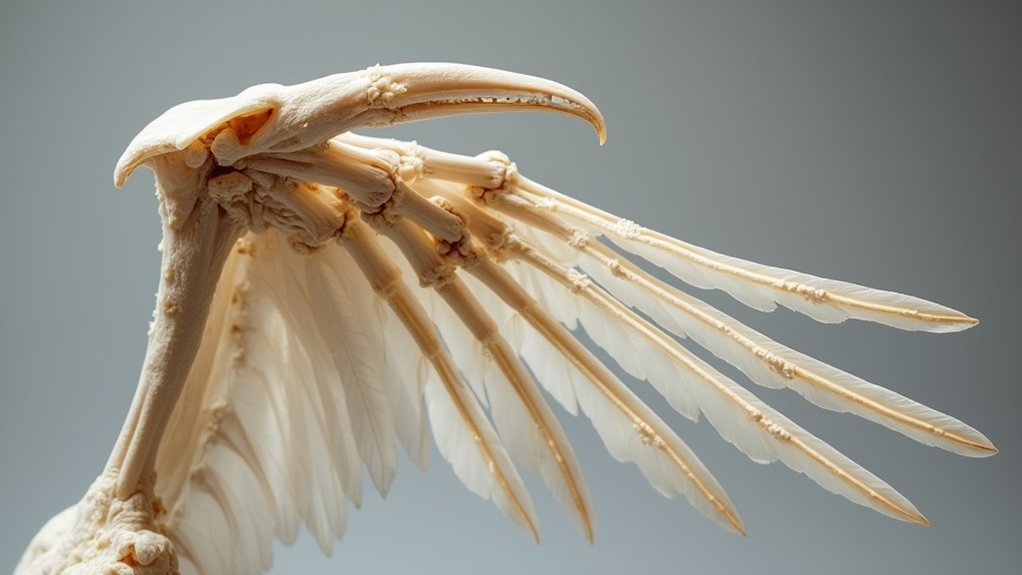
You’ll find the wing’s skeleton is made up of fused and specialized bones like the humerus, radius, and carpometacarpus. Each one is designed to provide the perfect mix of strength and flexibility. Many of these bones are part of the pectoral girdle, which includes the coracoid, scapula, and furcula to support the wings. The spots where feathers attach are neatly lined up along these bones, which helps with efficient force transmission when the bird is flying. Plus, the way the bones are shaped limits joint movement just enough to balance mobility with the stiffness needed for good aerodynamic control.
Wing Bone Anatomy
Bird wing anatomy combines a complex arrangement of bones designed for both strength and flexibility during flight. You’ll find the humerus, radius, and ulna forming the primary framework, with the ulna being more robust. These bones separate slightly, creating a bowed shape that resists bending forces.
The carpometacarpus merges carpal and metacarpal bones, supporting three digits, including the independently moving alula. The frontmost finger has a unique structure, typically featuring only one phalanx, which contributes to wing maneuverability finger phalanx structure.
The pectoral girdle, composed of the coracoid, scapula, and furcula, anchors the wing and withstands powerful muscle contractions.
Bone density varies, with pneumatic (hollow) bones enhancing lightness and strength in soaring birds.
Humerus rotates away from the body during flight, lying against it when folded.
Carpometacarpus supports finger phalanges adapted for wing control.
Pneumatic bones optimize strength-to-weight ratio for flight efficiency.
Feather Attachment Sites
The wing bones not only provide structural support but also serve as critical anchor points for flight feathers. You’ll find primary and secondary remiges firmly attached to bones like the ulna via ligaments and muscles that coordinate feather movement during wing flexion and extension.
Small smooth muscle bundles link upper forearm coverts to the ulna, while ligaments secure feather quills through structures such as the postpatagium, a thick tendinous band adding stability.
Specialized features like quill knobs on the ulna act as precise attachment sites for secondary feathers. Remiges are located on the posterior side of the wing, attached by ligaments to wing bones and supported by postpatagium.
Multiple connective tissues, including collagen fiber bundles and elastic regions, work together to maintain feather positioning and enable synchronized furling and unfurling.
This intricate architecture guarantees that feathers remain stable yet mobile, responding dynamically to wing motions essential for flight.
Joint Movement Restrictions
Although wing bones must allow sufficient motion for flight, their joint structures impose strict movement limits to optimize aerodynamic efficiency and mechanical stability.
You’ll notice the shoulder joint’s deep, rigid glenoid cavity restricts humeral motion to a narrow arc. Meanwhile, the foramen triosseum channels tendons to control powerful upstroke rotation precisely.
The elbow acts as a hinge, limiting rotation to maintain feather alignment. Distally, fused carpometacarpus and reduced digits limit wrist and finger movements, forming a semi-rigid lever for fine wing shape adjustments.
The shoulder girdle rigidity trades broad rotation for stable load transfer during flapping. Humerus and elbow joints emphasize flexion-extension over abduction or rotation.
Distal wing fusion minimizes movable joints, reducing inertial costs and enhancing control. Additionally, many bird species possess hollow bones that contribute to the overall structural adaptations supporting flight.
Pelvic Limb and Lower Extremity
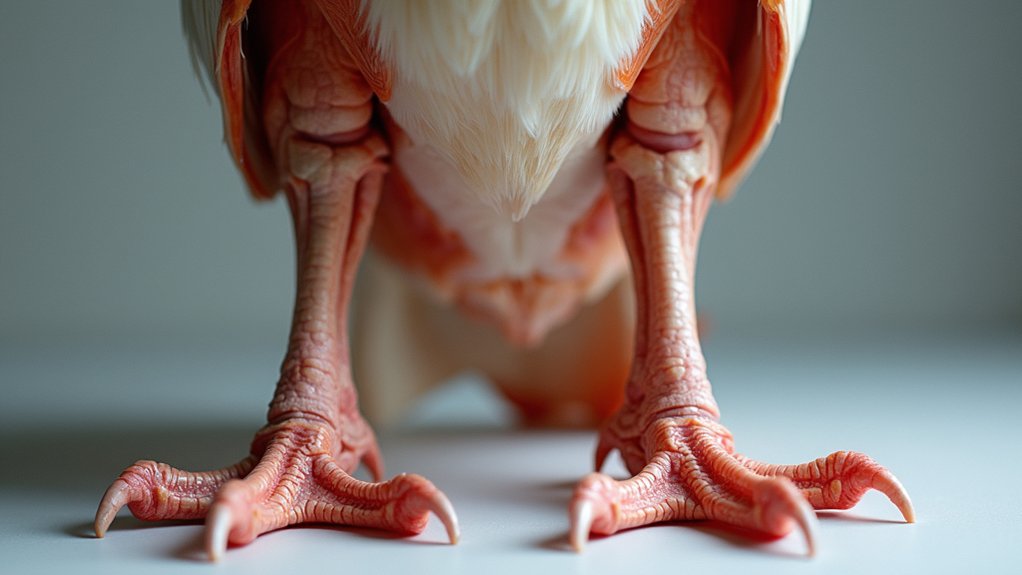
When examining the pelvic limb and lower extremity, you’ll find a complex integration of fused bones and specialized joints that provide both strength and mobility.
The pelvic girdle fuses ilium, ischium, and pubis with the synsacrum, forming a rigid plate with an incomplete acetabulum allowing femoral articulation and hip mobility. The synsacrum is a key structure formed by fused lumbar and sacral vertebrae, providing a strong foundation for the pelvis.
The pelvic girdle merges key bones with the synsacrum, creating a sturdy yet flexible hip joint for mobility.
The femur, stout and often pneumatized, slopes cranially, with the greater trochanter locking against the antitrochanter for stability. You’ll notice a patella redirecting quadriceps forces at the knee, emphasizing a “knee-based” gait with minimal femoral motion.
Distally, the tibiotarsus, formed by tibia and proximal tarsals, connects via the intertarsal joint to the elongated tarsometatarsus.
The foot typically bears four digits with a caudally directed hallux, essential for grasping and perching functions.
Overall Body Morphology Without Feathers
If you strip away feathers, you’ll see that a bird’s body reveals a streamlined, spindle-shaped core optimized to reduce drag during flight.
The naked torso is widest at the mid-chest and tapers toward the neck and tail, emphasizing a smooth, aerodynamic form.
The neck appears long and highly flexible, creating a distinct separation between the small, lightweight head and the robust thorax.
The thoracic region features a deep, laterally compressed ribcage with fused vertebrae, producing a rigid, barrel-like trunk.
The sternum’s pronounced keel supports powerful flight muscles, giving the chest a deep, ridged profile. This keel is essential for the attachment of major wing muscles that enable flight, highlighting the specialized structures associated with flight.
The shoulder girdle forms a rigid triangular frame visible at the wing base.
The wing skeleton appears narrow and jointed, lacking the feathered surface area.
Frequently Asked Question
How Do Birds Regulate Body Temperature Without Feathers?
You regulate your body temperature by actively controlling blood flow to heat dissipation areas like your beak, legs, and wing pits.
Your countercurrent heat exchange system conserves core heat in cold but boosts heat loss in heat via vasodilation.
You also rely on evaporative cooling through panting and gular flutter.
Behavioral strategies like bathing and physiological adjustments, including metabolic rate changes, help maintain your core temperature around 40–42°C despite lacking feathers.
What Do Birds’ Skin Colors Look Like Beneath Feathers?
You’ll find that birds’ skin colors beneath feathers vary widely, primarily due to melanin distribution.
Some birds have black skin, rich in melanin, especially in areas with thin or absent plumage.
Others display yellow or red hues from pigments like carotenoids or blood flow.
Seasonal and geographic factors influence skin color, with darker skin common near the equator.
Melanocytes control pigmentation, producing eumelanin for black and pheomelanin for yellow or orange shades.
Do Birds Have Visible Muscles Without Feathers?
You won’t see birds’ muscles bulging like a bodybuilder’s without feathers. Their skin stays smooth, covering major muscles like the pectoralis, which powers flight but remains hidden beneath thin skin and fat.
Feather removal exposes skin, follicles, and subtle contours, not distinct muscle fibers.
Even in plucked areas, muscles show as gentle shapes under skin, never raw or striated. This preserves the bird’s sleek form despite feather loss.
How Do Birds Protect Their Skin Without Feather Coverage?
You protect featherless birds’ skin by providing shade and controlled environments to prevent sunburn and moisture loss.
You apply topical antimicrobial and moisturizing treatments designed for avian skin, avoiding harsh chemicals.
Using protective vests or saddles helps prevent self-injury and further damage.
Supplementing their diet with omega fatty acids supports skin repair and feather regrowth.
Maintaining appropriate humidity levels also preserves skin hydration and overall health.
Are Birds Vulnerable to Injury Without Feathers?
If you stumble upon a featherless bird, you’ll quickly realize it’s highly vulnerable to injury.
Without feathers, your bird’s thin skin and muscles are exposed, increasing risks of cuts, bruises, and UV damage.
Feathers normally shield against parasites and physical trauma.
Their absence invites ectoparasites and mechanical harm.
Conclusion
So, if you ever imagine birds sans feathers, picture a bizarre skeleton parade. Spindly bones awkwardly jut out, ribs forming a fragile cage, and wings reduced to delicate, elongated struts.
Without their feathery armor, these creatures look like avian marionettes, stripped to the bare essentials of spine, girdles, and limbs. It’s a skeletal blueprint of flight, not quite ready for the runway, but certainly a marvel of evolutionary engineering in stark, unadorned detail.