
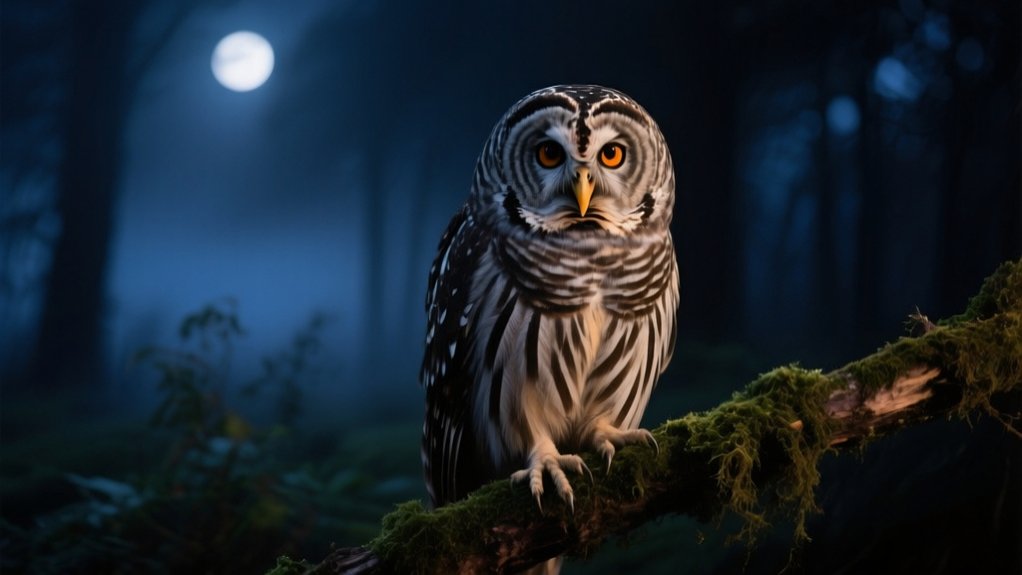
You’ll recognize a Barred Owl by its distinct hooting pattern of 8–9 clear notes, often rendered as “Who cooks for you? Who cooks for you-all?” These vocalizations carry well through wooded habitats, serving long-distance communication and territorial claims.
Besides hoots, they use bill snapping and varied sounds like cackles and gurgles for social signaling. Their calls contrast particularly with other owls.
Understanding these details offers deeper insight into their behavior and communication strategies.
Barred Owl Songs and Vocalizations
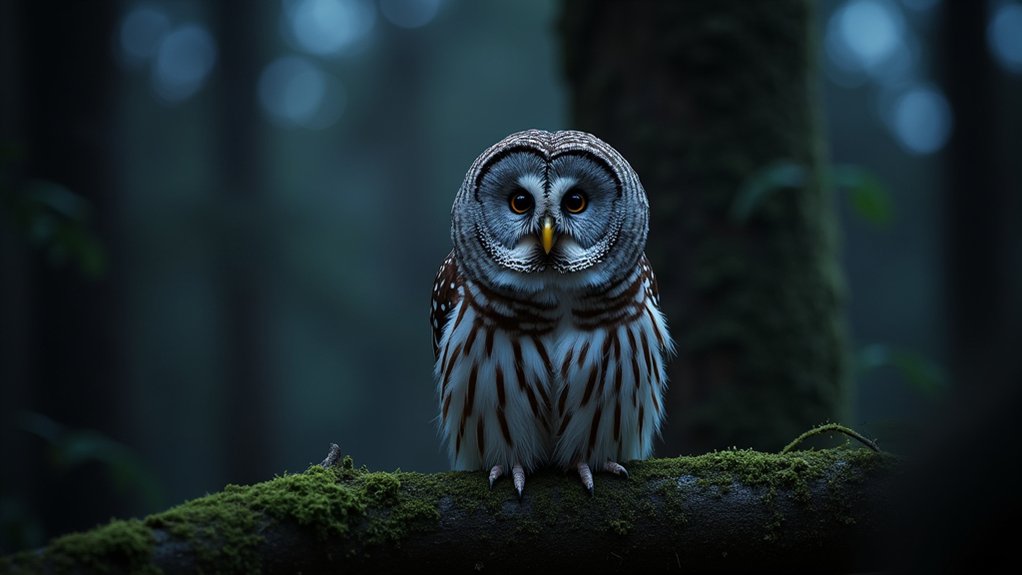
The Barred Owl’s signature hoot, often transcribed as “Who cooks for you? Who cooks for you-all?” consists of a distinct series of 8-9 notes. These vocalizations carry clearly through wooded environments, making the Barred Owl’s presence detectable from a distance.
You’ll notice mated pairs perform duets during courtship, combining hoots, cackles, caws, and gurgles in an intricate sound exchange.
Furthermore, the Barred Owl uses bill snapping as a sharp, non-vocal signal during territorial disputes or agitation.
This species’ vocal repertoire also includes mimicry, allowing their calls to be imitated by humans with relative ease.
If you’re creating a new account of Barred Owl sounds, focus on these precise elements to capture their acoustic complexity accurately.
For birdwatchers, recognizing calls without visual confirmation is a vital skill that can deepen your understanding of Barred Owl behavior and help distinguish them from other nocturnal species.
Understanding the Hooting Call
Barred owls rely heavily on their hooting call to establish presence and communicate across dense woodland habitats. You’ll recognize this call by its distinctive phrasing, sounding like “Who cooks for you? Who cooks for you-all?” comprising 8–9 clear notes.
This call carries efficiently through thick forests, enabling you to detect barred owls over long distances.
When observing mated pairs, you might notice duets blending hoots with cackles, caws, and gurgles during courtship.
Key features of the hooting call include:
- Distinctive 8–9 note phrasing
- Effective long-distance communication in wooded areas
- Duets involving mixed vocalizations during mating
- Bill snapping used during territorial disputes (though not part of the hooting call)
Barred owls can be distinguished from Great Grey Owls by their unique vocalizations, as Great Grey Owls produce a low, repetitive sound rather than the characteristic hooting call.
Understanding this call helps you identify barred owls precisely in their natural environment.
Other Sounds Barred Owls Make
You’ll notice that Barred Owls produce more than just their classic hoots.
They actually use a range of vocalizations like cackles, caws, and gurgles to communicate. Bill snapping is another key sound, especially when they’re agitated or involved in territorial disputes.
It signals tension to others nearby. Understanding this variety really helps you recognize how these owls convey different messages within their environment.
Bill Snapping Communication
Although hooting calls dominate their vocalizations, barred owls also use bill snapping as a key communication method during disputes. This sharp, clicking noise serves as an auditory signal primarily in conflict scenarios, indicating agitation or territorial contention.
Both adults and juveniles employ bill snapping, reflecting its role in social dynamics within barred owl communities. When you observe these owls, note that bill snapping supplements their vocal repertoire, providing nuanced communication beyond their characteristic hoots.
Key points about bill snapping communication include:
- Occurs mainly during disputes or aggressive interactions
- Signals agitation or territorial defense
- Produced by both adult and juvenile barred owls
- Adds diversity to their communication sounds beyond hooting
This behavior underscores the complexity of barred owl communication strategies in the wild.
Agitation and Territorial Sounds
When barred owls feel threatened or need to defend their territory, they produce a range of sounds beyond their familiar hoots. One key sound is the sharp bill snapping, which signals agitation and asserts territorial claims.
This snapping occurs during disputes not only between adults but also involving young owls, functioning as an intra-species communication tool. You’ll notice it complements the classic “Who cooks for you?” hoots, collectively reinforcing territorial boundaries and strengthening pair bonds.
These agitation and territorial sounds work together to maintain social order within barred owl populations.
Observing these vocal and mechanical signals offers insight into how barred owls navigate conflicts and assert dominance without escalating to physical confrontations.
Vocalization Variety Overview
Beyond the sharp bill snapping and territorial hoots, barred owls produce a diverse array of vocalizations that serve various social and communicative functions.
You’ll notice these include complex sounds used during courtship, conflict resolution, and parent-offspring interactions. Understanding this variety helps you interpret barred owl behavior more accurately.
Key vocalizations include:
- Cackles and gurgles, often part of mated pairs’ courtship duets
- Hoots phrased as “Who cooks for you? Who cooks for you-all?” carrying through dense woods
- Bill snapping, signaling agitation or dominance during disputes
- Caws, used less frequently but contributing to their vocal repertoire
How Barred Owls Use Their Calls to Communicate
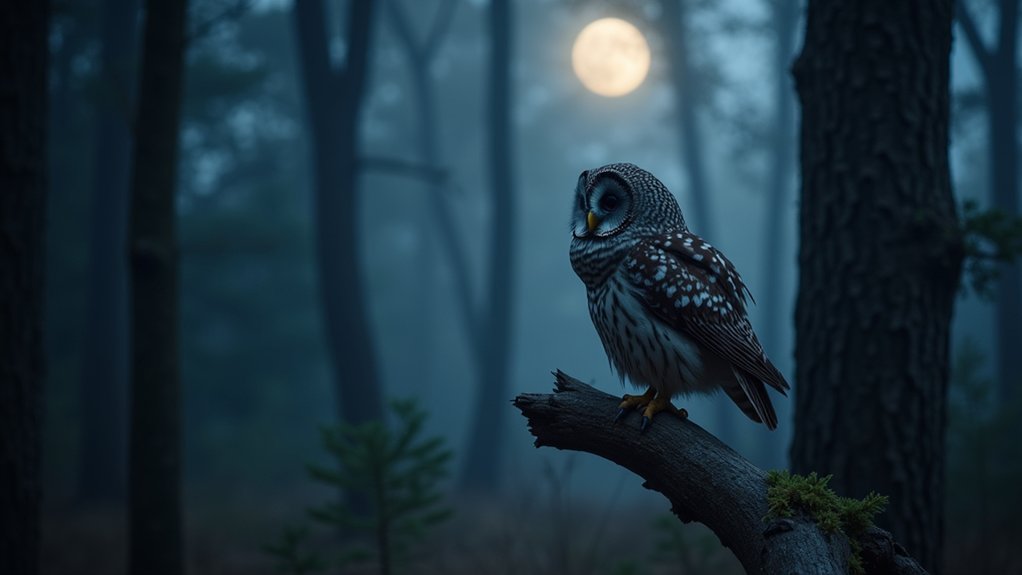
Because Barred Owls rely heavily on vocalizations, their distinctive hooting calls serve as primary tools for communication within their environment. You’ll recognize their typical call as the phrase “Who cooks for you? Who cooks for you-all?”—an 8 to 9-note sequence that carries efficiently through dense woodlands.
Barred Owls communicate through distinctive hooting calls, famously sounding like “Who cooks for you-all?” across their woodland homes.
This call establishes territory boundaries and attracts mates. When pairs are bonded, they often perform duets combining hoots, cackles, caws, and gurgles, especially during courtship.
Moreover, you might observe bill snapping during territorial disputes, signaling agitation.
These vocal signals not only facilitate direct communication between individuals but also reinforce the owls’ presence within their habitat, effectively marking territory and coordinating social interactions.
Understanding these calls offers insight into their complex social behavior and environmental adaptation.
Comparing Barred Owl Sounds With Similar Species
When you listen closely, you’ll notice the Barred Owl’s call has this rhythmic series of hoots.
It often sounds like they’re saying, “Who cooks for you? Who cooks for you-all?”
Now, if you compare that to the Spotted Owl, their hoot is more muted and stretched out.
It doesn’t have that same repetitive pattern you hear from the Barred Owl.
These differences in their calls are pretty handy, especially when you’re trying to tell them apart in thick woods.
Barred Owl Vs Spotted
Although both Barred and Spotted Owls share forested habitats, their vocalizations differ markedly in structure and function.
You’ll notice the Barred Owl’s call as a loud, repetitive sequence of 8–9 hoots, often rendered as “Who cooks for you? Who cooks for you-all?”
In contrast, Spotted Owls produce softer, more melodic hoots with variable pitch and rhythm.
These differences reflect their communication needs. Barred Owls use territorial calls and duets during courtship, while Spotted Owls tend toward solitary, less frequent vocalizations.
Humans can easily imitate Barred Owl calls, but Spotted Owl calls resist replication due to their complexity.
- Barred Owl: loud, repetitive 8–9 note hoots
- Spotted Owl: softer, melodic, variable hoots
- Barred Owl: territorial and duet calls
- Spotted Owl: solitary, less frequent vocalizations
Distinctive Calls Comparison
Three distinctive owl calls often cause confusion among bird watchers, but each species has unique vocal characteristics that set it apart.
The Barred Owl’s call, a clear sequence of 8–9 hoots often rendered as “Who cooks for you? Who cooks for you-all?”, carries robustly through dense woods.
In comparison, the Spotted Owl’s call is softer and more subdued, lacking the Barred Owl’s rhythmic clarity.
The Great Horned Owl emits a deeper, more resonant call, distinctively guttural. Meanwhile, the American Barn Owl’s harsh scream contrasts sharply with the Barred Owl’s melodious hoots.
The Great Gray Owl’s vocalization consists of soft hoots that differ markedly from the Barred Owl’s pattern.
Recognizing these differences helps you accurately identify owls by sound in their natural habitats.
Tips for Identifying Barred Owl Calls
Because the Barred Owl’s call features a distinctive sequence of 8–9 hoots resembling the phrase “Who cooks for you?,” you can use this pattern to identify it reliably in the field.
The Barred Owl’s unique 8–9 hoot sequence, “Who cooks for you?,” makes it easy to identify in the wild.
Listen for the clear, repetitive hoots that carry well through dense woods, distinguishing Barred Owls from other species.
Pay attention to duets between mated pairs, which mix hoots with cackles and gurgles, indicating courtship behavior.
Also, note the occasional bill snapping during territorial disputes, a sharp, non-vocal sound unique to their communication.
To identify Barred Owl calls effectively:
- Recognize the “Who cooks for you-all?” 8–9 note hoot sequence
- Detect vocal duets combining hoots, cackles, and gurgles
- Listen for bill snaps signaling agitation or disputes
- Practice imitating calls to improve auditory recognition skills
Technology and Apps for Bird Call Identification
Mastering Barred Owl calls involves more than just auditory practice; technology now plays a significant role in enhancing your identification skills. You can use apps like Merlin, which allow you to compare live or recorded sounds directly with authentic Barred Owl vocalizations.
These applications often feature audio recognition tools that analyze ambient sounds, helping you accurately pinpoint species in real time.
Beyond apps, online databases offer extensive libraries of mating calls and hoots, providing valuable references for practice. Educational videos and sound clips further demonstrate the nuances of Barred Owl communication, reinforcing your auditory memory.
By integrating these digital resources, you systematically refine your ability to distinguish subtle variations in calls, making your field identifications more precise and reliable.
Technology therefore bridges your observational skills with scientific accuracy in bird call identification.
Observations and Experiences With Barred Owl Sounds
The Barred Owl’s distinctive call, often rendered as “Who cooks for you? Who cooks for you-all?”, comprises 8–9 hooting notes that carry clearly through dense woods.
When you listen attentively, you’ll notice mated pairs use these vocalizations to maintain contact.
During courtship, you might hear intricate duets blending cackles, hoots, caws, and gurgles, revealing complex communication patterns.
If you observe bill snapping, it signals agitation or territorial disputes.
Tracking these sounds enriches your understanding of local biodiversity and sharpens your birding skills.
Pay attention to:
- The rhythmic sequence of hoots in their primary call
- Duet performances indicating pair bonding
- Bill snapping as a sign of tension
- Clear propagation of sounds through wooded habitats
These observations deepen your appreciation for Barred Owl behavior and ecology.
Engaging With the Barred Owl Community
While exploring barred owl vocalizations, you’ll find a vibrant community actively sharing observations, experiences, and analyses. Members contribute detailed reports on barred owl calls, noting variations in pitch, rhythm, and context.
Discussions often include personal encounters paired with audio recordings, enhancing collective understanding of these owls’ communicative behaviors. You’ll notice active engagement through numerous comments, reflecting high interest and appreciation for the species.
Notable contributors frequently highlight distinctive call patterns, encouraging you to examine acoustic characteristics critically. The community fosters collaborative learning by exchanging scientific insights alongside light-hearted remarks, creating a dynamic yet informative environment.
Engaging here sharpens your observational skills and deepens your knowledge of barred owl vocalizations within a supportive network of wildlife enthusiasts and experts.
Frequently Asked Question
What Is the Average Lifespan of a Barred Owl in the Wild?
You can expect a barred owl to live about 4 to 5 years in the wild on average, though some individuals reach 10 years or more.
Their lifespan depends heavily on factors like habitat quality, prey availability, and threats from predators.
Young barred owls face high mortality rates, often not surviving their first year.
Adults are vulnerable to habitat loss and human impacts, which can shorten their natural lifespan considerably.
Where Do Barred Owls Typically Build Their Nests?
You know what they say: “A bird in the hand is worth two in the bush.”
Barred owls typically build their nests in tree cavities or reuse abandoned nests of hawks or crows. They prefer mature forests with mixed deciduous and coniferous trees.
Their nests are usually 10 to 50 feet above ground, offering protection from predators.
During nesting season, females lay 2 to 5 eggs in these secure, raised sites.
What Do Barred Owls Primarily Eat?
You’ll find that barred owls primarily eat small mammals like mice and voles, which form the bulk of their diet.
They also consume birds, reptiles, amphibians, and insects, adjusting their intake based on what’s available in their habitat.
Using silent flight and acute hearing, you’ll observe them hunting mostly at night, though they can be active during the day when food is plentiful.
Their dietary flexibility helps them thrive across various North American environments.
Are Barred Owls Active During the Day or Night?
Barred owls are primarily nocturnal, so you’ll find them most active during the night.
However, they also exhibit crepuscular behavior, increasing activity around dawn and dusk.
While night is their peak hunting time, you might observe them foraging during the day, especially in dense cover or overcast conditions.
Their adaptability lets them adjust activity patterns based on prey availability, so daytime sightings, particularly in urban areas, aren’t uncommon.
How Large Is the Typical Barred Owl Territory Range?
You’ll find that a typical barred owl’s territory ranges from 100 to 400 acres. This size depends largely on resource availability, like food and nesting sites.
When food is abundant, their territories tend to be smaller. During breeding season, they become more territorial and vocal. Mated pairs often share and defend their territory together, sometimes overlapping with others in prey-rich areas.
You’ll notice their boundaries shift based on habitat quality.
Conclusion
By paying close attention to the barred owl’s distinctive hoots and varied vocalizations, you’ll sharpen your ability to identify this species in the wild. Remember, “the early bird catches the worm,” so start listening during twilight when their calls peak.
Using technology and field observations together improves your understanding of their communication patterns. With practice and patience, you’ll not only recognize barred owl sounds but also appreciate their role in the ecosystem with greater clarity.