
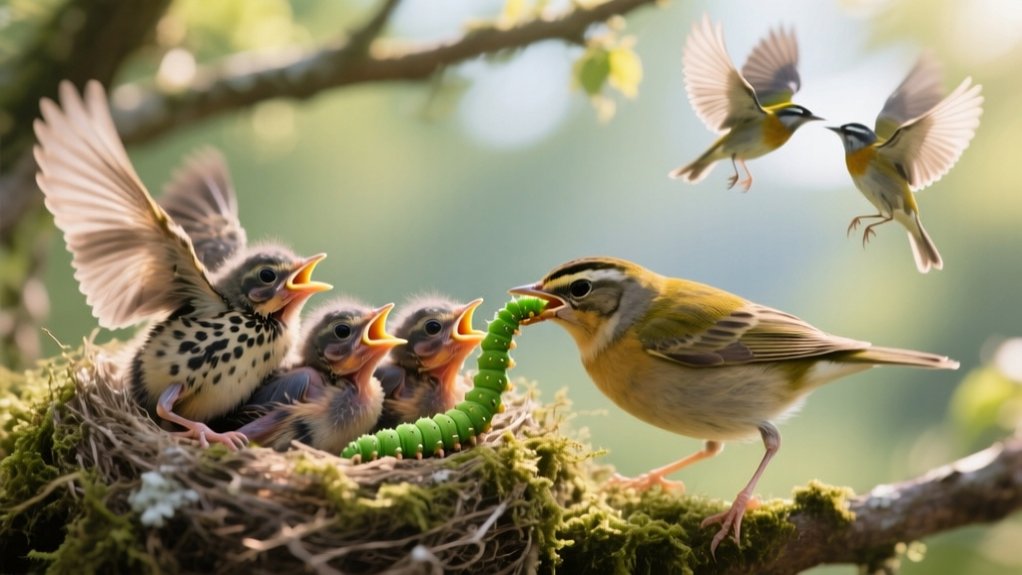
To understand a bird’s life cycle, observe each stage from the embryo developing inside the egg to hatching. The chick relies on yolk nutrients and parental warmth during this time.
Notice clutch size variations influenced by the environment. Hatchlings need protein-rich food and parental care as they grow feathers and muscles for flight.
Watch fledglings gain independence, adopting juvenile traits before maturing into reproductive adults. Recognizing these phases reveals survival strategies and behaviors essential for development and reproduction.
Exploring further will uncover intricate details of their growth and challenges.
The Egg Stage and Embryonic Development
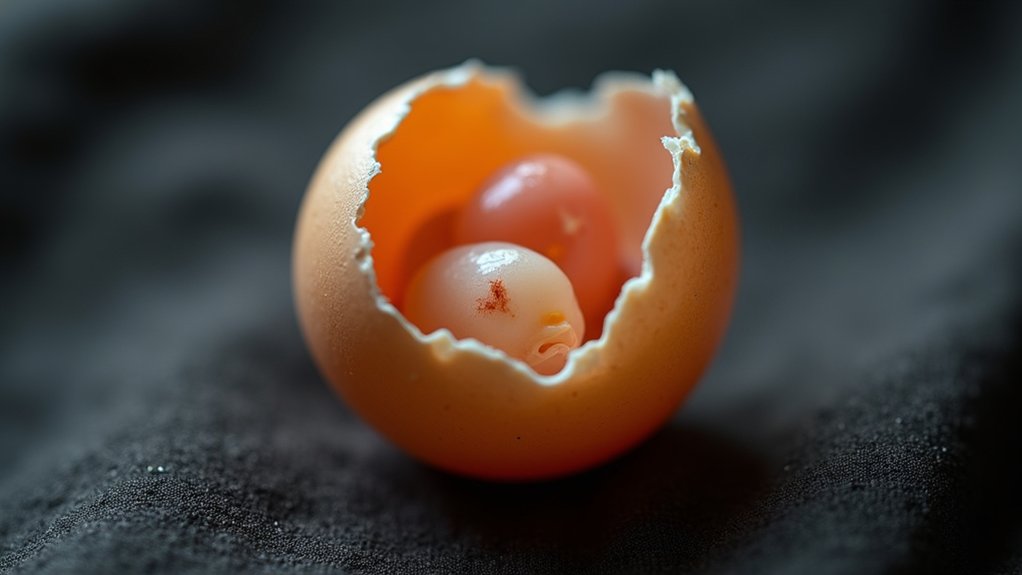
How does a bird’s life begin inside the egg? It starts with fertilization in the upper oviduct, where the ovum is fertilized before albumen and shell layers form. The egg comprises yolk, albumen, shell membranes, and a calcified shell.
The yolk provides lipids, proteins, vitamins, and minerals, nourishing the embryo. Albumen cushions and hydrates, while shell membranes regulate gas and water exchange, protecting against pathogens.
The shell, made of calcium carbonate, safeguards mechanically yet allows gas diffusion through pores. Parents engage in incubation behavior to keep the eggs warm, allowing the embryo to develop by utilizing the yolk and albumen.
Early cleavage happens only on the blastodisc atop the yolk, forming a blastoderm by laying time with tens of thousands of cells.
The blastoderm differentiates into epiblast and hypoblast layers, setting the stage for gastrulation and embryonic development.
Variations in Clutch Size Across Bird Species
Once the embryo develops inside the egg, the number of eggs laid in a clutch becomes a key factor influencing reproductive success. Clutch size varies widely among bird species, shaped by ecological, morphological, and environmental factors.
You’ll notice larger clutches in temperate and northern latitudes due to seasonal resource abundance. Tropical birds lay fewer eggs because of constant predation risks and less seasonality. Developmental mode matters: precocial species lay more eggs than altricial ones. Nest type and migratory behavior also influence clutch size.
| Factor | Clutch Size Trend |
|---|---|
| Latitude | Increases with latitude |
| Developmental Mode | Precocial > Altricial |
| Nest Type | Cavity nesters > Open nesters |
Understanding these patterns helps you predict clutch size based on species traits and habitat.
The Hatching Process and Hatchling Characteristics
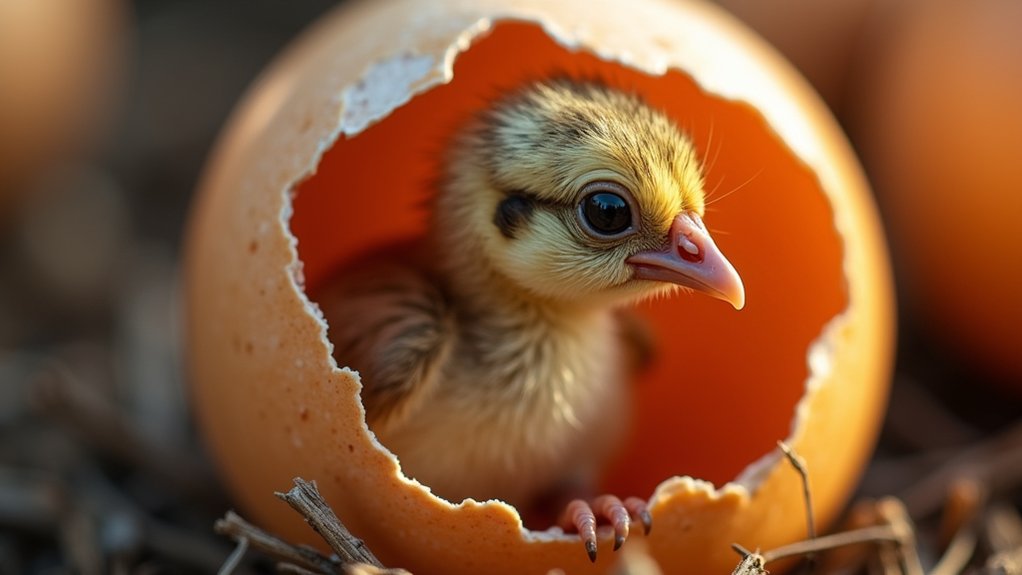
Although the hatching process demands considerable effort from the embryo, it follows a precise sequence beginning with the formation of the air cell. This air cell enlarges near hatch time to provide the first source of air.
You’ll observe the embryo perform an internal pip by piercing the inner membrane to access this air, initiating pulmonary respiration. Rising carbon dioxide levels then trigger external pipping, where the embryo uses its egg tooth to fracture and unzip the shell cap.
This interval can last 12–36 hours as the chick repeatedly thrusts using a specialized neck muscle. In many species, the mother often clears out egg shells from the nest after hatching to maintain nest hygiene.
Upon emerging, hatchlings often appear wet with matted down and closed eyes if altricial, or fluffy and alert if precocial. Residual yolk sustains early metabolism during this vulnerable stage.
Nutritional Needs of Hatchlings and Parental Care
After hatching, the chick faces demanding nutritional needs to fuel its rapid growth and development.
You’ll observe that hatchlings require very high protein and fat intake to support tissue synthesis and energy-dense thermoregulation.
Calcium and phosphorus are critical for skeletal mineralization, while vitamins A, D3, E, and C support immune function and bone growth.
Essential minerals and vitamins fortify bone growth and enhance immune defenses during early development.
Parents provide regurgitated, pre-digested food rich in insects, larvae, and soft pulp to match the chick’s delicate swallowing reflex. During this early stage, parental care not only includes feeding but also protection and teaching essential survival skills.
Feeding occurs every 15 to 60 minutes, with small meals preventing crop overdistension.
Parental brooding maintains thermoregulation, conserving energy for growth, while nest hygiene minimizes pathogen exposure.
These precise nutritional and behavioral adaptations guarantee hatchlings efficiently absorb nutrients critical for survival before shifting to diverse diets as they mature. Specialized hand-feeding formulas like Health-18 and Health-19 have been developed to replicate these early nutritional needs and support growth when parental feeding is unavailable.
Growth and Development During the Nestling Stage
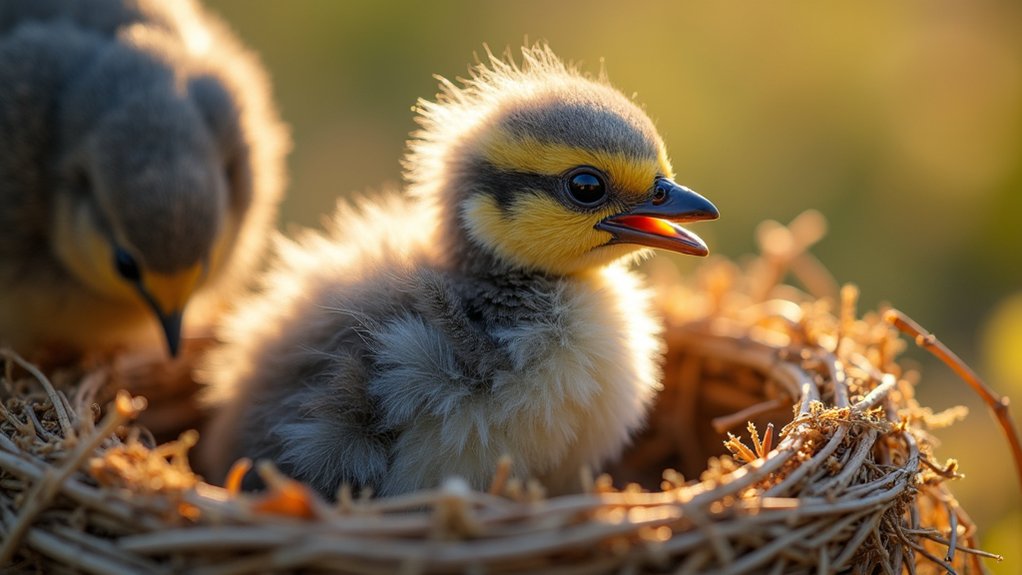
During the nestling stage, birds undergo rapid and complex growth that transforms them from fragile hatchlings into fledglings capable of flight.
You’ll notice sensory and neurological systems develop quickly: eyes open near the end of week one, and auditory skills refine to recognize parental calls. Their motor control improves, enabling coordinated movements within the nest. At this stage, nestlings are still dependent on parents for feeding and protection as they prepare for the next phase of life.
Physically, body weight can multiply several times, with wing size increasing relative to the abdomen, preparing for flight. Weight may fluctuate due to weather affecting food supply, with bad weather slowing feather growth and requiring energy for thermoregulation impacting growth.
Thermoregulation shifts too, as nestlings move from relying on constant brooding to partially self-warming by day eight or nine.
Key developmental highlights include:
- Rapid brain and nervous system growth supporting coordination and begging behavior
- Explosive weight gain sensitive to environmental conditions
- Progressive motor skills from head lifting to wing flexing
- Improving thermoregulation allowing independent heat maintenance
Feather and Muscle Progression in Nestlings
You’ll notice that nestlings start out with just a few sparse down feathers.
As they grow, contour and flight feathers begin to emerge from pin feather sheaths, developing in a sequence that goes from the body outward toward the wing tips. This process can vary depending on the clutch size and the specific needs of the species.
At the same time, their pectoral muscles get stronger and larger, responding to the lengthening feathers.
This muscle growth helps them practice wing-fluttering exercises, which are really important for building the strength they need to fly.
Nestlings remain completely reliant on parents for food, protection, and warmth during this crucial stage of development completely reliant on parents.
All of this feather and muscle development happens together, getting the bird ready for its big transition to fledging and actual flight.
Feather Development Stages
Although newly hatched altricial nestlings initially display mostly bare or sparsely down-covered skin, you can observe the earliest signs of feather development within the first few days.
By day 3, feather germs appear as dark spots beneath the skin, soon elongating into pinfeathers enclosed in keratin sheaths.
Between days 6 to 12, these sheaths thicken, then split to release barbs that unfurl into contour and flight feathers, dramatically transforming the nestling’s appearance. It is important to recognize these stages to determine the bird’s development stage before offering any help.
Pinfeathers first emerge on wing, dorsal, and head tracts, leaving belly and flanks mostly bare initially.
Sheath breakdown produces white flakes (“dandruff”) in the nest as feathers expand.
Flight feathers start as pinfeathers along wing margins, becoming short vaned feathers insufficient for flight.
Tail feather emergence lags behind wings, completing the feathered outline by fledging.
Muscle Growth Patterns
When you observe nestling birds, you’ll notice that their muscle groups don’t grow uniformly; instead, each major muscle set follows a distinct timeline tailored to its functional role.
Leg muscles grow rapidly early on, supporting postural control and begging behaviors, while pectoral muscles lag initially but accelerate toward fledging.
This staggered pattern guarantees functional readiness: early neck and leg muscle hypertrophy aids head lifting and posture, while later pectoralis fiber enlargement boosts contractile and aerobic capacity necessary for flight.
Muscle development involves initial hyperplasia followed by fiber hypertrophy, accompanied by rising oxidative enzyme activities like citrate synthase.
Under sibling competition, gape and jaw muscles receive prioritized growth to improve feeding success.
These coordinated growth patterns facilitate the nestling’s shift from dependent support to power generation, vital for survival and development.
Flight Preparation Process
As nestlings develop, their feathers and muscles progress in tightly coordinated stages that prepare them for flight.
You’ll notice down feathers give way to sheathed “pin feathers” that gradually unfurl into aerodynamic vanes.
Simultaneously, flight muscles strengthen, enabling wing flapping.
Key features to observe include:
- Shift from soft juvenile feathers to more rigid ones, essential for lift and thrust
- Rapid elongation of primary and secondary feathers forming the wing’s airfoil shape
- Progressive sheath breakdown exposing barbs and barbules, creating smooth aerodynamic surfaces
- Increasing wing-to-body ratio and covert feather growth that reduce drag and improve flight efficiency
If you find a nestling on the ground, it’s important to return to nest if possible as they are not yet ready to leave.
The Fledgling Phase: Learning to Fly and Independence
Once fledglings leave the nest about two weeks after hatching, they enter a critical phase where they develop their flight skills and gradually gain independence.
At this stage, you’ll notice they’re mostly feathered, though some down may remain, with short, still-developing wing and tail feathers.
They start by hopping and fluttering close to the ground for several days, practicing wing spreading to slow falls before achieving coordinated flapping. This trial and error process is essential for gaining confidence and strength.
Parents stay nearby, feeding and protecting them while encouraging movement away from the nest to reduce predation risk.
You’ll observe fledglings using open spaces to master takeoff, landing, and maneuvering in wind. This process takes days to weeks.
During this vulnerable period, fledglings rely on parental care but steadily evolve toward self-sufficiency as their flight improves.
Juvenile Plumage and Behavioral Changes
Although juvenile birds have left the fledgling phase, their plumage and behavior continue to undergo significant changes that reflect their progression toward maturity.
Juvenile plumage is typically duller and camouflaged with spots or streaks, reducing detection by predators. This cryptic coloration matches their nesting habitat, increasing survival during vulnerability. For example, juvenile bald eagles replace their down with juvenile plumage while still in the nest, which is relatively uniform and dark brown with some white flecking juvenile plumage. For ground-nesting species, this camouflage adaptation is especially critical to avoid predation during their most susceptible stage.
Juvenile birds sport dull, camouflaged plumage that blends with their habitat, enhancing survival from predators.
Behaviorally, juveniles investigate more but remain site-attached and shift from parental feeding to self-foraging, often inefficiently.
You can observe key features of this stage:
- Juvenile feathers replace natal down quickly, showing uniform coloration initially
- Plumage resembles adult females in many species, lowering aggression risk
- First juvenile molt synchronously renews all feathers, later molts are sequential
- Socially, juveniles maintain subordinate status and engage in trial-and-error foraging
These changes balance survival and development before adulthood.
Transitioning to Sub-adult and Adult Maturity
Juvenile birds gradually develop traits that prepare them for independence, but reaching full maturity involves distinct stages that vary widely among species. You’ll observe sub-adults showing a blend of juvenile and emerging adult plumage, often duller and mottled. Adults exhibit definitive, vibrant plumage and sexual maturity.
Timing differs: small passerines mature within a year, while large raptors may take several years. Sub-adults survive independently but often occupy marginal habitats. Each stage plays a role in the lifecycle and reproductive success of birds, highlighting the importance of understanding these life stages.
| Stage | Plumage Characteristics | Sexual Maturity | Typical Duration |
|---|---|---|---|
| Juvenile | Juvenile feathers | Immature | Weeks to months |
| Sub-adult | Mixed juvenile and adult feathers | Usually immature | Months to years |
| Adult | Definitive, vibrant plumage | Fully mature | Lifetime |
| Variation | Species-dependent duration | Overlapping stages | Body size influences timing |
Reproductive Behaviors and Adult Responsibilities
You’ll notice that birds put on some pretty elaborate courtship displays. They use a mix of sights and sounds to catch the attention of potential mates and build connections. Courtship stimuli in birds are primarily visual and auditory; odour may be relevant in some species courtship stimuli.
Once they’ve paired up, both adults usually pitch in to build the nest, picking out materials that fit their surroundings and help keep predators at bay. In some cases, birds must also defend their nests from brood parasitism, where another bird might lay its eggs in the nest to have the host birds raise their young.
After the eggs are laid, it’s common for both parents to work together—taking turns incubating the eggs, feeding the chicks, and defending them—to make sure their young survive.
Courtship and Mating
When birds engage in courtship and mating, they rely on a complex array of signals and behaviors. These not only attract mates but also convey vital information about their health, genetic quality, and species identity. Nocturnal vocalizations can also play a role in mate attraction, especially in species where nighttime singing signals stamina and territorial strength.
You’ll notice courtship includes vocalizations, visual displays, and even feeding rituals that demonstrate fitness and compatibility. Male birds often sing to attract females, as song characteristics signal male fitness and reproductive potential.
Key aspects include:
- Complex songs and dances that signal stamina and neurological fitness
- Bright plumage and symmetrical ornaments indicating parasite resistance
- Courtship feeding that reflects foraging skill and supports egg production
- Mutual displays like synchronized movements reinforcing pair bonds
Nest Building Duties
Although nest-building duties vary widely among bird species, they play an essential role in reproductive success and adult responsibilities. In many species, the choice of nest location is influenced by site selection for rookeries to ensure safety from predators and proximity to food sources.
You’ll often see females constructing most or all of the nest, while males defend territory or assist.
In some species, both partners alternate in gathering and arranging materials like twigs, grass, or mud. Males sometimes build initial structures, with females lining nests for insulation.
You’ll find nests placed strategically in trees, cavities, or ground scrapes to balance predator avoidance, shelter, and food access. Some species excavate burrows or build intricate woven nests, investing considerable energy. Some species use natural formations like knot-holes or burrows rather than building nests.
Helpers from previous broods may join in cooperative breeders, increasing efficiency.
Materials are carefully selected and manipulated using beaks and feet, ensuring mechanical stability and protection for eggs before incubation begins.
Caring for Offspring
Because parental care directly influences offspring survival, bird species have evolved diverse strategies to balance feeding, brooding, and immersion duties. You’ll observe that about 85% of birds share bi-parental care, with both adults feeding and guarding the young.
Females mainly incubate eggs, but provisioning is primarily biparental. When you watch nestlings, one adult often broods while the other feeds, sometimes passing food via regurgitation to improve efficiency. Studies show a moderate consistency in care patterns across breeding stages, indicating some behavioral stability between tasks. In addition, the social needs and interaction of birds can influence how parental responsibilities are distributed and how well offspring adapt to their environment.
Feeding rates increase brood success but tax adult energy and immunity. Parental roles adapt flexibly to paternity certainty and mating opportunities. Hormonal regulation underlies care behaviors, affecting chick development.
Species with precocial young rely more on guidance than direct feeding. This complex balance guarantees offspring thrive while parents manage survival trade-offs.
Survival Challenges and Life Span Variations in Birds
While predation, disease, and environmental hazards pose constant threats to birds, their survival strategies and physiological traits greatly influence life span variations across species. You’ll notice that flight capability dramatically reduces mortality by enabling rapid escape from predators, explaining why volant birds often live up to four times longer than comparable sized non-flying mammals. Bats also exhibit longer lifespans than expected for their size, similar to birds, highlighting the role of flight in longevity flight as a factor.
Larger species, like albatrosses and parrots, can reach 50 to 70 years, benefiting from delayed maturity and low reproductive rates that prioritize adult survival. Conversely, small passerines typically survive only 2–5 years. Ecological factors such as nocturnal activity and arboreal habitats also favor longevity. Even after death, birds contribute to the ecosystem through decomposition and nutrient cycling, supporting the health of their environment.
Moreover, birds possess unique cellular repair mechanisms that slow aging despite high metabolic rates, allowing them to maintain functionality well into old age. These adaptations highlight the complex interplay between environment, physiology, and life span in avian species.
Frequently Asked Question
How Do Birds Choose Their Nesting Sites?
You choose nesting sites by evaluating predator risks, balancing exposure to aerial and ground threats.
Often, you select spots with dense understory or raised positions to conceal nests.
You also consider habitat structure, preferring areas with ample canopy cover and specific substrates for protection.
Proximity to food matters, so you nest near abundant resources.
Social context influences you too.
You may nest near conspecifics up to a threshold, optimizing safety and resource access.
What Are Common Predators of Bird Eggs and Chicks?
You’ll find common predators of bird eggs and chicks include mammals like rats, raccoons, and foxes, which raid nests mostly at night or dawn.
Avian predators such as crows, hawks, and owls target eggs and young birds, often using stealth or group tactics.
Reptiles, especially snakes, swallow eggs whole without leaving shell fragments.
Understanding these threats helps you protect nests by securing areas against entry and reducing attractants like food and rodent populations.
How Do Birds Communicate During Mating Season?
Imagine the forest bursting into a symphony at dawn. Birds sing hundreds of songs daily to attract mates and defend territories.
You’ll notice males flaunting complex melodies and vibrant plumage, signaling health and genetic quality. They integrate song with dance, allopreening, and tactile gestures like bill contact to strengthen bonds.
Hormones heighten auditory sensitivity, ensuring courtship calls resonate perfectly.
These multimodal signals create a nuanced dialogue essential for successful mating.
What Adaptations Help Birds Survive Extreme Climates?
You rely on birds’ physiological adaptations like feather insulation trapping heat and shivering muscle contractions to survive cold.
Behaviorally, they fluff feathers, huddle, and seek shelter in snow burrows.
Energy-wise, they build fat reserves and cache food.
Evolutionarily, migration and genetic shifts help track suitable habitats.
Together, these strategies optimize heat retention, conserve energy, and adjust behaviors, enabling birds to endure extreme temperatures and fluctuating climates effectively.
How Do Migratory Patterns Affect Bird Life Cycles?
Migratory patterns reshape bird life cycles by segmenting the year into breeding, migration, and overwintering phases. Each phase is timed to environmental cues like day length and food availability.
You’ll notice migrants often delay molt to avoid energy conflicts. Their breeding season compresses at high latitudes, forcing rapid reproduction.
Migration windows control brood numbers and first breeding age. You must consider how energy demands, survival risks, and stopover refueling critically influence their annual and lifetime strategies.
Conclusion
So, you think bird life’s just eggs and chirps? Think again. From embryonic gymnastics inside the egg to the frantic buffet demanded by hatchlings, and the awkward teenage plumage phase, birds juggle survival like pros.
They don’t just flap wings. They master complex reproductive rituals and dodge predators with the finesse of a seasoned spy. Understanding their life cycle reveals a drama far richer than a morning birdwatcher’s coffee break.
Nature’s tiny avian soap opera—now that’s science.