
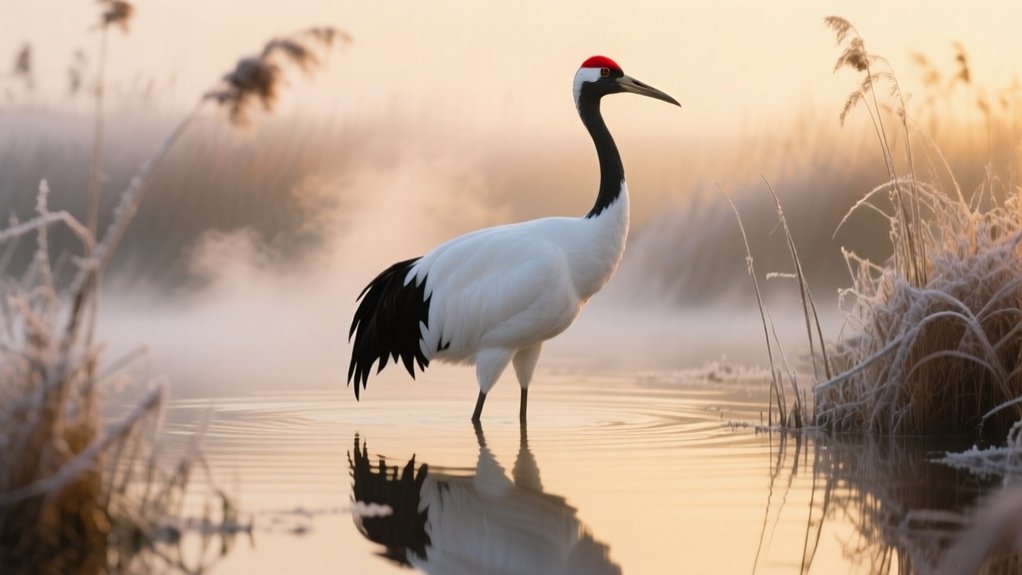
The national bird of China is the red-crowned crane, known for its distinctive red crown atop a tall, white body with a black neck. You’ll find it primarily in wetlands across Siberia, Northeast China, and Mongolia, migrating seasonally to Korea and East-Central China.
This elegant bird symbolizes longevity and fidelity in Chinese culture. Its omnivorous diet and role in maintaining wetland ecosystems are essential for biodiversity.
Investigate further to understand its cultural significance, habits, and conservation efforts.
Overview of the Red-Crowned Crane
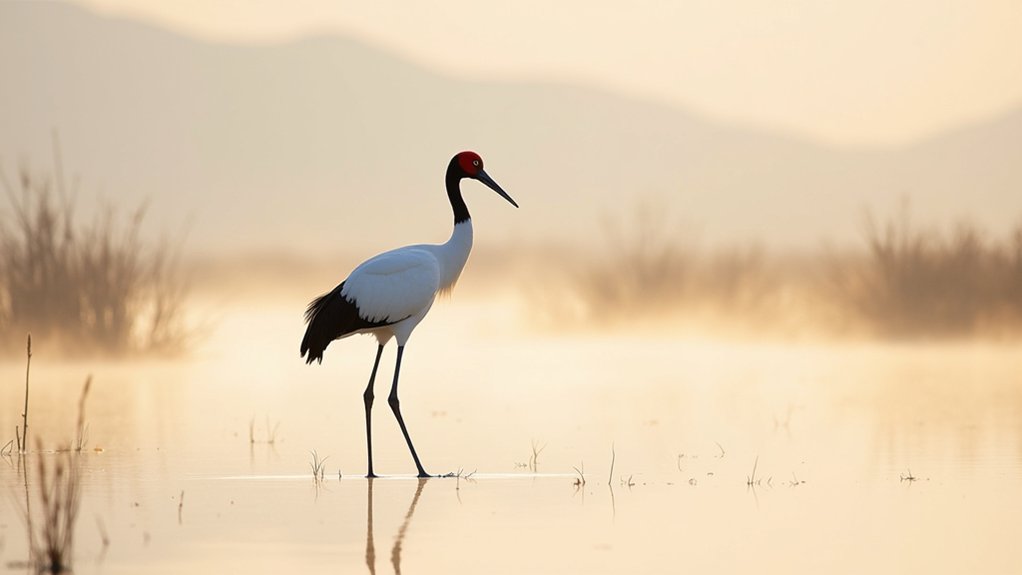
The red-crowned crane, Grus japonensis, stands out as China’s national bird due to its symbolic association with longevity and fidelity across Asia.
You’ll find these cranes primarily inhabiting wetlands, marshes, and paddy fields in Northeast China, Siberia, and occasionally Mongolia.
Their diet is omnivorous, including rice, fish, amphibians, and small rodents, requiring about 750 grams daily.
As an endangered species, the red-crowned crane faces threats from habitat loss, fragmentation, and human disturbances.
Because of this, conservation efforts are essential; initiatives focus on protecting and restoring wetlands important for their breeding and feeding.
Understanding these factors helps you appreciate why the red-crowned crane holds such ecological and cultural importance as China’s national bird.
Physical Characteristics and Identification
You’ll notice the red-crowned crane by its striking red patch of skin atop its head. This patch really stands out and actually gets even brighter during mating season.
These cranes stand tall, between 150 and 158 cm, and their wingspan can reach up to 250 cm. Generally, the males are a bit bigger than the females.
What’s really eye-catching is their snow-white body that contrasts sharply with a black neck.
If you spot a juvenile, you’ll see a mix of white, tawny, and gray hues, which makes them pretty easy to identify.
Distinctive Red Crown
Although you might first notice the striking snow-white plumage of the red-crowned crane, it’s the bright red patch of bare skin on its crown that serves as its most distinctive identifying feature. This patch intensifies in color during mating season, signaling reproductive readiness.
As one of the rarest cranes and a large East Asian crane, the red-crowned crane’s red crown distinguishes it from other species. While adult males exhibit black markings on cheeks, throat, and neck, females show a pearly gray hue in these areas, but both share the vibrant crown.
Juveniles display muted tones and a grayish collar that fade as they mature. This red crown, emblematic in Chinese culture, is essential for identifying Grus japonensis in the wild.
Size and Coloration
Standing between 150 to 158 cm tall with a wingspan spanning 220 to 250 cm, adult red-crowned cranes rank among the tallest crane species.
You’ll notice their snow-white bodies sharply contrast with black wing secondaries.
Males display additional black markings on the cheeks, throat, and neck, while females show a pearly gray tint in these areas, reflecting sexual dimorphism in size and coloration.
These cranes weigh between 4.8 to 10.5 kg, with males generally larger.
A distinctive bright red patch of bare skin crowns their heads, intensifying during mating season.
Juvenile red-crowned cranes exhibit a blend of white, tawny, cinnamon brown, and grayish hues, aiding camouflage.
Understanding this size and coloration aids precise identification of this iconic crane species.
Geographic Range and Preferred Habitats
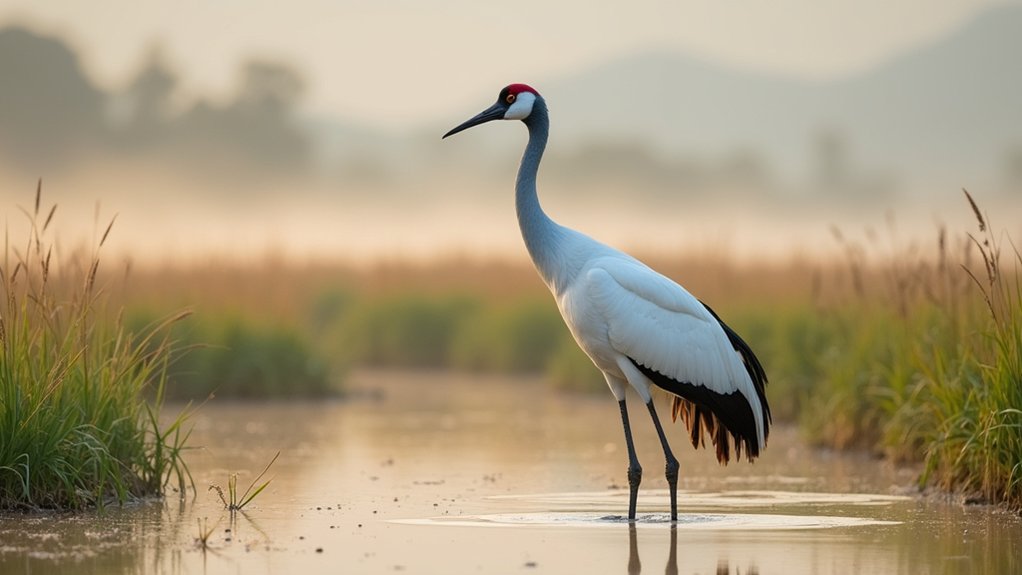
While the red-crowned crane primarily breeds in the wetlands of Siberia, Northeast China, and parts of northeastern Mongolia, it migrates seasonally to the Korean Peninsula and east-central China for winter.
You’ll find its core geographic range centered around Lake Khanka, straddling the China-Russia border, where diverse wetlands support breeding.
The red-crowned crane favors habitats such as marshes, riverbanks, and paddy fields, which supply abundant food and isolated nesting sites.
Significantly, a resident population inhabits eastern Hokkaido, Japan, exhibiting limited seasonal movement.
These varied habitats are essential for their survival, offering protection and resources throughout different life stages.
Understanding the red-crowned crane’s geographic range and habitat preferences helps you appreciate the ecological requirements critical for conserving this emblematic species in China.
Migration Patterns and Seasonal Movements
Understanding the red-crowned crane’s habitat preferences sets the stage for examining its migration patterns and seasonal movements.
You’ll find that this species breeds primarily in Siberia and Northeast China during spring and summer, often near wetlands like those at Lake Khanka.
Come winter, most red-crowned cranes migrate to the Korean Peninsula and east-central China, relying on wetlands, marshes, and rivers as essential stopover and wintering sites.
In winter, red-crowned cranes journey to Korea and China, depending on vital wetland habitats.
In contrast, the population in eastern Hokkaido, Japan, is mostly non-migratory, moving only about 150 km seasonally.
You’ll notice their breeding territories vary from 1 to 7 km, and they typically depart wintering grounds by February to return north.
Flock sizes fluctuate based on food availability, highlighting the importance of wetland habitats along their migration routes.
Feeding Habits and Diet Composition
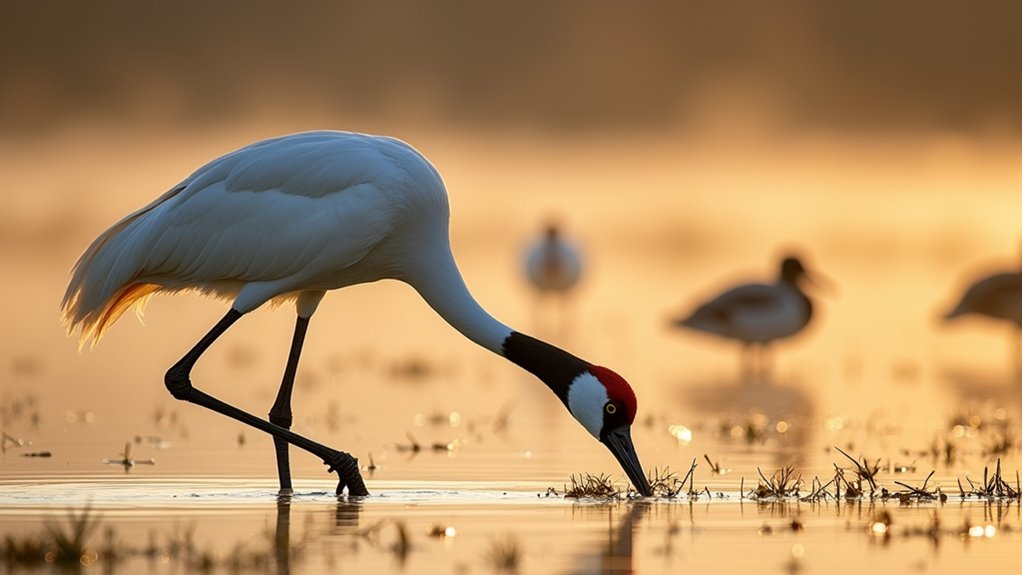
Because the red-crowned crane thrives in diverse wetland environments, it has developed a highly omnivorous diet that includes rice, vegetables, fruits, aquatic plants, fish, amphibians, insects, small reptiles, and rodents. This varied diet composition supports its nutritional needs, requiring approximately 750 grams of food daily.
You’ll find these cranes searching in wet grasslands, cultivated fields, and shallow waters, adapting their feeding habits seasonally.
Key aspects include:
- Preference for plants with high crude protein and low crude fiber, optimizing nutrient intake.
- Utilization of multiple feeding strategies, such as hunting amphibians and foraging rodents.
- Seasonal diet shifts corresponding to breeding and wintering habitat food availability.
Understanding these feeding habits reveals the red-crowned crane’s ecological adaptability and dietary flexibility essential for survival.
Social Behavior and Mating Rituals
You’ll notice that red-crowned cranes form lifelong pair bonds.
They reinforce these bonds through coordinated vocal duets and elaborate mating dances.
These synchronized displays—like jumping and wing flapping—not only strengthen the pair’s connection but also help them assert their territorial boundaries.
Pair Bonding Duets
While observing red-crowned cranes, you’ll notice their distinctive pair bonding duets. These duets play an essential role in their social behavior and mating rituals.
These synchronized vocalizations help establish and reinforce their monogamous partnerships, often lasting for life. Their duets also serve as territorial signals, communicating ownership over nesting areas that span 1 to 7 km.
Key aspects of these pair bonding duets include:
- Long-distance vocal synchronization that strengthens pair bonds and deters rivals.
- Timing during the breeding season, primarily spring, coinciding with mating rituals.
- Demonstration of commitment to resource defense and partnership stability.
You’ll find that these duets are fundamental to both social cohesion and reproductive success in red-crowned cranes.
Mating Dance Displays
Observe how red-crowned cranes perform intricate mating dance displays involving synchronized bowing, jumping, and dancing that reinforce pair bonds and attract mates.
These rituals occur primarily during the breeding season in April and early May, signaling readiness to mate and demonstrating physical fitness.
The dances are complemented by vocal duets, which not only advertise territory but also strengthen social connections within established pairs.
By engaging in these coordinated actions, you witness how red-crowned cranes communicate courtship intent and assess partner suitability.
Successful mating dance displays often culminate in lifelong monogamous pair bonds, highlighting their importance in reproductive success.
Understanding these behaviors provides insight into the species’ social structure and the evolutionary advantages conferred by such elaborate courtship.
Territorial Defense Signals
Although red-crowned cranes are renowned for their elaborate mating dances, their vocal duets play an essential role in territorial defense and social bonding during the breeding season.
These duets function as a critical form of territorial advertisement, signaling occupancy and deterring rivals.
You’ll notice that pair bonds strengthen through synchronized vocalizations and movements, integral to their mating rituals. Their nesting territories span 1 to 7 kilometers, emphasizing space’s importance for resource defense.
Key aspects include:
- Vocal duets establish and maintain territorial boundaries while reinforcing pair bonds.
- Males supplement vocal signals with dance displays to assert dominance and attract mates.
- Coordinated behaviors guarantee synchronized breeding aligned with environmental cues in April and May.
Understanding these signals reveals the complexity of their social behavior and reproductive strategies.
Breeding Cycle and Nesting Practices
Because red-crowned cranes reach breeding maturity at 3 to 4 years old, their reproductive success depends on carefully timed behaviors and strong pair bonds.
Their breeding cycle begins with elaborate courtship dances, followed by territory establishment spanning 1 to 7 kilometers.
Nesting practices occur between April and early May, where females lay 1 to 3 eggs. Both parents share incubation duties, lasting about 30 days, ensuring ideal temperature and protection.
The precocial chicks can walk and forage shortly after hatching but rely on parental care for several months.
Given the species’ endangered status, successful breeding and effective nesting practices are crucial for population recovery.
You must understand these precise reproductive behaviors to appreciate conservation efforts addressing habitat loss and human disturbances threatening red-crowned cranes.
Ecological Role and Interactions With Other Species
You’ll find that the red-crowned crane plays a critical role in regulating wetland ecosystems by preying on fish, amphibians, and small mammals. This helps maintain population balance.
Plus, its foraging behavior also facilitates nutrient cycling and seed dispersal across diverse habitats, like marshes and agricultural fields.
What’s more, the crane’s interactions with other species—such as foraging alongside livestock—really highlight its integral function in ecosystem dynamics and habitat health.
Ecosystem Functions
When you observe the red-crowned crane within wetland ecosystems, you’ll notice it plays an important ecological role by regulating populations of small fish, amphibians, and insects through its omnivorous diet.
This top predator influences prey abundance and distribution, maintaining ecosystem balance.
Furthermore, the red-crowned crane contributes to seed dispersal, enhancing plant diversity and wetland health. Its presence serves as an indicator of habitat quality, aiding wildlife conservation efforts.
Key ecosystem functions include:
- Population control of aquatic and terrestrial prey, preventing overpopulation and resource depletion.
- Seed dispersal through foraging, promoting vegetative regeneration and biodiversity.
- Acting as a bioindicator species, reflecting the environmental integrity of wetland habitats.
Understanding these functions is crucial for supporting conservation strategies focused on the red-crowned crane and its ecosystem.
Species Relationships
Although the red-crowned crane occupies a top predator position in wetland ecosystems, it also serves as prey for larger carnivores. This creates a dynamic balance within its ecological community.
You’ll find these cranes regulate fish, amphibian, and invertebrate populations, directly influencing wetland biodiversity. Their foraging disperses seeds, promoting vegetation growth essential for diverse species.
Sharing habitats with birds, mammals, and aquatic life, the red-crowned crane supports mutual survival strategies. Their presence signals ecological integrity, reflecting habitat health.
| Interaction Type | Species Involved | Ecological Role |
|---|---|---|
| Predator-Prey | Red-crowned crane & fish | Controls aquatic population |
| Mutualism | Cranes & aquatic plants | Seed dispersal and plant growth |
| Competition | Cranes & other birds | Resource sharing and niche balance |
| Prey for Carnivores | Cranes & large carnivores | Maintains predator-prey dynamics |
Habitat Impact
How does the red-crowned crane influence its wetland environment? This species plays a pivotal role in maintaining the ecological balance within its habitats.
By regulating fish and amphibian populations, the red-crowned crane helps sustain aquatic ecosystem stability.
Furthermore, its foraging in agricultural areas aids pest control, indirectly supporting crop health. The crane’s interactions with other species foster biodiversity, enhancing habitat resilience.
Consider these key impacts:
- Controls aquatic prey populations, preventing overpopulation and ecosystem degradation.
- Supports pest management in adjacent agricultural fields, linking natural and human-altered habitats.
- Acts as an ecological indicator, signaling high biodiversity and clean water presence.
Conservation Status and Threats
Because habitat loss and fragmentation have severely impacted the red-crowned crane, the International Union for Conservation of Nature classifies it as endangered. You should know that the global population stands at over 3,800 individuals, with roughly 2,300 adults remaining.
The primary threats include habitat loss, human disturbances, poisoning, poaching, and wetland degradation, all of which jeopardize their survival. Conservation efforts focus on mitigating these threats by protecting critical habitats and raising awareness.
These efforts require international collaboration among Russia, China, Japan, and Korea to address habitat preservation strategically. While these challenges persist, targeted actions aim to stabilize and eventually increase populations.
Understanding these conservation challenges highlights the urgency of protecting this iconic species and the fragile ecosystems they depend on.
Ongoing Protection and Recovery Efforts
Protecting the red-crowned crane demands coordinated actions that address the threats outlined earlier, focusing on habitat preservation and population support. Ongoing protection relies heavily on targeted conservation strategies that mitigate habitat loss and human disturbances.
Effective protection of the red-crowned crane hinges on coordinated habitat preservation and population support efforts.
You can observe the following key efforts:
- Wetland habitat protection initiatives guarantee the cranes have critical ecosystems necessary for feeding and breeding.
- International collaboration among China, Russia, Japan, and Korea facilitates migratory population recovery through shared resources and knowledge.
- Programs like the National Aviary’s egg donation to the Khinganski Nature Reserve bolster genetic diversity and population numbers.
These combined efforts have led to population increases in Japan and Korea, though challenges persist in China.
You must recognize that sustained conservation strategies are essential to avert further declines and secure the species’ future.
Significance in Chinese Culture and Symbolism
The red-crowned crane, or xiān hè (仙鹤) in Chinese, holds profound symbolic significance deeply rooted in Chinese culture and Taoist philosophy. You’ll find this bird embodies longevity and immortality, acting as a spiritual bridge between earthly life and the afterlife.
In traditional Chinese symbolism, it’s closely linked to reclusive scholars, admired for its grace and elegance in poetry and art. The red-crowned crane also represents peace and harmony, frequently depicted in cultural expressions like paintings and literature.
Beyond its ecological role, this crane symbolizes loyalty and fidelity, especially in romantic contexts.
As China’s national bird, it not only reflects the country’s rich natural heritage but also reminds you of the cultural and spiritual values embedded in wildlife conservation efforts.
Representation in Japanese Traditions and Folklore
You’ll find that the red-crowned crane, or tanchōzuru, holds deep symbolic meaning in Japanese culture.
It represents longevity, fidelity, and good fortune. In folklore, it’s often depicted as a messenger of happiness, which really highlights its role in traditional art and ceremonies.
When you look closely at these cultural elements, you can see how the crane embodies key values in Japanese mythology and social customs.
Symbolism in Japanese Culture
Although the red-crowned crane, or tanchōzuru, is native to East Asia, its symbolism in Japanese culture holds particular depth and significance.
You’ll find this bird epitomizes longevity, believed to live for a thousand years, symbolizing eternal life and happiness. Its presence in art and literature conveys peace, fidelity, and loyalty, especially in marriage contexts.
Key aspects of its symbolism include:
- Representation of longevity and eternal happiness, central to health and life expectancy beliefs.
- Emblem of peace and fidelity, frequently depicted in traditional artworks and on currency.
- Role in New Year customs, where origami cranes are gifted to invoke good fortune.
Folklore and Mythology
When exploring Japanese folklore, you’ll find the red-crowned crane, or tanchōzuru, deeply embedded as a symbol of longevity, good fortune, and spiritual significance.
In Japanese mythology, cranes are believed to live for a thousand years, symbolizing enduring life and prosperity. This belief permeates traditional art and literature, where cranes represent peace and fidelity.
You’ll also encounter the famous origami practice: folding a thousand cranes, which is said to grant a wish, underscoring the bird’s role as a symbol of hope and healing.
In ceremonies like weddings, cranes embody loyalty and harmony, reflecting their cultural importance.
Their depiction on Japan’s Series D 1000-yen note further cements their status within folklore, underscoring the crane’s profound spiritual and national symbolism.
Cultural Importance in Korea
Because the red-crowned crane, known as “hakuro” in Korean, embodies longevity and fidelity, it holds a significant place in Korean culture.
This bird’s cultural significance is evident in various domains, including art, mythology, and conservation.
You’ll find that:
- Traditional Korean art and folklore often depict the red-crowned crane as a symbol of peace and harmony, reinforcing community values.
- The crane is considered a national treasure, protected through rigorous conservation efforts aimed at preserving its endangered status and habitat.
- In spiritual contexts, the crane represents the soul’s journey to heaven, highlighting its role in Korean mythology and religious practices.
Historical Research and Scientific Study
Building on the cultural reverence for the red-crowned crane in East Asia, extensive historical research and scientific study have documented its ecological and biological importance.
You’ll find that ancient Chinese art and literature frequently depict the red-crowned crane, underscoring its symbolic association with immortality in Taoism.
Scientific studies reveal that the breeding population primarily inhabits Siberia and Northeast China, especially around Lake Khanka.
The red-crowned crane breeds mainly in Siberia and Northeast China, notably near Lake Khanka.
Migration data show that some red-crowned cranes winter in the Korean Peninsula and east-central China, while a resident population remains in Japan’s Hokkaido year-round.
Conservation efforts involve multinational collaboration between Russia, China, Japan, and Korea, addressing critical threats like habitat loss and human disturbance.
These efforts are crucial for preserving the red-crowned crane’s population and ecological role across its range.
How to Support Red-Crowned Crane Conservation
One effective way you can support red-crowned crane conservation is by participating in habitat restoration projects that focus on preserving and enhancing wetland ecosystems.
These wetlands are essential for the species’ breeding and feeding. Your involvement directly improves habitat quality, increasing survival rates.
Furthermore, donating to organizations engaged in research and conservation programs funds critical activities like population monitoring and nesting site protection.
To maximize your impact, consider these three actions:
- Engage in habitat restoration efforts that maintain wetland integrity and biodiversity.
- Donate to reputable organizations dedicated to red-crowned crane conservation to support scientific research and habitat protection.
- Raise awareness about threats such as habitat loss and human disturbance, mobilizing community support for conservation initiatives.
Frequently Asked Question
How Long Do Red-Crowned Cranes Typically Live in the Wild?
Red-crowned cranes typically live up to 30 years in the wild.
You should know their lifespan depends heavily on factors like habitat quality, food availability, and human threats such as poaching and habitat loss.
If you’re observing these cranes, note they reach breeding maturity around 3 to 4 years and form lifelong pairs, which helps their survival.
Conservation efforts greatly improve their chances of living longer in natural environments.
Are Red-Crowned Cranes Kept as Pets Anywhere?
You won’t find red-crowned cranes kept as pets because they need specific wetland habitats and large spaces to thrive.
Their endangered status means legal protections prevent private ownership.
Instead, you’ll see them only in sanctuaries or zoos where experts support their complex social behaviors and breeding needs.
Trying to keep them at home would harm their welfare and conservation efforts, so it’s discouraged and often illegal to possess them privately.
What Sounds Do Red-Crowned Cranes Make?
You might think red-crowned cranes only trumpet loudly, but they actually produce a complex range of sounds.
Their calls include loud, resonant trumpeting used for long-distance communication and courtship, as well as softer coos, rattles, and whistles that serve social functions within flocks.
During breeding, their vocalizations become more intricate, helping to attract mates and defend territory.
These varied sounds reflect their sophisticated communication system in wetland habitats.
Can Red-Crowned Cranes Be Found in Zoos Outside Asia?
Yes, you can find red-crowned cranes in zoos outside Asia, especially in North America and Europe.
Institutions like the San Diego Zoo and the National Aviary in Pittsburgh actively participate in conservation programs, focusing on breeding and genetic diversity.
These zoos collaborate with global organizations to raise awareness and support habitat preservation, ensuring you explore the species’ behaviors, natural environment, and the challenges they face in the wild.
How Do Red-Crowned Cranes Adapt to Urban Environments?
You’ll find that red-crowned cranes adapt to urban environments by utilizing parks and wetlands within cities.
Studies show they forage in agricultural fields up to 5 kilometers from urban centers.
They adjust their social structure, forming smaller groups or pairs to reduce disturbance.
These cranes exploit omnivorous diets, feeding on crops like rice, and rely on protected green spaces and water bodies.
This highlights their remarkable flexibility in changing habitats.
Conclusion
You’ll find the Red-Crowned Crane’s striking silhouette soaring silently across serene skies, symbolizing strength and serenity. Its precise plumage patterns and purposeful movements paint a picture of nature’s perfection.
By studying its seasonal shifts and specialized feeding strategies, you deepen your understanding of delicate ecosystems. Supporting conservation safeguards these spectacular birds’ survival, ensuring future generations witness their graceful glide.
Adopt efforts that preserve this precious, powerful emblem of East Asia’s environmental elegance.