
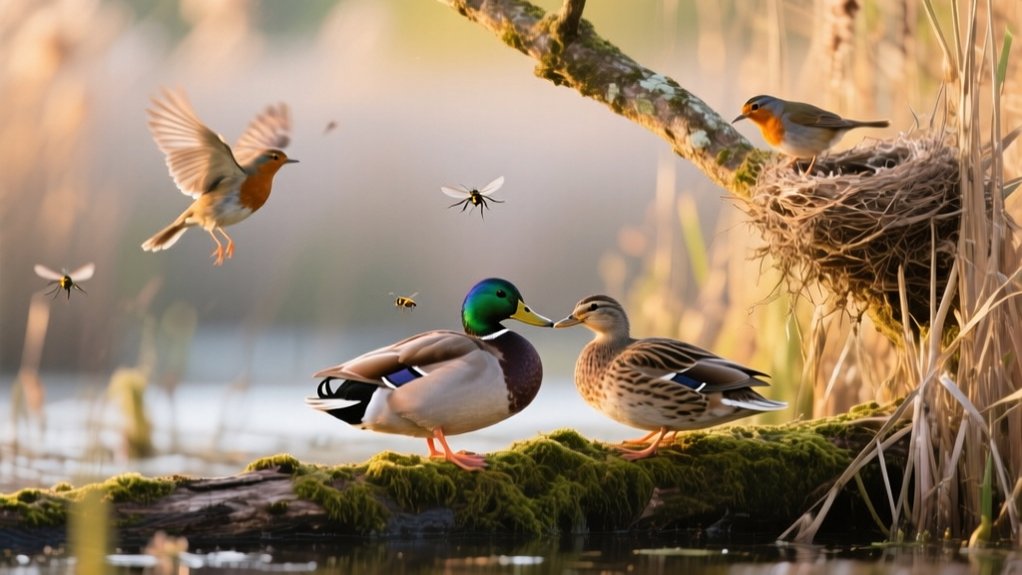
You’ll find most birds entering mating season during spring when longer daylight, warmer temperatures, and abundant food trigger courtship and nesting behaviors. Look for increased male singing, vibrant displays, nest building, and egg-laying starting typically from March to June, varying by species and habitat.
Some tropical and arid-region birds breed year-round or opportunistically after rain. Understanding these timing cues and behaviors reveals complex breeding strategies shaped by environment and climate shifts, offering deeper insights into avian reproductive cycles.
Typical Timing of Bird Mating Seasons Across Regions
Although bird mating seasons vary widely across the globe, they generally align with periods of ideal food availability to maximize offspring survival. In North America, most songbirds breed from late April to June, syncing chick rearing with peak insect abundance. Early nesters like Great Horned Owls start courtship in January and begin nesting as early as mid-February to early March to give their chicks more time to develop hunting skills.
Bird mating seasons worldwide align with food availability, ensuring chicks hatch during peak resource times.
Europe’s breeding season spans March to July, compressed in northern latitudes to 3–4 months, with corvids initiating earlier than smaller passerines.
Tropics feature year-round breeding potential, often tied to wet seasons when food surges, and some species exhibit two breeding peaks annually.
Arid regions see opportunistic breeding triggered by rainfall rather than fixed months, as desert birds rapidly respond to resource pulses.
Understanding these timing patterns reveals how birds adapt reproduction to environmental constraints globally. Additionally, some species like Canada Jays begin nesting very early and rely on food caching to survive harsh winters, though climate change is impacting this strategy.
Environmental Triggers That Signal the Start of Breeding
When environmental conditions shift, birds rely on specific cues to time their breeding precisely. You’ll find that rising spring temperatures strongly influence the onset of egg laying, especially in multi-brooded species where warmer periods extend breeding seasons.
Daylength acts as a primary cue, triggering physiological readiness, while local temperature and food availability fine-tune exact timing.
Snow cover persistence and precipitation patterns affect access to nest sites and food resources, delaying or advancing breeding.
You should also consider how shifts in insect emergence and plant phenology indirectly signal ideal breeding conditions.
Additionally, latitude impacts how these environmental factors interact, with higher latitudes showing more pronounced shifts.
Understanding these triggers helps you grasp why birds breed when they do, aligning reproduction with favorable conditions.
Behavioral Changes Indicating Mating Season Onset
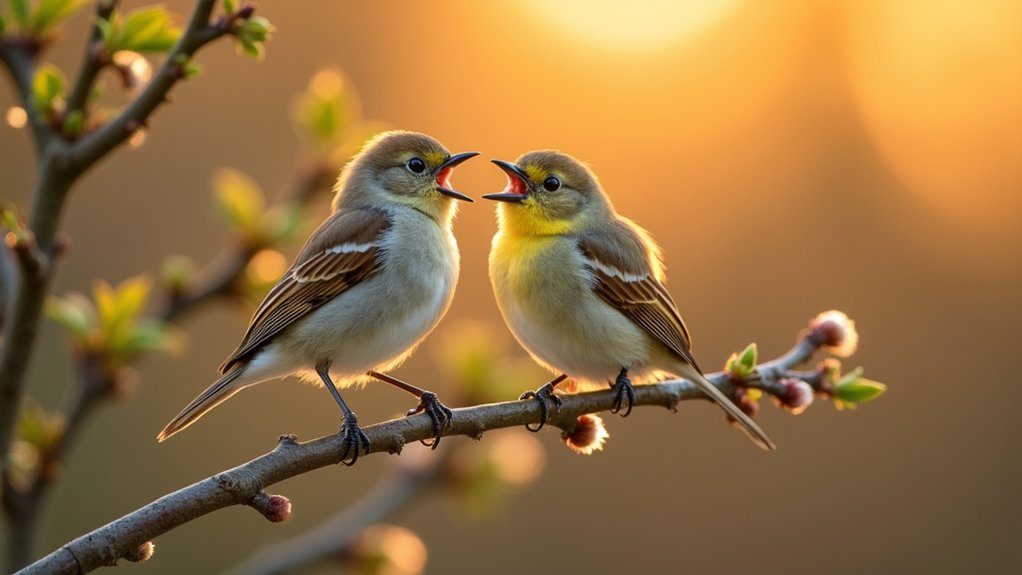
As the breeding season approaches, you’ll notice distinct behavioral changes in birds that show they’re ready to mate.
Males usually increase how often and how loudly they sing, switching from simple calls to complex courtship songs that attract mates or warn rivals away.
Visual displays become more intense too. You might see feather fluffing, tail fanning, and quick body movements.
Females often respond with submissive postures like flat backing and soft vocal sounds. They may also start seeking out dark places and scratch at the cage bottom as part of their nesting behavior.
Pair bonds get stronger through more allopreening and food sharing. Birds also start doing things together, like foraging or sitting side by side.
Territorial aggression rises as well, with birds defending their perches or nests by biting, lunging, or showing threatening postures.
If you have captive parrots, you might notice excessive screaming, wing trembling, and dominance behaviors.
These are linked to hormonal changes that mark the start of the breeding season.
Nesting and Egg-Laying Patterns During Breeding
You’ll notice that many temperate-zone birds start building nests as early as late winter. They carefully pick spots based on where they can find good habitat and plenty of food. For some species, multiple broods per year can occur if food is especially abundant and conditions remain favorable. Once the nests are ready, egg-laying usually kicks off in March. The females lay one egg each day until their clutch is complete. After that, they incubate the eggs for about two weeks or sometimes even longer. The timing of breeding is often triggered by day length, which initiates hormonal changes in birds.
Knowing this timing really helps us understand how birds sync up their breeding to give their chicks the best chance of survival as the seasons change.
Nest Construction Timing
Although nest construction precedes egg-laying by days to weeks, the timing varies considerably across species and regions. You’ll notice many small songbirds complete nests within 2–10 days before clutch initiation, while cavity-excavating woodpeckers may require 3–4 weeks.
In temperate zones, early breeders often begin nest building in late winter to early spring, such as long-tailed tits starting in February but delaying egg-laying until April. Some species, like crossbills, initiate nesting as early as January when food availability peaks.
Nest construction follows distinct phases. It starts with sturdy bases made from thick, rigid materials, then progresses to finer, softer linings for insulation and cushioning. Studies of species such as the Eurasian Bullfinch show that the base of the nest is composed of thicker, stronger, and more rigid materials than the cup lining, emphasizing the importance of mechanical properties in nest stability.
You’ll also observe colonial species refurbishing existing nests early to claim territory. Overall, construction timing balances the need for structural integrity with minimizing exposure to predation and harsh weather.
Egg-Laying and Incubation
When egg-laying begins, timing varies widely across species and regions, influenced strongly by latitude, climate, and food availability. Early breeders like crossbills and Great Horned Owls can start as early as January, while many songbirds lay eggs mainly from April to June. Birds at higher latitudes typically have shorter breeding periods due to cooler temperatures and less daylight.
Clutch sizes range from 1 to 25 eggs, with tropical birds laying fewer and waterfowl more. Most passerines lay eggs daily, promoting synchronous hatching, whereas raptors and herons often start incubating immediately, leading to asynchronous hatching.
Incubation duration correlates with species size, lasting 11 to 14 days in small birds and over a month in large raptors.
Both environmental factors and physiological changes, like hormonal shifts and photoperiod, regulate egg-laying and incubation, affecting timing and reproductive success.
Variations in Mating Seasons by Species and Habitat
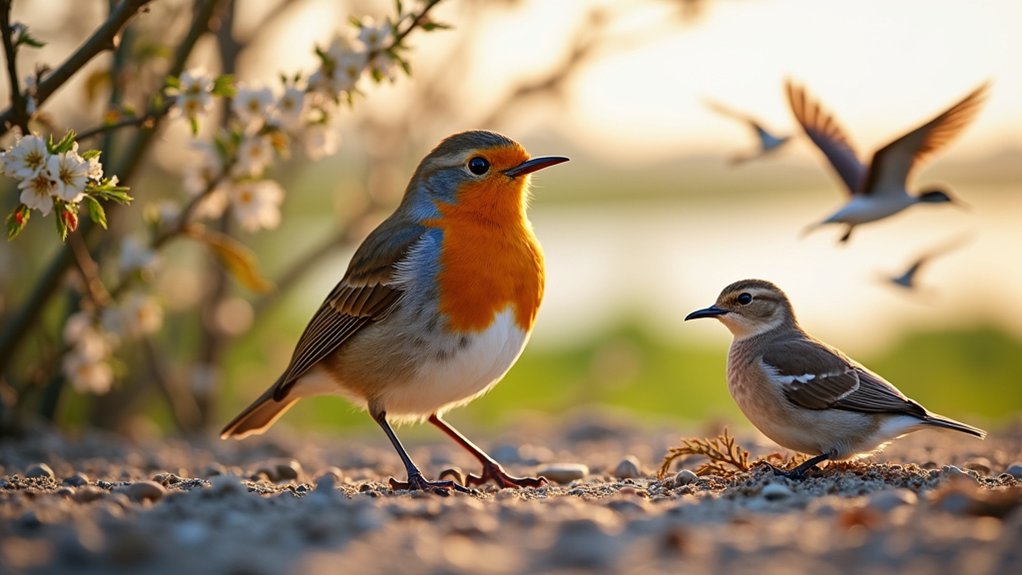
You’ll notice that bird species have their own unique breeding periods, which are shaped by the particular ecological niches they occupy.
Things like temperature, rainfall, and how much food is available all have a big impact on when and how long their mating seasons last. The number of birds at nesting sites is often influenced by food availability, which can affect breeding timing and success.
Species-Specific Breeding Periods
Because breeding periods vary widely among bird species and habitats, understanding these variations is essential for studying reproductive strategies.
For instance, Great Tits start breeding in March, raising 1–2 broods with a 14-day incubation in tree cavities.
Robins also breed early, from March, producing 2 broods in dense vegetation with a 12–15 day incubation.
In contrast, migratory species like House Martins and Common Redstarts begin in May after returning from wintering grounds, timed to peak insect abundance.
Wrens breed in April, raising 2 broods in ball-shaped nests near the ground, while Starlings start in March with 1–2 broods in tree holes.
Early breeders tend to have more broods per season, benefiting from favorable conditions, whereas late breeders often produce fewer broods, showing distinct reproductive timing linked to species-specific life histories.
Additionally, the availability of food sources is crucial for nesting and chick nutrition, directly influencing the timing and success of breeding seasons.
Habitat Influences on Timing
Although bird mating seasons are often linked to species-specific life histories, habitat characteristics play an essential role in shaping the timing and duration of breeding periods. You’ll notice forest birds breed with canopy leaf-out, matching insect peaks. Research shows that human modifications to habitats can significantly influence breeding pairs and mating success in urban bird populations, altering their evolutionary trajectories. Human-modified habitats affect bird mating patterns in complex ways.
Grassland species concentrate early in the growing season, while wetland breeders compress mating to water-level cycles. Desert birds breed opportunistically after rain, and urban birds may extend seasons due to artificial factors.
Climate gradients further modulate these patterns, compressing or extending seasons.
| Habitat Type | Breeding Timing Impact |
|---|---|
| Forest | Synchronizes with canopy growth |
| Grassland | Early, concentrated breeding |
| Wetland | Compressed by water levels |
| Desert | Opportunistic post-rain |
Understanding these patterns helps you predict when and where birds will mate.
Impact of Climate Change on Bird Breeding Timelines
As spring temperatures rise, many bird species have advanced their breeding timelines by several days per decade. This shift is particularly evident in temperate passerines like the Great Tit and Pied Flycatcher.
You’ll notice earlier egg-laying and migration dates tracking warmer springs, especially at higher latitudes. Observations of breeding evidence such as males singing and territorial behaviors help track these timeline changes.
However, these shifts often create mismatches between hatching and peak insect abundance. That reduces nestling growth and fledging success. Some species with flexible diets adjust better, but specialists suffer.
Warmer conditions can boost breeding success initially, yet extreme heat and increased storms raise mortality risks and reduce clutch sizes.
Furthermore, you’ll observe poleward and upslope range shifts as birds seek suitable habitats, altering community dynamics.
Frequently Asked Question
How Do Birds Choose Their Mates During Mating Season?
You’ll notice birds choose mates through vibrant displays like bright feathers or intricate dances, signaling health and genetics.
Males initiate courtship, showcasing assets while females assess these performances, including songs and scents.
Nest-building skills and gift-giving also matter, showing resourcefulness and parental ability.
You’ll see multiple sensory cues, visual, auditory, even olfactory, combine so birds select partners best suited for successful reproduction and offspring care.
What Role Do Hormones Play in Bird Reproduction?
Hormones regulate every stage of bird reproduction.
You’ll see GnRH trigger pituitary release of FSH and LH, stimulating gonads to produce sex steroids like testosterone and estrogen. These hormones drive courtship, gamete production, and nesting behaviors.
Prolactin then promotes incubation and parental care.
Stress hormones like corticosterone can inhibit this process, so your bird’s reproductive success depends on finely balanced hormonal signals responding to environmental cues and internal feedback.
Can Urban Environments Affect Bird Mating Behaviors?
You know what they say: “When in Rome, do as the Romans do.”
In urban environments, birds alter their mating behaviors due to artificial light, noise pollution, and temperature shifts.
You’ll notice earlier singing, prolonged courtship, and changes in song frequency.
These factors disrupt natural rhythms, affect territory selection, and sometimes cause mismatches with food availability.
Ultimately, these changes influence reproductive success and behavior in complex, species-specific ways.
How Do Migratory Birds Synchronize Breeding Across Continents?
You’ll find migratory birds synchronize breeding across continents through endogenous circannual rhythms that set internal schedules for migration and reproduction.
These rhythms adjust via photoperiod sensitivity to align arrival with breeding conditions.
Environmental cues like temperature and vegetation phenology fine-tune timing en route.
High mate fidelity and pair coordination further guarantee synchronized arrival, optimizing territory establishment and clutch initiation.
All of this is tightly coupled with resource peaks for successful breeding outcomes.
Are There Predators That Specifically Target Birds During Mating Season?
You’d think predators throw a nonstop feast during bird mating season! Indeed, many specifically intensify hunting then.
Corvids, gulls, raccoons, snakes, and urban predators like cats ramp up egg and chick predation when nests are fixed and adults distracted.
Birds’ reduced vigilance and noisy displays give predators an edge, targeting eggs, nestlings, and fledglings.
This seasonal surge critically shapes reproductive success and drives complex predator-prey dynamics every breeding cycle.
Conclusion
You might be surprised to learn that nearly 90% of bird species time their mating season to coincide with peak food availability. This ensures their offspring have the best survival chances. By observing shifts in behavior and environmental cues, you can better understand these precise breeding patterns.
Keep in mind, as climate change alters these cues, mating seasons are shifting. This affects nesting timelines and species’ reproductive success in complex, region-specific ways.