
You see birds plunge in winter mainly to find food and avoid harsh cold. They travel from breeding grounds to milder areas, sometimes crossing continents using well-known flyways. Their distances vary. Some move just a few dozen kilometers, others thousands.
They rely on internal magnetic compasses, celestial cues, and daylight-driven biological clocks to navigate. Stopover sites help them rest and refuel during these long journeys.
Understanding their migration reveals intricate survival strategies and diverse behaviors across species.
Reasons Behind Bird Migration in Winter
Although temperature changes signal the approach of winter, bird migration primarily responds to shifts in food availability and energy needs. As insect populations and plant productivity decline sharply in temperate zones, insectivores and omnivores face food scarcity, prompting movement to regions with stable resources. You’ll notice many hummingbirds stay put when reliable natural or artificial food sources persist through winter, highlighting food’s role as the main driver. Migratory birds seek wintering grounds in milder climates where insects, nectar, seeds, and fruits remain accessible throughout the non-breeding season. Changes in daylight length prompt migration behaviors, affecting brain chemistry and hormone production in birds, which triggers their migration restlessness. Poor-quality habitats during winter can impair body condition, reducing survival rates and breeding success. Consequently, migration balances energy demands by tracking adequate food supply, ensuring survival during harsh seasons and preparing birds for the energetically costly tasks ahead.
Varieties of Migration Distances Among Birds
You’ll notice that bird migration distances vary widely. Some birds make short regional shifts of just a few hundred kilometers, while others embark on extreme journeys that span over 90,000 kilometers annually.
For example, species like American Robins usually stick to shorter movements close to their breeding grounds. On the other hand, Arctic Terns are famous for their marathon migrations, traveling between the North and South Poles every year. Recent studies have shown that migration distances for many bird species are actually shortening over time, likely due to climate change and habitat shifts.
Understanding these differences really helps us see how birds adapt their survival strategies to thrive in a variety of environments.
Short vs. Long Distances
When you examine bird migration distances, you’ll find a clear distinction between short and long-distance movements, each with unique ecological and behavioral traits.
Short-distance migrants typically travel 50–100 kilometers, often shifting between nearby habitats or elevations within the same continent. Their breeding and wintering ranges frequently overlap, allowing flexible, latitudinal shifts in response to food availability and snow lines.
In contrast, long-distance migrants cover hundreds to thousands of kilometers, crossing continents and climatic barriers to reach tropical or subtropical wintering grounds. These birds exhibit high site fidelity and use looped routes, demanding precise navigation and endurance. Migration timing and intensity can also be tracked by radar systems, which estimate the number of birds flying at different altitudes and speeds during peak migration periods radar-based measurements.
Behaviorally, short-distance migrants display greater spatial flexibility in wintering areas, whereas long-distance migrants concentrate use in defined locations.
Wing morphology also adapts along this gradient, influencing flight efficiency and migration timing.
Notable Migration Examples
Because bird migration spans a vast range of distances, from local shifts to intercontinental journeys, examining notable examples reveals remarkable adaptations and strategies. You’ll find species like the Arctic Tern traveling 90,000 km annually, showcasing endurance, while Bar-headed Geese cross the Himalayas at 7,000 m altitude, illustrating physiological specialization. These migrations involve intricate routes and stopovers critical for fueling. Migration is often driven by necessity for survival, as birds seek food or suitable nesting locations during different seasons, emphasizing the survival necessity behind these journeys.
| Species | Migration Distance (km) | Notable Adaptation |
|---|---|---|
| Arctic Tern | 90,000 | Longest roundtrip migration |
| Bar-tailed Godwit | 11,000 | Non-stop transoceanic flight |
| Bar-headed Goose | 3,000–5,000 | High-altitude Himalayan crossing |
| Rufous Hummingbird | Variable (loop routes) | Complex seasonal loop migrations |
Understanding these examples sharpens your grasp of avian migratory diversity.
Key Migration Routes and Flyways in North America
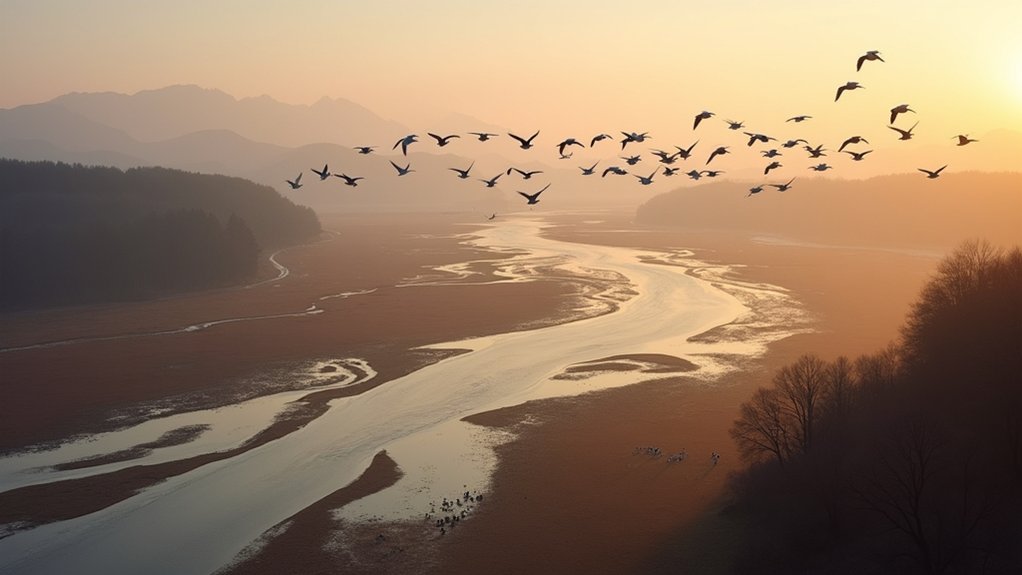
Although bird migration spans vast distances across the Americas, key routes and flyways concentrate these movements into identifiable corridors that facilitate navigation and resource access.
You’ll find four major North American flyways, each essential for different species and habitats:
- The Atlantic Flyway guides over 500 bird species along the eastern coast, using marshes and estuaries like Delaware Bay as crucial stopovers. Birds traversing this flyway often rely on visual landmarks such as coastlines and river mouths to aid in their navigation.
- The Mississippi Flyway funnels 40% of all North American waterfowl through the river valley, relying heavily on wetlands and floodplains.
- The Central Flyway spans the Great Plains and Rockies, linking prairie potholes and river corridors, supporting cranes and grassland songbirds. These flyways are critical for tracking and conservation efforts, serving as essential corridors for migratory species. flyway importance
Understanding these flyways reveals how birds optimize energy and survival during their long winter journeys.
Common Wintering Habitats for Migratory Birds
As you investigate the wintering habits of migratory birds, you’ll notice they rely on diverse habitats that meet their ecological needs during colder months.
Coastal marshes and intertidal zones offer rich invertebrate food sources for shorebirds and waterfowl, while nearshore marine waters shelter sea ducks. In Alaska’s Western Alaska region, coastal areas support wintering sea ducks such as Steller’s Eider.
Inland, freshwater marshes, lakes, and unfrozen river stretches provide important foraging and roosting areas for dabblers, plungers, and swans.
Managed wetlands and agricultural lands supplement natural habitats by supplying grains and green vegetation, essential for sustaining geese and sparrows.
Temperate grasslands and croplands support seed-eating species, while tropical forests and coastal shrubs in Central and South America host Neotropical migrants feeding on insects and berries.
Together, these habitats form complex wintering mosaics critical for survival and subsequent breeding success.
Notable Bird Species and Their December Migration Patterns
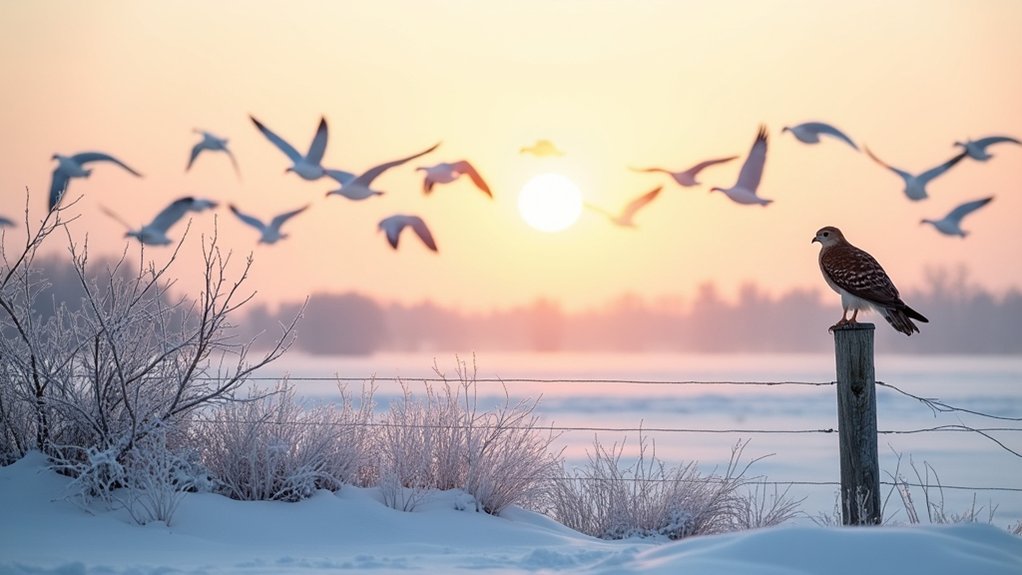
You’ll notice that in December, waterfowl often gather in temperate wetlands where open water is still around. This makes it easier for them to access aquatic resources. Species such as geese, swans, and ducks migrate to the UK in autumn and are commonly seen during this time.
Songbirds, on the other hand, tend to hang out in scrublands and tropical forests. They adjust their foraging strategies depending on the seasonal availability of insects.
Raptors take advantage of these changes too, chasing prey across different habitats to keep their energy up during winter.
Waterfowl December Movements
Four major North American flyways, the Atlantic, Mississippi, Central, and Pacific, serve as critical corridors for waterfowl migration during December.
You’ll notice large flocks of ducks, geese, and swans moving southward in response to cold fronts every 7–10 days. They seek open water and suitable stopovers.
Dabbling ducks like Mallards and Pintails dominate mid-latitude wetlands, shifting only hundreds of kilometers to find food and ice-free habitats. Migration is primarily driven by food scarcity during winter months and the need for survival.
Diving ducks concentrate in deep waters of the Great Lakes, timing their arrival after major snow events.
Geese and swans stage prominently along these routes, forming massive, coordinated V-shaped formations.
Consider these December migration facts:
- Cold fronts trigger fresh waves of waterfowl migration.
- Large flocks use energy-saving flight formations.
- Stopover habitats shrink as small wetlands freeze, intensifying competition.
You witness a precise, dynamic interplay between weather, habitat, and species behavior.
Songbirds and Raptors
Although most songbird species complete their migration by early December, you can still observe surprising numbers of stragglers moving through the region during this month.
Warblers, such as Yellow Warblers and American Redstarts, mostly finish migrating by October.
But late-moving American Tree Sparrows and Snow Buntings establish winter territories in November and December. Fox Sparrows and Lapland Longspurs also arrive late in fall. Other winter finches like redpolls and crossbills have unpredictable arrival times.
Regarding raptors, Rough-legged Hawks begin arriving in early November, escaping Arctic conditions, while Red-tailed Hawks show notable movements through November.
Merlins taper off by December, and Broad-winged Hawks migrate earlier in September.
Raptors travel broadly, so you’ll only see small groups at specific sites. In December, expect fewer active migrants but notable wintering species settling into their seasonal ranges.
How Birds Navigate and Time Their Migration
When birds commence on their seasonal migrations, they rely on a finely tuned internal system that integrates timing and directional cues to navigate thousands of miles.
You can appreciate how their circannual rhythm, triggered by changing day length, initiates migratory restlessness and fat accumulation. These birds inherit precise genetic programs that dictate when to depart and which compass direction to follow, even on their first journey.
Consider these key navigation mechanisms:
- An internal solar compass, synchronized with circadian clocks, guides their daily orientation.
- Magnetite-based receptors sense Earth’s magnetic field intensity, helping determine latitude.
- Celestial cues such as the Sun’s position and star patterns complement magnetic information, ensuring accurate route maintenance. Young birds, during their first migration, imprint on winter ranges, which allows them to return to the same area in subsequent years, enhancing their navigation skills through experience and learning of their specific destination. This imprinting on winter ranges is critical for their long-term migratory success.
Together, these intricate systems enable remarkable precision in migration timing and navigation.
The Role of Stopover Sites During Migration
Because long migratory flights demand immense energy and physiological resilience, birds depend on strategically located stopover sites to rest and refuel.
At these sites, birds can gain 4–10% of their body mass daily by feeding on abundant, predictable resources. This fat fuels subsequent non-stop flights across vast barriers like oceans and deserts.
Birds rapidly gain body mass at stopovers, fueling long non-stop flights over vast barriers.
Stopovers also allow recovery of muscle function and immune capacity impaired by endurance flight. Depending on fuel reserves, habitat quality, and weather, birds may stay from hours to over a week.
Stopover types range from emergency “fire escapes” to resource-rich “full-service hotels,” each serving distinct functional roles. For example, the Great Lakes area serves as a crucial stopover site for various bird species during migration.
These sites form networks along flyways, concentrating migrants and reducing mortality risks. Their spatial distribution and ecological quality critically influence population survival during migration.
Frequently Asked Question
How Do Climate Changes Affect Bird Migration Patterns?
You’ll notice climate changes shift bird migration by making spring arrivals earlier and fall departures longer.
Birds often stay longer on non-breeding grounds due to warmer northern sites. Some species migrate shorter distances or even overwinter farther north.
These shifts disrupt breeding timing with food availability, causing trophic mismatches that hurt chick survival.
Also, drying stopover wetlands increase risks during migration, reducing overall migratory activity and altering community structures.
What Physiological Changes Occur in Birds During Migration?
You experience dramatic physiological changes during migration: your appetite skyrockets due to hyperphagia, doubling your body mass by storing fat as fuel.
Your liver metabolism reprograms for efficient fat combustion, while your heart and flight muscles enlarge to boost oxygen delivery and power output.
Digestive organs grow to handle increased feeding but shrink before departure to reduce weight.
Hormonal shifts trigger restlessness and altered sleep, supporting intense nocturnal flights fueled primarily by lipids.
Do All Bird Species Migrate Every Winter?
No, not all bird species migrate every winter. You’ll find that roughly half of North America’s birds are year-round residents, staying put in their breeding territories.
These residents often show population increases, unlike many migratory species facing declines.
Migration depends on resource availability, climate, and species’ adaptations.
How Do Young Birds Learn Migration Routes?
You learn migration routes through a combination of innate genetic programming, social learning, and individual exploration.
First-time migrants rely on an internal “clock and compass” directing your flight direction and timing.
When you travel with experienced adults, you pick up safer, proven routes and survival strategies.
Over time, your own explorations help refine these routes, balancing energy use with information gained.
This leads to more direct and efficient migrations as you mature.
What Threats Do Migratory Birds Face During Their Journey?
You face a gauntlet when migrating: habitat loss fragments your essential stopover sites, forcing longer flights that drain energy.
Climate change shifts your range, escalating risks and disrupting connections.
Hunters and urban dangers, like collisions with buildings, light pollution, and predators such as cats, threaten your survival.
Pollution poisons your food and environment.
These combined pressures increase mortality and push many species closer to extinction, making your journey a perilous odyssey through an ever-changing landscape.
Conclusion
Now that you’ve investigated where birds go in winter, you understand their incredible journeys aren’t just instinct. They’re finely tuned survival strategies.
Like early explorers relying on ancient maps, birds navigate vast distances using celestial cues and magnetic fields. Their migration routes and stopover sites are essential for rest and refueling.
So next winter, when you watch birds disappear, remember their epic voyage is a marvel of nature’s precise timing and adaptation.