
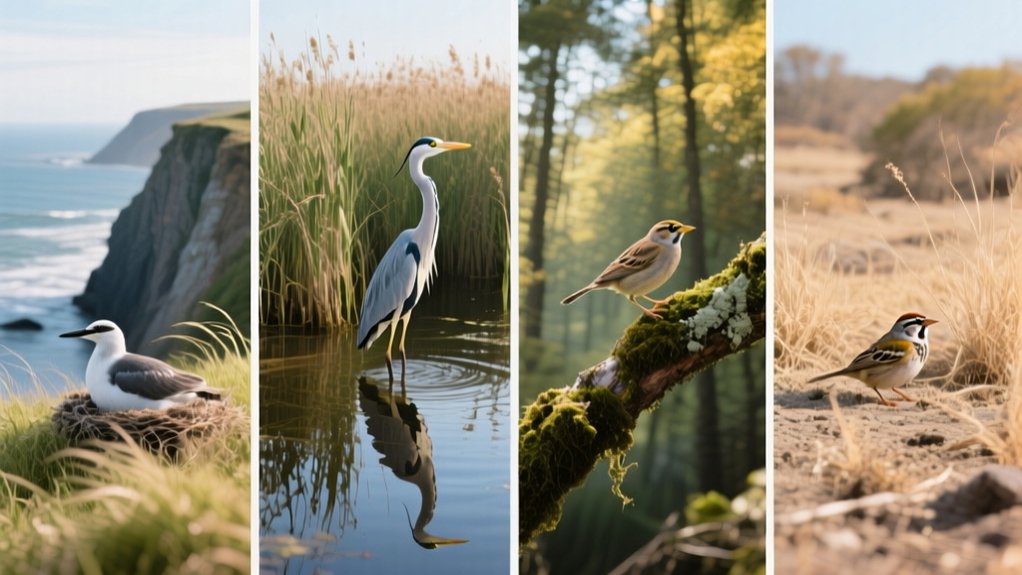
You’ll find birds adapting their foraging, nesting, and behaviors to suit forests, grasslands, wetlands, and urban spaces. Forest birds feed on canopy fruits, while farmland species exploit orchards.
Urban birds often shift diets and body traits to thrive amid pollution and lights. Seasonal migrations and elevation shifts help birds cope with climate and habitat changes.
Their survival hinges on access to suitable food, shelter, and connectivity. Exploring these adaptations reveals how complex and dynamic bird habitat use truly is.
Habitat Preferences Among Bird Orders
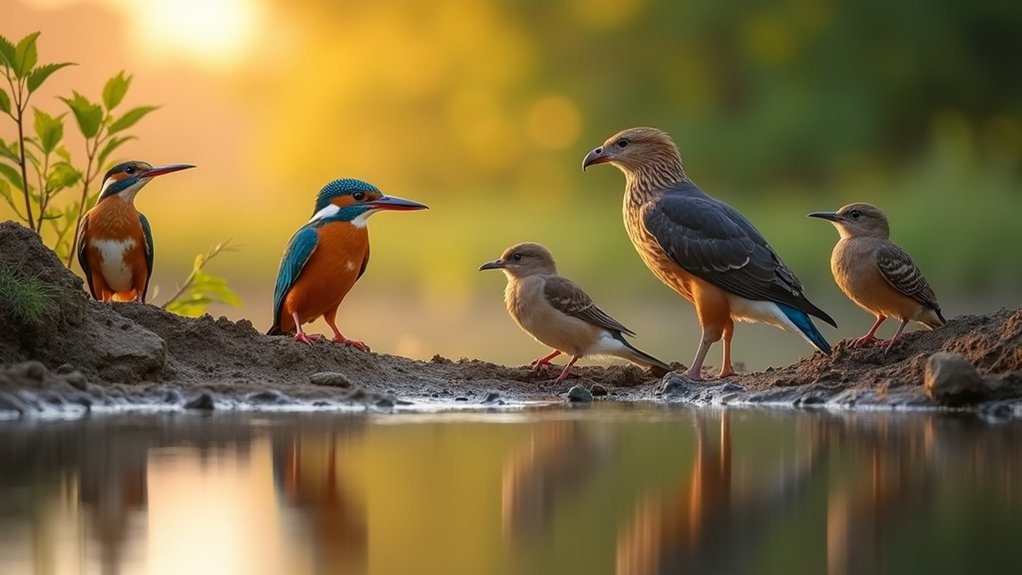
Although bird species exhibit varied habitat preferences, many orders demonstrate distinct affinities for specific environments that reflect their foraging behaviors and dietary needs.
In Taiwan, forest birds, comprising about 31% of identifiable species, specialize in foraging within tree crowns and feeding on canopy fruits. They thrive particularly in conifer, bamboo, and mixed forests. These habitats support balanced populations with high species evenness. Expert opinions have confirmed that many forest bird species strongly prefer these habitats over farmlands.
Farmland birds, numbering 28 species, favor agroforests and orchards that provide abundant fruit resources. This enhances species richness though not evenness. Some generalist species exploit both forest and farmland, attracted by fruiting banyan trees common in agricultural zones.
Grasslands and wetlands foster rich and even bird communities by offering diverse food sources, whereas aquaculture ponds, despite high bird numbers, reduce species evenness.
Your understanding of these preferences highlights the intricate link between habitat structure and avian ecological niches.
Effects of Urbanization on Bird Populations
When urbanization intensifies, bird populations undergo significant physiological and behavioral shifts that reflect their adaptation to city environments.
You’ll notice urban birds often have smaller bodies and eyes, such as cardinals and wrens, adapting to bright lights and pollution. Their diets diversify, and they search within tighter areas. A study found that 32% of species are positively affected by urbanization, showing resilience among certain bird populations. Certain black birds, such as crows and starlings, thrive in urban spaces due to their opportunistic feeding habits and adaptability.
Reproductive patterns shift, with fewer eggs laid per clutch. Some species, like cavity-nesters and seed-eaters, thrive, while others, especially forest and wetland-dependent birds, decline.
Urban birds lay fewer eggs; cavity-nesters and seed-eaters adapt well, forest and wetland species decline.
Noise, air, and light pollution disrupt communication and survival.
Collisions with buildings cause up to a billion bird deaths annually in North America.
You’ll also see urban bird communities homogenize across regions, reducing overall biodiversity despite occasional local diversity boosts through green infrastructure.
These changes highlight complex urban pressures on avian life.
Geographic Distribution and Regional Hotspots
Since bird species richness varies widely across the globe, understanding geographic distribution reveals key regional hotspots critical for conservation. You’ll find the highest species richness in tropical regions like the Amazon, Congo Basin, and Southeast Asia, where small-ranged species cluster in complex landscapes such as the Equatorial Andes and Southeast Asian archipelagos. Maps of these distributions are generated at a spatial resolution of 10×10 km to accurately reflect species presence.
Subtropical montane zones in East Africa and the Himalayas form secondary richness belts linked to elevational gradients. Meanwhile, higher latitudes support fewer species but large populations of widespread birds.
Importantly, hotspots of small-ranged and endemic species often occur in topographically complex or island regions, including the Andes and Southeast Asian islands, where isolation fosters endemism.
These areas face intense human pressures, elevating extinction risk. Recognizing these patterns helps prioritize conservation efforts where diversity is disproportionately high relative to total bird abundance.
Seasonal Migration Patterns and Habitat Use
Understanding seasonal migration patterns reveals how birds optimize timing, routes, and behaviors to balance energy expenditure and reproductive success.
Seasonal migration shows birds finely tune timing and routes to balance energy and reproductive needs.
You’ll notice spring migration is shorter but faster, with longer single flights averaging 16.8 hours, compared to the slower, lengthier autumn migration with more stopovers.
Birds often follow looped routes over oceans to exploit seasonal winds, while inland species use consistent paths. Recent research on Black-throated Blue Warblers shows that spring migration timing has advanced, with early migrants passing through banding sites about one day earlier each decade spring migration timing.
Consider these key points:
- Spring migration advances earlier each decade, lasting about 37 days; autumn lasts roughly 90 days with longer stopovers.
- Birds fly faster in spring, employing time-minimization strategies to reach breeding grounds promptly.
- Autumn detours extend migration distance, enabling molt during extended stopovers.
- Flight durations decrease through spring but increase in autumn, reflecting adaptive energy management.
These patterns illustrate birds’ finely tuned habitat use throughout the year.
Impact of Climate and Environmental Factors
You’ll notice that many bird species are moving their ranges higher up in elevation or further north as temperatures increase. Studies have shown a mean upward motion near 0.5 meters per year during early 21st-century warming. But they can’t always go as far as they’d like because physical habitat limits often get in the way.
Waterbirds are a good example here—they tend to be more or less resilient depending on things like wetland hydrology and how connected the landscape is. These factors help buffer them against extreme climate events.
Climate-Driven Range Shifts
Although climate change alters habitats unevenly across regions, bird species have consistently adjusted their geographic ranges to track shifting environmental conditions. You’ll notice North American birds shifting northward about 1.5 km per year, accumulating roughly 82.5 km over 55 years.
European birds, on the other hand, move generally north, east, and west, reflecting regional climate trends.
When you study these shifts, consider:
- One-third of North American species show significant latitudinal range shifts.
- Birds lag behind temperature isotherms by approximately 210 km, creating a climatic debt.
- Species with narrow thermal niches shift farther north, showing greater climate sensitivity.
- Dispersal limits are minor; delayed local extinctions contribute to range mismatches.
This reveals dynamic, yet incomplete, climate tracking among bird populations. Moreover, montane bird species often exhibit upslope elevational shifts as they seek cooler habitats in response to rising temperatures.
Elevation and Habitat Limits
When temperature drops with elevation, birds face sharply reduced thermal niches that limit their upper range due to cold stress. Meanwhile, heat stress and desiccation often restrict their lower limits.
You’ll notice that at higher altitudes, reduced oxygen partial pressure challenges flight efficiency and aerobic performance. This compels birds to develop physiological adaptations like hemoglobin with higher oxygen affinity and larger lungs. However, these specializations narrow their tolerance for warmer, low-elevation environments.
Moisture gradients also play an essential role. Shifts in precipitation and evaporation alter vegetation zones, reshaping habitat availability upslope or downslope. Studies show that precipitation patterns are frequently overlooked despite their significant influence on elevational ranges.
You must consider that realized elevational limits don’t reflect temperature alone but result from complex interactions among climate, food resources, predators, and competitors.
Furthermore, landscape connectivity often constrains dispersal, preventing birds from occupying all climatically suitable elevations.
Resilience of Waterbirds
Because climate change alters temperature and precipitation patterns, waterbird populations and distributions are shifting noticeably.
You’ll observe some species, like the white-headed duck, declining during droughts, while others such as the ferruginous duck show mixed resilience. This variability reflects how environmental factors impact waterbird survival.
Consider these key aspects:
- Over two-thirds of North American waterbird species face vulnerability under 3°C warming.
- Reduced wet-season precipitation in Mediterranean wetlands limits breeding habitats.
- Increased water temperatures foster disease outbreaks like botulism, affecting populations. Warming waters facilitate botulism outbreaks, linked to toxin production from bacteria in decomposing algae mats.
- Wetland restoration and environmental water management improve habitat resilience, buffering against climate stress.
Conservation Strategies and Habitat Management
Effective conservation strategies and habitat management depend on protecting and restoring large, contiguous habitat areas that support viable bird populations across diverse ecosystems such as grasslands, forests, wetlands, and coastal zones. The 2026 State of the Birds Report highlights that widespread declines in American bird populations across all habitats underscore the urgency of these efforts.
Birds rely on suitable habitats for food, shelter, and breeding, and maintaining these environments is essential to prevent population declines and promote biodiversity.
You should prioritize landscape-scale protection to reduce edge effects and sustain breeding, stopover, and wintering sites integral to migratory birds’ full annual cycles.
Restoring degraded habitats, like prairies and riparian corridors, paired with long-term monitoring, reverses population declines.
Targeting private lands through partnerships expands habitat beyond reserves. Data-driven monitoring informs adaptive management by evaluating projects and threat control, such as invasive woody plant removal and hydrologic restoration.
You must also address habitat loss from development and apply climate-smart practices to bolster resilience.
Collaborative governance and dedicated funding guarantee effective, coordinated conservation across regions.
Frequently Asked Question
How Do Birds Communicate Within Different Habitats?
You’ll notice birds adjust their communication based on habitat. In dense forests, they use low-frequency, complex songs to travel around obstacles.
In open areas, they sing higher, louder notes for distance.
Urban birds raise pitch and volume to overcome noise.
Visual signals vary too; open habitats favor large displays, while dense ones use subtle movements combined with calls.
Birds also rely on tactile and chemical cues in colonies, ensuring social bonds and recognition.
What Adaptations Help Birds Survive Extreme Weather?
You’ll notice birds survive extreme weather through multiple adaptations. They fluff their down feathers to trap heat and seek shelter in cavities or dense foliage.
Their strong tendons lock feet securely during storms, while shivering thermogenesis boosts warmth. Pre-storm feeding increases fat reserves, and seasonal plumage thickens for insulation.
Birds also orient bodies into wind, tuck bills and feet to reduce heat loss, and rely on communal roosting to share body warmth.
How Do Birds Choose Nesting Sites in Urban Areas?
You’ll notice birds in urban areas pick nesting sites strategically, favoring taller trees or raised structures around 25 meters high to reduce predation.
They balance canopy cover under 60% for light and concealment, often using dense foliage or cavities.
Proximity to open foraging spaces matters too, but they avoid heavily trafficked lawns.
Behavioral flexibility lets them exploit artificial substrates, shifting nest sites after failures to maximize survival amid urban challenges.
What Role Do Birds Play in Seed Dispersal in Forests?
You see birds disperse seeds by swallowing fruits, transporting them internally, and defecating fertile seeds far from parent trees.
They scatter-hoard nuts, caching seeds that sprout if forgotten.
They move seeds vertically and horizontally within forests, concentrating seed rain at edges and gaps.
Through these actions, birds accelerate forest regeneration, improve species diversity, and maintain plant-bird networks essential for ecosystem functions like carbon storage and habitat provision.
How Do Bird Diets Vary Across Habitat Types?
You’ll notice bird diets shift with habitat: in forests, they mainly eat insects and fruits, matching beak size to fruit size for efficiency.
In grasslands and farmland, seed consumption dominates, but they switch to insects during breeding.
Wetlands favor aquatic invertebrates, fish, and plant seeds.
Coastal birds often specialize in intertidal prey.
Urban birds rely heavily on supplementary feeding, altering natural diet patterns considerably.
Conclusion
You’ll find it fascinating that over 50% of bird species have adapted to urban habitats, showcasing incredible resilience. As you observe how birds thrive across diverse environments, from dense forests to city parks, you’ll see how seasonal migrations and climate shifts further shape their distribution.
Understanding these patterns is essential for effective conservation. It helps you appreciate the delicate balance between birds and their habitats amid ongoing environmental changes.