
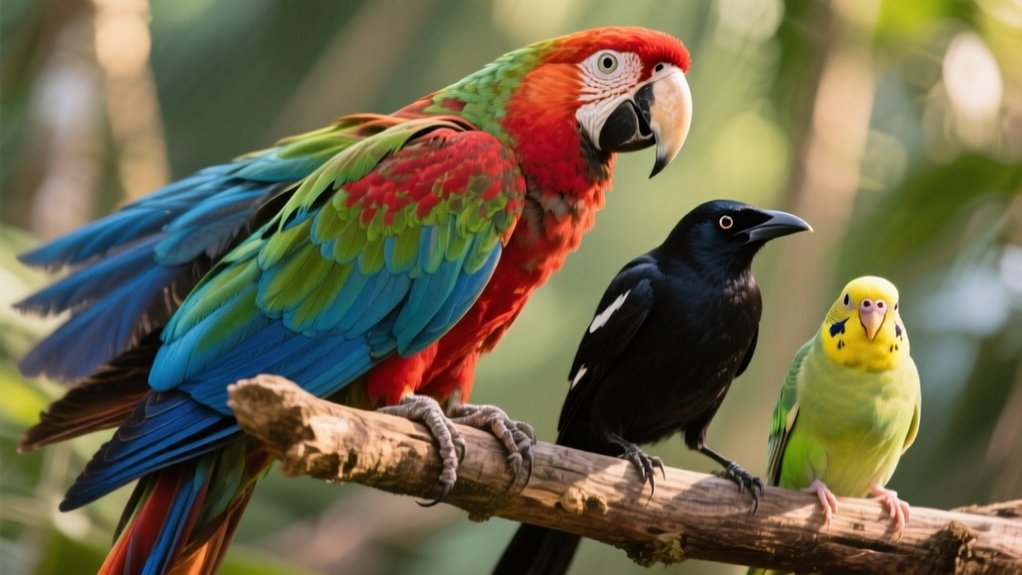
You’ll find that certain birds, like grey parrots, amazona parrots, and mynas, excel at mimicking human speech, often mastering extensive vocabularies and accurate context usage. Their specialized syrinx and neural pathways enable complex sound production and learning.
Factors like social interaction, brain architecture, and juvenile neuroplasticity improve their vocal abilities. You also see diverse natural repertoires and distinct dialects among species.
Exploring these aspects reveals fascinating insights about their communication and conservation needs.
Understanding Bird Vocalization and Mimicry
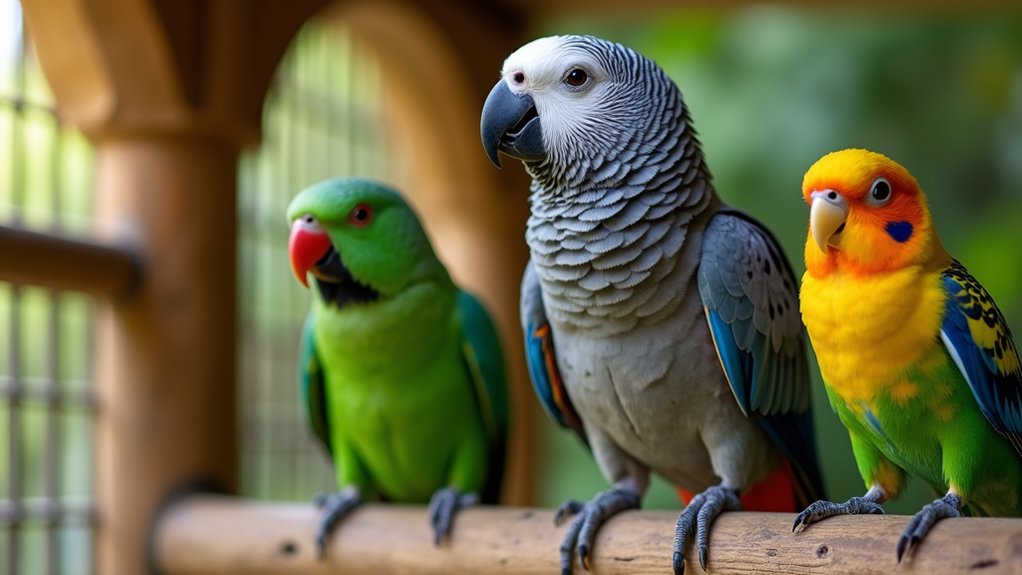
How do birds acquire the remarkable ability to mimic sounds and human speech? You should know that vocal mimicry depends on specialized brain regions and neural pathways.
In corvids, for example, distinct areas process acoustic structure and sequence sounds, while motor outputs refine vocalizations. The Corvidae family includes ravens, crows, magpies, and jays, all known for their impressive vocal mimicry capabilities.
Parakeets exhibit brain regions analogous to human verbal centers, supporting their speech-like mimicry.
This complex neural circuitry enables birds to replicate diverse sounds, from conspecific calls to human speech.
You’ll find that vocal learning develops through listening to tutors and social interaction, shaped by genetic predispositions and ecological factors.
Mimicry serves various functions, including resource competition, social communication, and mate attraction.
Understanding these cognitive mechanisms reveals how select bird species evolved sophisticated vocal abilities essential for survival and reproduction.
The Unique Role of the Syrinx in Bird Speech
Although birds share some respiratory structures with other vertebrates, their ability to produce complex vocalizations hinges on the syrinx, a specialized organ located at the base of the trachea where it splits into two bronchi.
This unique structure, absent in mammals and reptiles, contains paired membranes controlled by multiple muscles that adjust tension for precise vibration.
You’ll find that the syrinx’s dual-sided design lets birds generate independent sounds from each side simultaneously, enabling intricate vocalizations like internal duets.
Airflow stretches the membranes, with resonance improved by surrounding air sacs, achieving acoustic efficiency far surpassing the human larynx.
The syrinx’s cartilaginous support and optimized tracheal length further refine sound production, illustrating evolutionary adaptations that empower birds’ remarkable speech capabilities. Additionally, some species can produce two notes simultaneously by using independent control of each side of the syrinx, enhancing their vocal complexity (simultaneous two-note production).
Grey Parrots: Masters of Mimicry and Vocabulary
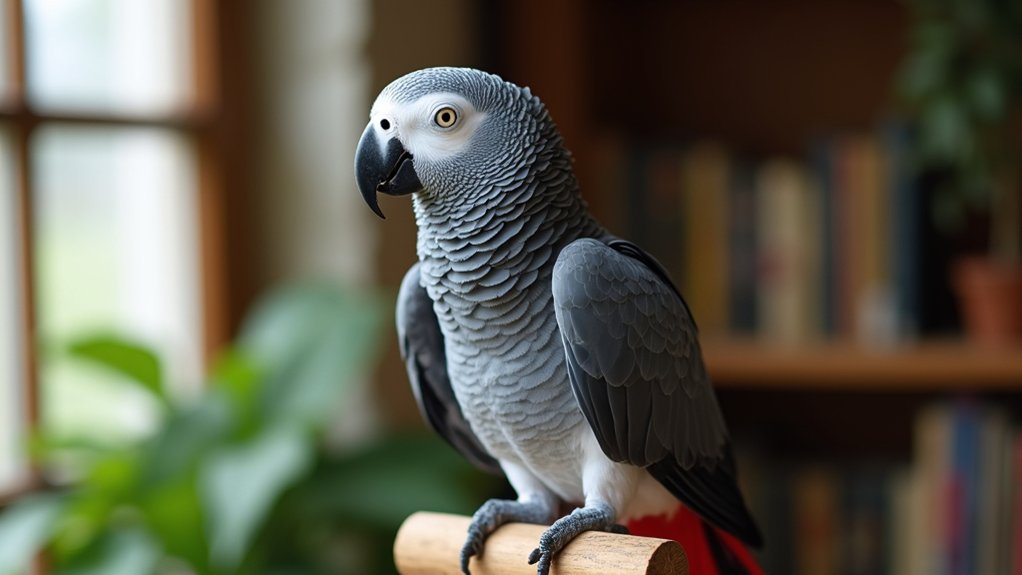
The syrinx’s complex anatomy equips certain bird species with extraordinary vocal abilities, but grey parrots stand out even among skilled avian vocal learners. You’ll find their vocabulary surpasses other parrots, averaging about 60 words, with some individuals mimicking over 500.
These birds don’t just mimic; they understand phonological units and recombine sounds to create novel words, demonstrating true linguistic competence. Their tonal accuracy and context-appropriate word use further differentiate them.
Consider these remarkable traits:
- Extensive vocabularies reaching 100+ words under laboratory conditions
- Phonological awareness enabling novel word formation
- Precise mimicry capturing individual human voices
- Complex comprehension of objects, colors, and numbers
You’re witnessing a species that redefines avian vocal learning through cognitive sophistication and vocal artistry. In addition, grey parrots mimic speech to feel included in their social environment, as they consider humans as part of their social flock.
Vocal Abilities of Amazona Parrots
You’ll find Amazona parrots exhibit remarkable vocal flexibility. They master complex sound patterns by learning from their environment, not just through genetics.
It’s pretty fascinating how their surroundings shape what they can say.
Now, species and gender also play a role in their vocal repertoires. For example, some species like the Double Yellow-headed Amazon have more extensive vocabularies.
They also tend to have clearer speech compared to others.
Understanding these differences really helps us appreciate how advanced their communication skills are. Additionally, the Yellow-Naped Amazon is especially noted for its exceptional vocal abilities and engaging conversational skills.
Plus, it sheds light on their social interactions, which are quite intricate.
Vocal Flexibility and Learning
When studying Amazona parrots, you quickly notice their vocal flexibility. This flexibility plays an essential role in their communication and social interactions.
These parrots show geographic vocal variations with distinct dialects that remain stable over decades. This stability demonstrates their impressive vocal learning abilities. Their vocal repertoire also adapts to behavioral contexts. Recent research has demonstrated that these dialects are regionally specific and do not overlap across different populations, underscoring the presence of distinct vocal dialects.
Plus, individual birds maintain unique vocal signatures that help with recognition within flocks. However, population declines impact vocal stability. This leads to altered dialects and decreased vocal diversity.
- Amazona parrots sustain stable vocal dialects for over 20 years.
- Individual vocal signatures allow precise identity recognition.
- Vocal repertoire complexity varies with environmental and social contexts.
- Declining populations disrupt learned vocal patterns and dialect maintenance.
This vocal plasticity highlights their advanced communicative capacity.
Species and Gender Differences
Although Amazona parrots show no visual sexual dimorphism, their vocal abilities present subtle species- and gender-specific variations that influence communication and learning.
You’ll find that most Amazona species exhibit equal vocal capacity across sexes, requiring DNA tests for sex determination due to identical morphology.
Significantly, female Yellow-headed parrots outperform males in mimicry repertoire size, contrasting with Blue and Yellow macaws where males dominate vocal output.
Species-specific capabilities vary widely: Grey parrots boast the largest mimicry repertoires, while Yellow-naped Amazons maintain stable geographic dialects integral to regional identification.
Behavioral temperament also differs; females tend to be calmer, males more vocal.
However, individual variation within sexes often exceeds intersex differences, underscoring the complexity of Amazona vocal communication and the necessity to evaluate each bird’s learning potential independently.
It is important to note that individual parrots vary in their talking ability, so training and attention are crucial factors influencing their speech development.
Talking Mynas and Their Speech Repertoire
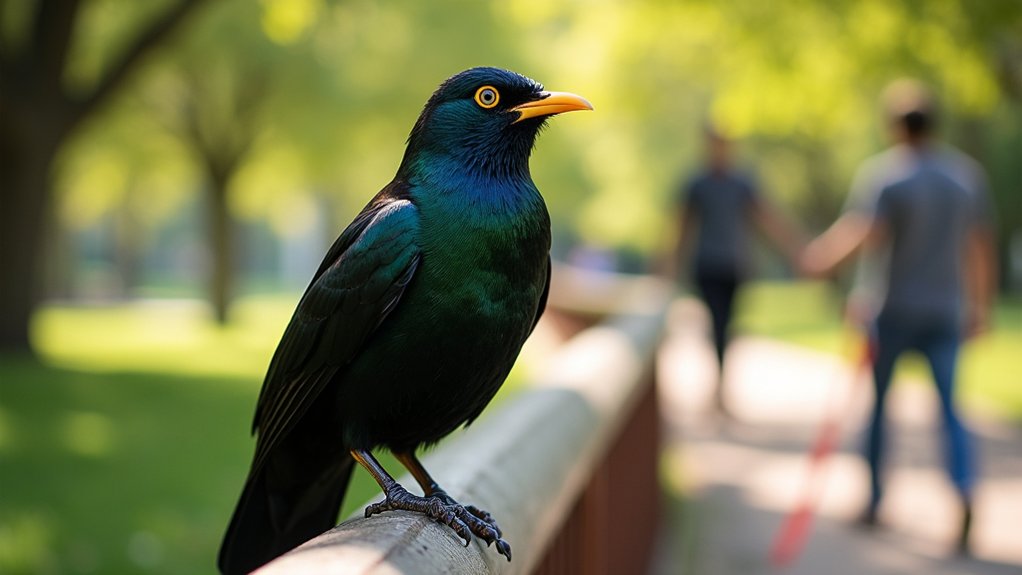
You’ll find that mynas have quite a range when it comes to their speech abilities.
Take the Hill Myna, for example—they’re especially good at mimicking sounds, way more so than some of their relatives.
It’s pretty interesting how their vocalizations can change depending on the species and even where they’re from, kind of like different dialects in human language.
Plus, their conservation status plays a role too. If their populations decline, it can affect how well these unique speech patterns are preserved over time.
Many mynas are native to Southern Asia, which influences their natural habitat and behaviors.
Myna Speech Capabilities
Anyone interested in avian vocalization will find mynas particularly remarkable for their speech capabilities. Common and hill mynas exhibit advanced mimicry, reproducing human speech and environmental sounds with precision.
You’ll notice individual mynas can learn over 100 words, expressing a range of needs and emotions through varied vocalizations, from chirps to whistles. Their syrinx and neurological structures enable this sophisticated vocal control.
Consider these key aspects of myna speech capabilities:
- Consistent training with repetition and positive reinforcement is essential for learning.
- Younger birds under six months acquire speech faster due to neuroplasticity.
- Social interaction and stimulating environments greatly improve vocal development.
- Sleep quality directly influences memory retention and vocal performance. Studies have shown that sleep deprivation can cause mynas to sing simpler songs and reduce their overall vocal output, demonstrating the importance of sleep for vocalization.
Species Vocal Variation
Building on the impressive speech capabilities of mynas, it’s important to recognize that vocal abilities vary considerably between species. Hill mynas exhibit far superior mimicry, reproducing over 100 words and everyday sounds with remarkable clarity. Common mynas, while vocal with distinct scolding calls, lack this complexity. Additionally, hill mynas develop their vocal repertoires when young and show strong dialectal variation that changes rapidly with distance.
Vocal repertoires differ not only by species but also regionally, with dialects shifting rapidly over short distances.
| Aspect | Hill Mynas | Common Mynas |
|---|---|---|
| Vocal Range | Wide, includes human speech | Moderate, species-specific calls |
| Mimicry Accuracy | Exceptional, clear human speech | Less sophisticated mimicry |
| Social Learning | Strong dialectal variation | Distinct, repetitive calls |
You should tailor expectations based on these species-specific vocal traits.
Conservation Status Impact
Although conservation challenges threaten many myna species, their speech repertoires offer unique insights into the urgency of preservation efforts. The critically endangered Bali myna, with fewer than 50 wild adults remaining, exemplifies this. Its distinctive vocal mimicry underscores the cultural and biological value at risk. The Bali myna is the only endemic vertebrate species of the island of Bali, making its conservation especially significant.
You can grasp the stakes through these points:
- Bali mynas’ extinction trajectory parallels the lost Bali tiger, demanding urgent vocal documentation.
- Hill mynas face population collapse from habitat destruction and trade, risking loss of their rich vocabulary.
- Common mynas thrive invasively, yet their speech skills impact native ecosystems negatively.
- Captive breeding and community programs foster survival and vocal recovery, highlighting conservation’s role in preserving these complex communicators.
Understanding their speech helps you appreciate the critical need for targeted preservation.
Cockatoos and Their Vocal Learning Skills
When you examine cockatoos, you’ll find their vocal learning skills stand out due to specialized neural circuits that support continuous acquisition of new sounds throughout their lives.
Their brains utilize both Anterior Forebrain Pathways (AFP) and Posterior Forebrain Pathways (PFP) for dynamic vocal learning, a mechanism distinct from songbirds and more analogous to human vocal learning.
This neural architecture enables cockatoos to flexibly rearrange vocal elements, as seen in species like the sulphur-crested cockatoo, which frequently reorganizes sounds. Ongoing research suggests that parrot brain mechanisms may share similarities with humans, differentiating them from other birds like songbirds.
Their mimicry extends beyond human words to ambient noises, demonstrating contextual use and creative language formation without prompting.
Vocal flexibility correlates strongly with larger vocal repertoires and social bonding, highlighting the complex integration of neural and behavioral factors that underpin cockatoos’ sophisticated vocal communication abilities.
Sex Differences in Bird Talking Abilities
The vocal learning abilities observed in cockatoos highlight intricate neural and behavioral mechanisms, but these capabilities don’t manifest consistently across sexes in all bird species.
In many songbirds, males possess larger song control nuclei, correlating with more complex singing behavior, while females often show compensatory neural adaptations. Both sexes can learn vocalizations, yet females may have a shorter sensitive period for song memorization. This difference sometimes influences the complexity of vocalizations produced by each sex.
Parrots, however, reveal parity in talking ability, with males and females similarly capable of mimicking human speech.
- Male songbirds generally sing more complex songs due to neural volume differences.
- Female songbirds can achieve comparable vocal outcomes via alternate neural pathways.
- Hormonal fluctuations modulate auditory and vocal capacities seasonally.
- Parrots exhibit no sex-based disparities in speech mimicry.
Natural Vocal Repertoires in Wild Talking Birds
Since vocal repertoires underpin communication and social interaction, understanding their size and complexity in wild talking birds is essential.
Grey parrots, for example, possess about 39 distinct vocalizations, while yellow-naped parrots, palm cockatoos, and others exceed 25 discrete vocal elements.
Grey parrots have around 39 unique vocalizations, with yellow-naped parrots and palm cockatoos exceeding 25 elements.
Most wild parrots use 5 to 15 calls naturally. Non-parrot mimics like lyrebirds and starlings incorporate environmental sounds into complex sequences, demonstrating advanced vocal flexibility.
Within species, repertoires vary greatly. Grey parrots can mimic zero to 600 human words, reflecting differences in individual learning capacity. A recent analysis of 877 birds found that sex, age, or social interactions generally do not have overarching effects on vocal repertoires, highlighting the complexity of mimicry repertoires.
Vocal flexibility correlates with repertoire size, particularly strong in cockatoos. Brain and syrinx structures differ across species, influencing vocal capacity.
These natural repertoires serve specific behavioral contexts, shaped by evolutionary pressures. They reveal intricate communication systems in wild talking birds.
Cognitive Factors Behind Bird Speech Learning
You’ll find that bird speech learning hinges on specialized brain structures that are quite similar to human language centers, like the cortex-basal ganglia-thalamus circuit.
This neural setup supports complex learning mechanisms. It involves things like auditory feedback and fine-tuning motor control, especially during sensitive stages of development.
Recent studies with Bengalese finches have shown that these birds can modify their song sequences in response to visual cues, demonstrating flexible cognitive control over vocalizations.
When you understand these processes, it becomes clear how birds acquire and adapt their vocalizations. They do this through a mix of innate pathways and interaction with their environment.
It’s pretty fascinating how much their brain architecture supports this kind of learning!
Brain Structures and Speech
Although bird species like songbirds, parrots, and hummingbirds evolved their vocal learning abilities independently, they share a remarkably comparable set of seven vocal brain nuclei that coordinate learned vocalizations.
This system divides into two pathways: a posterior pathway controlling motor neurons for vocal organ movement, and an anterior pathway forming loops integrating sensory feedback with motor output.
You’ll find left-hemisphere dominance in regions analogous to human Broca’s and Wernicke’s areas, supporting complex speech-like processing.
Key features include:
- Dual-pathway control enabling precise vocal motor execution and learning refinement
- Motor nuclei such as HVC and RA driving vocal output likewise across species
- Neural encoding of phoneme-like units in parrots mirroring human speech areas
- Evolutionary convergence producing functional brain architectures despite distinct origins
Brain structure is more significant than brain size for vocal learning capabilities, highlighting the importance of specialized forebrain areas. brain structure significance
Understanding these brain structures reveals the neurobiological basis behind birds’ remarkable speech abilities.
Learning Mechanisms in Birds
When juvenile birds engage in social interactions, their vocal learning accelerates markedly due to improved attention and sensory integration. You’ll notice adult tutors modify song structure by extending intervals and changing acoustic features when addressing juveniles. This behavior improves encoding and long-term retention.
Attention plays a critical role. Socially tutored birds show considerably greater catecholaminergic neural activity, particularly EGR-1 expression, which facilitates auditory processing in critical brain regions. This neuromodulation integrates multimodal sensory inputs, boosting vocal acquisition efficiency. Songbirds serve as ideal models for studying neural mechanisms of vocal learning and language disorders, providing insights into the specialized forebrain regions involved in vocal control songbird model.
Social interactions amplify attentional mechanisms beyond passive exposure, producing steeper learning gains. Additionally, midbrain catecholaminergic neurons modulate learning trajectories by habituating to repeated stimuli, balancing exposure and novelty.
Consequently, vocal learning in birds is a hierarchically organized, socially mediated neural process where attention, sensory integration, and neurotransmitter activity converge to optimize speech acquisition.
Conservation Status of Talking Bird Species
While extensive conservation data specific to talking bird species remains limited, understanding their status is essential due to the ecological and cultural significance of vocally advanced birds like parrots, mynas, ravens, and crows.
These species play crucial roles in ecosystems and human culture, yet face threats that risk their survival. According to the 2026 U.S. State of the Birds report, many bird populations are experiencing significant declines due to habitat loss and environmental stressors.
Consider these critical concerns:
- Habitat loss disrupts breeding and feeding, diminishing populations.
- Illegal pet trade targets parrots and mynas for their mimicry skills.
- Environmental pollution impairs vocal communication, affecting social structures.
- Climate change alters habitats, stressing adaptive capacities.
Although precise conservation assessments are sparse, these pressures demand your attention.
Supporting habitat preservation and enforcing wildlife trade regulations can help sustain these remarkable talking birds for future generations.
Frequently Asked Question
How Do Talking Birds Learn Words From Humans?
You learn words from talking birds by engaging in consistent, social interactions, where you repeatedly expose them to sounds linked to objects or actions.
You’ll need to use soft, high-frequency tones and reward their attempts, encouraging imitation.
Birds imitate through neural mechanisms similar to human speech learning, refining sounds via practice and feedback.
Providing environmental exploration and patience accelerates their vocabulary development, especially in younger birds with active social engagement.
Can All Parrots Be Trained to Talk?
Not all parrots can be trained to talk effectively. Their ability depends largely on species-specific vocal learning capacities.
While African grey parrots excel, others like cockatoos and amazons have moderate mimicry skills. Some species show minimal or no aptitude for human speech.
Individual variation and age influence outcomes, but innate cognitive and anatomical constraints limit true language comprehension and vocabulary size.
Do Talking Birds Understand the Meaning of Words?
Yes, talking birds like African grey parrots do understand the meaning of certain words, especially those linked to concrete objects or actions.
You’ll find that their comprehension extends beyond mere mimicry; they use words contextually, demonstrating cognitive association.
However, this understanding is mostly limited to tangible concepts, with abstract terms less reliably grasped.
Training quality and social interaction directly influence how effectively they grasp and use language meaningfully.
How Long Does It Take for a Bird to Start Talking?
Like a slow-burning fuse, a bird’s first words can ignite anywhere between a few months to over a year.
African Grey parrots often start speaking around 12 to 18 months, with Timneh species sometimes earlier.
Quaker parrots may mimic sounds within months, but some take up to a year.
Factors like species, age, personality, and training methods dictate this timeline, so you’ll need patience and consistent practice to see results.
Are Talking Birds More Intelligent Than Non-Talking Birds?
Yes, talking birds generally show higher intelligence than non-talking birds. You’ll find they excel in problem-solving and cognitive tasks, closely linked to their vocal learning abilities.
Parrots and corvids, for example, demonstrate cognitive skills on par with primates, mastering complex communication, tool use, and contextual recognition.
Their brain structures support advanced neural processing, giving you clear evidence that vocal learning correlates strongly with improved intelligence in birds.
Conclusion
You might be surprised to learn that Grey Parrots can mimic over 1,000 words, showcasing exceptional vocal learning abilities. Understanding how their syrinx enables such complex mimicry reveals not only fascinating cognitive traits but also highlights the importance of conserving these intelligent birds.
By appreciating their unique speech capacities and natural behaviors, you contribute to efforts protecting these species and deepening scientific knowledge about avian communication and cognition.