

You can identify a Whimbrel by its medium-large size (15–19 inches) with a long, down-curved bill sharply bent near the tip and a distinctive striped crown featuring a pale central stripe flanked by dark sides.
Their flight shows a characteristic “7” wing shape and a white rump patch. Listen for rapid, clear whistled calls repeated 5 to 7 times, often in flight.
These precise field marks and vocal patterns stand out among shorebirds. Exploring further reveals even finer identification details.
Size and Overall Shape of the Whimbrel

When identifying a whimbrel, you’ll notice its size places it firmly in the mid-sized category of the curlew genus, measuring between 15 and 19 inches (37–47 cm) in length with a wingspan spanning 30 to 35 inches (75–90 cm).
You’ll find its weight varies from 9.5 to 17.4 ounces (270–493 g), reflecting individual differences.
The whimbrel has a robust, compact frame with a relatively long neck and long, stilt-like legs adapted for wading.
The whimbrel’s sturdy frame and long legs are perfectly designed for graceful wading.
Its feet, slightly webbed and showing blue or blue-gray hues, improve aquatic movement.
The bird’s long, down-curved bill is distinctive, shorter in juveniles than adults, and the body exhibits grayish-brown, streaky plumage.
Its distinctive striped head with a dark brown crown and pale central stripe is a key identification feature.
This precise combination of size and shape aids your confident identification in the field.
Comparing Whimbrel Size to Other Shorebirds
If you want to accurately distinguish a whimbrel from other shorebirds, understanding its size relative to similar species is essential. The whimbrel measures 37–47 cm in length with a wingspan of 75–90 cm, roughly matching the American Crow’s size.
It’s significantly smaller than the Long-billed Curlew, whose bill is considerably longer. Male curlews’ bills exceed whimbrels’, and female curlews’ bills are about twice as long.
Compared to smaller shorebirds, the whimbrel surpasses the Eastern Willet and Western Willet in size and appears larger and browner than the Greater Yellowlegs.
Though similar in length to the Marbled Godwit (15–19 inches), the whimbrel seems slightly smaller due to lighter plumage and less contrasting underwing patterns. The whimbrel’s distinctive bold facial stripes also help differentiate it from other shorebirds.
This size hierarchy aids precise field identification among shorebirds.
Body Proportions: Neck and Leg Length

You’ll notice the Whimbrel’s neck is distinctly elongated, and it keeps a pretty consistent proportion to its overall body length. This helps the bird feed more efficiently and makes it easier for us to spot out in the field.
Then there are its long, stilt-like legs, which usually match its body length of about 16 to 18 inches. Together, these features give the Whimbrel a unique silhouette that really sets it apart from other shorebirds.
These long neck and leg traits aren’t just for show—they’re important adaptations that help the bird forage in a variety of wetland environments. Its medium-sized shorebird build and slender shape, combined with the long, down-curved bill, contribute to its distinctive appearance.
Extended Neck Features
The whimbrel’s extended neck plays an essential role in its identification and ecological function. It makes up a significant portion of its 43-46 cm total length.
This slender, elongated neck improves its ability to forage in deeper waters while maintaining stability. It also allows a horizontal body posture during wading and creates a distinctive silhouette with a bold striped head visible above marsh vegetation.
The neck’s flexible structure supports specialized feeding by probing soft mud and capturing prey. At the same time, it helps maintain streamlined positioning during long migratory flights. The whimbrel’s relatively long neck and legs contribute to its robust shorebird shape and help distinguish it from similar species.
| Feature | Function |
|---|---|
| Length | Significant percentage of total body length |
| Foraging posture | Supports stability in deeper water |
| Visual identification | Neck and head stripes above vegetation |
| Feeding adaptation | Enables deep probing and prey capture |
| Flight mechanics | Streamlined neck-body alignment |
Long Leg Identification
Leg length serves as a critical metric for identifying the whimbrel, as its extended limbs surpass those of most shorebird species in proportion and function.
You’ll notice the legs extend well beyond typical shorebird dimensions, often exceeding the torso length considerably. This elongation creates notable ground clearance and a distinctive silhouette both on land and in flight.
The blue-gray coloration of the legs remains consistent through seasons, contrasting with the underpart plumage, adding another identification layer.
When comparing species, the whimbrel’s leg length outmatches the Willet but falls short of the Long-billed Curlew, helping you differentiate these shorebirds accurately. Additionally, whimbrels possess a wingspan of around 80 cm, which complements their leg length in creating their distinctive appearance.
Feel the thrill of spotting unmistakable long legs amid coastal flocks.
Appreciate the elegance of extended limbs enhancing flight silhouettes.
Recognize the rare bluish leg tones that set whimbrels apart.
Experience the visual height boost from these remarkable leg proportions.
Distinguish whimbrels quickly by their unique leg-to-body ratio.
Wingspan and Wing Shape Characteristics
A whimbrel’s wingspan typically measures between 30 and 35 inches (approximately 71 to 81 centimeters), with detailed assessments noting a range from 30.5 to 35.5 inches.
You’ll notice its wings are large relative to its 15- to 19-inch body length, yielding a wingspan-to-body ratio of about 2:1.
The wing structure is long and pointed, featuring slightly curved formations during flight that create a distinctive tapered silhouette.
Pointed wing tips extend beyond the body length, enhancing aerodynamic efficiency for long-distance migration.
When airborne, the wings form a characteristic “7” shape, supported by robust morphology.
This wing profile, combined with brown underwing coloration and bright white shaft markings on the outer primaries, aids in precise field identification without contrasting wing colors.
The whimbrel’s ability to maintain an average flight speed of 31 mph during migration is supported by this specialized wing design, enabling efficient long-distance travel average flight speed.
Tail Features and Shape Identification
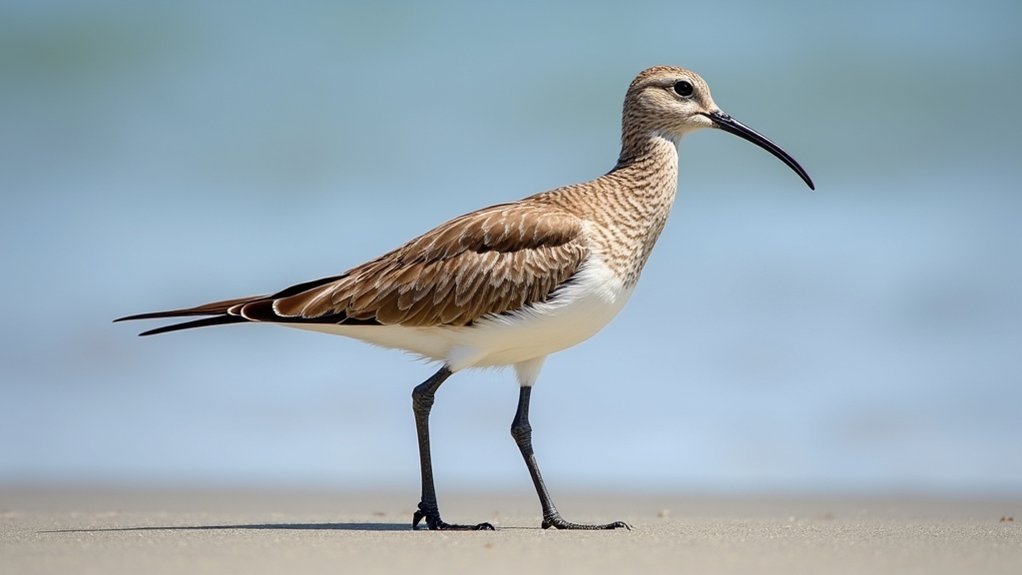
While wings offer dynamic cues during flight, tail features provide subtle yet telling identifiers when observing a whimbrel’s silhouette. You’ll notice the short, rounded tail tapers gradually, creating a streamlined profile that blends seamlessly with the rump’s feathering. The tail coloration ranges from uniform brown in the hudsonicus subspecies to barred white patterns in variegatus, affecting how the tail contrasts or doesn’t with the body. These nuances are essential for subspecies identification, especially since the tail’s plain appearance often merges with the background during flight.
- Short, rounded tail with gradual tapering creates a sleek outline
- White rump patterns vary by subspecies and aid field identification
- Tail feathers exhibit subtle barring and white edging for texture
- Uniform brown tails indicate hudsonicus origin
- Plain tail silhouette challenges distant observation but confirms species
- The white rump tapering into a point on the back is a distinctive field mark aiding identification.
Distinctive Head Markings and Crown Stripes
You’ll notice that the Whimbrel’s crown has this pale stripe running right down the middle, splitting its dark brown cap into two clearly defined sections.
On either side, there are parallel dark streaks that really make that central stripe stand out from most angles. This gives the bird its classic “capped” look.
Then, if you look at its face, you’ll see some distinct stripes too. There’s a dark eye stripe, and just above that, a pale supercilium that contrasts nicely.
These facial markings come together to form a precise pattern that’s key for identifying the species accurately.
Juveniles, however, can be distinguished by their paler crown stripe and spottier wing pattern, which differs from adults’ plumage juvenile plumage.
Crown Stripe Patterns
Three distinct elements define the whimbrel’s crown stripe pattern: a dark brown crown, a pale central stripe running from the forehead to the nape, and flanking dark side-crowns.
This pale stripe contrasts sharply against the dark crown, creating a “capped” appearance that remains consistent across seasons.
Juveniles exhibit a paler, more evenly marked stripe, while adults develop richer, sharper hues during breeding.
Compared to curlews, the whimbrel’s crown pattern is more defined and reliable for identification.
Feel the thrill of spotting the sharp, pale stripe cutting through dark feathers.
Appreciate the subtle seasonal shifts that reveal the bird’s life cycle.
Notice the striking contrast that separates whimbrels from their cousins.
Understand the juvenile’s softer pattern that signals youth.
Experience the clarity that a fresh autumn plumage brings to identification.
Whimbrels are often found in estuarine environments throughout New Zealand, primarily in the northern half of the North Island, which makes these estuaries throughout New Zealand ideal locations for observing their distinctive crown markings.
Facial Stripe Details
The whimbrel’s facial stripe pattern offers a precise field mark that sets it apart from similar species. You’ll notice a dark brown crown with a distinctive pale central stripe running from the forehead down to the neck, creating a “capped appearance.” This pale stripe contrasts sharply with alternating grayish-white and brown stripes across the face.
Above the eye, a white eyebrow stripe provides strong contrast to the dark eye and a narrow dark eyeline. Two dark streaks cross the crown alongside the central pale stripe, making the head pattern bold and unmistakable year-round. Whimbrels are known for their skittish and alert nature, which means their distinctive facial markings are often observed only briefly during encounters in the field, adding to the challenge of identification in northern breeding grounds.
Unlike the Long-billed Curlew’s bland face, the whimbrel’s facial striping remains vivid and consistent, aiding reliable identification in the field.
Facial Patterns and Eyebrow Stripe Details
Although subtle at first glance, the facial patterns of a Whimbrel provide essential identification markers, especially the distinctive eyebrow stripe. You’ll notice a pale, horizontal eyebrow line sharply contrasting the darker crown and eyeline, visible year-round.
This stripe, combined with the dark crown bisected by a light central stripe, creates a segmented, capped appearance unique to Whimbrels. The dark eyeline beneath the eyebrow further frames the eye, adding to the bird’s unmistakable lined facial pattern. Whimbrels are large shorebirds with long legs, which can also assist in distinguishing them from other similar species.
These markings remain consistent across subspecies and seasons, aiding precise field identification even from a distance.
- The pale eyebrow stripe stands out vividly against the darker crown.
- The segmented crown pattern exhibits a distinctive red cap split by a light stripe.
- Dark eyeline adds depth, enhancing facial contrast.
- Facial patterns surpass Long-billed Curlew’s plain face in prominence.
- Consistent markings endure through breeding and non-breeding seasons.
Bill Shape: The Signature Curved Structure
Beyond the distinctive facial patterns, you’ll find the Whimbrel’s bill shape offers a defining characteristic for identification. Its long, down-curved bill, lending the genus name “Numenius” from the Greek for “new moon,” exhibits a sharp bend near the tip rather than a uniform arc.
This kink differentiates it from the Eurasian Curlew’s uniformly curved bill. Females typically have slightly longer bills than males, with juveniles showing shorter bills that lengthen as they mature.
The bill’s curvature matches fiddler crab burrow openings, enabling deep probing and effective extraction of prey from mudflats and marshes. Compared to larger curlews, the Whimbrel’s bill is noticeably shorter but more sharply angled at the terminal end, making it a reliable field mark when evaluating shorebird species in their natural habitats. Additionally, bills of whimbrels are abruptly bent at the tip, whereas curlews possess uniformly curved bills, providing a key difference for identification.
Bill Color Changes Across Seasons
When observing Whimbrels across seasons, you’ll notice their bill color shifts distinctly between breeding and non-breeding periods. During summer breeding, their bills show solid black pigmentation, especially on the upper mandible. This is a reliable identification marker for adults.
Whimbrel bills turn solid black in summer breeding, a clear sign of adult birds in prime condition.
By winter, the bill’s base develops a pinkish or reddish hue, creating a bicolored pattern on the lower mandible that contrasts with the darker upper section. This gradual color change aligns with the molt cycle occurring August through January. Recognizing these subtleties aids accurate identification in the field.
Solid black bills signify breeding adults’ dominance and readiness. Pinkish bases hint at seasonal change, evoking winter’s arrival. Bicolored lower mandibles fascinate with subtle complexity. Whimbrels are known for their wide wintering range, which often brings them to coastal areas on six continents during the non-breeding season.
Molt-linked shifts reveal nature’s precise timing. Seasonal bill colors connect you to Whimbrels’ life cycles.
Differences Between Adult and Juvenile Bills
Because juvenile Whimbrels have noticeably shorter bills relative to their body size, you can use bill length as a reliable field mark to distinguish young birds from adults. In juveniles, the bill-to-body ratio is measurably smaller and remains consistent until the first-year molt begins around October.
This molt initiates the development of longer, adult-like bills. Furthermore, juvenile lower mandibles often show a bicolored pattern with a pinkish base, contrasting with the typically black bills of breeding adults.
Both age classes share the characteristic downcurved bill shape, making curvature a stable identification feature.
This proportional bill shortness in juveniles, combined with color differences, provides a precise morphological basis to separate age classes before the onset of first-year adult plumage.
Plumage Colors and Feather Patterns
A Whimbrel’s plumage exhibits a complex interplay of gray-brown, mocha-brown, and bone-white tones arranged to provide effective camouflage in coastal environments.
You’ll notice a dark brown crown with a pale central stripe, flanked by strong black head stripes. These facial markings are unmistakable.
The back and mantle feature a bold checkered pattern with pale zigzag feather edges, while the breast and neck display fine, heavy streaking, especially in breeding adults.
Underparts show neat dark stippling and chevron marks on the flanks. Juveniles have buff-mottled patterns that differ subtly from adults. The Whimbrel is the only large wader with a long, down curved bill, which helps distinguish it from other shorebirds.
Neat dark stippling and chevron markings adorn the flanks, while juveniles display distinctive buff-mottled patterns.
- Strikingly lined crown with two dark bands separated by a pale stripe
- Checkered back pattern with sharply defined feather shafts
- Pronounced breast streaking enhancing identification in breeding season
- Subtle pale underparts streaking contrasting with darker chest marks
- Seasonal and age variations revealing the bird’s life stage and condition
Flight Appearance and Wing Coloration
When you see a Whimbrel flying, take a moment to notice its wing colors. The upper parts are a muted gray-brown, which contrasts nicely with the barred pattern on the underwings and the pale color underneath. It’s pretty distinctive.
Also, check out the shape it makes in the sky. The long, curved wings combined with a short tail create a sort of “7” silhouette. That’s a great way to spot a Whimbrel among other shorebirds.
While flying, you might also notice the unique white V shape that is visible, which is a hallmark of this species.
These flight details are super helpful when you’re trying to tell Whimbrels apart from similar species, especially during aerial surveys. Keep an eye out for these features!
Wing Color Patterns
Although you might focus on body coloration, the wing color patterns in flight provide critical identification cues for the Whimbrel. The upper wing surface displays a gray-brown tone with mottled brown coverts edged in pale zigzags when fresh.
Underwing patterns reveal buff bases with strong brown barring, especially on axillaries, creating a distinctive barred appearance. This barring helps separate Whimbrels from similar species like curlews. Notably, the Eurasian whimbrel’s call is a rippling whistle, often prolonged into a trill, which can aid identification in the field.
Furthermore, the rump coloration varies by subspecies. White forms a ‘V’ in Eurasian birds, while it’s drab brown in North American populations.
These subtle but consistent wing color traits are essential for precise field identification.
- Mottled brown upper wing coverts with pale edges
- Buff and brown barred underwing pattern visible in flight
- Axillaries show prominent barring distinguishing Whimbrels
- Subspecies rump color varies from white ‘V’ to brown
- Wing patterns remain consistent despite plumage wear
Flight Silhouette Features
The Whimbrel’s flight silhouette reveals a long, slender body with pointed, tapered wings that extend well beyond the tail tip, creating a distinctive “7” shape in the air. You’ll notice its crow-sized frame, streamlined around an exceptionally long bill.
The wings are narrow, elongated, and slightly curved, optimizing efficiency for sustained migratory flight. Their pointed tips contribute to aerodynamic oceanic travel, while the short tail, square or rounded, remains minimal and streaked, lacking contrasting colors.
Underneath, pale underparts show gray streaking on the neck and upper breast, with a whitish belly and barred underwings. They are often found flying along the coast during falling or low tides, which is a key time for spotting them in their preferred habitat.
The upperparts exhibit a gray-brown streaked back, and rump coloration varies: New World subspecies display a drab brown rump, whereas Eurasian ones show a pale rump, aiding subspecies identification during flight.
Recognizing Whimbrel Vocalizations
Anyone seeking to identify a Whimbrel by sound will focus on its distinctive flight calls, which consist of a series of 5 to 7 loud, clear whistled notes delivered in rapid succession with short, consistent intervals.
These notes maintain a mellow, piping whistle quality, usually on the same pitch, producing a confident, non-distressed tone that differentiates them from other curlews.
The rapid “pi-pi-pi-pi-pi” or “pip-pip-pip-pip-pip” patterns create a recognizable trill-like effect lasting under two seconds.
These calls occur both day and night during migration and across diverse habitats, ensuring reliable detection in the field. Whimbrels typically migrate at night, which makes their calls especially important for nocturnal identification.
Feel the crisp clarity of each confident whistle.
Sense the rhythmic pulse of rapid note repetition.
Detect the subtle pitch uniformity amidst the trill.
Experience consistent intervals that mark species identity.
Appreciate the call’s unmistakable presence in varied environments.
Typical Call Patterns and Sounds
You’ll hear the whimbrel’s flight calls as a series of 5 to 7 clear, whistled notes.
They often come in a rapid pip-pip-pip pattern that speeds up into trills.
When the bird is alarmed, its calls change to distinct scolding trills with varying intervals and sometimes a nasal tone, letting others know there’s a threat nearby.
Also, the contact calls between adults and chicks play important roles within their breeding grounds. Whimbrel’s call can be a series of quick notes or a trill, also known as ‘Seven Whistler.’
Whistled Note Sequences
Whimbrel flight calls consist of a distinct series of 5 to 7 loud, clear whistled notes arranged in a rapid pip-pip-pip pattern, typically averaging six notes per sequence.
These notes form a quick, trill-like series with a consistent pitch between 1.8 and 3.5 kHz and are separated by brief intervals averaging 0.03 seconds.
Each note shows a convex, arch-shaped acoustic profile, maintaining a level or gently descending contour throughout the call.
Variations in frequency forelegs can impart a harsher or rattling quality, depending on the bird’s context or motivation.
You’ll notice this precise, melody-like sequence remains stable day and night, making it a reliable field mark.
Rapid, clear whistles evoke a mesmerizing rhythm
Consistent pitch creates a haunting, melodic flight sound
Subtle arch shapes reveal acoustic complexity
Variations hint at emotional or situational shifts
Daytime and nocturnal calls share identical patterns.
Recent research from Iceland highlights that the vocalization frequency of Whimbrels varies notably between pre-incubation and incubation periods, reflecting changes in breeding behavior.
Alarm and Contact Calls
A variety of alarm and contact calls play essential roles in the communication system of these shorebirds.
You’ll recognize the predator alarm call by its slow, short trill of 4–8 syllables, spanning 1.8–3.5 kHz, with notes lasting 0.030–0.080 seconds and intervals averaging 0.043 seconds.
Flight alarms feature a distinctive pi-pi-pi pattern of 5–7 whistled notes, confident and rippling, used both day and night during migration.
When adults contact chicks, they emit a low whistle between 0.9–1.6 kHz, repeated steadily 2–20 times to maintain group cohesion.
Scolding trills vary in note composition and duration (0.85–1.96 seconds), overlap predator alarm frequencies, and reflect motivational states.
These calls operate across diverse habitats, adapting delivery speed during excited chattering sequences.
Alarm and Mating Calls of Whimbrels
Although often subtle, the alarm and mating calls of whimbrels reveal a complex vocal repertoire essential for communication during breeding and territorial interactions.
You’ll recognize their alarm calls by the short predator alarm, a slow trill of 4-8 syllables, each lasting about 0.064 seconds, signaling danger.
During mating, listen for the variable chase call, featuring husky waves and shifting speeds that convey aggression and territory defense. The low whistle call, steady and repeated up to 20 times, marks settling behavior in breeding.
Low trill calls, extensive and rapid, dominate breeding grounds, delivered in multi-phrase patterns.
Finally, the pi-pi-pi flight call guides nocturnal migration with its clear, piping notes.
- Heart-pounding predator alerts
- Intense territorial disputes
- Tender settling signals
- Persistent breeding choruses
- Nighttime migratory guidance
Frequently Asked Question
What Habitats Do Whimbrels Prefer During Migration?
You’ll find whimbrels favoring coastal habitats during migration, especially rocky and sandy beaches for stopovers. They feed on tidal flats and mudbanks, exploiting abundant invertebrates.
Estuarine marshes and salt marshes provide critical resting and foraging sites. They also use lagoons and river mouths where food concentrates.
Their route choices depend heavily on food availability, and they show high fidelity to traditional stopover sites, often returning to the same areas annually.
When Is the Best Time of Year to Spot a Whimbrel?
The best time to spot a whimbrel is during spring migration, from late April through May, when peak northward passage occurs, especially along northern coasts.
Autumn migration, spanning early July to late September, also offers extended viewing opportunities, particularly in September.
You’ll find them concentrated at coastal mudflats and wetlands during these periods.
Keep in mind, juveniles migrate later, extending the season.
Dawn and dusk provide ideal observation windows for active whimbrel behavior.
How Do Whimbrels Behave When Feeding?
When feeding, whimbrels don’t just flap around aimlessly like confused tourists.
You’ll see them probe just below the surface with their long bills, but not too deep. They prefer picking prey from the surface more often.
They rapidly peck, visually hunting for small crabs and insects.
Watch them break crab legs and crush shells before dining. They feed solo or in small groups, fiercely defending territories during migration and winter stops.
Are Whimbrels Solitary or Social Birds?
Whimbrels are both solitary and social, depending on the season. You’ll find them foraging alone during breeding but shifting to large, highly gregarious flocks during migration and winter.
They form concentrated groups on coastal mudflats and sandflats, often cooperating while feeding.
Outside breeding, they roost communally, but during nesting, territorial pairs display moderate assertiveness, defending territories with threat displays and aerial pursuits to maintain breeding success.
What Predators Commonly Threaten Whimbrels?
You’ll find that Peregrine Falcons pose a known predatory threat to juvenile whimbrels, targeting them during vulnerable stages.
Furthermore, ground predators like foxes and raccoons may prey on eggs and chicks, especially in nesting areas.
While adult whimbrels are agile and wary, these predators exploit moments when birds are distracted or nesting.
Understanding these predator-prey dynamics is essential for conservation and managing whimbrel populations effectively.
Conclusion
You might think identifying a whimbrel is as simple as spotting any shorebird. Wrong. Its unique size, neck length, and distinct wing shape give it away, but only if you pay close attention.
Those calls? Not just background noise. They’re precise signals you’ll need to decode. So, next time you’re certain you’ve nailed your shorebird ID, remember: the whimbrel is always quietly challenging your confidence with subtle, technical details you’d better not overlook.