
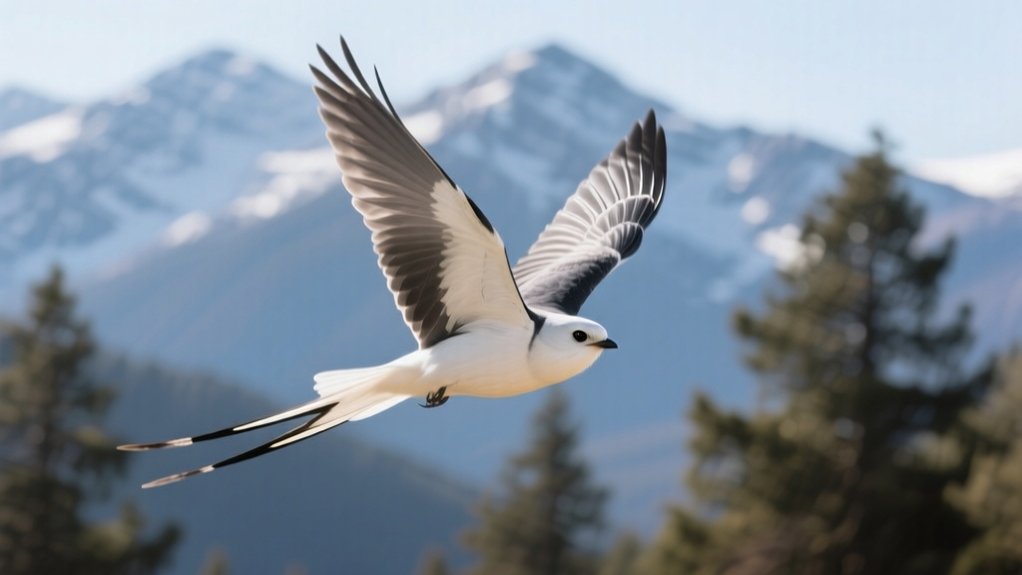
You’ll identify the white-throated needletail by its robust, cigar-shaped body, sharp white throat, and square, non-forked tail. It breeds mainly in Central Asia’s rocky hills and southern Siberia, wintering across South Asia to Australia.
This swift reaches speeds up to 170 km/h, capturing flying insects in rapid flight. Its complex migration covers over 40,000 km annually, with specialized vocal and non-vocal communication. Continuing, you’ll uncover details on its conservation challenges and habitat needs.
Physical Description and Size
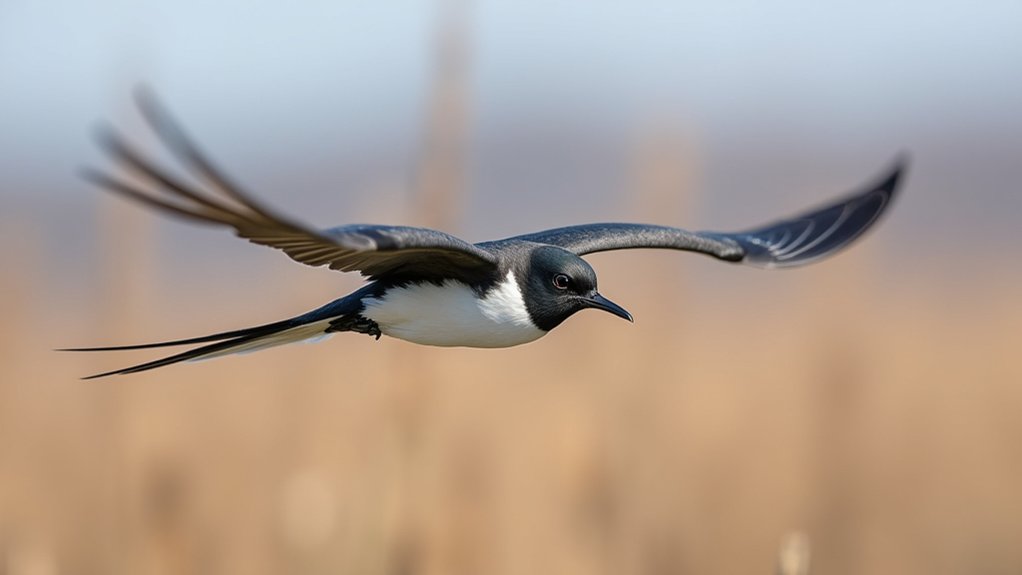
The White Throated Needletail measures between 20 and 22 centimeters in length and weighs from 93 to 120 grams. It features a robust, barrel-like body shape reminiscent of the Alpine swift.
The White Throated Needletail boasts a sturdy, barrel-shaped body, measuring 20 to 22 centimeters long.
Its compact, cigar-shaped body supports wings extending over 8 inches from the carpal joint to the tip. The wings have broad, curved feathers ending in pointed tips.
The tail is short and square, approximately 7.75 inches long, with rectrix shafts protruding 2.5 to 6 millimeters beyond the feather webbing. It shows a non-forked design unique to the genus Hirundapus.
The bird’s legs are short and dark, with strong muscular feet arranged in three forward toes and one rear toe positioned on the inner shank. The tarsus length measures about 5/8 inch, adapted for surface perching. The White Throated Needletail is reputed to reach speeds of up to 170 km/h in horizontal flight, making it one of the fastest birds in level flight.
Distinctive Plumage Characteristics
When observing a White Throated Needletail, you’ll notice its plumage mainly presents a grey-brown tone with distinctive green and purple iridescent reflections on the head, back, and wings under certain lighting conditions. The throat and undertail are sharply white, creating contrast in flight, while the back shows a pale greyish patch. This swift is known for its long, curved wings with white markings, which contribute to its distinctive silhouette in flight.
Flanks are dark brown with white spotting, and the underwing features a dark leading edge contrasting with silvery grey-brown remiges.
| Feature | Description | Visual Impact |
|---|---|---|
| Head and Back | Grey-brown with green/purple iridescence | Glossy, metallic sheen |
| Throat and Undertail | Distinct white patches and horseshoe marking | High contrast identification |
| Flanks and Belly | Dark brown with white spotting, clove brown | Pattern disruption and camouflage |
| Underwing | Black-brown coverts, silvery flight feathers | Flight visibility and species ID |
| Central Back Patch | Pale greyish, fades with feather wear | Age and condition indicator |
Wing and Tail Structure
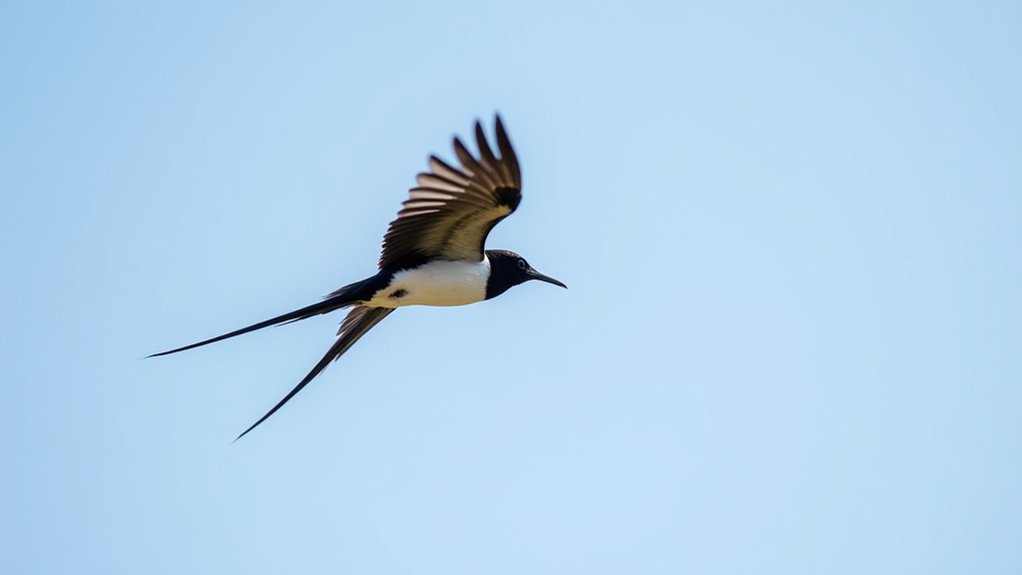
Wings shaped for speed define the White Throated Needletail’s aerial profile, featuring 11 primary feathers with p10 as the longest and p9 just slightly shorter by 1 to 4 millimeters. The wings are long, pointed, narrow, and back-swept, extending about 20 cm. Their long, pointed wings are a key characteristic that help distinguish this species.
Their aerodynamic design includes shallow camber, long primaries, and short secondaries, producing strong downward force and forward propulsion. You’ll notice a curved trailing edge on the primaries and a distinct kink near the wing base due to narrower secondaries, optimizing high-speed flight rather than maneuverability.
The tail is short, square-ended, and black with green gloss. Its protruding feather shafts create a spiky profile, with weak rectrix spines extending up to 6 mm, lending the species its “needle-tailed” name. This tail shape aids stability during rapid flight and is short square tail characteristic of the species.
Breeding Range and Locations
Understanding the White Throated Needletail’s flight adaptations naturally leads to examining where these birds choose to plunge and raise their young. You’ll find their breeding range spans diverse regions with specific habitat preferences.
- Central Asia hosts major populations in rocky hills and mountainous terrain featuring cliff formations, extending across multiple countries. These birds are capable of reaching speeds up to 120 kilometers per hour, allowing efficient travel across their breeding grounds.
- Southern Siberia serves as a primary breeding ground, with the subspecies caudacutus adapted to cold climates, although habitat loss threatens populations.
- The Far East and northern Japan mark secondary breeding density, focusing on continental edges including the Kuril Islands.
- The Himalayan foothills support irregular breeding of the subspecies H.c. nudipes, complicated by mixed resident and migratory behaviors.
Breeding occurs mainly from May to July, with nests in tree hollows and cliff crevices, occasionally using man-made structures.
Wintering Range and Migration Patterns
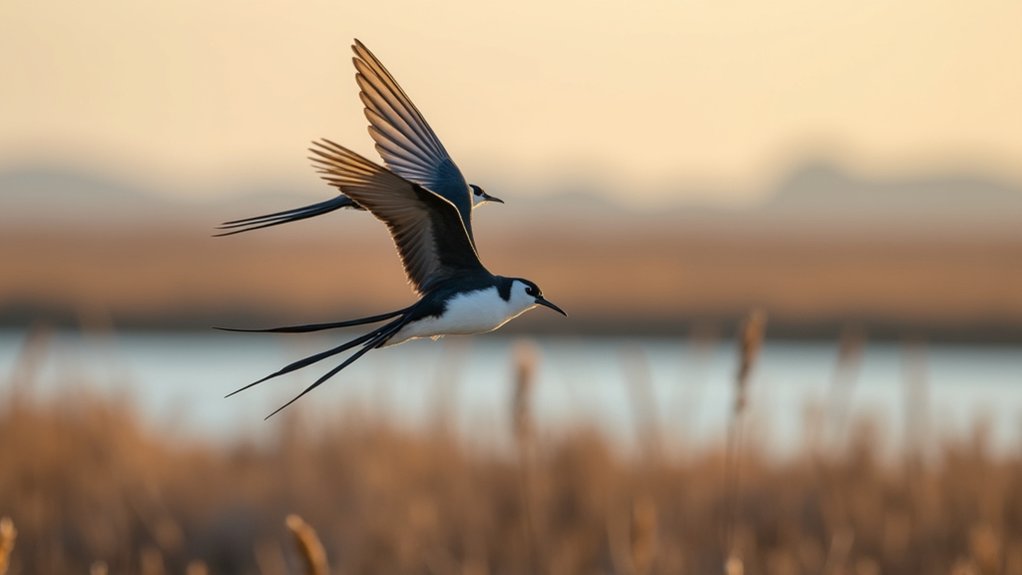
Although the White Throated Needletail breeds in the Northern Hemisphere, it spends the winter months across the Indian Subcontinent, Southeast Asia, and Australia, following a distinct migratory schedule.
It arrives in Australia primarily via the Torres Strait between September and November, reaching southern regions like Victoria and Tasmania by November, with peak numbers in March. Researchers have tracked these birds using ultra-lightweight geolocators to better understand their migratory routes.
Migration involves a figure-eight route: southbound in autumn moving over Korea, southern China, and the Pacific, then northbound in spring via a different path over the South China Sea.
This pattern likely optimizes wind use, avoids typhoons, and accesses mid-air prey.
The species sustains high-speed flight (up to 130 km/h) over 40,000 km annually, foraging airborne insects continuously.
Wintering habitats include diverse forested, grassland, and wetland areas across eastern and northern Australia.
Preferred Breeding Habitats
You’ll find White Throated Needletails primarily nesting in rock crevices along cliff faces.
These vertical structures provide secure sites for their nests. They also make use of hollow interiors of tall coniferous trees for shelter and nest construction.
Their preference for forests, parks, and agricultural landscapes supports their feeding habits and social behaviors.
Rocky Cliffs Nesting
When selecting nesting sites, White Throated Needletails rely on rock crevices within vertical cliff faces. These spots provide high elevation and seclusion from ground predators. Their strong feet enable them to cling securely to these vertical surfaces.
These inaccessible, sparsely vegetated cliff positions help you understand how the species remains airborne most daylight hours, minimizing ground contact during nesting.
Their nests, typically small brackets or half-cup structures, are made of finely interwoven plant material and feathers bound with saliva. They place these nests on vertical or overhanging rock walls.
Both sexes participate in construction and placement.
Key aspects include:
- Nest sites in high-elevation rock crevices reduce predation risk.
- Nest architecture employs cemented organic materials on vertical surfaces.
- Cliff surroundings support aerial foraging behavior.
- Both parents fairly share incubation and nest maintenance duties.
Hollow Trees Shelter
Large, vertically oriented cavities within tall coniferous trees serve as critical breeding shelters for the White Throated Needletail. You’ll find these cave-like hollows mainly in tall conifers across Central Asia and southern Siberia. These birds breed during the May-June season, which is when they utilize these nesting sites most actively.
The birds prefer high elevation sites, often above ground level, utilizing natural depressions or scrapes inside these cavities. Nest platforms are constructed minimally with sticks, placed directly inside the hollows without extensive modification. Here’s a detailed comparison:
| Feature | Description | Location/Example |
|---|---|---|
| Cavity Structure | Large, vertical hollows | Thick branches or trunks |
| Tree Type | Tall coniferous | Mountainous forests, lowlands |
| Nest Construction | Stick platforms, minimal saliva | Inside hollow depressions |
You must consider habitat threats, as deforestation reduces available cavities, impacting breeding success.
Nesting Sites and Protection
You’ll find White-throated Needletails nesting mostly in vertical hollows of tall conifers or on rock faces.
They build small bracket or half-cup nests on stick platforms in these spots. These raised sites—like cliff crevices or abandoned woodpecker holes—offer good protection from predators and environmental threats.
Knowing why they pick these safe nesting locations is really important. It helps us understand their reproductive success and figure out what they need for conservation.
Preferred Nesting Locations
Although the White Throated Needletail exhibits flexibility in nesting site selection, it primarily favors vertical hollows in tall trees and natural crevices in rock faces or cliffs.
You’ll find these birds often nesting in tall coniferous trees, where abandoned woodpecker holes and natural hollows provide ideal cavities. Rock crevices offer alternative raised sites, ensuring protection and facilitating rapid aerial exits. The species typically lays 2 to 7 eggs in these protected sites, often in scrapes or natural depressions within the hollows.
Key preferred nesting locations include:
- Vertical hollows in tall coniferous trees, offering secure cavities.
- Natural crevices and half-cup nests within rock faces and cliffs.
- Abandoned woodpecker holes utilized as nesting cavities.
- Raised positions above ground level to reduce predation risk.
These preferred sites align with the species’ distribution and ecological requirements.
Nesting Site Safety
Because nesting sites play a critical role in the White Throated Needletail’s reproductive success, understanding the safety challenges they face is essential.
You should note that predation is a major risk: fledglings are vulnerable to small hawks, and adults risk ambush when entering nest cavities.
Nesting in high tree hollows or vertical rock crevices reduces ground predator threats. However, man-made hazards like wind turbines, overhead wires, and power infrastructure pose additional dangers, causing collisions and electrocutions near nesting areas.
Logging activities further exacerbate risks by removing old coniferous trees and stumps that provide natural cavities, fragmenting habitats.
Climate change disrupts breeding timing and food availability, increasing vulnerability.
You can support conservation by promoting artificial nest boxes, protecting old-growth forests, and safeguarding key roosting sites to improve nesting site safety.
Habitat Use During Migration and Winter
While migrating and wintering, White Throated Needletails utilize diverse habitats across the Indian Subcontinent, Southeast Asia, and Australia. Eastern Australia serves as their primary plunging destination in the Southern Hemisphere. You’ll find them wintering mainly from October to April, with presence confirmed in India, Malaysia, and northern Australia.
Their habitat use during these periods includes foraging over forests and grasslands in mountainous and lowland areas, where they exploit thermal currents for insect prey. They also utilize rising wind fronts linked to storm systems and bushfires to maximize feeding efficiency.
These birds stop at multiple sites along migration routes, spanning diverse terrain types. They adapt to environmental challenges such as habitat loss, frequent fires, and pesticide-induced prey scarcity.
This habitat flexibility supports their energetic demands during migration and wintering phases.
Flight Behavior and Roosting Habits
You’ll notice the White Throated Needletail has some pretty impressive aerial foraging skills. It catches insects right out of the air using its wide beak, all while flying at different heights.
When it’s not busy feeding or migrating, it prefers to roost up high—like on tree branches—and never lands on the ground.
Oh, and here’s a cool fact: it drinks water on the fly by skimming over water surfaces, so it stays hydrated without ever having to slow down.
Aerial Foraging Techniques
Although the white-throated needletail excels in sustained high-speed flight, it adapts its aerial foraging techniques to operate efficiently across a wide altitude range, from just under 1 meter to over 1000 meters above ground.
You’ll notice its hunting is constrained above 200 meters due to decreased prey availability.
To optimize foraging, it:
- Utilizes wide gaping beaks to capture diverse flying insects mid-air, including beetles, flies, and moths.
- Exploits rapid speed and agility to intercept aerial plankton within dynamic atmospheric zones, such as low-pressure system edges.
- Operates primarily within altitudes rich in insect prey, maximizing energy intake relative to flight expenditure.
- Forages in flocks, especially during migration, covering vast areas with a fly-and-forage strategy. This flocking behavior also provides benefits such as predator protection and efficient foraging.
This combination of speed, altitude versatility, and prey specialization defines its aerial hunting efficiency.
Roosting Site Selection
Mastering high-speed aerial foraging requires the white-throated needletail to periodically secure rest in carefully chosen roosting sites that support its flight demands and physiological needs.
You’ll find these birds selecting trees with dense canopy foliage, often utilizing vertical hollows and natural depressions within tall trees to roost securely. They also exploit cliffs, rock crevices, and caves, depending on habitat availability.
Their short legs and long wings prevent ground takeoff, so raised sites are essential. Roosting often aligns with breeding site locations, and repeated use of specific tree hollows is confirmed through radio-tracking.
You’ll notice they roost communally, especially during cold weather, resting in hollow branches. Their roost site selection balances shelter, height, and accessibility, ensuring safety and energy conservation for their sustained high-velocity flight patterns.
In-Flight Drinking Methods
The white-throated needletail employs a specialized skimming technique to drink while maintaining active flight, gliding low over water surfaces without needing to land. This method integrates seamlessly with its aerial insect foraging, optimizing energy use. Notably, the bird’s needle-like tail feathers assist in precise maneuvering during this skimming behavior.
As you observe, note these key aspects:
- The bird’s eyes are shielded by a protective membrane and a feather ridge during water contact, preventing damage.
- Drinking occurs during active flight, eliminating the need for landing and reducing vulnerability.
- Water intake synchronizes with feeding, supporting continuous diurnal activity without interruption.
- Skimming low over water surfaces maximizes hydration efficiency while maintaining speed and maneuverability.
This technique exemplifies the needletail’s adaptation to an airborne lifestyle, combining hydration and nutrition within its flight dynamics.
Feeding Techniques and Prey
When you observe the White Throated Needletail feeding, you’ll notice it specializes in capturing a wide variety of flying insects such as beetles, flies, termites, and ants.
Additional prey like bees and moths appear seasonally in Australia.
It employs a wide, gaping beak to intercept prey during high-speed flight, often exceeding 1,000 meters altitude.
You’ll see it hunting singly or in scattered flocks, concentrating feeding efforts on rising thermal currents, storm fronts, and areas affected by bushfire smoke where insect density increases.
Its diet shifts regionally, reflecting local insect availability across breeding and wintering grounds.
Adaptations like protective eye membranes and an aerodynamic body facilitate sustained aerial foraging.
This insectivorous bird never feeds on terrestrial prey or plants, relying exclusively on “aerial birds” for sustenance.
The White Throated Needletail can often be found in eastern and northern Australia during its non-breeding season.
Vocalizations and Communication
Observing the White Throated Needletail’s feeding behavior reveals more than its aerial hunting skills. It also depends heavily on vocal and non-vocal sounds for communication. The species’ primary vocalizations are flight calls used during rapid, acrobatic flight and flock coordination. This species is known for its very rare status in certain regions, highlighting the significance of effective communication during migration and feeding.
Non-vocal sounds, generated by wing flapping and specialized tail feathers, dominate its acoustic signaling. These sounds are continuous during aerial maneuvers and are essential for social interactions within large feeding flocks.
Key aspects of their communication include:
- Flight calls recorded across Asia, Russia, Japan, and Australia, aiding in migration and feeding coordination.
- Wing morphology directly influences sound production, serving as an acoustic communication mechanism.
- Social behaviors intensify acoustic signaling in thermal currents during collective feeding.
- International sound libraries archive these vocal and non-vocal sounds, supporting ongoing research.
Population Status and Conservation Concerns
You’ll find that three main factors define the population status and conservation concerns of the White Throated Needletail: global conservation classifications, documented population declines, and regional status variations.
Globally, the IUCN Red List categorizes this species as Least Concern. But Australia lists it as Vulnerable since 2019 under Criterion A, due to a population reduction exceeding 30-50% over 25.5 years.
Globally Least Concern, yet Australia classifies the White Throated Needletail as Vulnerable due to significant declines.
Documented declines show mean flock sizes dropping from 164 individuals in the 1950s to 36 by 2017, with eastern Australian states experiencing 30-50% decreases. The species is known for its aerial foraging behavior, which influences its habitat requirements and vulnerability to environmental changes.
Regionally, the species is Vulnerable under Australia’s Environment Protection Act, an uncommon migrant in Singapore, and a rare vagrant in Western Europe.
These variations underscore the need for continued monitoring to assess population trends across its extensive migratory range.
Threats Impacting Survival and Habitat
Understanding the population status of the White Throated Needletail highlights the multiple pressures this species faces across its range. These threats greatly impact survival and habitat integrity:
- Chemical poisoning from insecticides, particularly organochlorines, reduces invertebrate prey and causes secondary poisoning. This disrupts the food chain.
- Logging in Siberian taiga forests removes essential nesting hollows. This directly decreases reproductive success.
- Collisions with wind turbines, power lines, windows, and lighthouses cause substantial mortality during migration and local flights.
- Habitat loss and fragmentation in Australian forests reduce roosting sites and prey availability. Meanwhile, hunting in Northern Hemisphere breeding areas diminishes adult survival and reproductive output.
Addressing these factors requires targeted conservation to stabilize and recover populations effectively.
Frequently Asked Question
How Fast Can the White Throated Needletail Fly?
You can expect the white-throated needletail to fly at confirmed speeds around 111.6 km/h (69.3 mph) during flapping flight, with documented ranges reaching 120-130 km/h during migration and feeding.
While unverified claims suggest speeds up to 170 km/h or even 349 km/h, these lack scientific confirmation.
Its aerodynamic wings and tail spines enable efficient high-speed flight, especially during mating displays and foraging, but standardized speed records remain elusive.
What Is the Typical Lifespan of a White Throated Needletail?
You can expect the typical lifespan of a white-throated needletail to be uncertain due to limited field data, but estimated generation time is about 8.5 years.
Mortality rates are relatively low, under 20% annually.
Despite challenges like predation and migration risks, some individuals may live longer spans.
The population’s three-generation timeframe approximates 25.5 years, indicating potential reproductive maturity and extended longevity within the species.
Are White Throated Needletails Solitary or Social Birds?
You’ll find white-throated needletails are social birds, not solitary. They typically gather in flocks ranging from 50 to 100 individuals, sometimes even thousands.
These flocks forage and travel collectively, coordinating hunting and migration efforts. Their social behavior includes vocal communication with sharp calls and whistles, helping maintain flock cohesion during flight and environmental changes.
How Do White Throated Needletails Care for Their Young?
You’ll find white-throated needletails express dedicated nurturing through shared incubation of their clutch, lasting about 40 days.
Both parents engage in aerial courtship and maintain nest hygiene meticulously.
Once hatched, chicks, initially vulnerable, receive frequent regurgitated insect meals directly from parents.
Feeding focuses on winged ants during swarms, supporting rapid chick growth.
After 40-42 days, fledglings depart the nest, swiftly gaining independence as breeding pairs vacate between May and August.
Can White Throated Needletails Be Kept or Bred in Captivity?
You can’t currently keep or breed White-throated Needletails in captivity because detailed captive care protocols don’t exist.
These birds have specific environmental and flight requirements that are difficult to replicate indoors.
Their natural behaviors and wide-ranging migratory patterns complicate captivity efforts.
Without established husbandry guidelines or successful captive breeding records, attempting to maintain them in captivity isn’t recommended or supported by scientific data at this time.
Conclusion
You’ll find the white-throated needletail remarkable, especially given its impressive speed. It can reach up to 170 km/h in level flight, making it one of the fastest birds.
Its specialized wing and tail structure enable this aerodynamic efficiency. This design is essential for its migratory and feeding behaviors across vast ranges.
Understanding these adaptations helps clarify its ecological role. It also highlights the importance of conserving habitats threatened by human activity to maintain stable population levels.