
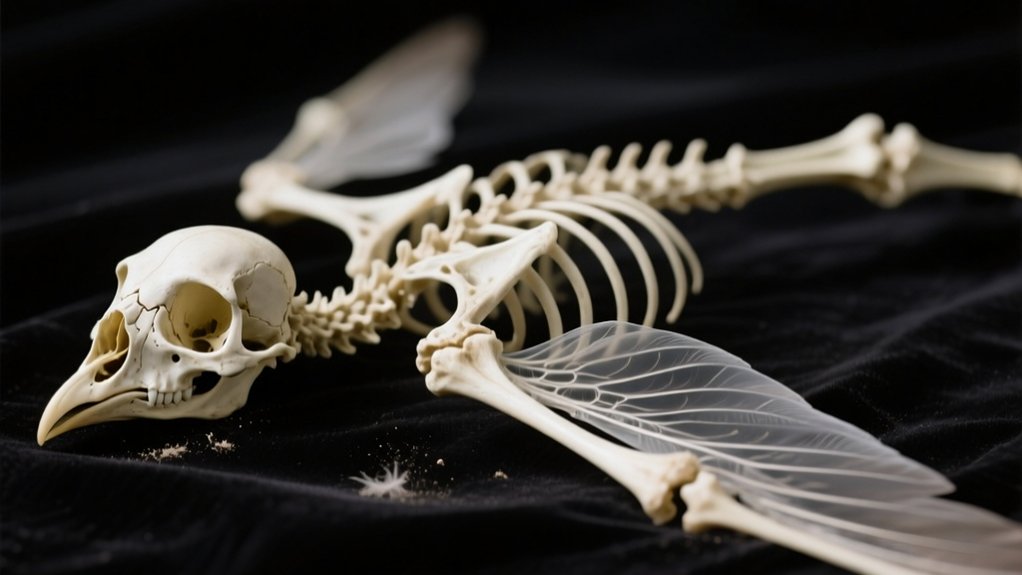
You’ll find birds’ bones hollow because this design cuts their weight while keeping strength, which is essential for efficient flight. Air sacs invade bone tissue during growth, creating pneumatic cavities connected to the respiratory system, enhancing oxygen exchange.
These bones have internal struts and calcium reinforcements to maintain stiffness despite thin walls. This lightweight yet strong structure varies among species according to their lifestyle. Exploring further reveals how bone density and architecture fine-tune flight and buoyancy control.
The Structure of Bird Bones
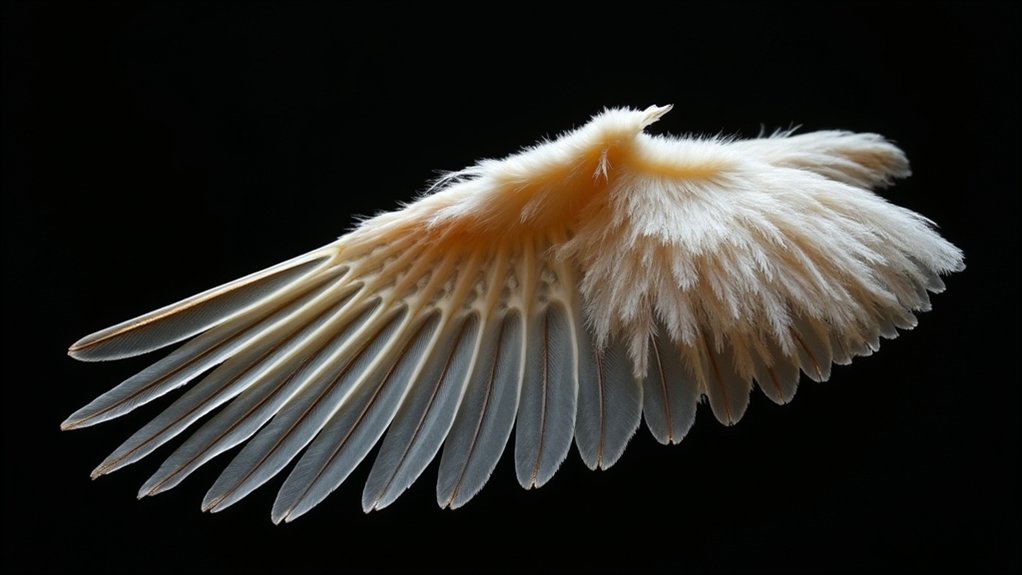
Although bird bones may seem fragile due to their thin walls, they’re distinctly adapted with pneumatic cavities, or air-filled spaces that reduce weight without compromising strength.
Bird bones, with their thin walls and air-filled cavities, balance lightness and strength for flight.
You’ll find that the extent of these hollow bones varies among bird species, reflecting their ecological needs.
For instance, the humerus often contains extensive pneumaticity, especially in larger birds, to offset increased mass. Yet, not all bird bones are hollow. Diving birds possess solid bones, enhancing underwater performance by reducing buoyancy.
Despite their hollowness, these bones maintain stiffness and strength through optimized bone density, balancing fragility and resilience.
This specialized skeletal design enables birds to achieve flight efficiency by minimizing weight while preserving structural integrity. It really shows an evolutionary trade-off finely tuned to their lifestyle and environment.
How Pneumatized Bones Develop
You’ll notice that pneumatized bones develop when air sacs actually invade the bone tissue as a bird grows.
These sacs don’t just hang out—they create and keep direct connections to the hollow spaces inside the bones.
This link between bone and air is super important because it helps boost the bird’s respiratory efficiency throughout its life.
Air Sacs Invasion
When baby birds grow, air sacs begin to invade their developing bones, creating pneumatized, or hollow, structures filled with air. This process forms hollow bones that are vital for avian respiration and flight efficiency.
The invasion of air sacs creates air-filled cavities within bones, reducing skeletal weight without sacrificing strength. It continues throughout the bird’s life, maintaining a dynamic connection between the respiratory system and the skeleton.
This process supports improved oxygen exchange by integrating with the bird’s unique respiratory cycle. This adaptation is essential for meeting the high metabolic demands of flight, allowing birds to sustain prolonged activity.
Bone-Air Connection
As air sacs expand during a bird’s growth, they actively invade the developing bones, creating interconnected air-filled cavities known as pneumatized bones. This invasion forms a continuous network where the air sacs remain connected to these hollows throughout the bird’s life.
Because birds have hollow bones, their skeletal structure becomes remarkably lighter without losing strength, a critical adaptation for flight. You’ll find that larger bird species exhibit a higher proportion of air within their bones, helping them offset weight and improve flight efficiency.
This bone-air connection isn’t random; it’s an evolutionary adaptation that optimizes respiratory function by allowing efficient oxygen exchange during both inhalation and exhalation. This adaptation enhances overall flight capability and metabolic efficiency.
The Role of Air Sacs in Bone Hollowing
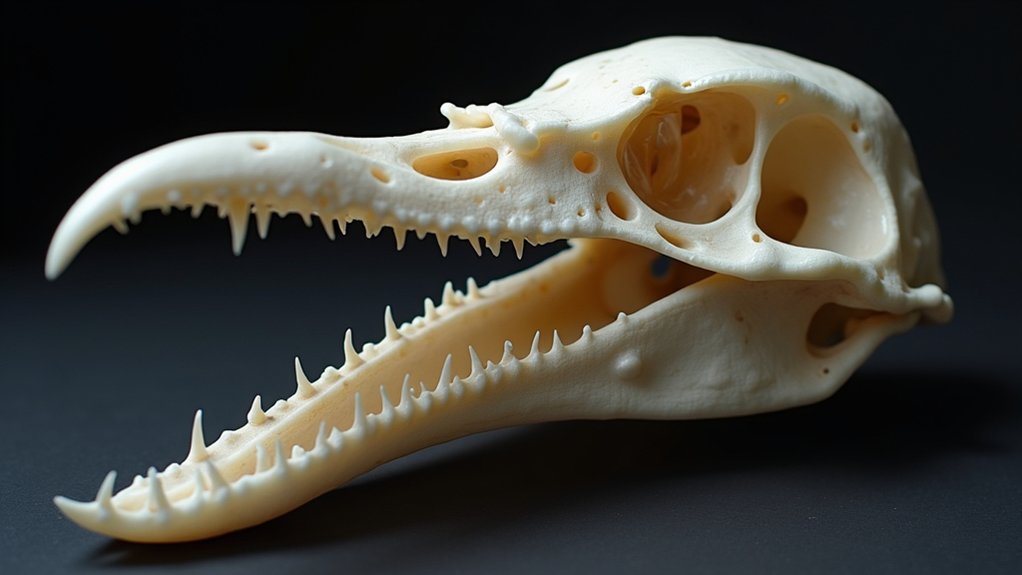
Although bird bones appear fragile, they develop hollows through the active invasion of air sacs during growth. These air sacs penetrate the developing bones of baby birds, creating pneumatized, hollow structures that persist into adulthood. This adaptation is essential for flight efficiency and respiratory function.
Bird bones become hollow through air sacs invading during growth, aiding flight and respiration.
You can understand the role of air sacs in bone hollowing by noting that they maintain a continuous connection with bone cavities, enhancing oxygen flow during both inhalation and exhalation.
They also reduce skeletal weight without compromising structural strength necessary for flight dynamics.
Plus, air sacs support the high metabolic demands of birds by facilitating a constant oxygen supply through pneumatized bones.
Differences Between Flying and Diving Birds’ Bones
Because different ecological demands shape their skeletal structures, flying and diving birds exhibit distinct bone characteristics.
Flying birds, especially larger gliders, have hollow bones that reduce weight, facilitating aerodynamic efficiency and supporting their high metabolic rates through an intricate respiratory system. These hollow bones contain air-filled spaces essential for sustained flight.
Conversely, diving birds like the Long-tailed Duck possess denser, marrow-filled bones that increase skeletal mass, helping them overcome buoyancy underwater. This difference reflects adaptations to their respective environments: hollow bones optimize flight, while thicker bones aid submerged locomotion.
Understanding these variations reveals how ecological pressures influence bone pneumaticity, with skeletal structures tailored precisely to the lifestyle requirements of flying versus diving species, ensuring functional optimization without compromising survival demands.
Bone Density and Strength in Birds
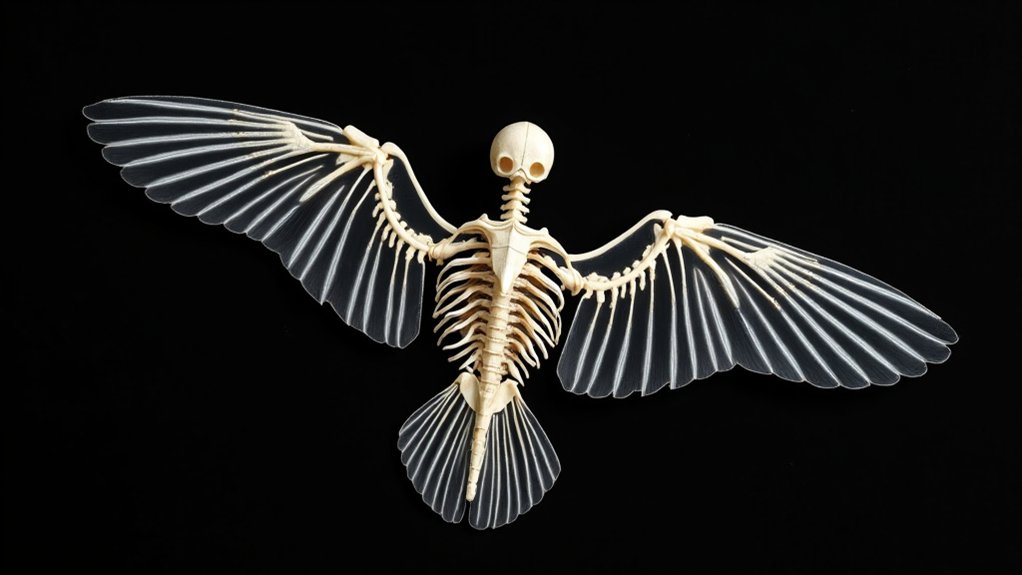
Bone density plays a critical role in enabling birds to achieve flight without sacrificing strength.
Although birds have hollow bones, these structures are pneumatized, containing air-filled spaces that reduce weight while preserving durability.
You’ll find their bone density is surprisingly high, providing the stiffness necessary to withstand aerodynamic forces.
This balance between lightness and strength is achieved through:
- Internal architecture featuring struts and cross-bracing, enhancing rigidity
- Thinner bone walls in larger birds compensating for increased air volume
- A density optimized to maintain structural integrity despite hollow cavities
Adaptations for Efficient Respiration
The hollow structure of birds’ bones does more than lighten their skeletons; it plays a crucial role in their respiratory system. These hollow bones connect directly to air sacs, allowing birds to draw oxygen continuously during both inhalation and exhalation.
This unidirectional airflow guarantees a constant oxygen supply, meeting the high metabolic demands of flight. As birds develop, pneumatization occurs when air sacs invade the bones, forming these hollows and enhancing respiratory efficiency.
This adaptation not only reduces skeletal weight but also facilitates an efficient respiratory mechanism unique to avians. By integrating hollow bones into their respiratory system, birds optimize oxygen exchange, which is essential for sustaining prolonged flight and high energy output.
Understanding this connection reveals key evolutionary innovations in avian physiology.
Impact of Bone Structure on Flight Performance
You’ll notice that birds have these air-filled cavities in their bones, which lower bone density without making them weaker.
This clever design helps them stay lightweight but still strong enough to fly.
Take the humerus, for example—it’s got these pneumatic spaces that boost stiffness and make wing movement more efficient.
Bone Density and Strength
Although hollow bones might seem fragile at first glance, they possess a sophisticated internal architecture that balances lightness with remarkable strength.
You’ll find that bird bones contain air-filled spaces interspersed with dense trabeculae, which improve stiffness without increasing weight. This unique design allows birds to maintain a lightweight skeleton essential for flight while preserving structural integrity.
Consider these key aspects of bone density and strength in birds:
- Hollow bones reduce mass but retain mechanical strength through trabecular reinforcement.
- Larger birds increase air volume in bones, replacing marrow to offset added body weight.
- Species-specific adaptations exist; diving birds have denser bones for buoyancy control, while gliding birds optimize hollow bones for aerodynamic efficiency.
This interplay of density and strength enables birds to perform complex flight maneuvers and endure flight stresses effectively.
Air-Filled Cavities Benefits
Building on how birds balance bone density and strength, air-filled cavities within their bones play a significant role in optimizing flight performance. These hollow bones, a product of pneumatization, reduce skeletal weight without compromising structural integrity. This allows you to experience efficient flight dynamics.
Connected air sacs enable continuous oxygen exchange during both inhalation and exhalation, meeting the high metabolic demands of flight. Larger birds incorporate more extensive air-filled cavities, compensating for their size with thinner bones, which decreases the energy needed for sustained flight.
Internally, hollow bones contain struts and cross-bracing that reinforce strength, ensuring durability against the stresses encountered during complex maneuvers.
Ecological factors and lifestyle adaptations influence the degree of hollowness, directly impacting flight capabilities by balancing weight reduction with mechanical resilience.
Evolutionary History of Hollow Bones
Since flight demands a lightweight yet strong skeletal framework, birds evolved hollow bones over millions of years to meet these requirements. Fossil records reveal that ancient bird-like species already exhibited pneumatized bones, indicating a gradual evolutionary process.
Hollow bones not only reduce weight but also strengthen through internal struts, supporting diverse flight maneuvers. You’ll notice that skeletal adaptations vary widely among species, reflecting ecological demands.
Key evolutionary points include:
- Early bird ancestors developed air-filled cavities for weight reduction without compromising durability.
- Larger soaring birds evolved extensively pneumatized bones for efficient gliding.
- Plunging birds retained denser bones for buoyancy control, showing evolutionary trade-offs.
Understanding hollow bones’ evolutionary history helps explain the complexity behind modern avian flight capabilities.
Misconceptions About Bird Bone Weight
You might think birds’ hollow bones are just about making them lighter for flight, right?
But actually, there’s more to it than that. Their bone density and structural design are super important too.
In fact, bird bones can be denser than those of mammals that are about the same size. This shows that birds prioritize strength and stiffness over just being lightweight.
Weight Reduction Myth
Although many assume that birds’ hollow bones exist mainly to reduce weight, this common belief oversimplifies their true function. Hollow bones don’t make birds simply lighter; they optimize bone structure for strength and stiffness essential for flight.
You should understand that bone density and strength play a critical role in flight capability, not just weight reduction. Larger birds have more air-filled bones to maintain strength without adding excessive mass.
Not all bird bones are similarly hollow. For example, the humerus often contains air, highlighting functional variation.
This knowledge challenges the simplistic view that hollow bones only lighten birds. Instead, they represent an evolutionary adaptation balancing mechanical demands and weight, enabling efficient flight without compromising skeletal integrity.
Bone Density Importance
When examining bird skeletons, it’s clear that hollow bones don’t simply make birds lighter for flight; instead, they reflect a complex balance between bone density and mechanical strength.
You might assume all bird bones are uniformly light, but in reality, bone density varies considerably among species.
Large gliding birds have more hollow bones to maintain strength while limiting weight, whereas diving birds possess denser, marrow-filled bones to aid buoyancy control.
This variation in bone density optimizes each species’ functional demands rather than just reducing mass.
Understanding these differences dispels the misconception that hollow bones exist solely for weight reduction, highlighting the critical role bone density plays in supporting flight capability and other ecological adaptations.
Structural Optimization Role
Three common misconceptions surround the hollow nature of bird bones, primarily that they exist solely to reduce weight.
In reality, the structural optimization of hollow bones plays a vital role in flight efficiency. When you examine these bones, consider that:
Hollow bones are denser and stronger than those of similar-sized mammals, ensuring resilience during complex aerial maneuvers.
Larger birds have more air-filled bones, balancing reduced weight with necessary structural integrity.
The architecture of hollow bones reflects evolutionary adaptations, optimizing strength-to-weight ratios rather than merely lightening birds.
Understanding this challenges the simplistic view that hollow bones just make birds lighter. Instead, they represent a sophisticated structural adaptation, essential for flight capability and mechanical performance.
Comparison of Bird Bones to Mammal Bones
Because bird bones contain air-filled spaces known as pneumatization, they differ markedly from mammal bones in both structure and function.
You’ll notice bird bones are hollow yet reinforced with internal struts, creating a lightweight but stiff framework optimized for flight.
In contrast, mammal bones are solid and denser, designed primarily for support and load-bearing without the necessity of minimizing weight.
The density of bird bones often exceeds that of comparable sized mammals, enhancing their resistance to mechanical stress despite their hollowness.
Furthermore, the extent of pneumatization in bird bones varies among species, with larger birds exhibiting more extensive air spaces.
Mammals, however, tend to maintain uniformly dense bones, reflecting differing evolutionary pressures related to locomotion and habitat.
This structural divergence underscores the specialized adaptations in bird skeletons.
Ecological Factors Influencing Bone Composition
You’ll notice that a bird’s lifestyle directly impacts the density and structure of its bones.
Birds adapted for flight typically have hollow, lightweight bones.
On the other hand, those living in aquatic environments develop denser bones to help regulate buoyancy.
Lifestyle Impact on Bones
Although bird bones are generally hollow to reduce weight for flight, the degree of pneumaticity varies widely depending on ecological factors like flight style and habitat.
You’ll notice that pneumatized bones adapt to different lifestyle demands, influencing bone density and structure. For example:
Larger birds often have more extensively pneumatized bones to minimize weight and facilitate soaring.
Submerging birds possess denser, marrow-filled bones that counteract buoyancy, improving underwater maneuverability.
Even closely related species show variations in bone pneumaticity, reflecting specific ecological niches and behaviors.
Understanding these adaptations helps you appreciate how bone composition is finely tuned to each bird’s lifestyle, balancing the need for strength, buoyancy, and lightness to optimize survival and performance in diverse environments.
Habitat and Bone Density
The relationship between a bird’s habitat and its bone density reveals how ecological demands shape skeletal structure. Birds inhabiting aerial environments typically have lower bone density with more air-filled cavities, reducing weight to improve flight efficiency.
Conversely, species adapted to aquatic habitats, like the Long-tailed Duck, exhibit increased bone density with marrow-filled bones to counteract buoyancy, enabling effective plunging.
For example, the Eurasian Teal’s humeri are almost entirely pneumatic, reflecting its habitat’s flight demands.
These variations in bone density directly correspond to ecological pressures, balancing the need for lightweight skeletons in flight against the necessity for heavier bones in water.
Understanding these habitat-driven adaptations clarifies how skeletal pneumaticity evolves, tailoring bone composition to optimize survival and performance in diverse environments.
Structural Reinforcements in Hollow Bones
Because hollow bones might seem fragile at first glance, you might wonder how birds maintain the strength needed for flight. The bones in a bird’s skeleton incorporate internal reinforcements that provide essential structural support without adding weight.
These reinforcements enable the bones to withstand the stresses of flight and landing.
Key features include:
- Internal struts and cross-bracing within hollow bones that resist bending and breaking
- A unique skeletal design evolved to balance durability with extreme lightness
- Strategic placement of calcium deposits at critical stress points to improve strength
Together, these adaptations allow birds to achieve remarkable flight stability and maneuverability, demonstrating an elegant engineering solution perfected by evolution.
Calcium Deposits and Skeletal Support
Building on the internal struts and cross-bracing that reinforce hollow bones, calcium deposits play an essential role in enhancing skeletal strength where it’s needed most.
These deposits form dense regions called bone trabeculae, strategically positioned at high-stress sites such as joints and muscle attachments.
Calcium deposits create dense trabeculae at high-stress points like joints and muscle attachments.
You’ll find that calcium deposits increase the durability of bird bones, enabling them to endure the intense forces generated during flight maneuvers.
In particular, the reinforcement in wing bones maintains stability and control across varied flight patterns.
This precise distribution of calcium deposits contributes to the bird skeleton’s unique combination of lightness and strength, optimizing it for efficient flight without compromising structural integrity.
Understanding this balance highlights how calcium deposits are fundamental to the support framework within hollow bones.
The Relationship Between Bone Structure and Bird Size
When you examine bird species of varying sizes, you’ll notice that larger birds often have more air-filled bones, a strategic adaptation to reduce skeletal weight without sacrificing strength. This relationship between bone structure and bird size is essential for maintaining efficient flight.
Bird skeletons show remarkable variation. Larger birds replace heavy marrow with air, especially in bones like the humerus, to minimize weight. Thinner bone walls in bigger species preserve structural integrity despite increased size.
Contrastingly, plunging birds maintain thicker, marrow-filled bones to counteract buoyancy.
These adaptations demonstrate how ecological pressures and lifestyles shape skeletal pneumaticity. Understanding this interplay helps clarify why bird skeletons vary so markedly with size and function, optimizing flight performance across diverse species.
Insights From Modern Imaging Techniques
Advancements in high-resolution CT scanning have opened new possibilities for examining the internal architecture of bird bones. This allows researchers to distinguish precisely between air-filled cavities and marrow.
By analyzing sixty bird species, scientists revealed that larger birds possess more air content in their bones. This enables hollow bones for flight efficiency with thinner structures.
In contrast, diving birds exhibit thicker, marrow-filled bones for buoyancy control. These insights deepen your understanding of how ecological demands shape avian bone structure variations.
| Bird Type | Bone Air Content (%) | Bone Thickness (mm) |
|---|---|---|
| Large Birds | 75 | 0.8 |
| Small Birds | 50 | 1.2 |
| Diving Birds | 30 | 2.0 |
| Soaring Birds | 70 | 0.9 |
| Ground Birds | 40 | 1.5 |
Frequently Asked Question
How Do Hollow Bones Affect Bird Reproduction?
Hollow bones directly improve your bird’s reproductive success by reducing skeletal weight, allowing you to conserve energy during demanding courtship and mating activities.
They connect to your respiratory system, ensuring a steady oxygen supply that supports egg production’s high metabolic needs.
Plus, their structural strength helps you maintain stability while incubating eggs, protecting your offspring effectively.
These traits increase your chances of attracting mates and successfully raising young.
Do Hollow Bones Impact Bird Longevity?
Think of hollow bones as a bird’s internal suspension bridge: strong yet lightweight. They reduce the overall body weight, easing flight and decreasing physical stress.
This structural efficiency improves a bird’s ability to evade predators and maintain high-energy activities, indirectly promoting longevity.
Furthermore, hollow bones support a more effective respiratory system, increasing oxygen intake, which boosts health and metabolic function.
Can Diseases Alter the Hollowness of Bird Bones?
Yes, diseases can alter the hollowness of bird bones. Conditions like osteopetrosis increase bone density, reducing hollowness by excess tissue buildup.
Infections may disrupt pneumaticity, which impairs respiratory efficiency. Nutritional deficiencies weaken bone structure and affect hollow integrity.
Avian osteoporosis thins bone walls, compromising strength without fully losing hollowness.
Environmental stressors also induce skeletal deformities, altering bone growth and hollowness.
You must consider these factors when evaluating avian bone health.
How Do Hollow Bones Influence Bird Migration Patterns?
You should know that birds with highly pneumatic bones can reduce their skeletal weight by up to 30%, directly influencing migration patterns.
This weight reduction lets you fly longer distances with less energy.
The hollow structure also boosts oxygen intake, supporting sustained aerobic activity.
Consequently, you’ll notice that species with lighter bones tend to commence longer, more energy-efficient migrations, while birds with denser bones often stick to shorter or less demanding routes.
Are Hollow Bones Unique to Birds Only?
No, hollow bones aren’t distinctive to birds. You’ll find pneumatic bones in some reptiles and certain mammals too, although they’re less common.
What sets birds apart is how their hollow bones connect directly to their respiratory system, optimizing oxygen exchange during flight.
This adaptation reduces weight while maintaining strength, essential for flying.
Conclusion
You might think hollow bones only help birds fly, but as you’ve seen, their intricate structure balances lightness with strength through pneumatization and calcium reinforcement.
Coincidentally, this delicate design mirrors how nature optimizes function and form. Air sacs hollow bones just as innovation hollows out inefficiency.
Understanding these details reveals not just how birds soar, but how complexity in biology achieves efficiency, reminding you that even emptiness can be purposefully strong.