
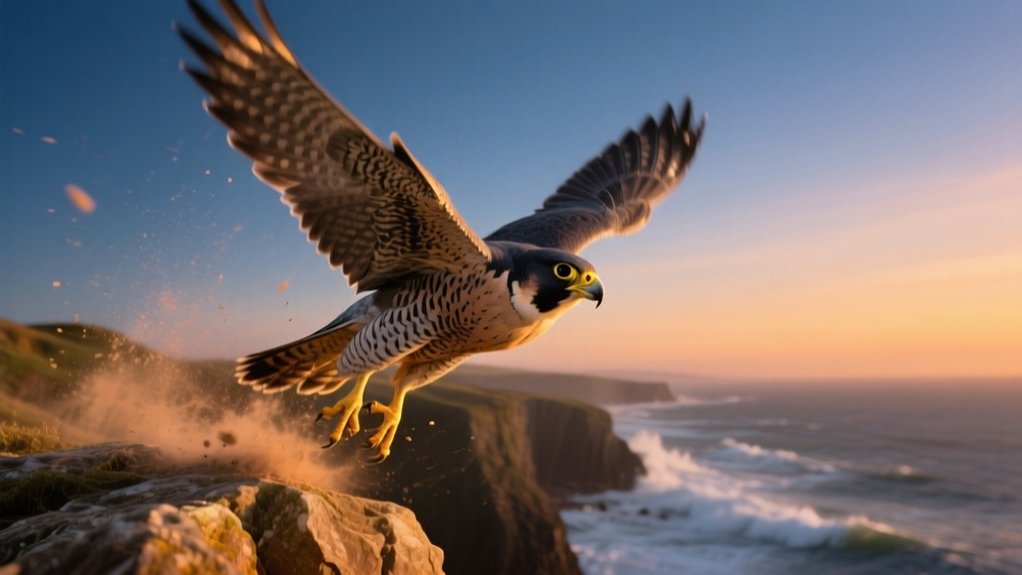
You see, birds fly to survive and thrive. They search for food efficiently, escape predators, and migrate to find seasonal resources.
Their wings, shaped by powerful muscles and lightweight bones, create lift and thrust with precise movements. Different wing shapes suit varied environments, from quick maneuvers to long glides.
Feathers, meticulously maintained, enable aerodynamic control and insulation. Understanding these details reveals how flight is essential for bird life and behavior. It invites you to investigate their fascinating adaptations further.
The Purpose Behind Bird Flight

Although bird flight might seem like a simple act of movement, it serves several critical purposes essential to their survival and reproductive success. When birds fly, they use their wings and feathers to manipulate air currents, allowing them to search for food efficiently and escape predators swiftly.
Flight enables them to reach distant habitats and migrate across vast regions, exploiting seasonal resources and securing ideal breeding grounds. You’ll notice that young birds also rely on flight to disperse, establishing territories away from their parents and reducing competition.
Furthermore, flight grants access to high altitudes and remote areas, offering refuge from ground-based threats. Beyond survival, birds use flight displays to assert territorial dominance and attract mates, showcasing their physical condition through controlled movements of wings and feathers in the air. Many birds enhance these advantages with specialized flight adaptations such as lightweight bones and efficient respiratory systems, allowing them to thrive in diverse environments.
Essential Anatomy for Flying
When you observe a bird in flight, you witness a complex interplay of specialized anatomical features that enable its effortless movement through air.
The shape of the wings, formed by elongated limb and finger bones, creates an aerofoil essential for generating lift.
Elongated limb and finger bones shape wings into aerofoils vital for generating lift.
Primary feathers extend from the wing tips and provide critical surface area and aerodynamic properties that optimize flight efficiency.
Beneath these feathers, powerful wing muscles, particularly the chest muscles, drive wing movements, accounting for over a quarter of the bird’s body weight.
Feathers provide not only lift but also control, allowing precise adjustments during flight.
Moreover, birds’ lightweight bodies with hollow bones and a centralized center of gravity contribute to balance and agility, making their anatomy perfectly adapted for sustained, controlled flight.
Just as beak diversity reflects how birds are adapted to their specific diets and environments, their flight anatomy demonstrates the remarkable ways in which evolution shapes birds for survival in the skies.
Mechanics of Wing Movement
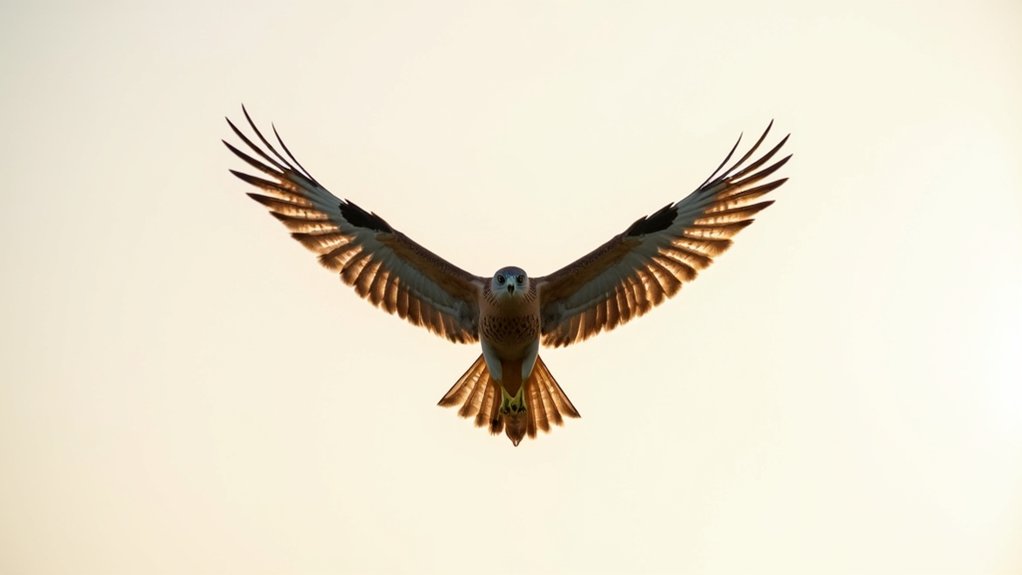
Because birds rely on precise muscle coordination, their wing movement involves powerful pectoral muscles pulling the wings downward to generate thrust and lift.
Meanwhile, smaller supracoracoideus muscles raise the wings during the upstroke, creating a seamless cycle essential for sustained flight.
When flapping their wings, you’ll notice three key mechanics:
- Wing muscles contract forcefully during the downstroke, driving the primary flight feathers to push air backward and downward.
- During the upstroke, birds fold their wings slightly, reducing air resistance and conserving energy.
- The wing bones support flight feathers that optimize lift by creating pressure differences above and below the wing.
Together, these mechanics allow birds to stay in the air efficiently. They balance thrust and lift for continuous motion.
Variations in Wing Shapes and Their Functions
As you observe different bird species, you’ll notice their wing shapes vary considerably, each adapted to specific flight needs and environments. Birds fly using wing muscles tailored to their wing type.
Short, rounded wings improve maneuverability in woodlands, ideal for raptors and passerines traversing tight spaces. Pointed wings, seen in falcons and ducks, streamline high-speed flight for rapid pursuit.
Long, thin wings allow albatrosses to glide efficiently on ocean air currents, conserving energy over vast distances. Wide wings enable buzzards, eagles, and storks to soar on thermals, covering long distances with minimal effort.
Moreover, primary feather slots in large wings minimize turbulence, boosting stability and flight efficiency.
Understanding these variations reveals how wing shape optimizes flight for each species’ ecological niche.
Feather Structure and Maintenance
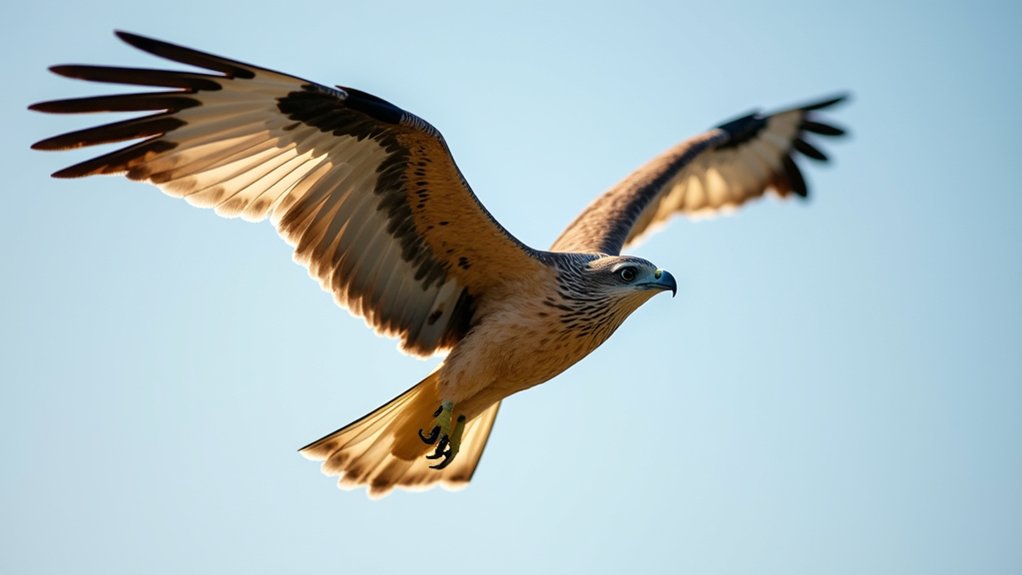
Feathers, composed primarily of keratin, form the essential surfaces that allow birds to achieve flight and maintain insulation.
These feathers are composed of a shaft with barbs and hooked barbules that interlock, creating a solid wing surface vital for flight. To keep these surfaces efficient, birds rely on precise maintenance routines.
You can observe three key aspects of feather care:
- Preening aligns feathers and removes parasites, ensuring wing muscles work efficiently during flight.
- Bathing, either in water or dust, maintains feather flexibility and cleanliness.
- Nesting sites are often chosen with access to safe preening and bathing spots, supporting daily upkeep.
Some birds also spread their wings to aid in drying feathers, which is essential after bathing or rain to maintain flight ability and insulation.
This maintenance lets birds soar on thermals effortlessly, optimizing lift and conserving energy.
Frequently Asked Question
How Do Birds Navigate During Long Migrations?
You navigate long migrations by using a combination of celestial cues like the sun and stars, Earth’s magnetic fields detected through specialized eye cells, and environmental factors such as wind patterns and landmarks.
Birds like the indigo bunting rely on star positions at night, while V formations help conserve energy and maintain direction.
These natural tools work together, allowing you to adjust routes and stay on course even in challenging conditions.
Can All Bird Species Fly?
Certainly, not all birds boast the ability to brave the skies.
While many master marvelous migrations, some species, like ostriches and kiwis, have forsaken flight for terrestrial tenacity.
Their bulky bodies and diminished wings diminish lift, making flight impossible.
These flightless fowl evolved from flying ancestors but adapted to alternative environments.
Ostriches sprint swiftly, and penguins swim skillfully.
How Do Birds Rest While Flying?
You can observe that birds rest while flying by gliding, spreading their wings wide to use air currents and reduce muscle effort.
Species like albatrosses exploit wind and thermal updrafts, gliding for hours without flapping. They alternate short flapping bursts with gliding to conserve energy.
Dynamic soaring lets them gain altitude into the wind and descend to rest muscles.
Some, like kestrels, hover stationary, conserving energy while scanning their surroundings.
What Role Does Bird Flight Play in Ecosystems?
Bird flight acts like a living thread weaving ecosystems together.
When you watch birds fly, you see them transporting pollen, dispersing seeds, and balancing food webs by preying on insects and small animals.
Their movements aid nutrient cycling through scavenging and droppings, enriching soils.
Furthermore, migratory birds connect distant habitats, promoting genetic diversity and ecosystem resilience.
Your understanding of ecosystems deepens when you recognize how essential bird flight is to ecological stability.
How Do Environmental Changes Affect Bird Flight Patterns?
Environmental changes force you to adapt your flight patterns considerably.
Altered wind patterns and temperature shifts can change your migratory timing and routes, increasing energy demands.
Habitat loss makes you seek new nesting and feeding grounds, while urban obstacles require precise navigation adjustments.
Changes in land use affect thermals and updraft availability, forcing you to find alternative soaring strategies.
These challenges directly impact your survival and reproductive success.
Conclusion
Now that you understand the purpose behind bird flight, you see how their anatomy works like a finely tuned machine. Their wing movements create lift and thrust, while variations in wing shapes suit different flying needs.
Feathers, meticulously maintained, act like aerodynamic armor. Together, these elements let birds master the sky, as if they’re painting invisible brushstrokes across the air.
By observing these details, you grasp why flight is both an art and a science.