
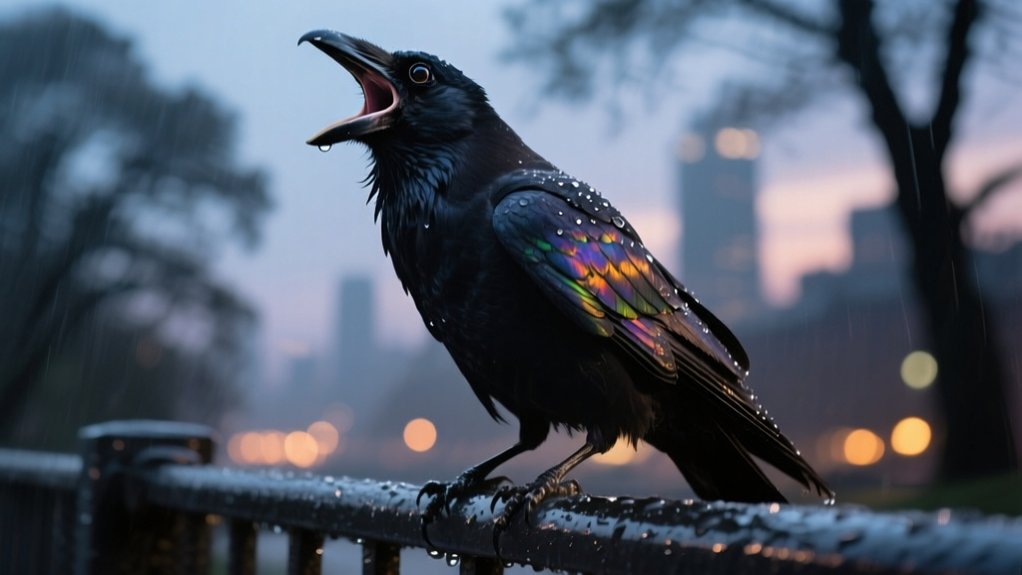
You’ll hear birds scream loudly mainly to communicate urgent information like territory defense, alarm calls, or maintaining group cohesion across distances. These vocalizations peak during breeding seasons due to hormonal shifts that improve vocal muscle control.
Loud calls also serve as social signals of fitness or stress responses to environmental changes and anxiety. Their vocal complexity reflects both physical constraints and social context. Investigate further to understand how these factors shape the intensity and timing of bird screams.
Communication and Social Signaling in Birds
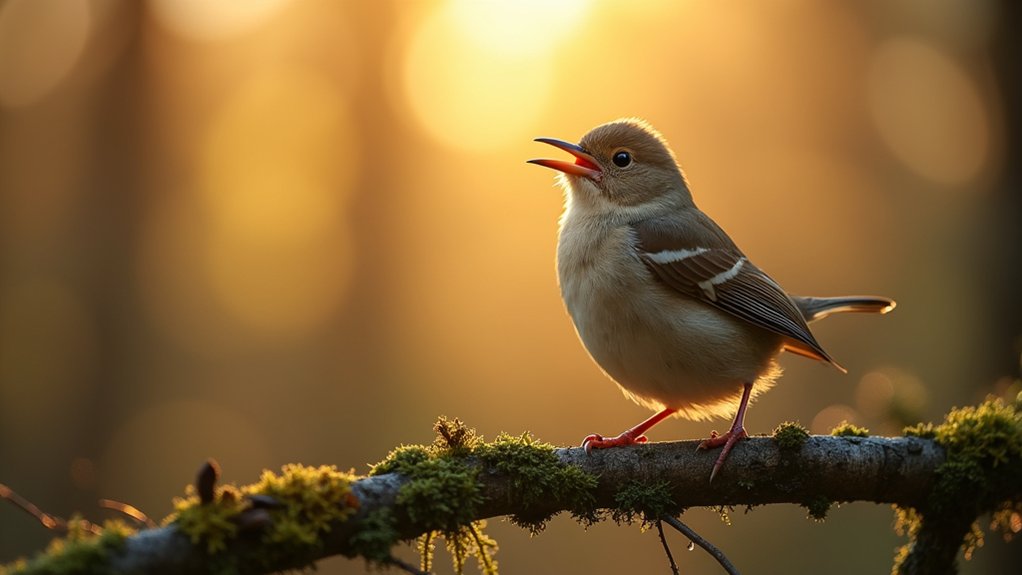
Although birds rely on various sensory modalities, vocal signaling plays a central role in their communication and social interactions. When you listen closely, you’ll notice birds use loud songs and calls to establish territories, especially during breeding seasons. These vocalizations peak at dawn and dusk, aligning with heightened activity and mate-guarding. You’ll also observe that birds respond aggressively to unfamiliar songs, validating the “dear enemy effect.” The loudness and complexity of their songs signal individual quality and fighting ability, deterring intruders. Furthermore, physical constraints on vocal performance, like trill rate and frequency bandwidth, guarantee honesty in these signals, reflecting the bird’s condition. Studies have shown that species-specific learning bias influences the preference and effectiveness of these vocal signals, ensuring communication remains within the same species. In some cases, nocturnal singing occurs to maximize the effectiveness of communication by reducing competition from daytime vocalizations. Consequently, loud vocalizations serve as precise, strategic communicative tools in territory defense and social structuring.
Long-Distance Contact Calls in Dense Habitats
When you navigate dense forest habitats, you’ll notice birds rely heavily on long-distance contact calls specially adapted to overcome the acoustic challenges posed by thick vegetation.
These calls typically occupy lower frequencies (1–4 kHz) to minimize attenuation and scattering by leaves and branches. Their narrower frequency bandwidth and tonal structure improve transmission through cluttered understory.
You’ll observe slower-modulated, less abrupt notes that resist degradation over distance, aligning with the acoustic adaptation hypothesis. Birds increase call amplitude in noisy conditions, employing the Lombard effect, and often emit repeated short notes during periods of reduced background noise, like dawn or dusk.
These adaptations maintain flock cohesion across 100–300 meters in visually obstructed environments, facilitating spatial orientation, territory advertisement, and regrouping during migration despite dense foliage masking visual cues. This communication strategy is crucial because birds play a vital role in maintaining the ecosystem balance by interacting with local plants and animals.
Alarm Screams and Predator Warnings
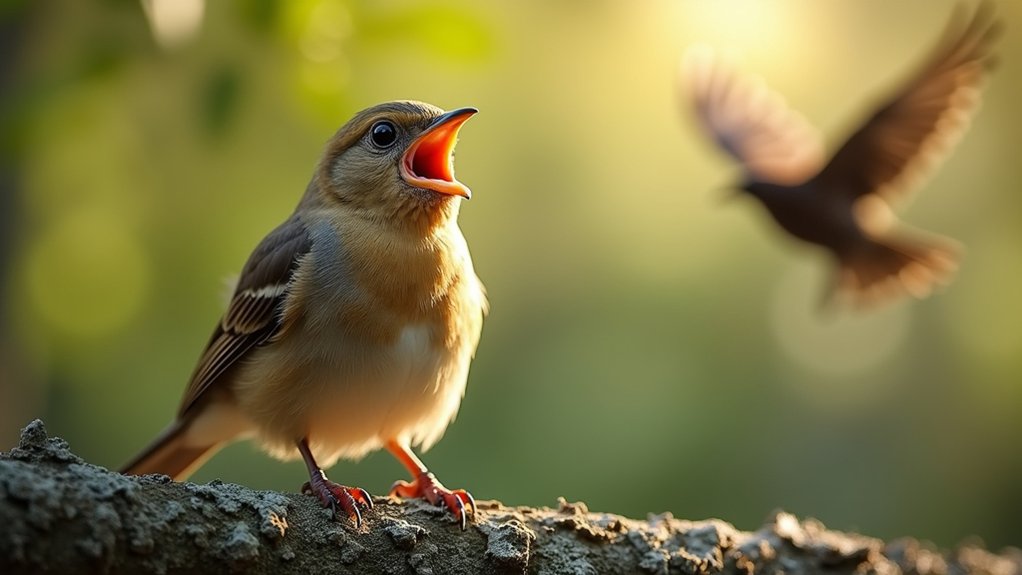
Beyond maintaining contact in dense habitats, birds employ alarm screams and predator warnings that convey immediate threats with remarkable specificity.
You’ll notice that their calls vary in frequency, duration, and structure to communicate the level and type of danger efficiently. These vocalizations prompt rapid responses, enabling you and other birds to react almost instantaneously. Alarm calls provide an early warning system for potential threats, allowing groups to enhance their safety.
New Holland honeyeaters signal more dangerous predators with complex calls, triggering responses within 100 milliseconds.
Chickadees add “dee” repetitions correlating with predator threat level, mobilizing group defense.
Lower frequencies in calls travel farther and penetrate obstacles better, increasing detection. High-pitched “seet” calls warn conspecifics silently, avoiding predator interception.
Multi-species alarm networks facilitate cross-species survival through shared understanding of vocal warnings. Other species, such as nuthatches and squirrels, actively respond to these warnings, demonstrating interspecies communication and influence.
Territorial Displays Through Vocalization
Territorial vocalizations serve as essential signals that communicate ownership and deter intruders by broadcasting a bird’s presence and status within a defined space. When you observe these birds, note how their loud songs mark territory boundaries, preventing physical confrontations through countersinging and song-type matching. These vocalizations often involve syllabic diversity, which adds complexity and effectiveness to the territorial signal.
You’ll see adjustments in amplitude and frequency tailored to habitat noise, ensuring signals penetrate surrounding environments effectively. These vocal displays also serve as assessments of rival quality, with complex, high-rate songs indicating a strong contender. Birds may also increase vocal intensity during seasonal migration to coordinate group movements and reinforce social cohesion.
In mated pairs, coordinated duets further reinforce territorial claims, presenting a unified front. Seasonal factors influence vocal intensity; during breeding, territorial defense escalates, especially around nesting sites.
Understanding these patterns helps you recognize how loud vocalizations function as sophisticated, multi-layered territorial strategies rather than mere noise.
Screaming as a Mate Attraction Strategy
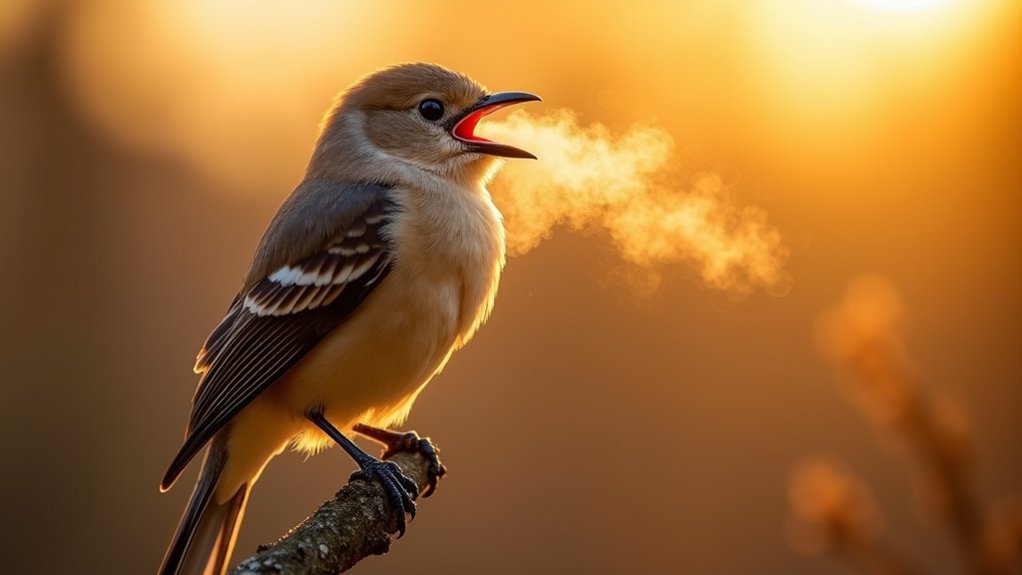
You might’ve noticed that during the breeding season, males start screaming a lot more—both louder and more often.
This happens because their hormone levels, especially testosterone, go up quite a bit. When these hormones surge, they actually boost how well the vocal muscles work and improve breathing control.
This means the males can make louder, longer calls. Studies show that males often repeat their song notes with high vocal consistency to attract females effectively.
Breeding Season Vocal Surges
When breeding season approaches, male birds dramatically increase their vocal output. They often spend over 90% of their post-dawn time producing loud, repetitive calls to attract mates. This surge in screaming serves as an acoustic advertisement of presence, stamina, and territory quality.
You’ll observe that vocalizations become louder, more frequent, and persistent, especially among unpaired males seeking mates. As social animals, birds like parrots use vocal communication to express needs and interact with others, which intensifies during such critical periods of social engagement social communication.
Key features of breeding season vocal surges include:
- Peak vocal output during pre-breeding and early breeding stages
- Higher song rates in unpaired males versus paired ones
- Shift to repeat call modes for long-range mate attraction
- Encoding of age and quality through vocal intensity and repertoire
- Temporal decline in vocal rate post-pairing and nest initiation
This strategic vocal escalation maximizes mate encounter rates during peak fertility.
Hormonal Influence on Screaming
Male birds ramp up their vocal activity during breeding seasons not only as a behavioral display but also through underlying hormonal mechanisms that drive these intense screaming bouts. Hormonal surges trigger chemical changes increasing vocal intensity and duration, signaling reproductive readiness. These hormonal changes are often prompted by longer daylight and warmer temperatures typical of spring, which act as natural environmental triggers.
You’ll notice species-specific courtship screams paired with physical displays like fanned tails and flashing eyes, reinforcing attraction. Hormonal influence also drives territorial defense vocalizations tied to mate protection.
| Factor | Effect on Screaming | Behavioral Indicator |
|---|---|---|
| Hormonal Surge | Intensifies scream duration | Aggressive body language |
| Environmental Triggers | Boost hormone production | Nesting and pair bonding |
| Nutritional Input | Improves vocal output | Increased irritability |
Understanding these mechanisms helps you manage and interpret your bird’s loud courtship calls effectively.
Social Coordination and Group Activities
Although loud screaming might seem chaotic, it plays an essential role in maintaining flock cohesion and coordinating group activities among birds.
You’ll notice that these vocalizations serve critical functions in social organization and survival. For example:
Loud contact calls keep flock members aware of each other’s locations during flight, foraging, and roosting. This group coordination is especially important during long-distance migration, when remaining together increases safety and navigation success.
Synchronized screams signal collective movements at dawn and dusk, aligning daily routines like takeoff and settlement.
Species-specific scream patterns help distinguish home flocks from neighbors, preserving territorial boundaries.
Alarm screams rapidly alert the group to threats, triggering collective escape or mobbing behavior. Additionally, environmental factors such as cage size and environment can influence the frequency and intensity of these vocalizations in captive birds.
Group vocalizations reinforce social bonds and facilitate juvenile learning of species-typical calls through call-and-response interactions.
Attention-Seeking Behavior in Captive Birds
Since captive environments often restrict natural behaviors, birds commonly develop loud, persistent screaming as an attention-seeking strategy.
You’ll notice that limited space and lack of environmental enrichment raise arousal and frustration, triggering repetitive, high-intensity vocalizations.
When you confine birds to small cages without adequate foraging or social stimuli, they compensate by emitting piercing contact calls aimed at attracting your attention or reacting to ambient sounds. Research shows that captive-bred birds exhibit a rapid loss of antipredatory behaviour, which can alter their natural responses and increase stress in captivity (loss of antipredatory behaviour).
This behavior intensifies if your responses, like talking or feeding, reinforce screaming, creating a feedback loop that strengthens vocal persistence.
Additionally, social isolation increases dependency on human interaction, leading to pronounced flock-calling directed at you or any movement.
To mitigate this, you must improve complexity in their environment and maintain consistent interaction patterns, reducing screaming by addressing the underlying need for stimulation and social contact.
Learned Vocalization and Reinforcement Loops
When you examine the neural mechanisms underlying learned vocalization in birds, you’ll find that specialized brain circuits coordinate complex sensorimotor integration essential for vocal learning and modification.
The song system nuclei form loops that sequence and time vocal output, while auditory and motor convergence in HVC matches self-produced sounds to memorized templates.
Song system nuclei create loops to sequence vocalizations, with HVC matching sounds to internal templates.
Reinforcement loops evaluate vocal performance, guiding trial-and-error adjustments.
Key features include:
- Cortico, basal ganglia, thalamocortical circuits control learned call structure
- Auditory and somatosensory feedback drive error correction
- Dopaminergic signals encode reward prediction errors
- Respiratory and vocal motor pools enable rapid loud vocalizations
- Basal ganglia circuits introduce exploratory variability for optimization
These feedback and reinforcement loops continuously refine loud vocalizations, including screaming, by strengthening successful motor commands over time. Recent studies have shown that somatosensory feedback can drive vocal learning independently of auditory cues, highlighting the role of non-auditory sensory input in vocal plasticity.
Environmental Factors Contributing to Screaming
You’ll notice that boredom and under-stimulation can actually raise a bird’s baseline arousal. This often leads them to make repetitive, loud vocalizations because they’re looking for some kind of engagement. Observing and assessing specific behaviors is crucial before implementing solutions, as understanding the behavioral triggers can guide effective intervention.
On top of that, sudden changes in their environment or constant exposure to noise can mess with how they process sensory information. This disruption tends to trigger alarm or distress screams.
Boredom and Under-Stimulation
Although parrots are highly intelligent and social animals, they often suffer from boredom and under-stimulation in captivity. This leads to increased screaming and other problem behaviors. You must understand that wild parrots spend hours daily foraging and problem-solving. These activities are largely absent in captivity.
This lack of cognitive engagement causes frustration and stereotypic behaviors. To mitigate this, consider providing foraging toys and puzzle feeders to stimulate problem-solving. Providing interactive toys and stimulation is essential to combat boredom and reduce stress. Creating a balanced habitat in the aviary can further enrich your parrot’s environment and reduce stress-induced vocalizations.
Also, give destructible items for shredding and chewing. Try cage reconfiguration to promote active exploration. Scheduled, structured social interaction helps reduce attention-seeking vocalizations.
Make sure there’s sufficient physical space for climbing and flying within the cage. Addressing these factors reduces boredom-driven screaming by satisfying parrots’ intrinsic need for mental and physical activity.
Noise and Environmental Changes
Since parrots rely heavily on auditory and visual cues to interpret their surroundings, environmental noise and changes directly influence their vocal behavior.
You’ll notice household noise like TVs or barking dogs triggers loud calls as parrots attempt to join or compete vocally. Owner reactions significantly impact parrot choices and behaviors; even negative responses can reinforce the screaming if given attention owner reactions.
Sudden sharp sounds, like doorbells or alarms, often act as reliable triggers for screaming bouts. Chronic background noise increases arousal, making startle responses more frequent. Increased stress behaviors in parrots are also commonly observed when their environment is unpredictable or disrupted.
Visually, outdoor activity or unfamiliar animals provoke alarm calls. Changes in cage placement or new furniture heighten stress, reflected in increased vocalization.
High-traffic areas maintain heightened arousal, perpetuating loud calls. Adjusting cage location to quieter, lower-traffic zones and limiting visual stimuli reduces screaming frequency and intensity.
This shows the strong link between environmental factors and parrot vocal behavior.
Physical Needs and Health-Related Vocalizations
When birds scream loudly, they often signal unmet physical needs or health issues that demand immediate attention. This vocal behavior frequently acts as an alarm for discomfort, pain, or physiological stress.
You should observe these signs closely:
- Repetitive screaming due to hunger, thirst, or environmental discomfort like extreme temperatures or soiled cages.
- Abrupt vocal outbursts indicating pain from injuries such as blood feathers, fractures, or soft-tissue damage.
- Intermittent sharp screams linked to systemic illnesses, especially when the bird is handled or moved.
- Increased baseline vocalization caused by chronic nutritional imbalances or obesity-related irritability. Monitoring food and environmental conditions is essential to address these issues and reduce excessive vocalization.
- Persistent loud calls associated with overtiredness from inadequate or fragmented sleep patterns.
Always rule out physical causes before attributing screaming to behavioral issues.
Hormonal Influences on Screaming Patterns
You’ll probably notice your bird’s screaming spikes during breeding season.
That’s because hormones kick in, triggered by things like longer daylight hours. These reproductive hormones really ramp up their vocal activity, especially around dawn and dusk.
It ties into their natural daily rhythms. Knowing this can help you predict when your bird will be extra noisy and find ways to manage it better. However, it is important to remember that extended screaming is often not hormonal but reflects inadequate training.
Breeding Season Vocal Surges
Although birds’ vocal surges during breeding season may seem random, they’re closely regulated by hormonal changes triggered by environmental cues like increased daylight and temperature.
Rising sex hormones such as testosterone and estrogen heighten territorial and mating calls, preparing birds for reproduction. The frequency and intensity of these calls can depend on species differences, as some birds are naturally more vocal or breed more frequently than others.
You’ll notice loud screaming especially near potential nesting sites or during dawn and dusk peaks.
Key factors influencing breeding vocal surges include:
- Extended daylight (12–14+ hours) triggering hormonal activity
- Warm, stable indoor climates promoting year-round breeding conditions
- Nest-like enclosures intensifying territorial calls
- Physical affection interpreted as sexual stimulation increasing vocal output
- Species-specific variability, with cockatoos and Amazons exhibiting pronounced surges
In the wild, some parrot species may scream for 15-20 minutes several times daily as a natural alarm and contact call behavior.
Understanding these parameters helps you manage and predict vocal behavior during breeding cycles effectively.
Circadian Rhythm Calls
Since birds rely on internal clocks to regulate their vocal behavior, circadian rhythms play an essential role in shaping daily patterns of screaming and calling.
You’ll find that endogenous circadian clocks in the pineal gland, retina, and hypothalamus coordinate vocal output, with melatonin rhythms linking light–dark cycles to timing.
Melatonin modulates call propensity by altering vocal structure and entropy, with injections inducing sleep-like states and increased variability.
Morning peaks in calling coincide with heightened vocal entropy, producing louder, less precise screams.
As the day progresses, circadian-driven motor control tightens, reducing variability and stabilizing calls.
Disruptions in melatonin signaling shift vocal activity phases, showing hormonal influence on screaming patterns.
Neural circuits governing song and calls receive phase information from pineal clocks, ensuring integrated timing of vocal and locomotor behaviors.
Recent research using variational autoencoders has revealed that juvenile birds exhibit systematic age-dependent shifts in song features, reflecting maturation processes influenced by circadian rhythms.
Daily Rhythms and Circadian Vocal Behavior
When you observe bird vocalizations throughout the day, you notice that their timing aligns closely with endogenous circadian rhythms controlled by specialized clocks in the brain, pineal gland, and retina.
These internal clocks regulate song and call activity, even under constant lighting conditions, ensuring vocal behavior synchronizes with sleep and wake cycles.
Internal clocks maintain song and call timing, aligning vocal behavior with sleep-wake cycles even without light cues.
Melatonin rhythms modulate this timing, while neural circuits in song control nuclei adjust daily.
Peak vocalizations typically occur at dawn and dusk, optimizing acoustic transmission.
- Endogenous circadian clocks govern daily vocal timing
- Melatonin disruption alters song and call patterns
- Neural activity in song nuclei parallels singing behavior
- Dawn and dusk choruses represent vocal peaks
- Juvenile birds show morning song variability linked to learning
Research on juvenile zebra finches reveals that circadian patterns significantly influence song variability and performance during sensorimotor learning phases.
This precise circadian control shapes daily vocal output profiles across species.
Fear, Anxiety, and Separation-Related Screams
When your bird experiences sudden stimuli, it often reacts with startle responses that come out as sharp, intense screams.
These screams are basically distress calls, acting as urgent signals that your bird is uncomfortable or feeling separated. They really reflect heightened anxiety levels.
Startle Responses
Although sudden loud noises or rapid movements near a bird’s perch often trigger an automatic startle reflex, this response involves more than just an abrupt vocalization.
The sympathetic nervous system activates fight-or-flight mechanisms, elevating heart rate and respiration, which intensify the scream’s volume and sharpness. You’ll notice species with tight flock bonds, like parrots and corvids, produce especially piercing startle calls to alert others rapidly. Parrots use these loud vocalizations to stay connected with their flock and mates, which helps them coordinate and maintain safety even from a distance flock communication.
In captivity, unfamiliar household stimuli can sensitize birds, lowering their threshold for screaming. Chronic stress and inconsistent routines further exacerbate this hyperreactivity.
Key factors influencing startle responses include:
- Sudden loud sounds or rapid movements near the bird
- Activation of fight-or-flight physiology
- Strong flock cohesion amplifying vocal intensity
- Sensitization from repeated exposure without desensitization
- Environmental stressors increasing baseline anxiety and vocal reactivity
Distress Calls
Why do birds emit distress calls that sound so urgent and piercing? These vocalizations arise primarily when a bird faces direct physical restraint by a predator rather than merely spotting one. The calls are brief, harsh sequences under five seconds, separated by silence, spanning broad frequency ranges at high amplitudes to maximize detectability.
You’ll notice birds often call more intensely if they retain some chance to escape, like being held loosely, potentially startling predators. Distress calls also honestly reflect the bird’s condition. Harsher screams indicate better health and escape potential.
Socially, these calls attract nearby flockmates who approach to assess the threat visually rather than flee. When isolated, many birds produce loud, repetitive separation screams to re-establish contact, with intensity linked to social dependency and anxiety levels. Because communication from conspecifics affects neophobia behavior, these vocalizations can influence how birds respond to novel or threatening situations.
Anxiety Vocalizations
Distress calls signal immediate danger through intense, brief screams, but birds also produce loud vocalizations driven by internal states of fear and anxiety.
When you observe a bird’s anxiety vocalizations, you’re witnessing activation of conserved limbic circuits, where neurotransmitters like GABA and serotonin modulate arousal.
Loud calling often accompanies behaviors such as freezing, reduced exploration, and heightened vigilance.
Anxiety can sensitize stress circuits, causing mild stimuli to trigger exaggerated screams.
Separation from social partners further intensifies these vocalizations, reflecting strong attachment bonds and social distress.
Anxiety vocalizations stem from perceived threats activating fear systems.
Neurobiology parallels mammalian anxiety pathways.
Behavioral signs include freezing and reduced feeding.
Separation triggers persistent, loud contact calls.
Chronic noise raises baseline anxiety, increasing vocal outbursts. Research increasingly shows that urban noise can exacerbate anxiety and mood disorders in humans, suggesting environmental soundscapes influence mental health across species.
Managing and Understanding Excessive Screaming
When you observe prolonged, repetitive screaming beyond normal flock calls, it’s crucial to identify the underlying causes and triggers to manage this behavior effectively.
Identifying the causes behind prolonged, repetitive screaming is essential for effective behavior management.
Start by distinguishing baseline vocalizations, which are typically 15–20 minutes several times daily, from excessive screaming. Normal vocalizations serve to communicate danger or maintain contact among flock members, so understanding these helps set a baseline for normal behavior.
Assess environmental factors like sudden routine changes, cage relocation, or new stimuli. Also check for unmet needs such as hunger, loneliness, or hygiene issues. Monitor for medical concerns if vocal patterns shift abruptly.
Implement a predictable schedule with consistent feeding, sleep (10–12 hours), and enrichment to reduce anxiety and boredom.
Use behavior modification by applying ABC analysis, withholding reinforcement immediately after screams, and rewarding quiet alternatives consistently across caregivers.
Finally, recognize stress indicators like pacing or feather plucking to adjust the environment or seek veterinary advice. This ensures welfare-focused interventions.
Frequently Asked Question
Can Certain Bird Species Scream Louder Than Others Naturally?
Yes, certain bird species can scream louder than others naturally due to anatomical and biomechanical factors.
You’ll find species like the white bellbird reach up to 125 dB at 1 meter, thanks to features like a wide-opening beak, a specialized syrinx, and strong abdominal muscles.
These adaptations enable higher sound pressure production, reflecting evolutionary responses to ecological and sexual selection pressures.
You can observe this in species inhabiting dense forests that require long-distance communication.
How Does Bird Age Affect the Loudness of Their Screams?
You’ll find that young birds, like hatchlings, produce softer screams due to underdeveloped syrinx muscles and respiratory systems.
As they mature into adults, their vocal apparatus strengthens, enabling louder, more intense calls essential for territory and mate attraction.
However, as birds age into late adulthood, muscle degradation reduces their maximum scream loudness.
Despite this decline, experienced older birds often compensate by optimizing timing and frequency to maintain effective communication.
Are There Differences in Screaming Behavior Between Wild and Domesticated Birds?
You’ll notice wild parrots typically scream in bursts during dawn and dusk, maintaining quiet intervals, while domesticated birds often vocalize excessively throughout the day.
In captivity, screaming can last hours, driven by unmet needs or boredom, unlike wild birds whose loud calls serve precise ecological functions.
For instance, captive parrots may scream up to 50% more frequently due to social isolation and human attention seeking, a behavior rarely seen in natural settings.
Do Birds Scream Differently Depending on the Time of Year Aside From Breeding Season?
Yes, you’ll notice birds’ screaming varies beyond breeding season.
Seasonal daylight shifts alter hormone levels, influencing vocal intensity and patterns. For example, longer spring days heighten overall calling, while shorter autumn days reduce hormonal screams but increase contact calls.
Environmental changes like indoor lighting or household routines also modulate screams.
Furthermore, daily peaks at dawn and dusk persist year-round, though their timing adjusts with seasonal sunrise and sunset changes, reflecting innate communication needs.
Can Diet Changes Reduce or Increase a Bird’s Loud Screaming?
Think of your bird’s diet as the fuel driving its vocal engine. Yes, adjusting what you feed can either amplify or quiet its loud screams.
High-fat, high-carb foods act like turning up the volume, boosting energy and hormonal surges that trigger screaming.
Conversely, cutting seeds to under 10% and offering fresh, natural foods reduces aggression and stress vocalizations.
Managing dietary components meticulously helps stabilize behavior and lowers excessive screaming effectively.
Conclusion
When you hear a bird’s loud scream, remember it’s more than noise. It’s a complex code shaped by survival, social bonds, and biology. These vocalizations act like nature’s Morse code, signaling danger, territory, or desire across dense forests and open skies.
By understanding the hormonal and environmental rhythms behind these calls, you can appreciate how each scream fits into an intricate communication network. It blends instinct with strategy in the avian world’s daily symphony.