
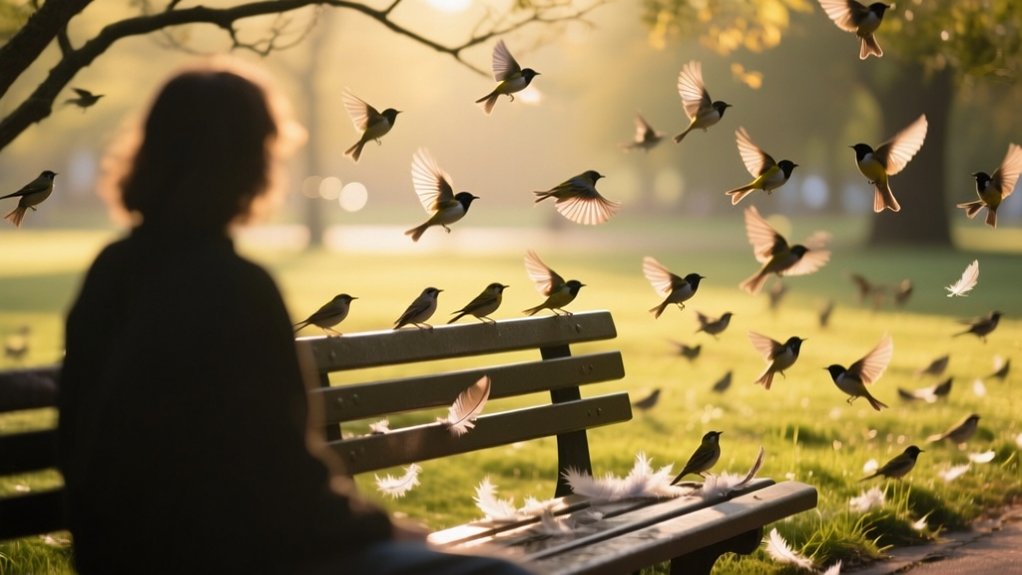
You attract birds because they’ve learned to recognize your presence, often associating you with food or safety in their environment. This habituation reduces their fear, prompting curiosity and closer approach.
Birds’ sensory awareness allows quick investigation of minimal movements or sounds you make. Spiritually, their sudden appearance can symbolize protection or guidance, reflecting deeper meanings tied to your life.
If you investigate further, you’ll uncover how biology and belief intertwine to explain this fascinating interaction.
The Science Behind Birds’ Awareness of Human Presence
The science behind birds’ awareness of human presence reveals their remarkable ability to recognize individual people and assess potential threats.
You’ll find that mockingbirds, for example, distinguish one human from thousands by observing repeated approaches to their nests. When the same person returns daily, the birds escalate alarm calls and attack flights, showing fine-scale risk assessment. Conversely, a different human elicits a baseline response, indicating specific recognition.
Birds also detect minimal human movement from afar, triggering investigation and attraction behaviors, especially when scents or sounds hint at food. Additionally, birds are drawn to areas where food and water sources are available, which often include human environments.
Species vary in tolerance: larger birds like pelicans tolerate closer proximity, while smaller ones, such as hummingbirds, remain wary.
Urban birds balance risk and resource opportunities, adapting their responses based on repeated human interactions and environmental cues.
How Habituation Changes Bird Behavior Near Humans
You’ve probably noticed that birds seem to tolerate you more in urban parks than when you’re out in remote forests. This change in behavior happens because of something called habituation.
Basically, after repeated encounters where they realize humans aren’t a threat, birds start to reduce how far away they fly off and how quickly they react to potential danger. In fact, some studies have shown that certain bird species may even have similar or higher reproductive success in areas with regular human disturbance, suggesting possible habituation benefits.
It’s pretty interesting when you think about it. These adaptations show us that birds are actually adjusting how they assess risk and how they use resources when humans are around.
Habituation Effects on Birds
Although birds initially respond to human presence as a potential threat, they quickly learn to recognize repeated, non-threatening encounters through habituation. This process diminishes stress responses and alters behavior, enabling you to observe birds appearing closer.
Key effects include:
- Reduced flight initiation distance (FID), allowing birds to tolerate closer human proximity.
- Behavioral and physiological adaptations that minimize energy spent on unnecessary stress.
- Faster habituation rates in urban birds due to continuous exposure to humans.
- Species-specific differences, with granivores adapting more rapidly than carnivores.
Understanding habituation explains why birds near you seem less fearful and more opportunistic, as they associate your presence with food and safety.
It helps refine their survival strategies in human-dominated environments.
Behavioral Adaptations Nearby
When birds habituate to human presence, their flight initiation distance (FID) decreases markedly, reflecting a shift in escape response patterns. You’ll notice urban birds tolerate closer proximity, reducing FID compared to rural counterparts who initiate flight earlier. This behavioral adaptation aligns with the Flush Early and Avoid the Rush (FEAR) hypothesis, where birds balance vigilance and energy costs by escaping sooner when humans approach from longer distances.
You’ll also observe species-specific traits influencing tolerance: larger-bodied birds and those with greater flight capacity maintain longer escape distances. Additionally, birds with larger clutches tend to show less tolerance towards human approaches, highlighting reproductive investment as a factor in escape behavior. Furthermore, birds exploit human-modified environments for resources, associating your presence with food and shelter. Birds remain oviparous, always laying eggs rather than giving live birth, which impacts their reproductive strategies and interactions with their environment.
Seasonal and environmental factors further modulate escape behavior, with wetter conditions prompting increased risk aversion. Ultimately, habituation drives nuanced, context-dependent adjustments in avian behavior near humans.
The Role of Food Association in Bird-Human Interactions
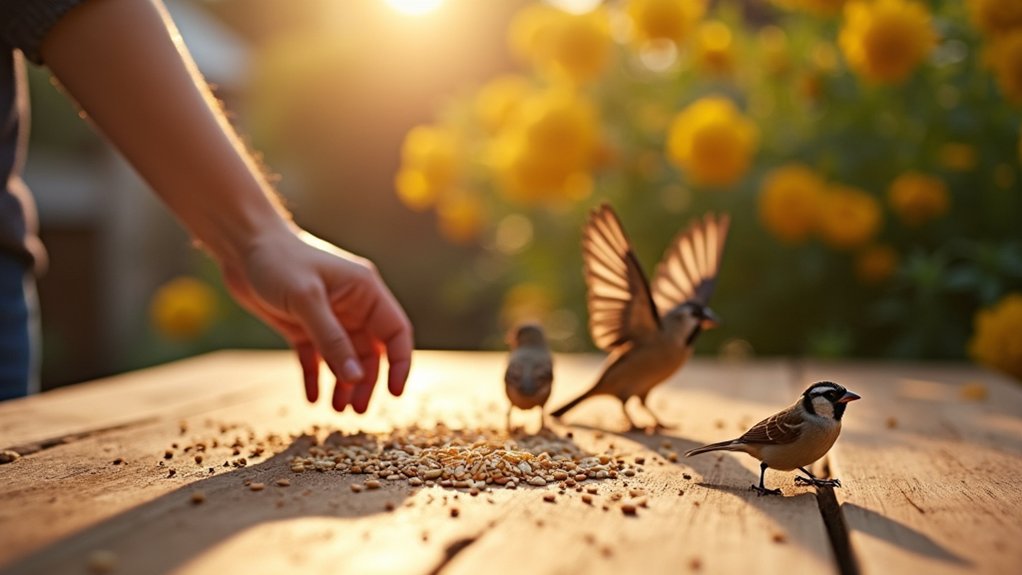
You’ll notice that birds quickly imprint on places where food is consistently available. They start to link your presence with the possibility of getting something to eat.
This learned association helps them remember where to find food and guides their future visits. Plus, these behaviors often get passed down from one generation to the next, which reinforces patterns of bird-human interaction over time.
It’s pretty fascinating how these little connections shape their habits! If you offer nutrient-rich seed blends, birds are more likely to return and stay longer, as they recognize both the quality and consistency of the food source you provide.
Imprinting and Learning
Since birds rely heavily on imprinting as an innate learning mechanism during critical developmental stages, their interactions with humans often hinge on food association.
You’ll notice young birds imprint on conspicuous stimuli, like your presence paired with feeding, creating a filial bond that shapes social recognition.
This imprinting involves neural changes in the intermediate and medial mesopallium (IMM), where stimulus patterns become encoded and discriminated.
Over time, repeated exposure to you as a non-threatening source of food strengthens specific neural pathways, modifying approach behaviors.
Key points to take into account:
- Imprinting occurs during sensitive developmental periods, critical for survival.
- Filial bonds form through learning stimulus characteristics.
- Neural plasticity in IMM encodes human-related cues.
- Food association habituates birds to human proximity without fear.
This precise learning mechanism underpins why birds suddenly appear near you, demonstrating the critical periods when young birds are most responsive to environmental stimuli.
Food Source Locations
Imprinting shapes how birds recognize humans as reliable food sources, but the specific locations and types of food you provide play a significant role in sustaining these interactions.
Birds in urban environments associate your presence with consistent access to seeds in feeders, discarded human foods, or incidental protein like insects on vehicles. The availability of water sources, such as birdbaths or fountains, can further attract birds and reinforce their association between your presence and essential resources.
Proximity matters: birds near campuses or urban sites forage shorter distances due to frequent, reliable food sources, unlike rural birds who travel farther.
Behavioral flexibility enables species like House Sparrows to exploit processed foods increasingly, adapting their foraging strategies based on availability.
You establish predictable food locations, such as feeders, benches, and garbage areas, that birds systematically recognize.
This reinforces habituation and reduces flight distances.
This spatial and nutritional association drives urban tolerance, population growth, and range expansion among species adapting to anthropogenic environments.
However, this increased tolerance may lead to potential domestication effects, where birds begin to see humans as caretakers rather than threats.
Intergenerational Behavior Transfer
Although birds initially learn to associate humans with food through direct encounters, these behavioral traits often persist across generations via epigenetic and social transmission mechanisms.
When you observe birds approaching you, you’re witnessing a complex inheritance of learned behaviors shaped both genetically and culturally. Persistent chirping, for example, can be a key form of communication that signals needs such as hunger or the presence of food, reinforcing the association between humans and feeding opportunities.
Consider these key points:
- Epigenetic modifications, like DNA methylation, transmit feeding-related behaviors without altering DNA sequences.
- Juvenile birds acquire food association not only from parents but also from siblings and non-parental adults, highlighting the crucial role of social learning from siblings.
- Habituation to human presence reduces fear, reinforcing food-seeking behaviors near people.
- Cultural inheritance in bird populations evolves through multiple social learning pathways beyond vertical transmission.
This intricate interplay guarantees that your presence becomes a reliable food signal, perpetuated across bird generations.
Why Birds Are More Common Near Human Habitations
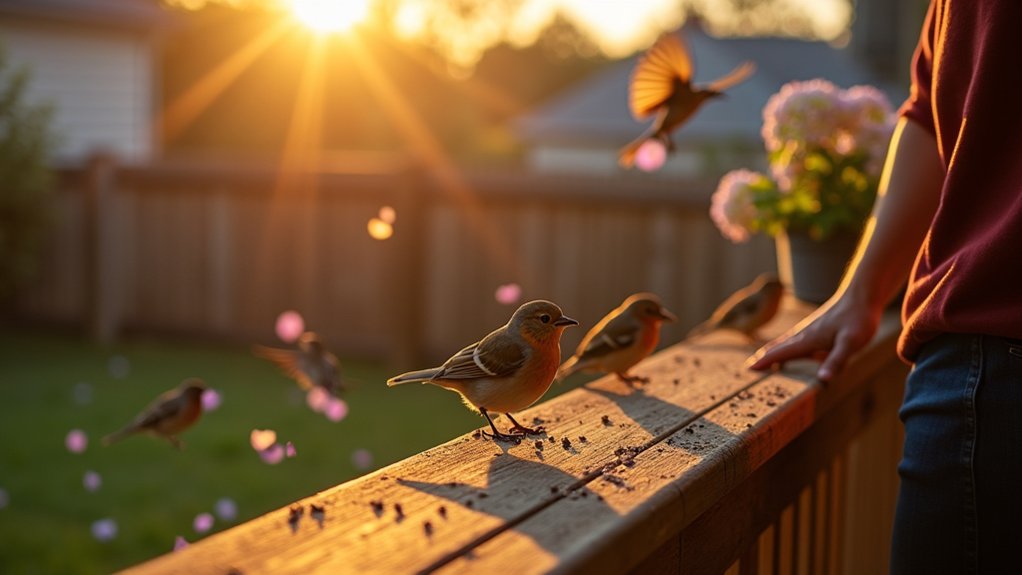
When you observe birds thriving near human settlements, it’s often due to the reliable food sources and shelter opportunities these environments provide.
Human habitations supply consistent nutrition through feeders, waste, and discarded meals, enabling birds to sustain populations even during natural scarcities. Urban land cover is expected to triple between 2000 and 2030, intensifying these habitat changes and resource availability in many regions (urban expansion). Urban environments are becoming increasingly important as bird habitats, supporting adaptable species and contributing to the diversity of bird populations found around people.
Built structures offer novel nesting sites and microclimates that buffer temperature extremes, while urban settings reduce predation risks via habitat modifications.
Birds habituate to human presence, displaying reduced fear responses and shorter flight distances, facilitating closer proximity.
Furthermore, urban noise masks predator cues, allowing birds to forage with lower vigilance.
Species with traits favoring urban exploitation, like colonial nesting, high productivity, and exploratory behavior, dominate these areas.
Together, these factors create ecological niches where certain bird populations concentrate. This explains their increased abundance near human habitations.
Understanding Bird Sensory Awareness and Investigation
You know, birds have really sharp eyesight and hearing. Their eyes are placed on the sides of their heads, which helps them spot things all around. Plus, they’ve sensitive ears that can pick up even the smallest sounds. Recent research shows that crows and ravens possess sensory consciousness, meaning they have subjective experiences influenced by their perceptions. These impressive senses also play a big role in bird communication, as they use vocalizations and body language to interact with each other and respond to their environment. So, when they hear or see something unusual, their natural curiosity kicks in. They start checking things out to figure out if there’s any danger or maybe something interesting.
All of this working together means birds can react quickly and adjust to what’s going on around them.
That’s why sometimes it feels like they just suddenly show up right near you!
Visual and Auditory Cues
Because birds rely heavily on sensory input to navigate complex environments, understanding their visual and auditory cues is essential to grasping their behavior and detection mechanisms. You must consider both modalities to appreciate how birds detect and respond to stimuli:
- Auditory detection varies by frequency; low-frequency calls (100–2500 Hz) travel farther than high-frequency ones (1500–8500 Hz), limiting small bird detection range to about 150 meters.
- Visual detection employs lateral fields with high spatial resolution, allowing effective target sampling up to 100 meters. This is vital for predator and prey identification.
- Sound pressure level and body mass influence acoustic detection probability, but SPL explains only a third of the variation. Passive acoustic monitoring studies have shown that detection probability is significantly affected by species body mass and sound pressure level.
- Environmental context, such as forest density and height, modulates detection, with auditory cues dominating in dense habitats.
Understanding these factors clarifies why birds suddenly appear as you approach.
Investigative and Curiosity Behavior
Although birds rely on keen sensory awareness to navigate their environments, they actively engage in investigative behaviors to gather critical information. You’ll notice they manipulate objects with their feet and bills, examining food, nest materials, or potential threats closely. Birds utilize these modes of exploration such as locomotion, manipulation, and inspection to acquire knowledge essential for survival.
Their sensory detection is sophisticated, enabling them to differentiate between harmless and dangerous stimuli. This curiosity-driven investigation reduces uncertainty, helping birds adapt and survive. Some species also display extraordinary aerial endurance that allows them to observe and respond to the environment even while in flight.
Understanding these behaviors reveals why birds may suddenly appear near you. They’re evaluating safety, resources, or companions.
| Behavior Type | Emotional Insight |
|---|---|
| Object Manipulation | Curiosity sparks connection |
| Predator Inspection | Caution meets bravery |
| Sensory Detection | Heightened awareness |
| Habituation | Trust through familiarity |
| Information-Seeking | Drive for understanding |
The Impact of Human Mobility on Bird Detection Patterns
When human mobility patterns shifted dramatically during the COVID-19 lockdowns, bird detection rates responded in measurable ways across multiple species. You observed that 80% of focal species altered habitat use, while 76% showed statistically significant detection changes linked to mobility shifts.
Detection patterns varied daily and seasonally, influenced by local human activity levels. Key insights include:
- Increased human mobility raised detection likelihood in 23 species, particularly songbirds in yards and parks.
- Reduced mobility correlated with lower counts in over half the species, linked to habitat disturbance and noise sensitivity.
- Detection responses differed geographically, with urban areas showing more pronounced mobility effects than less developed regions.
- Temporal analyses revealed distinct daily versus seasonal influences on habitat use and detection probabilities, highlighting the importance of human activity.
Understanding these dynamics helps clarify how your movement influences bird presence and visibility.
Species-Specific Responses to Human Activity
Shifts in human activity elicit distinct responses across bird species, reflecting their ecological traits and behavioral adaptations. You’ll notice exploiter species like hooded crows and rose-ringed parakeets reduce activity when human presence declines, relying heavily on anthropogenic resources. Notably, studies during COVID-19 shutdowns found that overall bird tolerance to humans remained stable despite fluctuations in human presence, indicating a resilience that varies among species (avian tolerance stability).
Conversely, human-aversive species such as graceful prinias increase activity in less disturbed urban parks. Body size also predicts tolerance; larger birds exhibit greater alert distances and flee earlier than smaller species, which tend to adjust population counts more dynamically.
Foraging behaviors shift too. Carrion-eaters modify activity based on human outdoor presence, while many species avoid breeding in heavily used areas.
Habitat specificity matters: urban parks become refuges for sensitive species, and residential zones attract human-dependent birds during lockdowns.
These patterns reveal complex, species-specific behavioral plasticity shaped by ecological niches and urban filtering processes.
How Birds Learn to Recognize Humans as Non-Threatening
You know, birds actually become less scared of people when they see them around a lot without any threat. This is called habituation.
Basically, they get used to us being there and realize we’re not a danger. Increased stress behaviors in birds often result from environmental disturbances, so consistent, calm human presence can help birds feel more secure.
Over time, birds start to link humans with things that don’t harm them—like consistent, neutral behavior or even food.
When you feed them regularly, it helps them recognize you and feel safer around you. Many bird species, including crows and magpies, can remember faces, which aids in survival and social interactions face recognition.
Habituation to Human Presence
Although birds naturally perceive humans as potential threats, repeated non-threatening encounters lead them to habituate. This gradually reduces their defensive responses.
You’ll notice urban birds acclimate faster due to consistent human presence, while rural birds stay more alert.
Habituation reflects in flight initiation distance (FID), which decreases as birds grow accustomed to you.
Key factors influencing habituation include:
- Species type and residency status (residents habituate faster than migrants)
- Frequency and predictability of your presence
- Individual bird personality traits (bolder birds adapt quicker)
- Environmental context (urban settings promote faster habituation than rural ones)
Safety Perception Development
When birds repeatedly encounter humans without harm, their brains adapt through neuroplasticity, rewiring neural pathways to associate human presence with safety. This adaptation reduces fear responses, with birds gradually recognizing you as non-threatening. Research shows that expertise in recognizing similar objects, like birds or human presence, involves activation in specific brain regions, illustrating how neuroplasticity enhances recognition.
Behavioral cues shift: startle responses lessen, approach behavior increases, and flight distance shortens. Sensory systems analyze your movements and sounds to refine threat assessment.
Trust builds as your interactions become predictable and non-aggressive, solidifying safety perception over time.
| Aspect | Observation |
|---|---|
| Neural Adaptation | Strengthened connections with repeated exposure |
| Fear Response Reduction | Decreased startle and flight distance |
| Behavioral Recognition | Increased approach and relaxed body language |
| Sensory Assessment | Visual and auditory cues refine threat level |
| Trust Building | Predictable, gentle presence fosters trust |
Imprinting on Food Sources
Since birds rely heavily on early-life learning to identify safe food sources, they develop an imprinting process that links human presence with reliable feeding opportunities.
You’ll notice how young birds observe their parents selecting food near humans, imprinting on these locations as safe.
This process includes:
- Recognizing humans as non-threatening through repeated exposure without harm.
- Associating human activity with consistent food availability, like scraps or feeders.
- Developing lasting dietary preferences reinforced by early observation.
- Exploiting sensory cues such as scent and sight to locate feeding areas near people.
This behavior is similar to the concept of imprinting discovered by Konrad Lorenz, where early exposure leads to strong attachment and recognition patterns.
Protective Benefits of Human Proximity for Birds
Because human proximity often signals reliable resources and reduced threats, birds gain significant protective advantages by inhabiting areas near people. You’ll notice birds exploiting human-provided food, water, and shelter, which improves survival rates and reduces predation risk. Habituation to non-threatening human behavior further decreases stress and flight responses, allowing birds to conserve energy. Species like crows have demonstrated complex social behaviors that include recognizing and responding to familiar humans, which supports their ability to thrive in human-dominated environments. Birds that frequent human environments may also benefit from balanced nutrition when they are offered a variety of safe vegetables, which further supports their health and longevity.
| Protective Aspect | Mechanism | Benefit |
|---|---|---|
| Food Accessibility | Feeders, waste, intentional feeding | Lowers foraging effort |
| Shelter and Refuge | Trees, buildings, microhabitats | Reduces exposure, predation |
| Water Source Access | Birdbaths, ponds, urban streams | Guarantees hydration year-round |
| Habituation | Human recognition, reduced fear | Energy conservation, safety |
Your presence therefore indirectly fosters bird population stability and ecological resilience.
Behavioral Flexibility and Urban Adaptation in Birds
Although urban environments present unpredictable challenges, birds have developed remarkable behavioral flexibility to utilize these settings effectively. You can observe urban birds like House Sparrows and House Finches exhibiting heightened neophilia, enabling them to investigate novel food sources rapidly.
Their behavioral plasticity allows quick adjustments to foraging strategies and daily activity patterns in response to human presence and environmental shifts. When birds die in urban areas, scavengers like crows and sanitation services often remove the remains, which alters the natural recycling process found in more rural environments.
Consider these key adaptations:
- Increased neophilic tendencies promote utilization of unpredictable urban resources.
- Modified foraging behavior balances energy expenditure with risk assessment.
- Phenotypic plasticity supports rapid behavioral and physiological changes.
- Morphological traits, such as smaller body size and colonial nesting, improve survival in fragmented habitats.
Studies have shown that urban sparrows often spend more time scanning for danger, which impacts their foraging efficiency, reflecting a trade-off in their adaptive behavior urban sparrows’ vigilance.
These mechanisms collectively enable birds to thrive amid urban complexity.
The Effect of Human Presence on Bird Reproductive Success
Urban birds adapt their behaviors to cope with human presence, but these interactions also influence their reproductive success in complex ways. You’ll notice that human activity during territory establishment causes some birds to avoid areas with high recreational use, affecting settlement patterns and breeding density. Habitat loss caused by urbanization forces birds to find new nesting sites, which can further affect their breeding success and population dynamics. Habitat loss effects
However, in urban parks, human presence within 15 meters often shows negligible effects on hatching or fledging success. Still, proximity to roads and paths triggers species-specific reproductive trait changes, such as altered incubation duration or reduced chick mass.
| Factor | Impact on Breeding | Species Examples |
|---|---|---|
| Territory disturbance | Reduced settlement and abundance | Sensitive species |
| Urban park presence | No significant reproductive loss | Great tit, Blue tit |
| Proximity to roads | Changes in incubation, chick mass | Great tit, Blue tit |
This complexity reflects graduated responses to human disturbance intensity.
Curiosity and Investigative Behavior in Birds Around People
When you observe birds interacting with people, you’re often witnessing a blend of innate curiosity and learned investigative behaviors shaped by genetics and experience. This behavior roots in the Drd4 gene variants influencing dopamine receptor function, which governs exploratory drive. Scientists have identified a particular variant, SNP830, in the Drd4 gene that is strongly linked to this exploratory behavior, often referred to as the “curiosity-gene.”
Moreover, habituation to human presence reduces defensive reactions, increasing comfort and approach likelihood. Birds also associate humans with potential resources, fueling investigative actions.
Consider these key factors:
- Genetic predisposition: Specific Drd4 polymorphisms correlate with heightened curiosity.
- Habituation: Repeated non-threatening human encounters build familiarity.
- Resource association: Food and shelter cues near humans trigger investigation.
- Individual personality: Variations affect tolerance and engagement with novel stimuli.
Together, these elements create the precise, observable investigative patterns you notice around people.
Spiritual Interpretations of Birds Appearing Near Humans
Your observations of birds near humans can extend beyond behavioral patterns to include spiritual meanings. Birds often act as messengers from the divine, signaling protection, guidance, or transformation. You can interpret their presence by analyzing species, behavior, and timing. This can reveal spiritual awakenings or visits from departed spirits. Many cultures view birds as messengers that facilitate communication between the physical and spiritual realms.
| Spiritual Role | Interpretation | Signs to Observe |
|---|---|---|
| Divine Messenger | Warning or positive change | Specific species, sudden appearance |
| Angels & Spirit Guides | Protection and guidance | Unusual behavior, impeccable timing |
| Departed Spirits | Communication, liberation | Repeated species sightings |
| Spiritual Awakening | Personal growth, transformation | Birds flying in front |
| Divine Support | Reassurance, peace | Calm feelings during visitation |
Your precise observations help decode these subtle spiritual signals.
The Balance Between Fear and Curiosity in Bird Behavior
Although birds often exhibit wariness toward humans, their responses reflect a complex balance between fear and curiosity shaped by environmental pressures and social dynamics.
You’ll notice urban birds display reduced flight initiation distances, indicating habituation to human presence. Rural birds, however, maintain heightened caution due to predator aggression and neophobia. The burrowing owl, a species studied extensively in both urban and rural settings, exemplifies how behavioral adaptation enables birds to thrive in diverse habitats.
Social contexts further modulate this balance, as group dynamics often amplify collective fear, contrary to risk-sharing theories.
Key aspects include:
- Urban birds’ fearless behavior stems from selective colonization and habituation.
- Neophobia varies by species and environment, influencing exploratory behavior.
- Social transmission of fear can outweigh safety-in-numbers benefits.
- Genetic factors and urbanization duration contribute to consistent fear responses.
Understanding these elements helps you interpret birds’ sudden appearances near you as adaptive, nuanced behaviors.
Frequently Asked Question
Do Specific Bird Species Symbolize Different Spiritual Meanings?
Yes, specific bird species symbolize distinct spiritual meanings.
When you encounter an eagle, it signals courage and leadership; a swan represents purity and grace.
Ravens indicate transformation, while doves convey hope and divine messages.
Owls symbolize wisdom and spiritual insight.
Recognizing these symbols helps you interpret spiritual guidance, as each bird carries unique messages linked to cultural and religious traditions, acting as intermediaries between physical and spiritual domains.
Can Bird Appearances Predict Future Events or Messages?
Bird appearances can serve as nature’s early warning system, alerting you to future events through both scientific and spiritual channels.
You’ll notice birds detecting infrasound from storms days before humans do, signaling weather changes.
Spiritually, their presence often conveys symbolic messages linked to your emotions or upcoming shifts.
How Do Cultural Beliefs Influence Bird Symbolism Worldwide?
Cultural beliefs shape bird symbolism by assigning distinct meanings based on local values and experiences.
You’ll notice Native Americans link eagles to spiritual insight; Asians associate cranes with longevity and peace; Africans view fish eagles as rain-bringers; Europeans connect owls to wisdom.
These interpretations influence how you perceive birds, as messengers, protectors, or omens.
They reflect spiritual, environmental, and societal factors unique to each culture’s worldview and traditions.
Are There Rituals Involving Birds to Enhance Spiritual Connection?
You’ll find that over 60% of shamanic traditions incorporate bird feathers in rituals to improve spiritual connection.
These feathers cleanse energy, act as antennas for divine messages, and represent prayers ascending to higher dimensions.
By using bird imagery and feathers, you tap into air’s symbolism: intellect and communication.
This boosts your intuition.
Rituals like ornithomancy or feather work precisely align your consciousness with spirit worlds, increasing psychic awareness and facilitating soul travel.
Do Birds Appearing Near Sleep Indicate Dreams or Omens?
Yes, birds appearing near your sleep can indicate dreams or omens.
Scientifically, certain birds’ nocturnal activity aligns with your subconscious processing during sleep, potentially influencing dream content.
Spiritually, these visitations often symbolize messages or warnings, reflecting shifts between physical and spiritual states.
Observing species, behaviors, and timing helps you interpret whether the appearance signals positive change or caution.
This merges physiological sleep patterns with cultural omen traditions for precise understanding.
Conclusion
Next time birds suddenly appear when you’re near, consider more than coincidence. Their keen sensory awareness, shaped by habituation and food associations, draws them closer. Yet there’s an intricate balance between curiosity and caution at play.
Scientifically, their behavior hints at deeper ecological dynamics. Spiritually, some see meaningful signs. So, what truly triggers this mysterious dance of presence? The answer might be closer and more complex than you think.