
Finding the best 3-18 ffp scope can be a tough task, especially after dealing with scopes that fog up or lose zero quickly. Scopes that don’t hold up under changing light or recoil lead to frustration during critical moments.
The best 3-18 ffp scope balances magnification and reliability so you can trust it whether you’re making a precise shot at close range or spotting targets farther out.
Key factors that separate a solid 3-18 ffp scope from a weaker one include clarity at all zoom levels, durable construction, and precise reticle adjustment. Quality scopes typically offer a magnification range that smoothly transitions between 3x and 18x without distortion.
Look for scopes built from aircraft-grade aluminum with waterproof and fog-proof features. The reticle must stay crisp and allow easy windage and elevation adjustments, often in 1/4 MOA increments, for reliable shot placement.
Need a Quick Check?
| Image | Product | Price |
|---|---|---|
Our Top Picks 1  | BARSKA Blackhawk Spotting Scope | Check Price |
Our Top Picks 2  | Trijicon ACOG 3.5×35 Riflescope | Check Price |
Our Top Picks 3 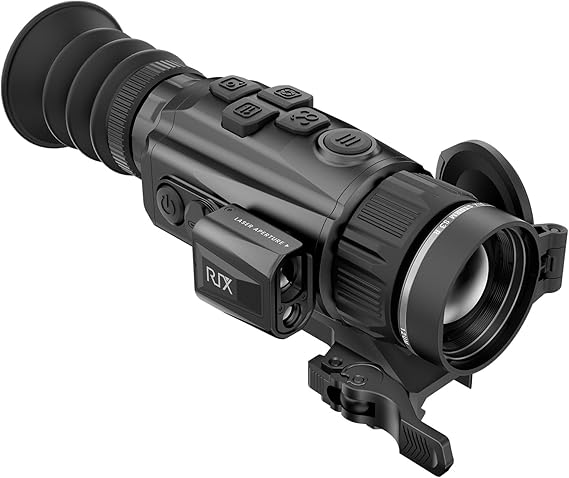 | RIX Storm S3 Thermal Scope | Check Price |
Our Selected Top 15 3-18 Ffp Scope You Can Trust
This list features carefully selected 3-18 FFP scopes, highlighting their performance, ideal users, and key advantages and disadvantages. Each review provides clear insights to help you understand how well the scope works and who it best suits for various shooting needs.
1. BARSKA Blackhawk 20-60×60 Spotting Scope
Offering a wide zoom range from 20-60x, this spotting scope suits both beginners and more experienced users looking for detailed, long-distance viewing. Its biggest strength is the clarity brought by multi-coated BAK-4 Porro prisms, which deliver crisp images even at the highest magnification.
Setup involves mounting it on a tripod, which it readily supports, making it stable during use. Manual focus allows precise adjustments, while the included reflex finderscope helps quickly locate targets. Waterproof and fogproof features make it reliable in varying weather.
Carrying cases and shock-absorbing armoring ensure safe transport and durability in the field.
Optical performance is impressive, especially at maximum zoom where detail remains sharp within the 10-degree field of view. The build feels solid thanks to its waterproof and shockproof design, though users sometimes find manual focusing a bit slow for fast-moving subjects. Multi-coated optics handle light effectively, reducing glare and improving contrast.
Users appreciate the clear, sharp images delivered even at 60x zoom, with durable construction that withstands outdoor conditions. Some find manual focusing cumbersome during fast action or wildlife viewing, which can slow down tracking.
Ideal for those prioritizing optical quality and durability on shoots needing high magnification. Not suited to those wanting lightweight, quick-focus scopes for rapid target changes or highly portable setups.
Pros
- Wide zoom range for versatile viewing
- Multi-coated optics improve image clarity
- Durable waterproof and fogproof design
- Includes tripod and protective cases
Cons
- Manual focus can be slow for quick targets
- Relatively large and not very compact
| Specification | Details |
|---|---|
| Zoom Ratio | 20-60x |
| Eye Piece Lens Description | Multi-coated BAK-4 Porro Prism |
| Field Of View | 10 degrees |
| Focus Type | Manual Focus |
| Mount | Altazimuth Mount |
| Additional Features | Waterproof, Fogproof, Shock Absorbing Armoring, Reflex Finderscope |
2. Trijicon ACOG 3.5×35 Riflescope
Trijicon ACOG 3.5×35 Riflescope excels as a durable magnified optic ideal for mid-range shooting, especially suited for tactical use. Its standout feature is the battery-free illumination that automatically adjusts brightness, providing clear visibility in various lighting without relying on batteries.
Setting it up is straightforward and forgiving thanks to its rugged forged 7075-T6 aluminum-alloy housing that stands up to rough handling with ease. The “both eyes open” design makes quick target acquisition natural, especially in close-quarters scenarios. The tritium/fiber optic system ensures the reticle brightness adapts automatically, removing the need to fiddle with settings during use.
The riflescope performs strongly with accurate bullet drop compensation for distances up to 1,000 meters, particularly suited for M249 and M855 ammo. Its build quality is nearly indestructible, making it a reliable companion in tough environments.
Most users appreciate its reliability and brightness adjustment, while some note the single 3.5x magnification might feel limited for longer-range targets.
The riflescope is praised for its reliable brightness adjustment without batteries, making it excellent for changing light conditions. The most frequent complaint highlights the fixed 3.5x magnification, which may not suit longer-range shooters wanting more flexibility in zoom.
Those needing a rugged, low-maintenance optic for mid-range targets and fast engagement will find this suitable. Shooters looking for variable magnification or applications beyond the M249 platform might prefer a different scope.
Pros
- Battery-free, auto-adjusting illumination
- Durable forged 7075-T6 aluminum housing
- Design supports shooting with both eyes open
- Bullet drop compensation to 1,000 meters
Cons
- Fixed 3.5x magnification limits versatility
- Primarily designed for M249 compatibility
| Specification | Details |
|---|---|
| Magnification Maximum | 3.5 x |
| Objective Lens Diameter | 35 millimeters |
| Magnification Minimum | 3.5 x |
| Compatible Devices | M249 |
| Reticle Type | Dot |
3. RIX Storm S3 R 12um 384 Thermal Rifle Scope
Feeling light on your rifle but packing serious thermal power, this scope offers impressive precision with its 12μm pixel detector. Great for those needing reliable long-range thermal imaging without lugging around heavy gear, it stands out with its compact built-in laser rangefinder.
Setting up is straightforward thanks to the quick detach mount, and the moderate weight of 0.97lb makes it easy to handle during extended use. The magnification range from 3.5x to 14x covers various shooting distances comfortably.
Switching targets is smooth, and having the ballistic calculator built-in helps dial shots in faster without extra gadgets.
Performance comes through sharply with a detection distance near 2000 yards and high-resolution 384×288 imaging, making distant heat signatures clear. The scope feels solidly built with a 35mm objective lens enhancing light capture.
Most praise centers on its precise laser rangefinder, while the typical gripe mentions the fixed reticle, which some find limiting for different shooting scenarios.
The built-in laser rangefinder delivers strong precision with ±1.09 yards accuracy, praised for boosting shot confidence. On the downside, the fixed reticle restricts flexibility, which some users find limiting for different shooting contexts.
Those needing a lightweight, precise thermal scope with rangefinding will appreciate its design and features. Shooters wanting customizable reticles or higher resolution might look for alternatives better suited to their needs.
Pros
- Lightweight at 0.97lb for less fatigue
- Compact built-in laser rangefinder
- Free ballistic calculator included
- Quick detach mount eases removal
Cons
- Fixed reticle limits adjustment options
- Resolution modest at 384×288 compared to newer models
| Specification | Details |
|---|---|
| Magnification Minimum | 3.5 x |
| Magnification Maximum | 14 x |
| Objective Lens Diameter | 35 millimeters |
| Pixel Pitch Detector | 12μm |
| Detection Distance | 1969 YDS |
| Built-in LRF Range | 1312 YDS |
4. RIX Storm S6 R 12um 640 Thermal Rifle Scope
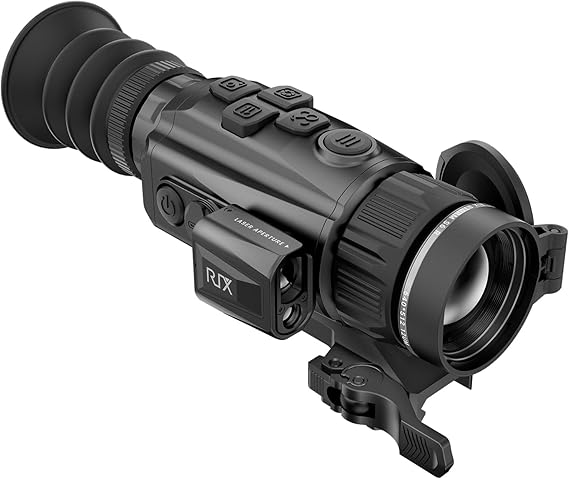
Compact and powerful, the RIX Storm S6 R offers clear thermal imaging with a solid rangefinder for hunters and shooters needing accuracy in low visibility. Its standout feature is the high-resolution thermal sensor that keeps images crisp even in challenging weather conditions.
Setup on a rifle is straightforward with the quick detach mount making it easy to take on and off. The 35mm objective lens combined with up to 10x magnification gives a clear view in various situations.
The built-in laser rangefinder helps you gauge distances up to 1,312 yards, and the free ballistic calculator keeps shots precise without extra gear.
Image quality is sharp due to the sensor’s resolution and NETD under 20 mK, minimizing noise and improving detail. The scope feels sturdy and well-built but remains lightweight enough not to bog down your rifle. A handful of users note occasional complexity in using the ballistic calculator, but clarity and range detection get consistent praise.
User comments highlight the remarkably clear thermal images and the precise distance reading, making it valuable for long-range shooting. Some find the ballistic calculator’s interface less intuitive, which can slow down adjustments during use. It handles humidity well while keeping images stable.
This scope suits someone needing reliable thermal sighting and rangefinding in a compact, rifle-friendly package. Those wanting higher magnification or simpler ballistic tools might look for alternatives better tailored to extended zoom or ease of use.
Pros
- High-resolution sensor with NETD<20 mK
- Compact laser rangefinder up to 1,312 yards
- Free ballistic calculator included
- Lightweight with quick detach mount
Cons
- Ballistic calculator can be tricky to use
- Limited maximum magnification at 10x
| Specification | Details |
|---|---|
| Magnification Maximum | 10 x |
| Objective Lens Diameter | 35 millimeters |
| Compatible Devices | Rifle |
| Mounting Type | Quick Detach Mount |
| Reticle Type | Duplex |
5. RIX Storm S2 256×192 Thermal Scope

Built with a 25mm objective lens and a Picatinny mount, it’s designed for hunters or shooters needing clear thermal imaging at various distances. Its biggest strength lies in the thermal sensor resolution of 256×192, which allows clear spotting of targets up to 1422 yards away, useful for those who want precise aiming power in low visibility.
Setting it up is straightforward thanks to its compatibility with standard rifle mounts. Daily handling is comfortable with 48 millimeters of eye relief offering a decent viewing distance.
The magnification adjusts from 3.5x to 14.0x, allowing you to spot details downrange, while the RIX RET technology improves image clarity to near higher detector standards without adding extra bulk or complexity.
Performance holds up well under various conditions, maintaining clarity across its magnification range. The build feels solid and reliable, supporting extended use without discomfort.
Praise often goes to the quality of thermal imaging and effective reticle design, though some note occasional difficulty in finer focus adjustments. Despite this, the scope’s rugged design supports dependable outdoor use.
Clear thermal imagery and a wide zoom range receive strong praise in reviews, helping to identify distant targets. A common complaint relates to minor challenges in fine-tuning the focus, which can require extra patience during setup or adjustments in the field.
Hunters and shooters looking for versatile thermal vision with good range will find this scope effective. Those needing a larger objective lens for potentially brighter images or extremely precise focusing might consider alternative models better suited for those needs.
Pros
- Clear thermal images up to 1422 yards
- Adjustable magnification from 3.5x to 14.0x
- Compatible with standard Picatinny mounts
- Comfortable eye relief distance of 48 mm
Cons
- Some difficulty with fine focus adjustments
- Limited objective lens size at 25 mm
| Specification | Details |
|---|---|
| Magnification Minimum | 3.5 x |
| Magnification Maximum | 14 x |
| Objective Lens Diameter | 25 millimeters |
| Field Of View | 4266 feet |
| Eye Relief | 48 millimeters |
| Mounting Type | Picatinny Mount |
6. RIX Storm S2R 12um 256×192 Thermal Rifle Scope
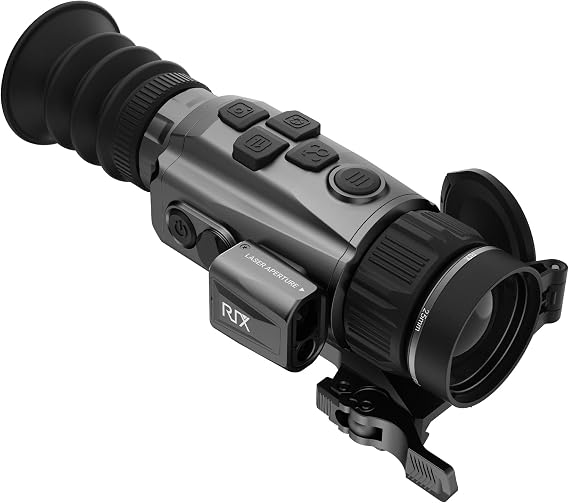
Lightweight and easy to handle, the RIX Storm S2R 12um 256×192 Thermal Rifle Scope suits shooters who need precise thermal imaging without the bulk. Its compact design and a detection range beyond 1400 yards stand out for those looking for long-distance clarity and responsiveness in the field.
Setup is straightforward with a Picatinny mount fitting most rifles securely. The intuitive operating system features four-directional enlarged buttons that make controlling the scope easy, even when you’re wearing gloves. The magnification adjusts smoothly from 3.5x to 14.0x, offering flexibility for spotting targets at varying distances during normal use.
Its 256×192 resolution and 12μm pixel pitch detector provide clear thermal imaging that performs well in different conditions. Built solid and weighing just 0.9 lb, the scope is durable yet comfortable to carry.
Most commonly praised is its detection distance, while some note the limited maximum magnification as a downside for very long-range precision.
The scope’s detection distance of 1422 yards and built-in laser rangefinder make it excellent for spotting targets from afar. Many appreciate how its user interface lights up buttons for easier control, but some find the top-end magnification less than ideal for ultra-long-range use.
Those seeking a lightweight, sharp thermal scope for medium to long-range observation will find this model well-suited. Shooters focusing primarily on very long-range resolution might want to explore models with higher maximum magnification.
Pros
- Lightweight at just 0.9 lb
- 1422 yards detection distance
- Easy to use with glove-friendly buttons
- Built-in laser rangefinder up to 1312 yards
Cons
- Maximum magnification may be low for extreme range
- Objective lens diameter smaller than some competitors
| Specification | Details |
|---|---|
| Magnification Maximum | 14 |
| Objective Lens Diameter | 25 mm |
| Magnification Minimum | 3.5 x |
| Mounting Type | Picatinny Mount |
| Eye Relief | 48 mm |
| Weight | 0.9 lb |
7. Gskyer 70mm AZ Astronomical Refracting Telescope

Perfect for beginners ready to explore the night sky with clear images, the Gskyer 70mm AZ Astronomical Refracting Telescope offers great optical quality with a 70mm aperture and 400mm focal length. It works well for star and moon observations, guided by easy aiming tools that make locating objects simple and enjoyable.
Setting it up involves assembling the altazimuth mount and attaching the eyepieces, which feels straightforward thanks to manual focus and the included finder scope. Using the wireless remote and smartphone adapter turns your phone into a viewfinder and camera, so you can capture celestial moments without struggling to manage multiple tools at once.
Viewing through coated glass lens optics, eyes stay comfortable while details come through sharply, especially when switching between the eyepieces and 3x Barlow lens that boosts magnification. Build quality feels solid for its price, though manual focusing requires patience.
Most users praise image clarity, but some note occasional difficulty in focusing sharply at higher zoom levels.
Image clarity stands out as the strongest feature, making celestial objects easy to see with minimal eye strain, though some users struggle with manual focus, especially when using higher magnifications. Setup is straightforward, but patience is needed to achieve sharp focus.
Those interested in exploring stars and the moon while capturing photos through a smartphone will find this telescope fits well. People wanting quick autofocus or completely wireless operation might want to explore other options better suited for tech-heavy use.
Pros
- Fully coated optics reduce glare and protect eyes
- Wireless remote and smartphone adapter included
- Altazimuth mount allows easy manual adjustment
- 3x Barlow lens triples magnification power
Cons
- Manual focus occasionally tricky at highest zoom
- Requires external power adapter to operate
| Specification | Details |
|---|---|
| Focal Length | 400 millimeters |
| Aperture | 70mm |
| Eyepieces | Two replaceable + one 3x Barlow lens |
| Mount Type | Altazimuth Mount |
| Focus Type | Manual Focus |
| Wireless Remote | Included for camera control |
8. Gskyer 130EQ Astronomical Reflector Telescope

Looking to explore the night sky with clear views of the Moon, planets, and some star clusters? The Gskyer 130EQ Astronomical Reflector Telescope fits right for beginners and more experienced stargazers who want bright and sharp images without fuss. Its key strength revolves around superior optics coupled with easy focusing.
Setup is straightforward thanks to its short 24 inch optical tube and toothless focusing base, making adjustments smooth and simple. The manual focus and equatorial mount let you lock in on celestial objects steadily.
The included smartphone compatibility lets you snap photos or share views directly from your eyepiece.
Optical quality is impressive thanks to a 5.1 inch aperture and multi-coated all-glass elements that deliver much brighter images. The telescope handles planets and brighter deep sky objects well.
Construction feels solid, though some find the manual focus less precise compared to motorized systems. The lightweight design aids portability but might need occasional rebalancing during use.
Brightness and clarity stand out thanks to the large aperture and high-quality glass components, but some users notice the manual focusing system can be less consistent when trying to fine-tune distant objects. This reflects a trade-off for ease of use and affordability.
Those wanting straightforward operation and solid image quality will appreciate this telescope’s blend of features. Users looking for motorized focusing or heavier-duty mounts might consider higher-end alternatives better suited to demanding or long-duration observations.
Pros
- Bright images with multi-coated glass optics
- Toothless focusing base for smooth adjustments
- Equatorial mount supports stable tracking
- Compatible with smartphones for photography
Cons
- Manual focus may feel imprecise at times
- Requires careful balancing on mount
| Specification | Details |
|---|---|
| Mount | Equatorial Mount |
| Focus Type | Manual Focus |
| Focal Length | 650 millimeters |
| Aperture | 5.1 inch |
| Eye Piece Lens Description | Barlow |
| Finderscope | Reflex |
9. Gskyer 600x90mm AZ Astronomical Refractor Telescope

600mm focal length and a 90mm aperture deliver crisp views, perfect for hobby astronomers looking for clear night sky visuals. Designed with fully coated optics glass lens, it suits anyone wanting easy setup and versatile magnification. Its standout feature is the high magnification combined with user-friendly adjustments.
Setting it up requires no tools, making it straightforward to use even without prior experience. The adjustable aluminum tripod lets you switch between viewing heights from 31.5 to 49 inches, fitting different positions comfortably.
Three eyepieces and a 3x Barlow lens let you quickly change magnification, helping you focus on details from the moon’s craters to distant stars.
The optics provide sharp, bright images thanks to fully coated lenses, helping protect your eyes during long sessions. The telescope’s build feels solid, especially the adjustable tripod, though some users find manual focusing a bit tricky at first. Its main praised point is the clear magnification range, but the common complaint involves focusing precision during high magnification.
Clear, sharp images stand out as one of the best features, especially with the variety of eyepieces and the Barlow lens increasing magnification options. Many find focusing manually to be a bit challenging when zooming in fully, which requires patience to get the perfect view.
Astronomy beginners and casual stargazers will appreciate the easy setup and adjustable tripod. People wanting quick, no-fuss star gazing with powerful zoom options will enjoy it. Those needing a wider field of view or automatic focusing may want to explore different alternatives.
Pros
- High magnification with three eyepieces plus Barlow lens
- Fully coated optics for bright, clear images
- Adjustable tripod for versatile viewing angles
- Easy no-tool assembly and quick focus
Cons
- Manual focus can be tricky at highest magnifications
- Limited field of view at 1.6 degrees may feel narrow
| Specification | Details |
|---|---|
| Focal Length | 600 millimeters |
| Aperture | 90mm |
| Mount | Altazimuth Mount |
| Focus Type | Manual Focus |
| Eyepieces | 24X, 60X, 120X with 3x Barlow lens |
| Tripod Height | 31.5-inch to 49-inch adjustable |
10. Unbranded 20-60×80 HD Spotting Scope

Anyone needing sharp, distant viewing for spotting or nature observation will appreciate this scope. It suits those who want a flexible zoom range and a large objective lens to catch as much light as possible. Its greatest strength lies in adjustable magnification from 20x to 60x, letting you start wide and zoom in close with ease.
Setting up involves a quick adjustment through dual focusing: fast focus lets you find the target quickly, while fine focus sharpens details precisely. The wide field of view at lower magnification helps in surface scanning before zooming in.
Day-to-day use feels natural since you can smoothly transition magnifications without losing sight of what you’re tracking.
The scope performs very well at high power, offering crisp images across long distances with solid clarity. The build reflects its purpose with an 8 cm lens that gathers plenty of light. Most users praise the zoom and focus controls, but many note the eye relief at 4.5mm can feel a bit tight, which might cause some strain over longer use.
Strong praise centers on the ability to zoom smoothly from a broad 20x view to a detailed 60x magnification, making it easy to spot and scrutinize distant subjects. Frequent fine focusing is often necessary at higher magnification levels to maintain image sharpness. Eye relief is noted as somewhat tight, which might cause discomfort during longer observation sessions.
Perfect for users seeking powerful zoom and a large lens size for daytime spotting and outdoor viewing. Those who prioritize comfortable eye relief or need quick sharp focus without adjustments might look for different scopes. Its design suits outdoor enthusiasts looking for detailed long-distance views without extra features getting in the way.
Pros
- Adjustable magnification from 20x to 60x
- Large 8 cm objective lens for light gathering
- Dual focusing for fast and fine adjustments
- Wide field of view at 20x for easier spotting
Cons
- Eye relief of 4.5 mm can cause strain
- Sharpness may require frequent fine focusing at max zoom
| Specification | Details |
|---|---|
| Magnification Minimum | 20 x |
| Magnification Maximum | 60 x |
| Objective Lens Diameter | 8 centimeters |
| Eye Relief | 4.5 millimeters |
| Field Of View | 86.4 feet |
11. Celestron Travel Scope 70mm Portable Telescope

Offering bright and sharp views in a compact form, this 70mm refractor telescope suits beginners looking for a simple yet quality instrument. Its biggest strength lies in delivering clear views of the Moon, planets, and daytime scenery without bulky gear, making it easy to take outdoors or on trips.
Setup takes just minutes without any tools, perfect for spontaneous stargazing or nature watching. The full-height tripod provides steady support, and the manual focus is straightforward to adjust. Everything fits neatly into the included backpack, so you can carry it around comfortably and be ready to observe anywhere, anytime.
Performance delivers crisp, fully coated glass views that outperform many beginner scopes. The build feels lightweight but sturdy, with an altazimuth mount that moves smoothly.
Praise highlights the clear optics and portability, while some mention manual focusing as less precise for distant objects.
Many appreciate its clear optics and easy portability, while some find the manual focus less accurate when aiming at faraway targets. The straightforward setup with no tools required is noted as especially convenient for casual observing sessions.
People new to telescopes and wanting a lightweight, travel-ready instrument will find this a good pick. Those seeking high magnification or precision focusing might want to explore other models.
Pros
- Sharp and bright views through fully coated lenses
- Lightweight and easy to carry with included backpack
- Tool-free setup with full-height tripod
- Simple manual focus suitable for beginners
Cons
- Manual focus can be tricky on distant objects
- Zoom ratio limited to 2x
| Specification | Details |
|---|---|
| Eye Piece Lens Description | Glass |
| Mount | Altazimuth Mount |
| Focus Type | Manual Focus |
| Coating | Fully Coated |
| Focal Length Description | 400 millimeters |
| Field Of View | 1.43 degrees |
12. Celestron SkyMaster 15×70 Astronomy Binoculars

Celestron SkyMaster 15×70 Astronomy Binoculars deliver powerful 15x magnification with large 70mm lenses, making them great for astronomy or distant land viewing. Best suited for anyone wanting bright, detailed views through a tripod-mounted setup, their strength lies in a clear, sharp image even in low light conditions.
Setting up these binoculars involves attaching them to a tripod using the built-in ¼”-20 adapter, which fits most standard tripods. Daily use means manual focusing with a center focus wheel, handy for adjusting sharpness precisely.
Their water resistance and multi-coated lenses help in varied weather and lighting, while the 18mm eye relief keeps viewing comfortable over longer sessions.
Performance is solid with bright, sharp views thanks to the BaK-4 prisms that maximize light transmission. The build feels sturdy but their size and weight require steady tripod support.
Praise often highlights excellent image clarity in low light, but the common limitation is the need for a tripod due to bulk, making handheld use uncomfortable.
Bright and clear viewing at dusk and night is a key strength thanks to BaK-4 prisms and large lenses. The biggest downside is their bulk and weight, which make handheld use impractical and force reliance on a tripod for stable viewing.
This product suits astronomy enthusiasts or land viewers who prioritize image clarity and brightness with steady support. Those seeking lightweight or handheld binoculars should look for smaller models better suited to mobility without a tripod.
Pros
- Bright, detailed views in low light
- Solid tripod compatibility with adapter
- Comfortable eye relief for extended use
- Water resistant for outdoor conditions
Cons
- Bulky and heavy, requires tripod
- Manual focus can be slow to adjust
| Specification | Details |
|---|---|
| Magnification Maximum | 15 x |
| Objective Lens Diameter | 7 centimeters |
| Prism Type | Porro Prism |
| Eye Relief | 18 millimeters |
| Water Resistance Level | Water Resistant |
| Field of View | 4.4 degrees |
13. Celestron 1.25 Eyepiece, Barlow & Filter Kit

Using a kit filled with five Plössl eyepieces and a 2x Barlow lens offers a wide range of viewing options for telescope users. It fits those who want flexibility in magnification and detailed views without swapping gear constantly. Its biggest strength lies in combining multiple eyepieces with a Barlow lens in one sturdy case, making storage and transport easier.
Setting up the eyepieces is straightforward thanks to the well-organized foam-lined case that keeps everything secure and accessible. Each eyepiece covers a variety of focal lengths from 32mm down to 6mm, with the option to double magnification using the 2x Barlow. Swapping lenses is quick, and the fully multi-coated optics help deliver clearer images through an altazimuth mount.
This kit works smoothly with most 1.25-inch telescopes in everyday stargazing sessions.
Magnification versatility is well tackled here, as the Plössl design delivers sharp views with a comfortable 52-degree field of view. Build quality feels solid, with each eyepiece crafted to handle regular use without issue.
Fans praise the range and clarity, while some note that the case, despite being sturdy, could be a bit bigger for future additions. It balances performance and durability effectively for amateur astronomers.
Availability of multiple eyepieces combined with a 2x Barlow lens covers a broad range of magnification needs effectively, earning praise for versatility and optical quality. Some users have pointed out the compact case can feel a bit cramped as the collection grows.
Ideal for someone looking to explore different powers without buying separate eyepieces, especially beginners or intermediate hobbyists. Those requiring wider fields of view or more advanced optics might look for specialized or larger kits instead.
Pros
- Includes five Plössl eyepieces for varied power levels
- 2x Barlow lens doubles magnification easily
- Foam-lined case keeps components organized and protected
- Fully multi-coated optics reduce glare and improve clarity
Cons
- Case size limits future eyepiece additions
- Limited field of view compared to some advanced eyepieces
| Specification | Details |
|---|---|
| Eye Piece Lens Description | Plossl |
| Mount | Altazimuth Mount |
| Compatible Devices | Most telescopes |
| Coating | Fully Multi-Coated |
| Field Of View | 52 degrees |
| Additional Features | Includes 2x Barlow lens for 10x magnification versatility |
14. SVBONY SV165 30mm F4 Guide Scope

SVBONY SV165 30mm F4 Guide Scope offers great value for those needing a reliable guide scope for astrophotography. Ideal for users with mainstream auto guiding cameras, it shines through its sharp, clear images and compatibility that meets key technical demands.
Setup is straightforward thanks to its 1.25inch and M42 mount interfaces, making it easy to connect with popular cameras like SV305C Pro and Orion ZWO models. Manual focus requires some patience but works well for fine adjustments.
The reflex finderscope helps with alignment, while nylon-tipped thumbscrews secure everything without damaging your gear.
Performance delivers crisp images, free from irritating reflections due to the ultra wide band fully multilayer coatings on the lenses. It feels solid and well-crafted, but the biggest gripe is that it cannot focus with a Dielectric Mirror Star Diagonal. This limitation requires additional accessories or avoiding certain camera setups.
Sharp image quality stands out as the most praised aspect, delivering bright and clear views. The common drawback is the inability to focus with certain diagonals, limiting use without additional gear. This affects users aiming for versatility across all accessories.
Those using compatible auto guiding cameras without special diagonals will find this guide scope reliable and effective. Individuals requiring compatibility with Dielectric Mirror Star Diagonals or simplified focus across all camera types might look for alternate options.
Pros
- Compatible with major auto guiding cameras
- Ultra wide band fully multilayer coated lens
- Clear, sharp images with no distracting reflections
- Nylon-tipped thumbscrews prevent mounting damage
Cons
- Cannot focus using Dielectric Mirror Star Diagonal
- Some camera models need extra parts to assist focusing
| Specification | Details |
|---|---|
| Mount | Fixed Mount |
| Focus Type | Manual Focus |
| Focal Length | 120 millimeters |
| Field Of View | 2.86 degrees |
| Coating | Fully Multi-Coated |
| Back Focus Distance | 45mm |
15. SVBONY SV106 60mm Finder Guide Scope

Made with a versatile 60mm aperture and built-in helical focuser, the SVBONY SV106 60mm Finder Guide Scope suits astrophotographers looking for precise guide star focusing. Its standout feature is the helical focuser that keeps your field of view steady while adjusting focus, making it easier to pinpoint guide stars.
Setting it up is straightforward with compatibility for equatorial and altazimuth mounts, and manual focus is smooth thanks to the helical design. Daily use involves manually adjusting the focus without worrying about the image rotating, which saves time. The fully multi-coated optics also improve clarity during star hunting, which helps in pairing with autoguider cameras or telescope accessories using female T-threads.
Performance in guiding during astrophotography sessions is reliable, helping capture higher quality images. The build feels solid with Kellner eyepiece lenses ensuring decent optical quality.
Most users appreciate how the helical focuser maintains orientation when adjusting focus. On the downside, some may find manual focus less convenient compared to motorized options, and the field of view at 2.39 degrees is somewhat limited compared to wider scopes.
Strongest praise highlights the helical focuser’s ability to move the device in and out without rotating the field, which makes refining focus more intuitive. Common complaint centers on manual focusing being somewhat slower or less convenient for some, especially compared to electronic focusers.
Astrophotographers wanting steady, clear guide star images with manual control will find this useful. Those needing faster or motorized focusing, or a wider field of view, might look for alternatives better suited to those preferences.
Pros
- Helical focuser keeps field steady during adjustments
- Fully multi-coated optics improve image clarity
- Compatible with common mounts and autoguider accessories
- Manual focus offers precise control
Cons
- Manual focus may be slower than motorized options
- Relatively narrow 2.39-degree field of view
| Specification | Details |
|---|---|
| Aperture | 60mm |
| Focal Length | 240 millimeters |
| Focus Type | manual focus |
| Mount Compatibility | Equatorial Mount or Altazimuth Mount |
| Eyepiece Lens | Kellner |
| Field Of View | 2.39 degrees |
Comparison of Top 3-18 FFP Scopes Side by Side
| Product | Magnification Range | Objective Lens Diameter | Mount Type | Reticle Type |
|---|---|---|---|---|
| BARSKA Blackhawk Spotting Scope | – | – | Altazimuth Mount | – |
| Trijicon ACOG 3.5×35 Riflescope | 3.5x | 35mm | – | Dot |
| RIX Storm S3 Thermal Scope | 3.5-14x | 35mm | Quick Detach Mount | Fixed |
| RIX Storm S6 Thermal Scope | Up to 10x | 35mm | Quick Detach Mount | Duplex |
| RIX Storm S2 Thermal Scope | 3.5-14x | 25mm | Picatinny Mount | RIX Reticle |
| RIX Storm S2R Thermal Riflescope | 3.5-14x | 25mm | Picatinny Mount | – |
| Gskyer 70mm AZ Refractor | – | – | Altazimuth Mount | – |
| Gskyer 130EQ Reflector Telescope | – | – | Equatorial Mount | – |
| Gskyer 600x90mm AZ Refractor | – | – | Altazimuth Mount | – |
| Unbranded 20-60×80 HD Scope | 20-60x | 80mm | – | – |
| Celestron Travel Scope 70mm | – | – | Altazimuth Mount | – |
| Celestron SkyMaster 15×70 Binoculars | Up to 15x | 70mm | Tripod Mount | – |
| Celestron Eyepiece & Filter Kit | – | – | Altazimuth Mount | – |
| SVBONY SV165 30mm Guide Scope | – | – | Fixed Mount | – |
| SVBONY SV106 60mm Guide Scope | – | 60mm | Equatorial or Altazimuth | – |
- Magnification Range–
- Objective Lens Diameter–
- Mount TypeAltazimuth Mount
- Reticle Type–
- Magnification Range3.5x
- Objective Lens Diameter35mm
- Mount Type–
- Reticle TypeDot
- Magnification Range3.5-14x
- Objective Lens Diameter35mm
- Mount TypeQuick Detach Mount
- Reticle TypeFixed
- Magnification RangeUp to 10x
- Objective Lens Diameter35mm
- Mount TypeQuick Detach Mount
- Reticle TypeDuplex
- Magnification Range3.5-14x
- Objective Lens Diameter25mm
- Mount TypePicatinny Mount
- Reticle TypeRIX Reticle
- Magnification Range3.5-14x
- Objective Lens Diameter25mm
- Mount TypePicatinny Mount
- Reticle Type–
- Magnification Range–
- Objective Lens Diameter–
- Mount TypeAltazimuth Mount
- Reticle Type–
- Magnification Range–
- Objective Lens Diameter–
- Mount TypeEquatorial Mount
- Reticle Type–
- Magnification Range–
- Objective Lens Diameter–
- Mount TypeAltazimuth Mount
- Reticle Type–
- Magnification Range20-60x
- Objective Lens Diameter80mm
- Mount Type–
- Reticle Type–
- Magnification Range–
- Objective Lens Diameter–
- Mount TypeAltazimuth Mount
- Reticle Type–
- Magnification RangeUp to 15x
- Objective Lens Diameter70mm
- Mount TypeTripod Mount
- Reticle Type–
- Magnification Range–
- Objective Lens Diameter–
- Mount TypeAltazimuth Mount
- Reticle Type–
- Magnification Range–
- Objective Lens Diameter–
- Mount TypeFixed Mount
- Reticle Type–
- Magnification Range–
- Objective Lens Diameter60mm
- Mount TypeEquatorial or Altazimuth
- Reticle Type–
How to Choose the Best 3-18 FFP Scope
Choosing the right 3-18 FFP scope means focusing on clarity, reliable reticle calibration, and durable construction to ensure precise long-range shooting. Prioritizing these factors helps avoid costly replacements and improves accuracy, saving you frustration and money over time.
Magnification Range and Clarity
Moving from 3x to 18x magnification often brings a noticeable shift in image quality. Without a scope that maintains clarity across this range, details get fuzzy at high zoom, making precise shots harder. A true first focal plane reticle shines here because its markings scale with magnification, allowing accurate holdovers and range estimation no matter the zoom level.
In daily use, smoothness in adjustment controls plays a huge role. Jerky or imprecise turrets disrupt shot setup, especially when switching from low to high magnification quickly.
Look for scopes with fine, consistent clicks and minimal play in the adjustment dials. That control avoids wasting time and helps maintain accuracy on the fly.
Reticle Design and Illumination
Reticle visibility varies with lighting, and a dim or overly bright reticle can ruin fast target acquisition in dawn or dusk conditions. A good design offers multiple brightness settings for illumination, powered by a reliable source like a long-lasting battery or solar panel to avoid surprises during use.
Reticle subtensions must match the ballistic calculations you use or the mil/dot system for effective holdovers and wind corrections. Precise subtensions ensure you can trust your adjustments without guessing.
Testing reticles that line up clearly with your preferred system saves frustration in the field.
Durability and Build Quality
Rugged construction matters most in rough environments. Aluminum or aircraft-grade materials resist shocks from recoil and accidental drops, while seals and quality o-rings keep moisture and dust out. These features prevent the scope from fogging internally or failing in wet weather.
Lens coatings protect from scratches and glare, crucial for maintaining a clear sight picture under bright sunlight or through brush. Coatings also improve light transmission for brighter images.
Turret robustness is key; cheap clicks wear down quickly and lose accuracy. Look for durable mechanisms that hold zero after repeated adjustments.
Eye Relief and Field of View
Eye relief distance is critical for comfort and safety, especially with powerful rifles that produce heavy recoil. Scopes providing 3.5 to 4 inches of consistent eye relief prevent painful strikes and allow quick alignment without losing sight of the target.
Wide field of view at low magnification helps locate targets rapidly, while a reasonable view at high zoom avoids tunnel vision. The eye relief should not change much when zooming in or out, so users don’t need to reposition their head constantly.
This consistency boosts shooting speed and comfort.
Mounting Compatibility and Adjustment Controls
Mounting needs to be quick and easy. Compatibility with standard rings or mounts lets you swap scopes between rifles without buying new hardware. Proper fit reduces wobble and preserves zero after moving.
Adjustments for windage and elevation should give tactile and audible feedback through distinct clicks, allowing fast changes without needing to look away from the target. Parallax and focus controls must be clear and easy to operate, because precise tuning sharpens the image and ensures target clarity at various ranges.
Optimizing Target Acquisition with a 3-18 FFP Scope
A 3-18 first focal plane (FFP) scope offers a wide magnification range that suits a variety of shooting distances, from close targets to those several hundred yards away. The FFP reticle scales with the zoom, meaning the holdovers remain accurate at any magnification setting.
This feature helps eliminate guesswork when adjusting for bullet drop or windage. Typical hunting or tactical scenarios benefit because the shooter always sees true markings, enabling faster target acquisition. A 3x zoom at the low end allows for quick target acquisition in close quarters, while the 18x maximum magnification provides precision at long range.
Users often appreciate that this setup reduces the need for multiple scopes or additional adjustments during a shoot. Consistent reticle sizing across magnifications contributes to better shot placement, especially in dynamic conditions where timing and speed are important.
Proper Cleaning and Maintenance for Longevity
Routine cleaning is essential to keep a 3-18 FFP scope functioning well and extending its lifespan. Dust and debris should be removed from lenses using a soft brush or lens cloth specifically designed for optics, avoiding pressure that might scratch the glass.
For fingerprints or smudges, a small amount of lens cleaning solution applied to a microfiber cloth works best. The outer body can be wiped with a damp cloth to remove grime. It is important to avoid using harsh chemicals or abrasive materials in maintenance.
Checking and tightening mounting rings regularly prevents scope movement during use. Storing the scope in a dry, padded case helps protect the lenses and internal components from moisture and impacts.
Periodic inspection of turret operation also ensures smooth adjustment without resistance or play over time, contributing to reliable performance.
Comparing 3-18 FFP Scopes to Alternative Magnification Options
Scopes with a fixed magnification, such as 4x or 6x, generally offer simpler operation and might be lighter, but limit versatility. Variable magnification scopes like the 3-18 FFP cover a broader range, which is valuable when shooting in varying environments. A 3-18 scope lets you engage targets at close and long distances without swapping optics or carrying additional setups.
Compared to second focal plane (SFP) scopes, the 3-18 FFP keeps the reticle proportional to magnification changes, making range estimation and holdovers more intuitive without adjustment at different zoom levels. This contrasts with SFP scopes where the reticle stays the same size and corrections must be mentally calculated as magnification varies.
Some users prefer simpler reticles found in fixed zooms, but the 3-18 FFP’s flexibility makes it a practical choice for many shooters demanding precision across distances.
People Also Asked
How Do I Properly Zero a 3-18 FFP Scope?
Adjust your scope at a short range like 25 yards to align your point of aim with impact. Use a stable rest and shoot groups, then fine-tune windage and elevation settings slowly before confirming zero at longer distances. Consistency matters during the entire process.
What Is the Ideal Reticle Size for 3-18 FFP Scopes?
Choose a reticle size that stays clear and precise at both low and high magnification levels. Thin lines help avoid covering small targets at 18x, while slightly thicker lines maintain visibility at 3x. Avoid overly busy reticles that obscure the target or complex holdover marks that can become confusing.
Are 3-18 FFP Scopes Safe to Use with High Recoil Rifles?
Most quality 3-18 FFP scopes designed for hunting or tactical use handle high recoil rifles well. Confirm the scope’s rated recoil tolerance, usually found in the specifications. Consistent mounting and using durable rings help prevent issues related to heavy recoil.
How Long Does a Typical 3-18 FFP Scope Last?
A 3-18 FFP scope typically lasts many years with proper care and maintenance. Avoiding exposure to hard impacts, regularly checking mount integrity, and keeping lenses clean contribute to long-term performance. Some scopes last a decade or more under moderate use.
What Common Problems Do 3-18 FFP Scopes Have?
Common issues include turret adjustments that feel loose or inconsistent, reticle shift under heavy recoil, and difficulty maintaining clarity at extreme zoom levels. Mounting problems often cause zero shifts, so ensuring solid, stable installation is critical for dependable use.
Conclusion
Choosing a 3-18 FFP scope mainly depends on clear glass quality, reliable adjustment turrets, and a reticle that suits your shooting style. These factors affect how well you can see the target, make precise shots, and use the scope comfortably over time.
Consider how you plan to use the scope and the size of your shooting environment before buying. Match your choice with your budget and expected frequency of use to avoid overspending.
Review the comparison table and detailed picks above to find the scope that fits your needs best.