
Wobbly shots and lost moments are all too common when a cheap or wrong tripod is in use. The best shooting tripod solves this by providing a stable and reliable platform for cameras, no matter the conditions.
Shaky frames and complicated setups vanish when the tripod holds steady, allowing sharp and precise captures every time.
Key to a solid shooting tripod is the build quality, carbon fiber or aluminum are preferred for their mix of strength and weight, typically holding cameras weighing 5 to 15 pounds without strain. Height range matters too; a good model extends beyond eye level, around 55 to 70 inches, yet packs down compactly for transport. Leg locks should be secure but quick to adjust, and the head must offer smooth panning and tilt without slippage, ensuring both safety and precision during use.
Need a Quick Check?
| Image | Product | Price |
|---|---|---|
Our Top Picks 1  | BOG DeathGrip Tripod | Check Price |
Our Top Picks 2  | BOG DeathGrip Infinite | Check Price |
Our Top Picks 3  | FANAUE HTC-4030-65 Tripod | Check Price |
Our Selected Top 15 Shooting Tripod Worth Your Money
The list includes a range of shooting tripods suited for different types of photography and videography. Each review covers how well the tripod performs, the types of users it fits best, and highlights its main strengths and weaknesses. This helps in finding the right model for specific needs.
1. BOG DeathGrip Hunting Tripod
BOG DeathGrip Hunting Tripod is a stable shooting platform made for hunters who need solid support for rifles, shotguns, or crossbows up to 40 pounds. Its biggest strength lies in the adjustable clamp that holds weapons firmly without damaging their finish, making it reliable for different firearms and terrains.
Setting up involves adjusting large-diameter legs that lock quietly and securely at three angles: 20°, 45°, and 85°. Height can be fine-tuned from 7 inches up to 59 inches, letting you shoot from prone to standing positions comfortably.
A foam grip helps keep control while moving the tripod around, and the tilting and panning features offer smooth targeting of moving objects in the field.
Performance is steady during shooting with solid construction from lightweight aluminum. The clamp grips tightly and protects weapons with rubber inserts.
One common complaint is that quick adjustments can sometimes feel stiff since the lever leg locks prioritize security over speed. Durability runs high given the build, but occasional users mention the overall weight could be a concern for long hikes.
The secure clamp and stable support are praised for steady shots without damaging equipment. A drawback mentioned is that the leg lock mechanisms may require extra effort during fast repositioning, which can slow down target adjustments. The rubber inserts also provide added protection for firearm finishes.
Those who prioritize firm weapon support and flexibility in height will find this tripod suited to their needs. It fits well for users operating mainly in fixed shooting positions. Lightweight tripods with faster setup might suit better for those covering long distances or requiring quick adjustments.
Pros
- Secure weapon clamp with rubber inserts
- Adjusts from prone to standing shooting
- Large-diameter legs for solid stability
- 360-degree panning and 25-degree tilt
Cons
- Leg locks can feel stiff during quick moves
- Heavier than some alternatives for hiking
| Specification | Details |
|---|---|
| Maximum load capacity | 40 pounds |
| Height adjustment range | 7″ to 59″ |
| Leg angle locks | 3 positions: 20°, 45°, 85° |
| Material | Lightweight aluminum |
| Included components | Tripod only |
| Warranty | 1 Year Manufacturer |
2. BOG DeathGrip Infinite Hunting Tripod
Support feels steady with the BOG DeathGrip Infinite Hunting Tripod, designed to hold up to 40 pounds securely. It fits hunters and outdoor shooters who switch between rifles, crossbows, and spotting scopes, all on the same setup.
Height adjustability from 6.5 to 59.5 inches covers prone to standing positions effectively.
Setup involves adjusting leg angles to 20°, 45°, or 85°, depending on terrain and shooting posture. Twist leg locks secure height without slipping during use.
The DeathGrip Ultralite head clamps tightly onto gear and protects surfaces with rubber inserts. Its non-slip rubber grip on the tripod body helps when carrying or repositioning on uneven ground, which can get tricky in tight spots.
Rotation and tilt on the ball head operate smoothly across 360 and 180 degrees, useful for tracking moving targets. The clamp’s grip remains firm, avoiding slips during extended shoots. Build quality reflects American Outdoor Brands’ standards, so it handles rough outdoor conditions well.
Not all gun shapes fit perfectly, occasionally requiring adjustment of the clamp to avoid pressure points.
Strong grip on firearms prevents slipping during use, supported by rubber inserts that protect surfaces. The clamp may not fit every firearm shape perfectly, so it requires readjustment in some cases. Leg locks are secure once tightened but demand attention during adjustments to avoid loosening unexpectedly.
Hunters or shooters needing variable height and the ability to swap optics without changing tripods will find this model useful. Those requiring very quick setup or with firearms that have unusual shapes might consider alternatives with simpler clamping mechanisms or quicker leg lock designs.
Pros
- Adjusts from low to high shooting positions
- Secures heavy firearms up to 40 pounds
- Non-marring rubber inserts protect gear
- 360-degree panning and 180-degree tilt
Cons
- Clamp sometimes requires careful positioning
- Leg locks need firm twisting to lock securely
| Specification | Details |
|---|---|
| Maximum Height | 59.5 inches |
| Minimum Height | 6.5 inches |
| Weight Capacity | 40 pounds |
| Mounting System | Arca-Swiss |
| Leg Angle Locks | 3 positions: 20°, 45°, 85° |
3. FANAUE Carbon Fiber Hunting Tripod HTC-4030-65
Perfect for wildlife photographers and hunters needing a strong, lightweight tripod, this carbon fiber model stands out for its quick height adjustments and durable build. It suits anyone requiring stability across uneven terrain and varying shooting heights.
Setup happens in seconds thanks to the flip-locking system on each leg. You can adjust leg lengths independently from 29 to 69 inches, accommodating sitting, kneeling, or standing positions without hassle. The included hex wrench allows switching the Arca-Swiss plate or exposing an extra M5 mounting hole for connecting other gear.
Made with thick carbon fiber tubes, the tripod resists twisting and shakes well, holding gear steady during long sessions. Construction feels solid, supporting strenuous outdoor use.
Lifetime warranty offers confidence, though some note the independent leg adjustment can require careful balancing. Quick locking speeds up transitions but may loosen if not securely fastened.
High stability and quick setup receive the most praise, with the thick carbon fiber legs providing solid support on rough ground. Common complaints focus on the flip-locks sometimes loosening and the need to fine-tune each leg individually for perfect balance.
Anyone requiring a sturdy tripod that adjusts from low to tall shooting positions will find this model practical and reliable. Choosing another tripod might be better for those who prefer simpler leg adjustment without individual leg control or require longer warranty coverage.
Pros
- Strong but lightweight carbon fiber legs
- Fast and easy height adjustments
- Legs adjust independently for varied stances
- Arca-Swiss plate allows versatile mounting
Cons
- Flip locks can loosen if not properly secured
- Independent leg adjustment needs careful balancing
| Specification | Details |
|---|---|
| Material | Carbon Fiber |
| Height Range | 29″ to 69″ |
| Locking Mechanism | Flip-locking system |
| Mounting Plate | Arca-Swiss removable with M5 hole |
| Warranty | One year |
4. Carbon Fiber Hunting Tripod with Ball Head WZ-324PA03

Carbon fiber forms the main structure of this hunting tripod, making it strong without adding weight. The design suits photographers and hunters needing a stable yet portable tripod. Its biggest strength lies in holding heavy camera gear steadily in tough outdoor environments.
Setting up involves quick quarter-turn locks for the legs, reaching up to 62.2 inches or folding down to just above 10 inches. Three leg angles adapt easily to uneven ground. Rubber feet can be swapped for metal spikes, improving grip on rough terrain.
A shoulder strap on the carrying bag makes transport straightforward on long treks.
The tripod delivers solid stability thanks to its thick, 8-layer carbon fiber construction and 32 mm maximum leg diameter. The CNC aluminum ball head holds up to 20 kg with 360-degree smooth rotation and 45-degree tilting.
Precise ball-and-socket engineering keeps movements minimal after tightening. Some report the tripod feels a bit bulky when packed due to its heavy-duty frame.
The ball head’s smooth, precise movement combined with strong load capacity earns high marks. Its stability on uneven terrain stands out, though some find the tripod cumbersome to carry due to overall size and weight. Adjusting leg angles takes a few practice rounds for efficiency.
Photographers or hunters needing a tough, stable tripod for heavy equipment will find this suited to their needs. Those prioritizing ultralight gear or compactness for backpacking may want to consider lighter alternatives. The included carrying bag eases transport despite the bulk.
Pros
- Strong carbon fiber legs resist bending and vibration
- Ball head supports heavy cameras up to 20 kg
- Quick-release Picatinny to Arca-Swiss adapter included
- Adjustable leg angles fit uneven ground easily
Cons
- Feels bulky when folded for transport
- Heavier than some ultralight tripods
| Specification | Details |
|---|---|
| Material | 8-layer Carbon Fiber |
| Maximum Height | 62.2 inches |
| Ball Head Load Capacity | 20 kg (44 lbs) |
| Leg Diameter | 32 mm |
| Minimum Height | 10.2 inches |
5. BOG DeathGrip Bantam Hunting Tripod

Weighing just 3.1 pounds, this hunting tripod suits anyone who needs a lightweight and portable support for shooting in various outdoor settings. Its most notable strength is its compact size combined with a strong grip designed specifically to hold firearms securely when aiming.
Setting up takes little time thanks to adjustable aluminum legs that extend from 20 to 42 inches, letting you switch quickly between kneeling or standing positions. The Deathgrip head has rubber inserts that prevent scratching the firearm and allows smooth tilting and panning up to 120 and 360 degrees respectively. Balancing on uneven ground is simple since each leg moves independently.
The tripod handles firearms up to 40 pounds firmly without slipping, demonstrating good strength and stability in rough terrain. The build feels solid yet lightweight enough to carry long distances.
The main complaint reflects occasional difficulty getting legs perfectly level on very uneven surfaces, requiring minor extra adjustment to keep it steady.
Hard to overstate how convenient the lightweight frame and compact size make it for moving through fields or setting up in a blind. The rubberized grip keeps the firearm secure without damage. On irregular terrain, it can take a few tries to get all legs balanced properly, which might slow quick shots.
People who value easy carrying and quick setup will appreciate how simple adjustments are for different shooting positions. Those requiring support for larger or heavier firearms will need to consider sturdier models that handle greater weight and tougher ground conditions better.
Pros
- Compact and lightweight for easy transport
- Non-marring rubber inserts protect the firearm
- Legs independently adjustable on uneven ground
- Tilting and panning provide flexible aiming angles
Cons
- Legs need fine-tuning on very rough terrain
- Not suited for firearms heavier than 40 pounds
| Specification | Details |
|---|---|
| Weight | 3.1 pounds |
| Material | Lightweight aluminum legs |
| Leg Length Adjustment | 20″ to 42″ |
| Head Movement | Tilt up to 120°, pan up to 360° |
| Max Load | 40 pounds |
| Manufacturer Warranty | 1 Year Manufacturer |
6. PRIMOS Hunting Trigger Stick Gen3

Anyone serious about hunting or shooting will appreciate the PRIMOS Hunting Trigger Stick Gen3 for its quick adjustability and solid stability. It especially suits those needing fast setup on uneven terrain and dependable support for steady shots. Its standout feature is the one-hand height adjustment that lets you get on target swiftly.
Setting up the shooting stick feels straightforward. The height adjusts from 24 to 62 inches with just a pull of the trigger, no twisting or fiddling needed. Extreme leg angles mean you can plant it firmly on rough or brush-covered ground without worry.
The quick detach yoke lets you switch between a monopod and tripod style smoothly, which is handy when changing shooting positions or using optics.
Performing as a shooting stick, it holds steady with a no-slip grip and smooth joint rotations for tracking moving targets silently. The build feels durable and lightweight, balancing firmness with ease of carry. Most praise highlights the fast, one-handed adjustments and stable leg setup.
Some find the rotating joint requires care to keep quiet and smooth over time.
Fast height adjustment and firm leg positioning make steady shooting easier across varied terrain. The quick detach yoke adds flexibility between monopod and tripod modes. Attention is needed to maintain the smooth, silent motion of the rotating joint for best tracking performance.
The tripod suits shooters who need quick setups on uneven or brushy ground and value one-handed control. Those wanting a compact, ultra-quiet support might look for a model with a simpler joint system or lighter grip design.
Pros
- One-hand height adjustment is fast and smooth
- Legs adjust to extreme angles for versatile setup
- Detachable yoke supports panning with optics
- Non-slip grip helps keep steady during shots
Cons
- Rotating joint can become noisy over time
- Some find the grip bulky for smaller hands
| Specification | Details |
|---|---|
| Adjustable Height | 24″-62″ |
| Key Feature | Quick Detach Yoke System |
| Leg Angle | Extreme angles for uneven ground |
| Grip Type | No-Slip Contoured Grip |
| Item Type | Primos Trigger Stick Gen 3 Series – Jim Shockey Tall Tripod |
7. Lightweight Adjustable Shooting Tripod with V-Yoke Rest
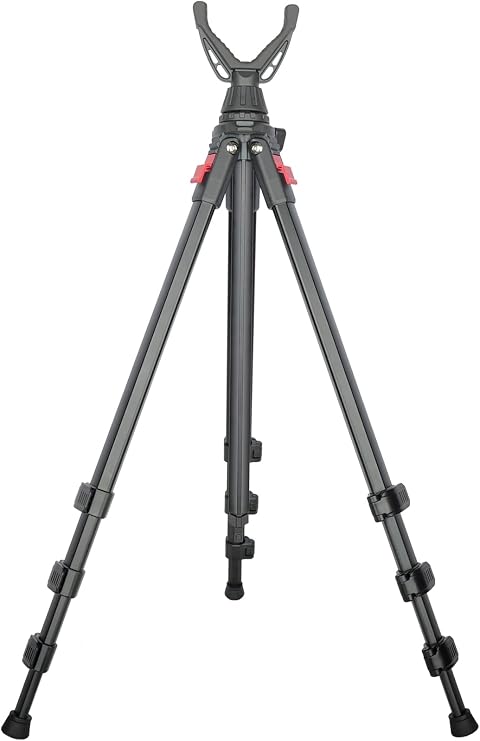
Hunting in uneven terrain calls for a shooting tripod that is both light to carry and sturdy enough for steady shots. Perfect for hunters who trek through forests or fields, this tripod offers a solid rest without weighing down your pack.
Its main strength lies in balancing ultralight design and strong support for various shooting positions.
Adjusting height happens quickly thanks to the three-section lever lock system. You can move from sitting at 21.25 inches up to standing at 69.3 inches in seconds.
Legs lock independently, which helps keep steady footing on rocky or muddy ground. Carrying it is simple with the included nylon bag, and folding it down to a compact size makes moving between locations less of a hassle.
The V-Yoke rest rotates a full 360 degrees with smooth tracking for horizontal and vertical target movement. The padded cradle protects rifles from scratches and absorbs shocks during setup. Built from aluminum, the tripod weighs only 2.25 lbs but handles rough use.
The most often noted issue concerns the stability on very soft or uneven mud despite the retractable spikes and rubber feet.
Strong points of the tripod include its smooth 360-degree V-Yoke rest and fast height adjustment, helping track moving targets easily. Weakness centers on occasional wobbles when set on soft, uneven soils despite the all-terrain feet. The strap that holds the tripod folded sometimes needs re-tightening during transport.
Hunters who prioritize ultralight gear and need fast adjustments will appreciate this tripod’s design. Those expecting firm stability on soft or muddy ground might consider models with more aggressive anchoring features or heavier builds to avoid instability during shots.
Pros
- Extremely lightweight at only 2.25 lbs
- Quick height changes with lever lock system
- Padded V-Yoke protects rifles from damage
- Rubber feet and spikes improve ground grip
Cons
- Less stable on very soft or uneven mud
- Strap securing folded tripod can loosen
| Specification | Details |
|---|---|
| Weight | 2.25 lbs |
| Height Adjustment Range | 21.25 to 69.3 inches |
| Material | Aluminum alloy |
| V-Yoke Rest Movement | 360° rotation |
| Included Components | Carry bag, Tripod |
| Model Number | Adjustable Tripod |
8. FANAUE ST-45 Carbon Fiber Hunting Tripod

Supports up to 55.12 lbs while staying lightweight thanks to 10-layer carbon fiber construction. Made for hunters and photographers needing a sturdy, portable tripod that adapts well to rough terrain. Its biggest strength is the safety-lock quick release plate that keeps gear secure even during sudden movements.
Adjusting height quick and simple with a single knob controlling an inverted two-section leg design. Three distinct leg angles let you stabilize the tripod on rocky or uneven ground. Foot pads grip well on slippery surfaces, while the Arca Swiss quick release plate allows fast mounting and dismounting of cameras or rifles.
Setup and shifting position take seconds, making it easy to track moving targets.
Build quality combines CNC aluminum with carbon fiber tubes measuring 1.41 inches in diameter for durability without excess weight. The tripod holds steady in varying conditions, with users praising its stable balance and quick leg angle changes. Some note the clamp can feel stiff initially.
The Arca mount’s safety stop works reliably, preventing accidental gear drops.
The safety lock system on the Arca Swiss plate reliably prevents gear slippage under impact, making it a key feature for confidence in the field. Most appreciate how fast height changes are with the one-knob system but mention the clamp may take some effort to loosen or tighten during initial use.
Hunting outdoors or photography requiring fast, stable repositioning on rough terrain suits this tripod well. Expect solid build quality that resists corrosion and wear over time. Users needing to support loads near or above 55 lbs may want to consider options with thicker legs or higher load capacities. Those valuing quick gear swaps with safe mounting will find this tripod.
Pros
- Strong hold up to 55.12 lbs load
- Quick height adjustment with one knob
- Non-slip feet for uneven terrain
- Arca Swiss plate with safety lock
Cons
- Clamp can be stiff at first
- Leg diameter limits some ultra-heavy setups
| Specification | Details |
|---|---|
| Material | 10-layer carbon fiber, CNC anodized aluminum |
| Maximum Load Capacity | 55.12 lbs |
| Leg Tube Diameter | 1.41 inches |
| Leg Angle Settings | 22°, 55°, 85° |
| Quick Release System | Arca Swiss with safety lock |
| Included Components | Hunting tripod, Wrench |
9. SIRUI Heavy Duty Carbon Fiber Camera Tripod

Professional photographers working with heavy gear will find the SIRUI Heavy Duty Carbon Fiber Camera Tripod a strong ally. Its standout feature is the ability to support up to 44 pounds, making it perfect for DSLRs equipped with large telephoto lenses or complex video setups.
Setting up the tripod is straightforward thanks to its four-section legs that extend up to 57 inches, offering a full-height shooting position without heavy bulk. The carbon fiber construction keeps the weight down to just 3.75 pounds, making it manageable for outdoor sessions.
Six accessory mounting ports add flexibility when attaching monitors, lights, or microphones, which suits professional use outside a studio.
The tripod performs well under heavy loads, maintaining stability even when fully extended. Its corrosion-resistant material proves reliable during shoots in harsh weather conditions. The lower center of gravity in the ball head helps reduce vibration, providing sharp images and smooth pans.
Some say the ball head can feel a bit stiff when fine adjustments are needed, but stability is never compromised.
Strong points include its ability to hold heavy camera setups securely without wobble, thanks to both the low-center-of-gravity ball head and carbon fiber legs. The common complaint concerns the ball head’s stiffness, which can make precise framing a bit challenging but does not affect the overall stability.
This tripod suits photographers who need a reliable, stable base for heavy cameras and accessories, especially outdoors or in tough environments. Those needing ultra-compact or lightweight options for casual travel might prefer a smaller model instead.
Pros
- Supports heavy cameras and lenses up to 44 lbs
- Lightweight carbon fiber weighs only 3.75 lbs
- Six mounting ports for attaching extra gear
- Corrosion-resistant material suitable for outdoor use
Cons
- Ball head can be stiff during fine adjustments
- Compact folded length still somewhat long for travel bags
| Specification | Details |
|---|---|
| Maximum Load | 44.09 lbs (20 kg) |
| Maximum Height | 57 inches |
| Weight | 3.75 lbs (1.7 kg) |
| Material | Corrosion-resistant carbon fiber |
| Ball Head | 56mm G1 with low center of gravity |
| Accessory Mounting Ports | 6 x 1/4″ |
10. QM-2836 Inverted Carbon Fiber Shooting Tripod

Manbily’s QM-2836 Inverted Carbon Fiber Shooting Tripod focuses on stability with its thick carbon fiber legs and inverted design. Ideal for professional outdoor shooters who need robust support in rough conditions, it handles heavy camera gear and uneven terrain without wobbling.
Setup involves unfolding sturdy 36mm legs with oil-free twist locks, allowing height adjustment from 5.9 to 61.4 inches quickly. The non-center column design prevents shake, and rubber feet keep grip on smooth floors. When shooting on soft ground, attaching metal spikes improves stability.
The included carrying bag aids transport between locations.
Performance-wise, the 45mm ball head supports up to 55 lbs and rotates smoothly for versatile angles. Carbon fiber keeps the tripod light yet strong.
The conversion adapter lets you switch between Picatinny and Arca-Swiss mounts conveniently. Some users note the twist locks require a firm quarter turn to adjust, which can feel stiff initially.
The ball head’s stability and smooth rotation are praised in reviews, supporting heavy setups with ease. Common critique points to the twist locks needing a firm quarter turn and initial stiffness during adjustments, which can take some getting used to in the field.
Photographers requiring a stable, heavy-duty tripod for outdoor shooting will find this model well suited to their needs. Those who prefer quick-lock legs or a removable ball head for different accessories might want to explore other options.
Pros
- Strong 8-layer carbon fiber legs provide stability
- High max load of 55 lbs supports heavy gear
- Picatinny to Arca-Swiss adapter included for flexibility
- Adjustable rubber feet with removable spikes for uneven ground
Cons
- Twist locks can feel stiff at first use
- Ball head is non-removable, limiting customization
| Specification | Details |
|---|---|
| Max Height | 61.4 inches |
| Min Height | 5.9 inches |
| Material | 8-layer high-density carbon fiber |
| Ball Head Diameter | 45 mm |
| Max Load Capacity | 55 lbs / 25 kg |
| Leg Diameter (base) | 36 mm |
11. Carbon Fiber Hunting Tripod with Ball Head and Accessory Rail

XILETU XT324C+GS54 carbon fiber tripod stands out for hunting and photography by combining lightweight design with strong load support. Ideal for outdoor enthusiasts who need steady, adaptable equipment in rugged environments, it excels at holding heavy optics or cameras with precision and stability.
Setting the tripod up is straightforward thanks to extendable legs that adjust from 9.5 to 59. It adapts well to uneven ground with three angle locks, useful for kneeling or standing shots. Rubber feet grip well on grass or rocks, and the removable spikes provide extra traction on mud.
The included storage bag makes it easy to carry on hikes or long trips.
Holding up to 77 lbs, the tripod delivers steady support for clear shots without much shake. The carbon fiber material feels durable and lightweight, balancing portability with toughness. The ball head allows smooth 360° panning and 90° tilting.
The camouflage sleeve adds scratch and corrosion resistance, but some mention the three-month warranty feels short compared to the price.
Clear support up to 77 lbs suits large optics and cameras well, while adaptive leg angles help on uneven terrain. The short warranty stands out as a downside for such a specialized product, and a few find the camouflage sleeve less durable under intense outdoor conditions.
Hunters and wildlife photographers wanting stable, lightweight gear on rugged terrain will appreciate this tripod. Those needing longer warranty coverage or expecting extensive abrasion resistance might consider different models focused on durability guarantees and tougher finishes.
Pros
- Lightweight carbon fiber frame
- Adjustable legs with multiple angle settings
- Compatible with Arca Swiss and standard rails
- Non-slip rubber feet plus removable spikes
Cons
- Short 3-month warranty
- Camouflage sleeve may wear with heavy use
| Specification | Details |
|---|---|
| Material | Carbon Fiber |
| Maximum Load | 77 lbs |
| Height Range | 9.5″–59″ |
| Length When Folded | 151 cm |
| Included Components | Tripod, 3 Foot Spikes, 3 Hex Wrenches, Storage Bag |
| Warranty | 3 months |
12. Leofoto SA-324CLX Carbon Fiber Shooting Tripod

Lightweight and sturdy, this carbon fiber shooting tripod fits well for photographers who prioritize stability and portability. Its unique one-handed angle adjustment makes setting up quicker, which is handy when you have to change positions often.
The combination of strong load capacity and compact folding size suits outdoor and studio use alike.
Adjusting the leg angles takes little effort thanks to the new X version angle stop that lets you lock angles with one hand. The large rubber feet provide solid grip on uneven ground without scratching surfaces.
Folding it down to just under 23 inches makes it easy to carry or pack alongside other gear. The side-mounted accessory socket is a practical addition for attaching small items.
Supports up to 25 kilograms, so it holds heavy camera setups steadily. The offset leg joints help transfer forces effectively for better durability and prevent wobbling.
Its carbon fiber tubes ensure a good balance between low weight and toughness. Most praise highlights the ease of angle adjustment and the stable build. A few find the leg locks may need careful tightening to avoid slipping over time.
Angle stops that lock with one hand are repeatedly mentioned as a strong feature because they speed up repositioning. The carbon fiber construction and offset leg joints deliver solid stability even under heavy camera loads. On the downside, a few remarks note that the leg locks can loosen if not secured firmly, which may cause minor instability.
Photographers who need a lightweight, strong tripod for varied shooting heights will appreciate this model, especially for outdoor work. Those requiring ultra-low angles might find the minimum height limit restrictive and should consider a tripod with a lower profile option in the same weight class.
Pros
- One-handed angle adjustment for quick setup
- Large rubber feet with good ground contact
- Compact fold length fits in most camera bags
- Supports heavy camera gear up to 25kg
Cons
- Leg locks may require regular tightening
- Relatively tall when fully extended for some shots
| Specification | Details |
|---|---|
| Maximum Height | 1639mm / 64.53in |
| Minimum Height | 101mm / 3.98in |
| Folded Length | 578mm / 22.8in |
| Weight | 1.50kg / 3.31lb |
| Max Load | 25kg / 55.12lb |
| Leg Sections | 4 |
13. Leofoto Carbon Fiber Tripod Kit with PG-1 Gimbal Head

Leofoto’s carbon fiber tripod kit suits photographers who need stable support for heavy lenses. Its strongest point is stiff carbon fiber legs that keep the setup steady while keeping weight low for easier carrying in the field. It’s built for wildlife and sports shooters who track fast-moving subjects.
Setting up involves quick twist-locks on five leg sections, which extend smoothly and adjust easily to uneven ground with three leg spread angles. The fixed-apex design lets you add accessories like a monitor or microphone.
The included gimbal head offers fluid panning and precise tracking, making it easier to follow subjects without jerky movement.
The tripod supports large telephoto lenses with solid balance and control. The carbon fiber legs hold steady under heavy setups while staying lightweight.
The gimbal head moves fluidly for smooth shooting. A common complaint is that the gimbal’s fine-tune tension adjustment can feel a bit stiff initially, requiring some practice to master.
The tripod holds heavy telephoto lenses firmly while remaining light to carry. The gimbal head’s smooth rotation gets praised, but its tension adjustment requires some patience to fine-tune. Some find switching between leg angles slows setting up on rough terrain.
Photographers tracking wildlife or sports with large lenses will appreciate the balance and control here. Those needing very quick setup on flat ground might prefer a simpler tripod without multiple spread angles. The accessory socket offers extra flexibility for specialized gear attachments.
Pros
- Lightweight carbon fiber construction
- Smooth gimbal head for tracking subjects
- Fast twist-lock legs with multiple spread angles
- Accessory socket adds mounting options
Cons
- Gimbal head tension feels stiff at first
- Setup can be slow adjusting multiple leg angles
| Specification | Details |
|---|---|
| Material | 10-layer Toray Carbon Fiber |
| Leg Sections | Five-section legs |
| Lock Type | Fast twist-locks |
| Included Head | PG-1 Gimbal Head |
| Extra Features | Fixed-apex with accessory socket |
| Model Number | LS-365CX-PG-1-Leofoto |
14. Vanguard Endeavor B Shooting Tripod

Carbon fiber legs shape a lightweight and portable shooting tripod suited for hunters and field shooters who prioritize packability. Its main strength lies in compactness without sacrificing adjustable height or stability.
Setting it up requires unfolding the legs with rubber feet that flip into spikes for uneven terrain. You can choose from three leg angle positions (23, 50, and 80 degrees) that help position the tripod low for sitting or kneeling shots.
The 4.3-pound weight keeps carrying manageable during long treks. The included padded bag makes storage and transport easier without adding bulk.
It holds steady on uneven ground thanks to the ball head’s low profile and precise aiming adjustments. You can secure a rifle easily using the GM-65 gun mount that fits 0.6” to 2” clamp widths. The strong carbon fiber and CNC-machined parts provide quality and precision.
Some experienced its clamp slipping on certain round barrel sizes, which could be a limitation.
The tripod gets praised for holding rifles steady while remaining easy to carry on long hikes. Some find the gun mount’s clamp less secure on thicker or round barrels, needing extra care to prevent slippage. The carbon fiber structure and adjustable legs receive strong approval for balancing lightness with stability.
Anyone needing a lightweight tripod for kneeling or sitting shots will appreciate this design, especially if they carry gear for miles. People who want a taller tripod for standing shots or need guaranteed clamp grip on all barrel types might want to consider other options.
Pros
- Very lightweight at 4.3 lbs for easy carrying
- Adjustable leg angles suit various shooting positions
- Includes solid GM-65 gun mount for different calibers
- Rubber feet convert quickly to spikes for grip
Cons
- Clamp can slip on some round barrels
- Height maxes out at 45.3 inches, may be short for standing shots
| Specification | Details |
|---|---|
| Material | Carbon fiber |
| Weight | 4.3 lbs |
| Height range | 22.2″ to 45.3″ |
| Max load | 44 pounds |
| Leg angles | 23°, 50°, 80° |
| Included components | Tripod with Ball Head and Gun Mount |
15. ZEISS Pro-Series Max-Duty Tripod Kit

Exceptional stability and solid build jump out first with this tripod kit, perfect for photographers who need a reliable setup on uneven terrain. It suits anyone who values firm footing and quick adjustments during long outdoor shoots.
Setting up happens fast thanks to the 3-section legs with extended twist locks and an easy-press leg adjustment system. You can quickly change height by removing the center column, and the rubber feet grip various surfaces firmly. The open apex design lets you swap heads without hassle, making it handy when switching between lenses or devices.
Maximizing steadiness with 10-layer carbon fiber legs and thick diameters means the tripod holds the camera securely under different conditions. The ballhead offers smooth tilt control and customizable resistance. Praise focuses on how stable it remains even on rough ground.
Some users find the setup a bit heavy for long hikes.
Stability stands out clearly due to thick carbon fiber legs and secure feet options, making it dependable for detailed work. Most find the tripod heavy to transport over extended periods, which is expected with such build quality and the included accessories. The ballhead’s low profile and adjustable resistance make framing smooth without sudden shifts.
People needing solid support on varied terrain and quick height changes will appreciate this tripod. Those who prioritize ultra-lightweight gear for backpacking may want to consider lighter models. It fits best for field photography where stability and versatility outweigh carry weight.
Pros
- Very stable on a variety of terrains
- Quick 3-section setup with twist locks
- Ballhead allows tilt up to 90 degrees
- Includes bag, adapters, and tool kit
Cons
- Tripod can feel heavy when carrying long distances
- Setup steps might seem complex initially
| Specification | Details |
|---|---|
| Leg Material | 10-layer carbon fiber |
| Leg Diameter | 36/40/44 mm |
| Center Column | Removable |
| Ballhead Model | L-55 Low Profile |
| Feet Type | Thread-in rubber and spiked feet |
| Warranty | 10 years with registration (2 years standard) |
Comparison of Best Shooting Tripods Side by Side
| Product | Warranty | Material | Maximum Height | Included Components |
|---|---|---|---|---|
| BOG DeathGrip Tripod | 1 Year Manufacturer | – | – | Tripod |
| BOG DeathGrip Infinite | 1 Year Manufacturer | – | 59.5 inches | Tripod |
| FANAUE HTC-4030-65 Tripod | ONE YEAR | Carbon Fiber | – | Carbon Fiber Tripod |
| WZ-324PA03 Carbon Fiber Tripod | 30-day refund/replacement | Carbon Fiber | 158 centimeters | BH-PA03 Ball Head, Tripod |
| BOG DeathGrip Bantam | 1 Year Manufacturer | – | – | Tripod |
| PRIMOS Trigger Stick Gen3 | Limited Manufacturer | – | – | Trigger Stick Tripod |
| Adjustable Shooting Tripod V-Yoke | Three mouths | – | – | Carry bag, Tripod |
| FANAUE ST-45 Tripod | lifetime warranty | – | – | Hunting tripod, Wrench |
| SIRUI Heavy Duty Tripod | 2 Year manufacturer | – | 22.05 inches | Tripod |
| QM-2836 Carbon Fiber Tripod | 1 Year Manufacturer | – | 61.4 inches | Ball head, Carrying bag, Allen Key |
| Carbon Fiber Tripod with Rail | 3 months warranty | Carbon Fiber | 151 centimeters | Tripod set, Foot Spikes, Hex Wrenches |
| Leofoto SA-324CLX Tripod | Lifetime | – | 163.9 centimeters | Tripod |
| Leofoto PG-1 Gimbal Kit | See Manufacturer Website | – | – | Tripod |
| Vanguard Endeavor B Tripod | 5 year warranty | – | – | Tripod with Ball Head, Gun Mount |
| ZEISS Pro Max-Duty Kit | 10 Years with registration | – | – | Max-Duty Tripod, Ballhead, Tripod bag |
- Warranty1 Year Manufacturer
- Material–
- Maximum Height–
- Included ComponentsTripod
- Warranty1 Year Manufacturer
- Material–
- Maximum Height59.5 inches
- Included ComponentsTripod
- WarrantyONE YEAR
- MaterialCarbon Fiber
- Maximum Height–
- Included ComponentsCarbon Fiber Tripod
- Warranty30-day refund/replacement
- MaterialCarbon Fiber
- Maximum Height158 centimeters
- Included ComponentsBH-PA03 Ball Head, Tripod
- Warranty1 Year Manufacturer
- Material–
- Maximum Height–
- Included ComponentsTripod
- WarrantyLimited Manufacturer
- Material–
- Maximum Height–
- Included ComponentsTrigger Stick Tripod
- WarrantyThree mouths
- Material–
- Maximum Height–
- Included ComponentsCarry bag, Tripod
- Warrantylifetime warranty
- Material–
- Maximum Height–
- Included ComponentsHunting tripod, Wrench
- Warranty2 Year manufacturer
- Material–
- Maximum Height22.05 inches
- Included ComponentsTripod
- Warranty1 Year Manufacturer
- Material–
- Maximum Height61.4 inches
- Included ComponentsBall head, Carrying bag, Allen Key
- Warranty3 months warranty
- MaterialCarbon Fiber
- Maximum Height151 centimeters
- Included ComponentsTripod set, Foot Spikes, Hex Wrenches
- WarrantyLifetime
- Material–
- Maximum Height163.9 centimeters
- Included ComponentsTripod
- WarrantySee Manufacturer Website
- Material–
- Maximum Height–
- Included ComponentsTripod
- Warranty5 year warranty
- Material–
- Maximum Height–
- Included ComponentsTripod with Ball Head, Gun Mount
- Warranty10 Years with registration
- Material–
- Maximum Height–
- Included ComponentsMax-Duty Tripod, Ballhead, Tripod bag
How to Choose the Best Shooting Tripod
Stability, weight, and height adjustment are key factors when picking a shooting tripod because they directly impact camera support and ease of use. Choosing the right balance between sturdiness and portability helps avoid extra expenses on accessories or replacements caused by poor performance.
Stability and Load Capacity
Carrying heavy camera bodies with long lenses can easily overwhelm a poorly constructed stand, causing wobble or shaking just as you’re about to capture a crucial shot. A solid model with a load capacity around 15 pounds or more feels reassuring during shoots. Materials like carbon fiber or thick aluminum legs hold steadier against the weight, and quality tripods rarely flex under pressure, even with additional accessories like external flashes or microphones attached.
Wind gusts and vibrations from nearby movement often blur photos, especially during long exposures. Tripods with wider leg spreads and rubber or spiked feet improve grip on different surfaces, limiting shaking. Strong locking mechanisms, such as twist locks or flip clamps, lock legs firmly and keep angle adjustments stable while carrying your gear.
Loose locks cause frustrating readjustments and risk gear falling over, so make sure each joint tightens firmly without slipping.
Height Range and Adjustability
Setting up for a low-angle shot often requires a tripod that can get almost to ground level, while capturing tall subjects demands a good maximum height beyond average eye level. Tripods with a minimum height under 15 inches allow for creative low perspectives, and a maximum height over 60 inches saves you from constantly bending or using awkward stools.
Tripods with legs that extend in multiple sections generally offer this range but watch for stability at full height, heavy-duty locks and thicker leg diameters help maintain a firm stance.
Adjusting the head for precise framing is another key element. Tripods with a ball head that smoothly locks and quickly releases make it easier to switch between horizontal and vertical orientations. A 360-degree rotating base simplifies this switch without the need to reposition the whole setup.
Legs that spread wide and allow for uneven terrain adjustment also make a big difference in holding the framing steady across different locations.
Build Material and Durability
Carrying a tripod made from heavy aluminum can become a chore after a full day of hiking or moving between locations. Aluminum models often weigh around 3 to 5 pounds for a mid-sized tripod, which adds up with other gear in your bag. On the other hand, carbon fiber options typically weigh 1 to 2 pounds less.
This weight difference translates into less shoulder strain and easier handling during long shoots. Beyond weight, carbon fiber also offers better vibration dampening, which helps keep shots steady in windy conditions or with long exposure times.
The durability of joints and locks matters as much as the frame material. Cheaper models can develop loose leg locks or wobbly joints after a few months outdoors, risking sudden collapse. Look for tripods with metal locking mechanisms and replaceable parts to extend service life.
Weather resistance is also crucial, especially if you shoot near water or in dusty environments. Tripods with sealed or rubberized components prevent grit and moisture buildup, making maintenance less frequent and failures less likely.
Expect to pay more for these features, but they pay off by lasting much longer under regular use.
Portability and Weight
Carying a tripod that weighs more than 3 to 4 pounds quickly becomes tiring during long shoots or travel days. One model I tried weighed just 2.5 pounds but still felt sturdy enough for most cameras. The difference in daily use is noticeable – heavier setups get left behind or cause unnecessary shoulder strain.
Lightweight options made from carbon fiber help keep the load manageable without sacrificing stability. Folded length really affects whether it fits in your backpack or carry-on.
Models folding down to under 20 inches tuck easily into tight spaces, while longer ones are a hassle on public transport or when packed alongside other gear.
The best picks include practical transport solutions like padded bags or shoulder straps. These accessories make a heavy setup less awkward to carry and protect it from bumps when tossed in a car or checked on a flight.
Without a bag, clean storage is difficult and the legs can get dinged or sticky. Look for quick-attach straps or a case with compartments for small parts. Compactness and easy transport matter as much as weight for making a tripod a reliable piece of gear you actually bring along.
Compatibility and Mounting Options
Trying to fit a camera to a tripod can quickly become frustrating if the mounting system isn’t compatible. Most cameras use a standard 1/4-20 screw, but some larger DSLRs or professional video cameras require a 3/8 mount.
The best models come with interchangeable plates or adapters to cover these sizes. Quick-release plates should lock securely, so the camera stays put even when adjusting angles or moving the setup. Plates made of metal, like aluminum or steel, usually feel more durable than plastic ones that can wear out after frequent mounting.
The ability to attach different head types like ball heads or pantilt heads expands how you can position your camera. Ball heads give fast, smooth rotation, while pantilt heads allow precise, separate control over horizontal and vertical movements. Tripods with universal mounting screws and built-in adapters can support both.
Some legs also have points for integrating sliders or stabilizers, useful for video or smooth panning shots. Without these options, the setup feels limited or requires extra gear that doesn’t fit neatly.
Tips for Maximizing Stability When Using a Shooting Tripod
Adjusting the tripod legs to different lengths can improve stability on uneven ground. Start by extending the thicker, lower sections first, as they offer better support than the thinner upper parts. Lock the legs firmly to avoid any unwanted movement during shooting.
Weight distribution plays a key role in keeping your camera steady. Hanging a small weight, like a camera bag, from the center column hook lowers the tripod’s center of gravity. This simple step can prevent wobbling, especially in windy conditions.
Keep the tripod’s center column as low as possible. Extending it too far raises the center of gravity, making the setup less stable.
Use the legs to adjust height preferentially.
Before locking the ball head or pan-tilt mechanism, make sure your camera is perfectly balanced on the mounting plate. This reduces strain on the tripod’s joints and keeps movements smooth.
- Check that all locks and knobs are tight before beginning to shoot.
- Place the tripod feet on solid surfaces rather than soft ground to reduce sinking or shifting.
Proper Maintenance and Care to Extend the Lifespan of Your Shooting Tripod
Tripods exposed to dirt, sand, or moisture need regular cleaning to maintain smooth operation. Use a soft brush to remove debris from leg locks and joints before collapsing the tripod.
Lubricate moving parts sparingly with a silicone-based lubricant to avoid attracting dust. Avoid using oil-based products as they can gum up over time and damage rubber grips.
Check the tripod’s feet for wear. Rubber feet degrade and lose grip after prolonged use. Replacing them ensures stability on uneven surfaces.
Store the tripod in a dry place away from direct sunlight to prevent degradation of plastics and coatings.
Here are practical tips for storage and care:
- Loosen leg locks before storing to reduce strain on mechanisms.
- Keep the tripod in a padded bag to avoid scratches during transport.
- Inspect screws and connections regularly to tighten any that may have loosened.
Proper maintenance prevents costly repairs and keeps your tripod reliable for precise shots over time.
Comparing Shooting Tripods with Monopods: Which Is Best for Your Needs?
Tripods provide three-point support, making them highly stable for shooting photos or videos. This stability is crucial when working with long lenses or in low-light conditions where camera shake can ruin a shot.
In contrast, monopods rely on a single point of contact, which offers more mobility but less firmness. This makes monopods suitable for fast-paced environments where quick repositioning is necessary, like sports or wildlife photography.
Considerations when choosing between the two include:
- Weight and Portability: Monopods are lighter and take up less space, making them easier to carry during long treks.
- Setup Time: Tripods require more time to set up and adjust, which can be a drawback in dynamic shooting situations.
- Height and Angle Flexibility: Tripods often have adjustable center columns and reversible legs for low-angle shots, while monopods have limited angle variation.
- Stability in Wind: Tripods resist wind better, reducing image blur outdoors.
Choosing between the two depends on your shooting style and environment. Tripods excel in controlled settings needing precision, monopods suit active, on-the-move use.
People Also Asked
How Do I Choose the Right Size Shooting Tripod?
Choose a shooting tripod based on the height you need and the weight of your camera setup. A tripod that extends comfortably to eye level without bending is ideal. Remember to check the folded and extended length to ensure it fits your carrying needs.
What Is the Safest Way to Set up a Shooting Tripod?
Always set the tripod legs wide and firmly on level ground before attaching your camera. Use the built-in bubble level to make sure everything is stable. Avoid overextending the thin sections of the legs to prevent wobbling.
How Can I Maintain and Care for My Shooting Tripod?
Clean tripod legs and joints regularly with a dry cloth to remove dirt and sand. Lightly lubricate moving parts with silicone spray to keep them smooth. Store the tripod in a dry place to prevent rust or corrosion over time.
What Are Common Problems with Shooting Tripods and Solutions?
Common tripod issues include loose leg locks and wobbling. Tighten all screws and leg clamps before shooting to fix this. If the tripod shakes on uneven terrain, use a spreader or adjust leg lengths individually for better balance.
How Long Does a Typical Shooting Tripod Last with Regular Use?
A typical shooting tripod lasts about 5 to 10 years with regular use if well maintained. Avoid dropping it or forcing leg sections, which can shorten lifespan. Replacing worn-out parts like feet or locking mechanisms can keep it working longer.
Conclusion
Stability and weight carry the most importance when choosing a shooting tripod. Strong legs that lock firmly in place matter more than fancy features.
The tripod height and head type should fit the camera gear and shooting style you prefer. Durability helps, especially if you plan to use the tripod outdoors or in tougher conditions.
Make sure the tripod matches your typical shooting environment and how often you will take it out. A heavy metal tripod might be tough but hard to carry daily, while a lighter model could sacrifice some steadiness.
Check the comparison table and detailed picks above to find the tripod that fits your needs and budget best.