
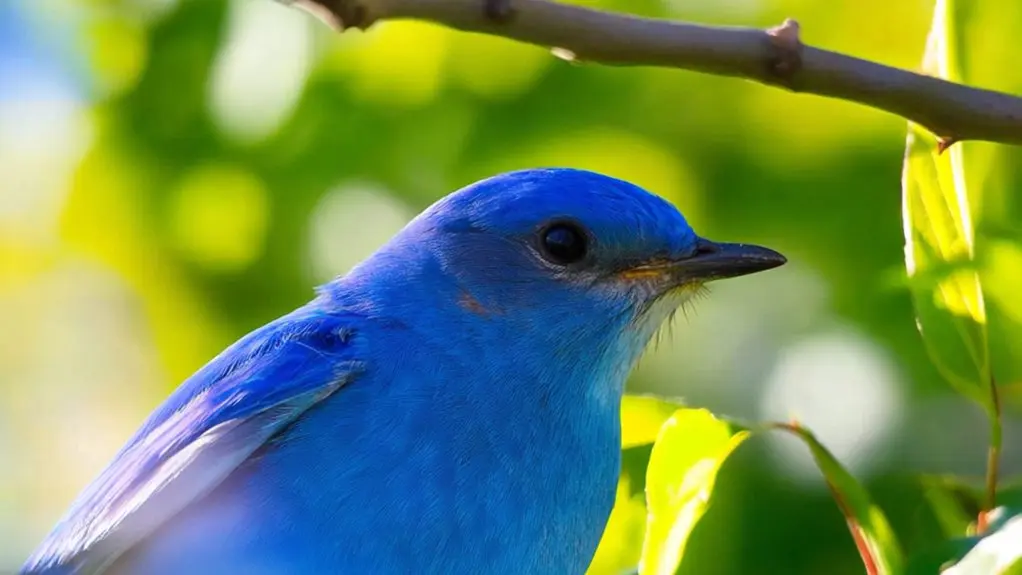
Yes, birds see blue vividly, but their vision goes way beyond what you experience. They have a fourth type of cone cell that’s sensitive to ultraviolet (UV) light. Along with specialized oil droplets, this lets them detect colors and patterns you can’t even see.
This expanded color perception helps birds find food, choose mates, and navigate their environment with remarkable precision. It’s pretty amazing when you think about it. Understanding their unique visual world shows that blue is just one part of their complex color spectrum.
How Bird Color Vision Goes Beyond Blue Light
Although humans see the world through three color receptors, birds possess a fourth cone cell that detects ultraviolet (UV) light. This enables them to perceive a broader spectrum of colors beyond blue.
This additional UV sensitivity allows you to observe feather patterns that reflect UV light, which are invisible to the human eye. Such patterns play an essential role in mating and species recognition.
Furthermore, birds use UV reflection as nesting signals. This helps them identify suitable nesting sites or communicate reproductive readiness.
The oil drops in their cone cells act as filters, enhancing contrast and making subtle color variations more distinct.
How Bird Color Vision Differs From Humans
You see colors through three types of cone cells. But birds? They’ve a fourth type that’s sensitive to ultraviolet light. This extra cone expands their color range way beyond what you can see.
Thanks to this UV vision, birds can pick up on signals that are completely invisible to humans. This ability plays a big role in important behaviors like mating and foraging.
Plus, their eyes have special oil droplets that help fine-tune how they perceive color. All of this makes their visual world a lot more complex and detailed than yours.
Ultraviolet Vision Advantage
Because birds possess a fourth type of cone cell sensitive to ultraviolet (UV) light, their color vision extends beyond the human visible spectrum. This UV sensitivity grants you, as a bird observer, access to visual information invisible to the human eye, including subtle variations in feather pigmentation and important migration cues.
You can appreciate how UV vision enhances birds’ interaction with their environment by detecting UV-reflective plumage patterns critical for mate selection and species recognition. It also helps them use UV cues to guide navigation during long migrations, improving orientation and survival.
Plus, they can identify food sources that reflect UV light, which aids efficient foraging.
This expanded visual range stems from UV-sensitive cones with specialized oil droplets that sharpen color discrimination beyond what you experience. So, birds perceive a richer, more complex world than humans do.
Cone Cell Differences
When comparing avian and human vision, the presence of a fourth cone cell in birds’ retinas markedly broadens their color perception beyond what you experience. Unlike humans, who rely on three cone types sensitive to red, green, and blue, birds have an extra cone that’s sensitive to ultraviolet (UV) light.
This UV-sensitive cone, combined with oil droplets in their cone cells that filter light, really boosts their ability to detect subtle color differences invisible to you.
This specialized vision lets birds see complex feather patterns and nuanced migration signals hidden in their environment. Because of this, birds can spot variations in coloration that look the same to humans.
This skill helps them read important visual cues for communication, mate selection, and navigation during migration.
Expanded Color Spectrum
Although humans rely on three types of cone cells to perceive red, green, and blue wavelengths, birds possess a fourth cone sensitive to ultraviolet (UV) light, considerably expanding their color spectrum. This visual adaptation greatly enhances their color perception, enabling them to detect hues beyond human capability.
The presence of oil droplets in bird cone cells refines light filtration, improving discrimination of UV and visible colors.
This expanded color spectrum plays a critical role in their behavior. You can appreciate how this adaptation helps birds by considering these functions: identifying UV-reflective plumage for mate selection, detecting food sources that reflect UV light, and enhancing environmental awareness through a broader range of color cues.
This advanced visual system represents a remarkable divergence in color perception between birds and humans. It’s pretty fascinating how nature equips different species with unique tools to navigate their world.
How Ultraviolet Light Shapes What Birds See
You see color through three types of cone cells in your eyes. But birds? They’ve a fourth type that can detect ultraviolet (UV) light. This means they can see beyond the colors we can perceive.
This UV sensitivity actually changes how birds behave. It reveals feather patterns and environmental details that are completely invisible to us. These hidden cues help birds communicate and survive in their world.
Ultraviolet Vision Explained
Because birds have a fourth type of cone cell that’s sensitive to ultraviolet (UV) light, their visual perception goes beyond what humans can see. This ultraviolet adaptation lets birds see colors that are completely invisible to us, which really boosts their color perception.
Each UV-sensitive cone contains special oil droplets that filter and amplify UV wavelengths. This helps birds sharpen their ability to tell apart even subtle color differences. So, birds get to experience a much richer and more detailed visual world.
With this expanded spectrum, birds can identify UV-reflective signals on mates and rivals. They can also detect ripeness in fruits by using UV cues. Plus, they can spot prey or predators that we simply can’t see.
These ultraviolet adaptations show that bird vision works on a whole different level compared to humans. It really highlights how complex and amazing their sensory systems are.
UV Influence On Behavior
The ability of birds to perceive ultraviolet (UV) light goes way beyond just making their color vision better. It actually has a big impact on how they behave. For example, UV signaling is super important in mate selection. Many birds show off UV-reflective feathers to signal that they’re healthy and ready to reproduce.
This kind of signaling affects how birds interact socially and can even decide who gets to mate. When birds are looking for food, they use UV contrast to spot berries, insects, or seeds that stand out against the leaves.
Plus, being able to see UV helps them detect predators better, so they can stay safe from threats and pesky parasites.
Birds also use UV cues to recognize and reject parasitic eggs, which helps protect their nests. All in all, UV vision really shapes how birds see their world and respond to different biological and ecological challenges.
Why Blue Is Only One of Many Colors Birds See
Although blue stands out prominently to human observers, birds perceive this color as just one component within a far broader and more complex spectrum. Their color perception comes from evolutionary adaptation, equipping them with four types of cone cells. These include one sensitive to blue light and another to ultraviolet (UV) wavelengths.
This expands their visible spectrum beyond what humans can see.
Key factors that shape their vibrant color perception include UV-sensitive cones that allow detection of colors invisible to us. They also have oil-based filters in their retinas, which enhance contrast and clarity of subtle hues.
Plus, they can distinguish multiple shades of blue alongside other colors in the UV spectrum.
How Birds Use Blue and UV Colors to Find Food and Mates
When birds spot blue and ultraviolet (UV) colors, they gain vital information that helps them locate food and select mates. Feather pigmentation often includes UV-reflective blue patches, which serve as essential visual signals during courtship, signaling health and vitality to potential mates. This UV perception also enhances species recognition.
In foraging, many flowers, berries, and insects reflect blue and UV light. This allows birds to distinguish ripe from unripe fruits and identify hidden prey. It’s pretty cool how they can see what we can’t.
Additionally, birds use these colors as migration cues, steering by environmental UV patterns invisible to humans. This sophisticated color vision helps birds optimize feeding efficiency and reproductive success by interpreting signals embedded in their feathers and surroundings. It’s an impressive evolutionary advantage in their visual system.
How Bird Color Vision Impacts Birdwatching and Conservation
Since birds perceive colors beyond the human visible spectrum, including ultraviolet light, you can leverage this knowledge to enhance birdwatching accuracy and contribute to conservation efforts.
Understanding how color perception evolved and how visual signaling works in birds helps you spot species by recognizing UV-reflective plumage patterns that are invisible to humans. This awareness improves data collection and interpretation, which is essential for effective conservation strategies.
You can also support habitat preservation by advocating for bird-friendly designs informed by avian vision. It’s pretty cool to think that by knowing how birds see the world, we can make smarter choices to protect them.
Consider these practical applications:
- Identifying species using UV-reflective traits for precise field observations.
- Employing UV-visible materials in window decals to reduce bird collisions.
- Designing habitat markers and deterrents that are visible to birds but subtle to humans.
Frequently Asked Questions
Can All Bird Species See the Color Blue Equally Well?
You won’t find all bird species seeing blue equally well because feather pigmentation and songbird communication influence blue sensitivity. Variations in cone cells affect perception, making some birds better at detecting blue hues essential for signaling and mating.
Basically, some birds just have a knack for spotting those blue colors more clearly than others. This difference helps them in important ways, like attracting mates or communicating with others. So, it’s not the same across the board when it comes to seeing blue.
Do Birds’ Blue Color Perceptions Change With Age or Health?
Imagine your world’s blue hues dimming like fading ink. Birds’ blue color perceptions shift with age and health due to color vision evolution and changes in blue pigment chemistry. This can impact UV reflectance and how they signal important information.
It’s like their view of the world subtly changes over time. These shifts aren’t random—they reflect real changes in their biology. So, the way birds see blue can tell us a lot about their age and health status.
How Do Birds’ Blue Color Preferences Affect Their Habitat Choices?
You’ll notice birds use blue feather signaling to assess mates, which influences their blue habitat selection. They prefer environments rich in blue hues, as these signal food, safety, and suitable nesting.
This directly guides their habitat choices. It’s pretty interesting how color plays such a big role in where birds decide to live and raise their young.
Are There Any Predators That Use Blue Coloration to Camouflage?
Yes, some predators use blue coloration as camouflage to blend into aquatic or sky environments. You’ll notice these camouflaging strategies reflect predatory adaptations, exploiting backgrounds that reflect blue light to remain concealed from their prey.
It’s pretty clever when you think about it. By matching their surroundings, these predators can sneak up on their target without being noticed. Nature really knows how to play with colors for survival!
Can Artificial Lighting Influence How Birds Perceive Blue Colors?
Ever wondered how light pollution affects birds’ color vision? Artificial lighting, especially LEDs, can distort blue hues and alter spectral quality. This can confuse birds’ navigation and foraging.
It reduces their ability to perceive natural blue colors accurately. So, artificial lights might be messing with how birds see the world around them. Pretty wild, right?
Conclusion
You might think blue is the star of birds’ color vision, but it’s just one note in their vibrant spectrum, including ultraviolet light invisible to you. Their eyes are finely tuned instruments, detecting hues beyond human reach. This helps them find food and mates with precision.
Understanding this colorful world deepens your appreciation for birdwatching and conservation. It reveals a hidden palette that shapes avian life in ways you never imagined.