

Yes, birds hear exceptionally well. They can detect high-frequency sounds from 4,000 to over 10,000 Hz, which is far beyond what humans can hear. Their specialized ear anatomy, including asymmetrical openings and a sensitive cochlea, helps them pinpoint where sounds are coming from with great precision.
Owls are especially unique because they use facial discs and the placement of their ears to hunt accurately at night. Birds can even regenerate damaged hearing cells, which helps them keep their hearing sharp over time.
Understanding these adaptations shows just how important sound is for birds. It plays a big role in their survival, communication, and navigation. Learning about this gives us a deeper insight into their sensory world.
How Well Do Birds Hear High-Frequency Sounds?

Although humans typically hear frequencies up to around 20,000 Hertz, many bird species can detect high-frequency sounds ranging from approximately 4,000 to over 10,000 Hertz. Some even perceive frequencies beyond human auditory limits.
This heightened auditory sensitivity supports critical behaviors like migration navigation. Birds rely on subtle acoustic cues to orient themselves across vast distances.
High-frequency hearing also complements visual signals such as feather coloration. This allows birds to communicate effectively in complex environments.
For example, alarm calls often fall within these high-frequency ranges, alerting others to predators or environmental threats.
Your understanding of birds’ hearing reveals their intricate sensory adaptations. These adaptations enable them to respond to ecological challenges with precision and speed, ensuring survival and successful migration.
Why Birds Hear Better Than We Do

When you compare human hearing to that of birds, you’ll find that birds possess specialized anatomical features that enhance their auditory capabilities. Birds detect a wider frequency range, including ultrasonic calls humans can’t hear.
Birds have specialized anatomy allowing them to hear a broader range of sounds, including ultrasonic calls beyond human hearing.
Their ear structures enable precise sound localization, which aids in critical behaviors like nesting site selection.
Moreover, birds maintain acute hearing by repairing inner ear damage. Three main factors contribute to their superior hearing:
Asymmetrical ear openings and facial features maximize sound collection. The ability to perceive high-frequency sounds helps them detect predators and communicate effectively. Auditory cues assist in evaluating environments, influencing decisions tied to bird feather coloration for camouflage and selecting ideal nesting sites.
These adaptations help birds survive and thrive in complex ecological niches.
How Bird Ear Anatomy Enables Sound Detection
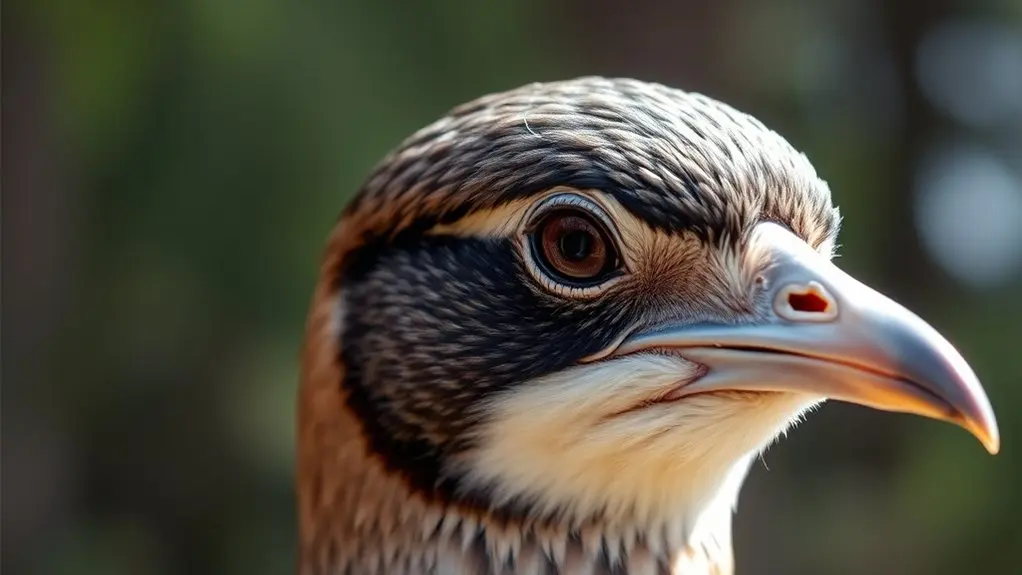
You might’ve noticed that birds don’t have external ears like we do. Instead, they’ve complex internal structures, including middle and inner ear parts, that are crucial for picking up sounds.
Their ears are usually hidden under feathers, and the shape of their heads plays a big role in how they process sound waves.
What’s really interesting is that certain features, like the size of their cochlea and the way their ear openings are sometimes uneven, help birds detect and pinpoint sounds with impressive accuracy.
Avian Ear Structure
How does the unique structure of a bird’s ear enable it to detect sounds with remarkable accuracy? Birds have a specialized ear anatomy that supports high auditory sensitivity essential for interpreting bird vocalization.
Their ears include three sections: outer, middle, and inner, with a cochlea ranging from 2.5 to 10 mm that transduces sound vibrations into neural signals. External ear coverts protect the openings without obstructing sound entry.
The middle ear’s columella transmits eardrum vibrations to the cochlea, ensuring precise sound perception.
Key structural features enhancing sound detection include ear coverts shielding ear openings while allowing sound passage, asymmetrical ear openings in some species to boost directional hearing, and cochlear size variability linked to frequency discrimination.
This complex design enables birds to detect a wide range of acoustic signals efficiently. It’s pretty amazing how their ears are built to catch all those subtle sounds in their environment.
Sound Localization Mechanism
The intricate structure of a bird’s ear does more than just capture sound; it also plays an essential role in locating where those sounds come from. Birds rely on differences in sound wave interference, like variations in timing and intensity between ears, to pinpoint direction. Even though they lack external ear structures, their head shape influences how sound is reflected and diffracted. This helps enhance localization.
Owls, for example, use asymmetric ear openings and facial discs to refine detection, especially across vocalization frequency ranges. The brain processes these subtle differences to map sound sources accurately.
| Feature | Function |
|---|---|
| Interaural time delay | Detects minute timing differences |
| Intensity disparity | Assesses volume variation between ears |
| Head shape | Modifies sound wave interference patterns |
| Specialized structures | Enhance vertical and horizontal localization |
Why Owl Hearing Is So Special
You might’ve noticed that owls have ears that aren’t perfectly symmetrical. This actually helps them hear sounds up and down with amazing precision.
Plus, their facial discs work like little sound reflectors, funneling even the faintest noises right to their special ears.
Because of this clever setup, owls can pinpoint where their prey is, even when it’s pitch dark.
Owl Ear Adaptations
Because owls rely heavily on sound to locate prey in darkness, their ear structures have evolved unique adaptations that enhance auditory accuracy. You’ll notice their ear openings are asymmetrically placed, with one higher than the other. This setup allows them to pinpoint sounds vertically with great precision.
Feather insulation around the ears protects them while still letting in subtle sounds. This even includes noises caused by wing vibrations during silent flight. These adaptations work together to maximize auditory input without messing up their stealth.
Key features include:
- Asymmetrical ear placement for 3D sound detection
- Large ear openings covered by specialized feathers for protection and sound entry
- Head shape that manipulates sound waves to improve hearing precision
All these traits help owls perceive sound with remarkable accuracy, which is super important for hunting at night.
Facial Discs Function
How do owls achieve such extraordinary hearing accuracy in the dark? The answer lies in their specialized facial discs, which act like satellite dishes to enhance sound focusing. These concave structures direct sound waves toward the owl’s ears, increasing sensitivity and precision in detecting prey.
You’ll notice that owls can alter the shape and size of their facial discs using muscles, optimizing sound collection from specific directions. In some species, facial discs are asymmetrical, with one side positioned higher to improve vertical sound localization.
This unique design, combined with the strategic placement of their ears, allows owls to pinpoint the location and distance of sounds with exceptional accuracy even in complete darkness.
Facial discs are vital for their remarkable auditory capabilities. It’s pretty amazing how nature has equipped owls with such a clever system to help them hunt so effectively at night.
How Birds Use Hearing to Locate Sounds
When birds detect sound waves, each ear receives the sound at slightly different volumes and times. This allows their brains to pinpoint the location of the source.
You’ll find that a bird’s head shape plays a vital role, as it reflects and diffracts sound waves, enhancing directional hearing.
Owls, in particular, have asymmetric ear openings and facial discs that fine-tune this ability.
This precise localization benefits you by supporting important behaviors such as:
- Vocal communication, where identifying the direction of calls matters
- Nesting behavior, helping detect predators or mates near nests
- Navigational awareness, essential for avoiding obstacles and finding food
How Birds Use Hearing for Communication and Survival
Why do birds rely so heavily on their hearing? Bird communication depends on acute auditory perception, enabling precise exchanges of calls and songs crucial for mating and defending territories.
Birds depend on sharp hearing for clear communication, vital for mating and protecting their territories.
You’ll notice that many birds detect high-frequency sounds beyond human range. This ability helps them spot predators early by alerting them to threats. It’s pretty amazing how sensitive their ears are.
Specialized adaptations, such as facial discs in owls or asymmetrical ear openings, help you understand how birds localize sound direction accurately. This precise hearing supports navigation and environmental awareness, which are essential to survival.
When predators approach, sharp auditory cues trigger immediate evasive behaviors. So, hearing isn’t just about communication; it’s a fundamental survival tool.
Birds’ Ability to Recover Hearing Loss
You can see that birds have an amazing ability to repair damage in their inner ears. This lets them restore their hearing by regenerating cells. It’s pretty impressive because this adaptation helps them survive by keeping their hearing sharp, even after an injury.
When you think about it, understanding how birds do this sheds light on some important differences between their auditory systems and ours.
It really shows just how resilient their senses are compared to humans.
Inner Ear Repair
Although many animals experience permanent hearing loss after inner ear damage, birds have a remarkable ability to repair their inner ear structures and restore auditory function. This inner ear regeneration helps them regain sensitivity, which is crucial for survival and communication.
Studies show that birds activate cellular mechanisms to rebuild damaged hair cells and support auditory nerve repair. You should know that this ability involves regrowth of sensory hair cells in the cochlea and restoration of auditory nerve connections for signal transmission.
Plus, birds recover function much faster compared to mammals. This process really sets birds apart from humans, who usually suffer irreversible hearing loss.
Evolutionary Hearing Adaptation
How do birds manage to recover hearing loss when many other animals cannot? This ability hinges on their evolutionary hearing adaptation, specifically ear regeneration. Birds possess cellular mechanisms that actively repair damage in their inner ears, restoring lost auditory function.
These processes enhance sound sensitivity, allowing birds to detect critical environmental cues such as predator movements or communication signals. Unlike humans, birds’ inner ear cells can regenerate. This trait is believed to be an evolutionary advantage essential for survival.
This regenerative capacity maintains acute hearing, enabling birds to respond swiftly to threats. Studies show this inner ear repair mechanism is unique among avian species. It highlights a specialized evolutionary trait that supports their exceptional sound sensitivity and auditory recovery in ways many other animals lack.
Hearing Restoration Mechanisms
Building on the evolutionary adaptations that enable birds to regenerate inner ear cells, their hearing restoration mechanisms reveal a sophisticated biological process. Unlike mammals, birds possess cellular pathways that repair auditory hair cells, which are vital for sound amplification and precise hearing.
This regenerative ability supports their survival by maintaining sensitivity to high-frequency sounds and predator calls. You should understand that this process involves activation of auditory plasticity allowing functional recovery and neural reorganization.
It also includes proliferation and differentiation of supporting cells into new sensory hair cells.
Plus, there’s restoration of cochlear structures essential for mechanical sound amplification. These mechanisms enable birds to recover from hearing damage that would be permanent in humans.
Their unique biological capacity ensures continued auditory acuity, which facilitates communication and environmental awareness essential for their ecological success.
How Birds Use Hearing to Detect Danger
When you listen closely, you mightn’t realize that birds rely heavily on their acute hearing to detect calls signaling nearby predators or threats. Birds demonstrate advanced auditory learning, enabling them to recognize specific warning calls that convey danger.
Birds depend on sharp hearing and learned recognition to detect warning calls of nearby dangers.
Their sound perception is finely tuned, allowing precise localization of these signals to assess the direction and distance of threats.
For example, owls possess specialized ear and head structures that enhance their ability to pinpoint prey or predators through sound alone.
Many bird species emit high-frequency danger calls, often beyond human hearing ranges. These calls play a critical role in survival by rapidly alerting others in the vicinity.
This sophisticated use of hearing really shows how important auditory cues are in avian threat detection. It’s pretty amazing how birds can pick up on sounds we might completely miss!
How Listening to Bird Sounds Improves Birding
Why does listening to bird sounds substantially enhance birding skills? When you attune to songbird melodies and habitat acoustics, you refine your ability to identify species accurately. Recognizing unique calls lets you locate birds before sighting them, increasing observation efficiency.
Engaging with spectrograms and audio tools deepens your understanding of vocal patterns. Listening regularly improves familiarity, enabling you to distinguish similar-sounding species across various environments and seasons.
Focus on these key benefits:
- Early detection of birds via distinct vocalizations
- Enhanced memory through spectrogram analysis
- Improved recognition using digital audio tools like Merlin
How Knowing Bird Hearing Improves Birdwatching
Understanding how birds perceive sound enhances your birdwatching by giving you insight into the auditory cues they rely on for communication and survival. Birds have specialized sensitivity to specific sound frequencies, which helps them detect calls and songs essential for identification.
By recognizing these auditory cues, you boost your ability to locate visually hidden or shy species. This means you’re more likely to spot birds that might otherwise go unnoticed. Using audio tools like spectrograms sharpens your perception of bird sound frequencies, enriching your mental library of vocalizations.
This knowledge deepens your appreciation of bird behavior and communication. It makes birdwatching more effective and way more rewarding.
| Benefit | Description |
|---|---|
| Improved Identification | Recognizing calls aids quick species ID |
| Enhanced Detection | Hearing hidden birds increases sightings |
| Audio Tools Usage | Spectrograms help memorize sound frequency |
Frequently Asked Questions
Can Birds Hear Underwater or in Noisy Environments?
You can’t expect birds to have effective aquatic hearing since their ears aren’t adapted for underwater sound transmission.
However, they do show impressive noise adaptation. This helps them filter background noise and detect specific calls accurately.
Do All Bird Species Have the Same Hearing Range?
You might think all birds hear the same, but evolutionary adaptations create diverse hearing ranges. Sensory overlap varies among species, reflecting distinct ecological roles and survival needs. So no, they don’t share identical hearing capabilities.
Different birds have evolved to pick up sounds that are important for their own environment and lifestyle. For example, some birds that hunt at night have sharper hearing to detect prey. Others might be more tuned to communication calls within their flock.
It’s pretty cool how these differences help each species thrive in their unique way. Hearing isn’t one-size-fits-all in the bird world!
How Does Bird Hearing Develop From Chick to Adult?
You’ll see auditory development starts early, with chick hearing responding to loud sounds first. As they mature, their cochlea grows, refining frequency detection and enabling precise sound localization.
This is super important for adult communication and survival. So basically, chicks start out hearing just the basics, but as they grow, their hearing gets way more detailed and helpful.
Can Birds Distinguish Human Speech or Music?
You’ll find that around 70% of bird species use vocal communication and acoustic signaling to respond to human speech or music. They recognize pitch and rhythm patterns that mimic their natural calls. This helps enhance interspecies auditory interaction.
Pretty cool, right? Birds aren’t just hearing sounds—they’re actually picking up on patterns that feel familiar to them. It’s like they’re tuning in to a language they understand, even if it’s coming from us.
Are There Birds That Are Deaf or Have Impaired Hearing?
Yes, some birds experience impaired hearing due to injury, illness, or genetic factors. This affects their avian communication in various ways.
Even though birds have sensory adaptations, damage to their auditory system can still hinder how they perceive sounds. This can impact their survival and how they interact with others around them.
Conclusion
You might think birds just chirp for fun, but their hearing is a finely tuned instrument, far surpassing ours in detecting high-frequency sounds and subtle cues. Their unique ear anatomy and specialized abilities, especially in owls, let them locate danger and prey with precision.
By understanding how birds hear, you’ll not only appreciate their world more deeply but also sharpen your own birdwatching skills. It can turn everyday sounds into a symphony of discovery.