
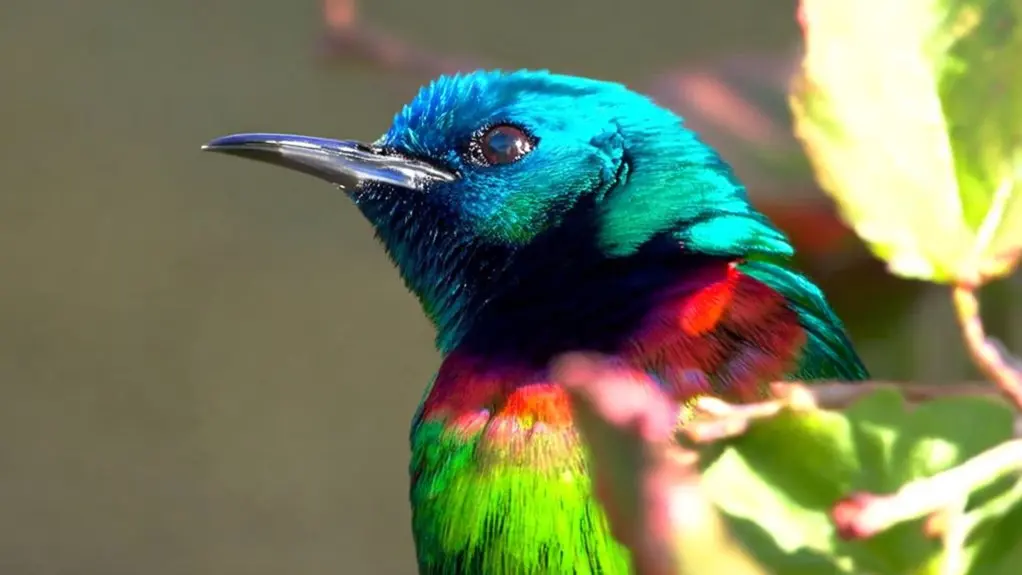
You can’t see as many colors as birds do because they have tetrachromatic vision, meaning they detect ultraviolet light beyond your visible spectrum. Their unique eye anatomy and specialized cone cells let them spot fine patterns, signals, and colors invisible to you. This helps them with navigation, foraging, and communication.
However, some bird colors remain hidden due to biological limits and evolutionary factors. Exploring further reveals how these visual marvels shape bird behavior and ecology. It’s pretty amazing how much more they experience through their eyes!
How Birds’ Eyes See More Colors Than Humans
Although humans rely on three types of cone cells to perceive color, birds have a fourth type that’s sensitive to ultraviolet (UV) light. This gives them tetrachromatic vision, which means they can see colors beyond the human visible spectrum. Imagine being able to spot hues that are completely invisible to you, especially in the UV range.
Their eyes pick up vibrant UV-reflective plumage and subtle patterns that are important for communication and mating. This enhanced visual ability helps birds tell males from females, different species, and even individual birds with great accuracy.
Plus, having a broader range of colors to detect makes it easier for them to navigate tricky environments, find food, and avoid predators.
How Bird Vision Becomes Tetrachromatic
Birds achieve their remarkable tetrachromatic vision through the presence of four distinct types of cone cells in their retinas, including one that’s specifically sensitive to ultraviolet (UV) light. This UV-sensitive cone expands their color perception beyond the human trichromatic range, allowing you to experience an additional dimension of color contrast invisible to us.
The integration of UV detection enhances visual acuity by enabling birds to discern subtle variations in plumage and environmental cues critical for survival and communication. This heightened sensitivity to UV-reflective patterns improves their ability to identify mates, recognize species, and detect food sources with precision.
Ultimately, tetrachromatic vision equips birds with an advanced sensory system that surpasses human capability in resolving complex color contrasts and fine visual details in their surroundings. It’s pretty amazing how different their world looks compared to ours!
How Bird Species See Colors Differently
When you examine the eyes of different bird species, you’ll find a remarkable variation in the number and types of cone cells. This directly shapes how each species perceives color. Plus, differences in eye morphology play a big role too.
These factors influence how birds interpret feather pigmentation and their environment. For example, birds of prey have binocular vision with specialized cones for sharp color and distance discrimination. This helps a lot when they’re hunting.
Nocturnal birds have larger eyes but fewer color detectors. So, their color perception is limited under low light conditions.
On the other hand, seabirds have oil droplets in their cone cells that boost color sensitivity. This adaptation is perfect for their marine environments.
All these adaptations show how eye morphology and cone cell diversity tailor color vision in unique ways. It really helps you appreciate the intricate relationship between bird species and their colorful world.
How Bird Eye Anatomy Enhances Color Perception
Because their eyes have a flattened, non-spherical shape, birds can keep more of their visual field sharply focused. This enhances their ability to perceive colors across a broad area. It’s pretty cool how this eye adaptation boosts visual acuity by allowing finer detail detection over a wider range.
The scleral ring reinforces the eye’s structure, making sure it stays stable for precise focusing. This stability is essential when it comes to discerning subtle color variations.
Plus, the lens’ forward positioning enlarges the retinal image, which improves resolution and color clarity.
Oily droplets in seabirds’ photoreceptors also play a role by refining color perception, especially under variable lighting conditions.
And the pecten oculi supplies critical nutrients and oxygen, supporting the retina’s high metabolic demand. This support is necessary for advanced color vision.
All these anatomical features work together to optimize birds’ color perception with exceptional accuracy. It’s a perfect example of how evolution fine-tunes vision to meet specific needs.
How Ultraviolet Vision Helps Birds Communicate
Although ultraviolet (UV) light is invisible to the human eye, many avian species rely on UV reflection in their plumage to communicate essential information about reproductive status and mate quality. UV signaling reveals intricate plumage patterns that remain hidden to us, enabling birds to convey subtle messages.
When you observe birds, consider these key roles of UV vision: Males display UV-reflective feathers to indicate vitality and attract females during social interactions. Females use UV cues to assess mate health and reproductive suitability.
UV perception assists birds in distinguishing species and sexes, refining social dynamics. This precise visual communication system enhances reproductive success and maintains social order.
It really shows the evolutionary significance of UV signaling in avian plumage patterns.
How Birds Use Color for Foraging and Mating
Since color perception plays an essential role in avian behavior, birds actively use both visible and ultraviolet hues to enhance foraging efficiency and mating success. You’ll notice that feather pigmentation and UV reflection signal health and dominance during mating rituals. Males with brighter UV-reflective feathers often appear more vibrant, increasing attractiveness.
When it comes to foraging, birds detect subtle color differences to locate camouflaged insects or fruit, improving food detection.
| Aspect | Role of Color |
|---|---|
| Feather Pigmentation | Signals health and dominance in mates |
| Mating Rituals | Bright colors and UV attract potential partners |
| Foraging | UV vision reveals hidden food sources |
| Reproductive Status | Color cues identify sex and breeding readiness |
How UV Reflection Reveals Hidden Bird Colors and Patterns
You’ll find that ultraviolet plumage reveals vibrant patterns invisible to your eyes but critical for birds’ communication and survival. It’s pretty amazing because these colors don’t show up in normal light, yet they play a huge role in how birds interact.
Male birds often have distinctive UV-reflective feathers that signal their fitness to potential mates. This helps other birds tell males apart from females, which is key during breeding seasons.
Plus, these UV patterns aren’t just about looks—they help birds recognize members of their own species and even spot parasites that might be hiding in their feathers.
All of these factors combined directly influence a bird’s chances of finding a mate and surviving in the wild. So, what seems invisible to us is actually a vibrant and vital part of their world.
Ultraviolet Plumage Effects
Three distinct types of cone cells in birds’ eyes enable them to perceive ultraviolet (UV) light. This reveals colors and patterns invisible to human vision. UV reflection in plumage produces feather iridescence and UV camouflage. These effects allow birds to exhibit striking visual features beyond what we can see.
When you observe birds through this lens, you’ll notice hidden metallic hues and deep purples. These colors often signal species or individual identity. You might also see UV camouflage that helps certain birds blend seamlessly into their environment. This camouflage shields them from predators.
Feather iridescence shifts dynamically as light angles change. This enhances communication and mating displays among birds. These UV plumage effects transform how birds interact visually. They enable precise recognition and survival strategies that rely on spectral information unavailable to humans.
Sex Differences In UV
How do ultraviolet (UV) reflections reveal hidden differences between male and female birds? UV signaling plays a vital role in distinguishing sexes by exposing plumage contrast invisible to the human eye.
Male birds typically display feathers with strong UV reflectance, enhancing brightness and patterns used during courtship displays.
In contrast, females generally exhibit more subdued UV reflection, resulting in less conspicuous plumage. This difference allows birds with UV vision to identify sex accurately, supporting mate selection and social interactions.
It’s pretty clever how nature uses light we can’t even see to send these important signals.
Additionally, the intensity of UV signals in males often indicates reproductive status and attractiveness, which influences mating success.
UV Patterns And Survival
Although humans can’t see ultraviolet (UV) light, birds rely on UV reflection to reveal hidden colors and intricate patterns on feathers that are otherwise invisible. This UV signaling, driven by specialized feather pigmentation, plays a vital role in survival.
You’ll find that UV patterns help birds identify mates and rivals by enhancing male plumage attractiveness and aiding sex differentiation. They also help birds recognize species boundaries to avoid interbreeding, which keeps their genetic integrity intact.
Plus, UV patterns let birds detect parasitic threats, like cuckoo eggs, through UV-reflective eggshell cues. This ability helps protect their nests from unwanted intruders.
Why Certain Bird Colors Are Invisible to Humans
Because birds possess ultraviolet-sensitive cone cells that humans don’t have, they see a range of colors beyond what we can perceive. This means they can detect ultraviolet (UV) light, which is completely invisible to us since our eyes lack those UV-sensitive cones.
Birds see ultraviolet light that humans simply can’t, revealing colors beyond our perception.
So, certain bird colors, especially those UV-reflective feathers, seem invisible or dull to us. But for birds, these colors are super important for communication and signaling to each other.
These UV patterns show hidden features that help birds with things like mate selection and being aware of their environment.
When you look at a bird, you miss out on those vibrant UV hues, which means you don’t see their true colors.
In short, the reason some bird colors are invisible to humans comes down to differences in the types of photoreceptor cells we’ve and how we perceive color.
Why Birds Can’t Show All the Colors They See
Even though birds perceive a wider range of colors than humans, they can’t display all of these hues in their plumage. This discrepancy arises primarily from color limitations and pigment constraints inherent in their biology.
You should understand these three key reasons:
- Pigment Constraints: Birds rely on specific pigments and feather structures to produce colors. Many hues, especially complex ultraviolet combinations, require pigments that birds simply can’t synthesize or deposit.
- Structural Limitations: Feather microstructures can only reflect certain wavelengths efficiently, restricting the visible palette despite birds’ broader visual sensitivity.
- Evolutionary Factors: Some colors offer no survival or mating advantage, so natural selection hasn’t favored their development in plumage.
How Bird Colors and Vision May Evolve
You’ll find that birds have a lot of potential to expand their color spectrum beyond what we see today through evolutionary changes. By tweaking the tiny nanostructures in their feathers, they can change how light reflects at a microscopic level.
This means they can create completely new colors.
It’s pretty fascinating how this back-and-forth between their vision and the feather nanotechnology keeps pushing the evolution of bird colors forward. Essentially, as their eyes adapt, their feathers can follow suit, leading to an ongoing transformation in avian coloration.
Expanding Avian Color Spectrum
While birds currently display only about 26-30% of the possible color hues in their feathers, ongoing evolutionary processes and advancements in nanotechnology suggest they could soon produce and perceive a much broader spectrum. You should know that evolutionary constraints have historically limited both color perception and feather pigmentation.
But these barriers might fade as natural selection favors new and exciting hues. Just think about the possibilities: birds might start detecting ultraviolet or polarized light variations that were invisible to them before.
New colors could totally change the game for communication, mating, and survival strategies. Plus, the avian visual system might adapt, expanding sensitivity beyond what we see today.
This expanding avian color spectrum shows how evolution can really push biological boundaries. It could give birds a richer visual experience and more complex ecological interactions than ever before.
Nanostructure Influence on Colors
As nanotechnology advances, birds gain the ability to manipulate light at microscopic scales through specialized feather nanostructures. This lets them create colors beyond their traditional palette. These nanostructures control light by bending and scattering specific wavelengths, producing effects like iridescence and enhanced UV reflection.
This kind of coloration goes beyond what pigments can do. Birds can generate hues that are impossible with pigments alone. It’s pretty fascinating how this structural mechanism works, right?
You can expect this evolutionary adaptation to expand avian visual communication and camouflage by introducing new spectral properties.
Ongoing research shows that as nanostructure coloration keeps improving, birds might develop entirely novel colors. This will influence not just how they look but also how they see the world.
All in all, this highlights the critical role of light manipulation at the nanoscale in avian color evolution. It’s a game-changer for understanding bird colors and their evolution.
Frequently Asked Questions
Can Birds See Colors at Night or in Low Light Conditions?
You can’t expect birds to see colors well at night because their nocturnal vision prioritizes brightness and contrast over color perception.
Their tubular eyes and rod cells limit color detection in low light conditions. So, when it’s dark, birds mostly rely on shapes and shades rather than vibrant colors.
Basically, their eyes are built to help them see better in dim light, not to enjoy a colorful view after sunset.
Do Baby Birds Have the Same Color Vision as Adults?
No, baby birds don’t have the same color vision as adults. Their developing cone cells limit perception of feather pigmentation and beak coloration until maturity enhances sensitivity to these essential visual cues for survival and communication.
Basically, their color vision improves as they grow. This helps them better recognize their surroundings and communicate with other birds. So, their vision evolves just like they do!
How Does Bird Color Vision Affect Their Ability to Avoid Predators?
You use birds’ advanced color vision to improve predator detection by discerning subtle UV cues. This allows you to exploit camouflage strategies effectively. You can identify threats early and increase survival chances through precise recognition of predators in complex environments.
It’s pretty amazing how birds see details we often miss. Their ability to pick up on these ultraviolet signals makes a big difference when it comes to staying safe. So, by understanding how birds use color vision, you can get better at spotting danger before it’s too late.
Are There Any Bird Species That Are Colorblind?
Colorblind birds are pretty rare because their feather colors and mating displays really depend on sharp, precise vision.
You don’t often find species that can’t see colors since their survival often depends on spotting subtle hues. These colors are super important for things like communication and avoiding predators.
Can Birds Distinguish Between Artificial and Natural Colors?
Yes, you can see birds distinguish artificial from natural colors because their feather pigmentation reflects ultraviolet light. This UV reflection plays a vital role in mating displays. It helps them tell genuine signals apart from human-made dyes.
Those dyes usually have limited UV components, so birds can easily spot the difference. It’s pretty fascinating how their vision works, right? They’re tuned into details we might completely miss.
Conclusion
Now that you know how birds brilliantly blend biology and behavior to behold beyond human hues, you’ll appreciate their advanced anatomy and astonishing abilities. Their tetrachromatic vision, enhanced by ultraviolet insights, reveals radiant realities we rarely recognize.
Remember, while we perceive a palette, birds perceive a spectrum, seeing secret shades and signals that subtly shape survival and social scenes. So, stay curious and celebrate the colorful complexities of bird vision evolving with every feathered flight.