
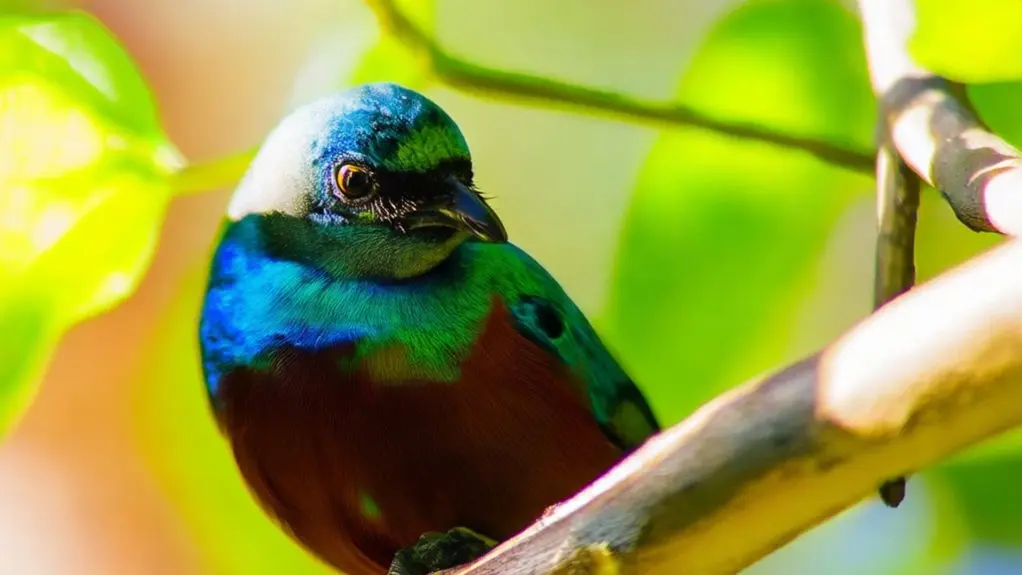
You might see a rainbow of colors, but birds perceive an even richer spectrum thanks to four types of cone cells, including one sensitive to ultraviolet (UV) light. This UV sensitivity lets them detect patterns and signals invisible to you, which helps with foraging, navigation, and mate selection.
Their specialized eye anatomy sharpens color discrimination and visual clarity across a wider range. It’s pretty amazing how their eyes work.
Understanding these adaptations shows us how birds experience the world in striking, complex hues beyond what humans can see. It really gives you a new perspective on their colorful lives.
How Birds See More Colors Than Humans
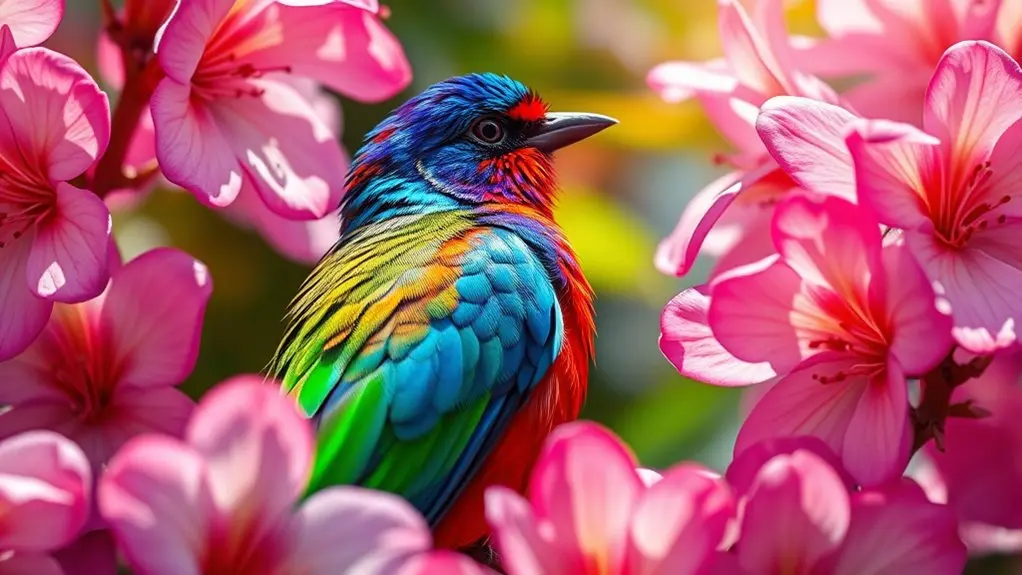
Although humans rely on three types of cone cells to perceive color, birds have four. One of these is sensitive to ultraviolet (UV) light, which means their visible spectrum goes beyond what we can see.
Humans see three color cones, but birds have four—including one for ultraviolet light beyond our vision.
This extra UV-sensitive cone gives birds a boost in color perception. It lets them detect wavelengths that are completely invisible to you.
This kind of visual adaptation helps birds spot subtle differences in plumage that we just can’t notice. It’s really useful for identifying species and choosing mates.
The tetrachromatic vision birds have offers a richer, more complex color experience. It includes UV reflections that change how feathers look.
Because of this expanded color perception, birds can navigate, forage, and recognize their own kind more easily. It’s amazing how these visual adaptations show the intricate ways birds use colors to interact with their world—colors far beyond what humans can see.
How Ultraviolet Light Enhances Bird Color Perception
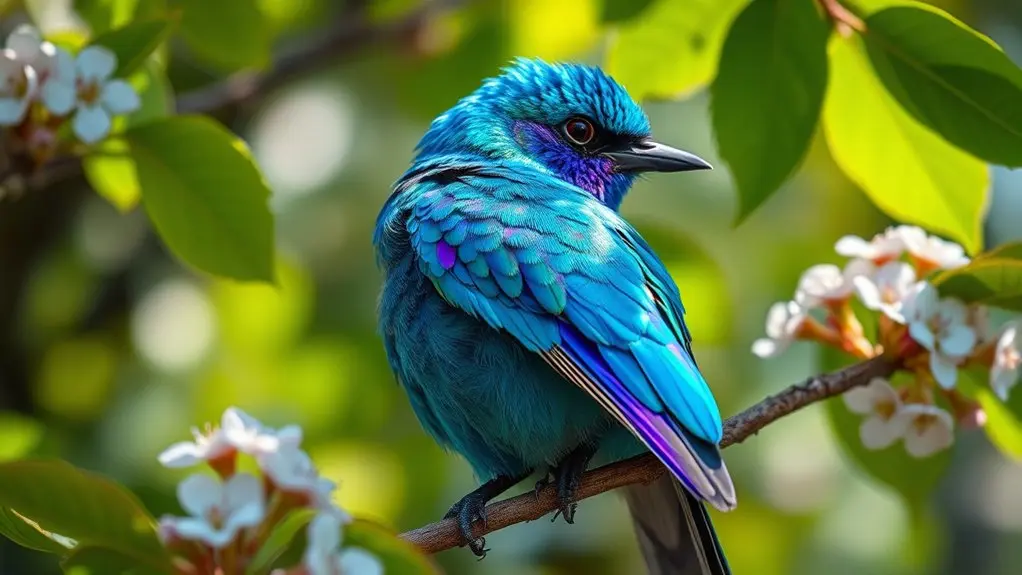
When you consider how birds perceive their environment, ultraviolet (UV) light plays an essential role in enhancing their color vision beyond what humans can detect. Birds have an extra cone cell that’s sensitive to UV wavelengths. This lets them see UV reflections off plumage that are completely invisible to us.
These UV reflections create vivid plumage contrasts, showing off metallic and vibrant patterns. These patterns are super important for telling males from females, distinguishing different species, and even checking the health of eggs.
Plus, having UV sensitivity sharpens contrasts in foliage and other environmental features. This helps birds navigate better, find food more efficiently, and spot predators quicker.
What Tetrachromatic Vision Means for How Birds See
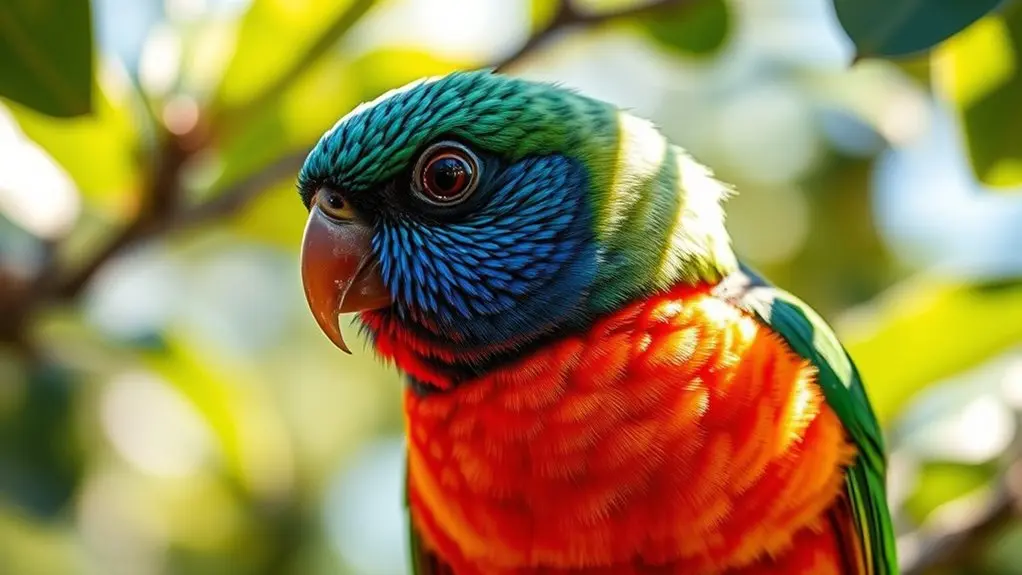
Because birds possess tetrachromatic vision thanks to four types of cone cells including one sensitive to ultraviolet light, they perceive a color spectrum far beyond human capabilities. This enhanced color perception allows you to see vibrant hues and subtle variations invisible to us.
This enhanced perception sharpens your visual acuity, enabling you to distinguish metallic reflections and complex feather patterns with remarkable precision.
The ultraviolet-sensitive cone broadens your color palette, enriching how you interpret your environment. This expanded range improves your ability to detect fine details in plumage and surroundings, which is essential for navigation and foraging.
Tetrachromatic vision fundamentally transforms how you process visual information, offering a multidimensional color experience that surpasses standard trichromatic vision.
How UV Vision Influences Bird Behavior and Mate Choice
You rely on ultraviolet plumage signaling to pick up essential cues that influence mate selection in birds. By detecting UV patterns that are invisible to humans, you get to see how males showcase their health and genetic fitness through vibrant reflections.
This UV vision really sharpens your ability to assess potential mates and their reproductive quality with remarkable precision. It’s like having an extra layer of insight that helps you make better choices when it comes to finding the right partner.
Ultraviolet Plumage Signaling
Although invisible to human eyes, ultraviolet (UV) plumage plays an essential role in bird communication and mate choice by providing signals that only UV-sensitive birds can detect. You’ll find that UV reflection in feathers serves as a key component of plumage signaling, allowing males to showcase their health and genetic quality.
When you observe these UV cues, you realize they convey information beyond visible color patterns. They influence social interactions and dominance hierarchies without alerting predators.
Additionally, UV plumage signaling helps you understand species-specific recognition. It maintains reproductive isolation by enabling birds to distinguish conspecifics accurately.
This nuanced visual communication system shows how UV-sensitive vision profoundly shapes behavior. It allows birds to exchange crucial information through signals imperceptible to humans.
Mate Selection and UV
When selecting a mate, birds rely heavily on ultraviolet (UV) vision to assess subtle plumage cues that signal health and genetic fitness. UV signaling plays a vital role in plumage communication, where males often display brighter UV-reflective feathers to attract females.
You’ll notice females prefer mates with more vivid UV plumage, interpreting these signals as indicators of superior territory quality and parental capabilities.
This UV perception enables birds to discern hidden patterns invisible to predators or rivals, refining mate choice accuracy. By relying on UV signaling, birds enhance reproductive success, reinforcing sexual selection based on visual cues.
Understanding this intricate use of UV plumage communication reveals how essential UV vision is in shaping avian mating behavior and evolutionary fitness.
How Birds Use Color to Protect Their Nests
Because birds possess UV-sensitive vision, they can detect subtle differences in nest and egg coloration that remain invisible to most predators. This ability really boosts nest camouflage. Birds use it to pick nesting sites and materials that blend UV-reflective properties with surrounding foliage, which helps hide their nests effectively.
You might notice that many bird species’ eggs show unique UV-reflective patterns. These patterns let birds recognize their own eggs precisely. It’s like having a secret code to spot their eggs and tell them apart from parasitic ones that don’t match the UV signatures.
UV vision also helps birds recognize their nests. This reduces the chance of nest theft or parasitism because birds can tell their nests apart from others.
How Color Vision Affects Bird Foraging
You rely on color cues to spot ripe fruits and nutritious insects. Birds, for example, use their tetrachromatic vision—which includes ultraviolet sensitivity—to boost their foraging accuracy.
This UV perception helps them see subtle contrasts in plumage and foliage that other animals can’t detect. By picking up on these signals, they can quickly find the best food sources.
In other words, it makes it easier for them to choose suitable prey or nectar, giving them an edge when searching for food in complex environments.
Color Cues in Food
Although many animals rely on scent or movement to locate food, birds primarily use their sophisticated color vision to identify ripe fruits and nutritious prey. Their advanced color perception allows them to detect subtle differences in hue, which signals the ripeness or nutritional value of food items.
This visual adaptation lets you distinguish edible from inedible objects even in complex environments.
Brightly colored insects and berries stand out clearly, enhancing your foraging efficiency. By interpreting these precise color cues, you can select the most beneficial food sources quickly.
This capability stems from your tetrachromatic vision, which expands your color discrimination far beyond what humans experience.
That means you can make accurate foraging decisions based on nuanced visual information, making it easier to find the best food around.
UV Vision Enhances Foraging
Building on the importance of color cues for identifying ripe fruits and nutritious prey, birds extend their visual capabilities beyond the human-visible spectrum by detecting ultraviolet (UV) light. This UV vision enhances foraging by revealing cues invisible to you, such as UV-reflective patterns on prey and food.
It also helps birds see through UV camouflage used by some insects and detect subtle feather patterns signaling health or status.
Consider these key benefits of UV vision in foraging:
- Detecting UV-reflective insects and parasitic eggs that blend into foliage.
- Distinguishing ripe fruits against complex backgrounds by UV contrast.
- Enhancing visibility in low-light conditions for precise prey capture.
- Identifying subtle feather patterns that may indicate prey vulnerability.
Your understanding of bird foraging deepens by appreciating these UV-based visual adaptations.
Plumage Signals and Selection
Because birds possess tetrachromatic vision that includes ultraviolet detection, they can perceive plumage signals with remarkable detail. This ability allows them to assess health and reproductive fitness accurately.
You’ll notice that feather iridescence and UV-reflective patterns serve as essential visual cues in mate selection. Often, these highlight subtle differences that are invisible to predators or competitors.
This enhanced color perception doesn’t just help in evaluating potential mates. It also influences foraging since UV cues assist in identifying prey and food sources more precisely.
Birds balance conspicuous coloration with camouflage strategies to avoid predation. This shows how evolutionary pressures shape their plumage.
Understanding these dynamics clarifies how color vision affects both signaling and survival. It really reinforces the crucial role of tetrachromatic vision in avian ecology and evolutionary biology.
How Bird Color Vision Differs Among Species
How do different bird species perceive colors so distinctly? Their color vision varies because of specialized adaptations that match their ecological needs, like camouflage and migratory navigation.
You’ll notice these differences in several ways. First, most birds have tetrachromatic vision with four types of cone cells. Some can even detect ultraviolet light, which is beyond what humans can see.
Birds of prey have dense receptor arrays. This helps them distinguish colors better, which is super important for judging distances when they’re hunting.
Seabirds have oil droplets in their eyes that sharpen color contrast. This makes it easier for them to navigate long distances and spot prey over water.
Night-active birds rely more on rod cells instead of cones. This means they don’t see colors as well, but their vision is better in low light.
All these differences show how evolution shaped each species’ visual system. It’s all about optimizing survival in different environments.
How Bird Eye Anatomy Supports Their Color Vision
Understanding the unique ways birds perceive color involves examining the specialized structures within their eyes that make this possible. The retinal structure in birds features four types of cone cells, including one sensitive to ultraviolet light. This enables you to see colors beyond human capability.
Birds perceive colors beyond human vision thanks to specialized retinal cones, including ultraviolet sensitivity.
Oil droplets within these cones filter light, enhancing color discrimination and distance vision, especially in seabirds. The flatter shape of the avian eye expands the focus area, allowing you to detect a broader color spectrum.
Forward lens positioning increases image size on the retina, sharpening your perception of fine color details.
Additionally, the pecten oculi nourishes this intricate retinal structure, supporting high visual acuity. Combined with exceptional eye mobility, these adaptations give you superior color vision and dynamic environmental awareness. It’s pretty amazing how all these parts work together, isn’t it?
Frequently Asked Questions
Can Birds See Colors at Night or in Low Light?
You can’t expect birds to see vivid colors at night. Their night vision relies on enhanced light sensitivity and rod cells. This means they sacrifice color detection.
Do Baby Birds Have the Same Color Vision as Adults?
You might think baby birds see the full color spectrum, but they don’t. Their visual acuity and cone cell development are immature.
As they grow, their color perception sharpens. It eventually matches the complex adult tetrachromatic vision.
How Does Bird Color Vision Compare to Other Animals?
You’ll notice bird color vision surpasses many animals through tetrachromatic cones, enhancing visual acuity and revealing feather pigmentation details invisible to others. This precision aids in communication and foraging, setting birds apart in color perception.
It’s pretty fascinating how these extra cones give birds a whole new way to see the world. They can spot colors we simply can’t, which makes a big difference when they’re looking for food or chatting with each other. So yeah, birds definitely have a leg up when it comes to color vision!
Can Birds See Artificial Colors Like Neon or LED Lights?
Like decoding a secret language, you’ll find birds detect neon visibility and LED perception differently than humans. Their tetrachromatic vision picks up intense wavelengths, yet their experience of artificial colors remains scientifically uncertain and unique.
It’s pretty fascinating when you think about it. Birds see the world in a way we can only imagine, especially when it comes to bright, artificial colors. But exactly how they interpret neon or LED lights is still a bit of a mystery.
Does Seasonal Change Affect Bird Color Perception?
Yes, seasonal plumage and migration signals change with light and foliage, affecting how you perceive bird colors.
During breeding, brighter colors help birds stand out and make recognition easier. In winter, the reduced UV light dims UV-reflective features, which changes how you see their colors.
Conclusion
You might be surprised to learn that birds can see around 100 million colors, compared to the one million you see. This incredible tetrachromatic vision, including ultraviolet perception, allows birds to detect subtle color variations invisible to you. It influences their behavior, from choosing mates to finding food and protecting nests.
Understanding how bird eye anatomy supports this helps you appreciate the complexity behind their vibrant world. Plus, it shows the critical role color plays in their survival. Pretty amazing, right?