
You might wonder if birds can see ghosts, but science shows they don’t perceive supernatural entities. Instead, birds have extraordinary vision, detecting ultraviolet light and subtle environmental cues invisible to you. This sharp sensory ability explains their unusual behaviors, like sudden flights or vocalizations, often mistaken for ghostly reactions.
Their responses reveal natural interactions with the environment, not spirits. Explore how their unique eyesight shapes what they notice beyond human limits. It’s pretty amazing how much more birds can see compared to us!
How Do Birds Perceive the World Differently From Humans?
Although you might assume birds see the world much like we do, their visual systems operate on a different spectrum altogether. You’d find that birds perceive ultraviolet (UV) light, invisible to humans, revealing details like feather coloration that appear dull to us but vibrant to them.
This UV sensitivity enhances how they interpret subtle signals within their environment, aiding in social communication and mate selection.
When tracking migration patterns, birds rely on their acute vision to detect faint cues in the landscape and sky, allowing precise navigation across vast distances. Their specialized cones detect a broader color range and minute movements, giving you insight into how their perception surpasses human limits.
It fundamentally alters how they experience and interact with the world around them.
How Does Bird Anatomy Enable UV Vision Beyond Human Sight?
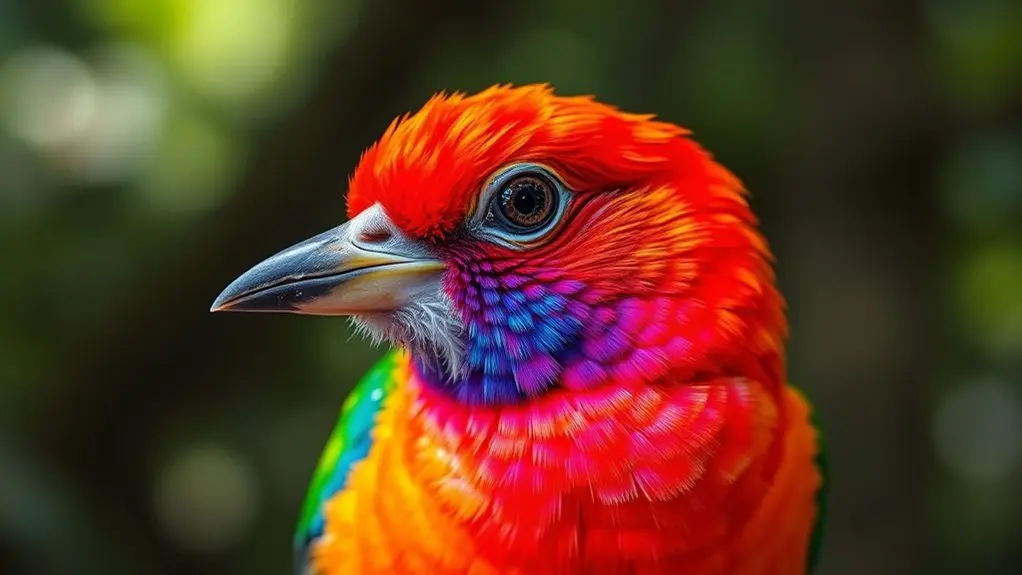
You rely on your eyes to see visible light, but birds have something pretty special going on. They’ve UV-sensitive cone cells that let them see beyond the range you can detect.
Their retinas don’t just have these unique cones—they also contain oil droplets that act like tiny filters. These droplets help sharpen their perception of UV patterns, making the world look quite different to them.
On top of that, birds have larger and more complex lenses in their eyes. These lenses focus UV light really efficiently, which gives birds a clear edge in spotting details that are invisible to you. It’s like they’ve their own secret visual superpower!
UV Cone Cells
Because birds possess four types of cone cells in their retinas, one of which is sensitive to ultraviolet (UV) light, they can perceive wavelengths below 400 nanometers that humans can’t detect. These UV cone cells, combined with specialized oil droplets, filter incoming light to sharpen color discrimination and enhance UV detection.
This adaptation allows you to observe feather coloration that’s invisible to the human eye, revealing intricate UV patterns used in mate selection and communication. The high density of UV-sensitive cones in the bird retina ensures fine spatial resolution of UV light, letting you detect subtle environmental cues.
This unique photoreceptor arrangement fundamentally broadens the birds’ visual spectrum, giving them a richer perception of their surroundings beyond ordinary human vision. It’s pretty amazing how much more they see compared to us!
Eye Structure Adaptations
When examining bird anatomy, you’ll find several specialized eye structures that enable them to detect ultraviolet light beyond human capabilities. Their retinas contain UV-sensitive cone cells with oil droplets filtering light, enhancing UV perception. A complex lens and cornea focus UV wavelengths precisely.
This adaptation helps birds discern subtle feather coloration changes, which is essential for mating and camouflage. The tapetum lucidum improves night vision, aiding migration navigation by detecting UV cues invisible to us. High cone cell density broadens spectral range, enabling detailed environmental awareness.
| Eye Structure | Function | Impact on UV Vision |
|---|---|---|
| UVS Cone Cells | Detect UV light | Enables UV sensitivity |
| Oil Droplets | Filter incoming light | Enhance UV wavelength clarity |
| Complex Lens/Cornea | Focus UV light on retina | Improves image sharpness |
| Tapetum Lucidum | Reflects light at night | Boosts low-light UV detection |
| High Cone Density | Increases color resolution | Distinguishes feather hues |
Could Birds’ UV Eyesight Explain Their Unusual Behaviors?
You see, birds can see ultraviolet light—wavelengths that are totally invisible to us. This means they pick up on hidden environmental hints, like glowing feathers or faint patterns we just can’t notice.
Because of this UV vision, birds might act in ways that seem a bit strange to us.
It’s like they’re responding to signals that we’re completely missing. Once you understand how their UV perception influences their behavior, it makes sense why birds sometimes seem to react to things that look ghostly or unseen from our perspective.
Ultraviolet Vision Explained
Although humans can’t see ultraviolet (UV) light, many birds, including parrots, can perceive this invisible spectrum. This ability considerably expands their visual world.
You’d notice that bird coloration appears dramatically different to them, revealing UV patterns invisible to human eyes.
These UV patterns often highlight plumage details that play essential roles in communication and identification within species. When you observe birds, their feathers might fluoresce or glow under UV light. This signals information about health, status, or mating readiness.
Ultraviolet vision also allows them to detect subtle environmental cues and predators camouflaged from human sight. By understanding this spectral sensitivity, you gain insight into how birds interpret their surroundings far beyond our visual limitations.
Behavioral Impacts Of UV
Since birds perceive ultraviolet light beyond human capabilities, their behavior often reflects responses to visual cues that remain invisible to us. Their enhanced color perception and visual acuity allow them to detect UV-reflective patterns. This influences behaviors like rapid flight or secretive movements.
These responses might seem unusual, but they’re actually grounded in UV signals that indicate mates, predators, or environmental changes.
| Behavior | UV Influence | Possible Explanation |
|---|---|---|
| Rapid flight | Sensing UV-reflective danger | Avoiding predators invisible to you |
| Agitation | Detecting UV-glowing plumage | Reacting to mates or rivals |
| Secretive moves | Following UV environmental cues | Orchestrating unseen stimuli |
| Heightened alert | Visual acuity in UV spectrum | Responding to subtle threats |
When you observe bird behavior, understanding their UV vision adds a whole new layer of context.
Hidden Environmental Cues
When birds detect ultraviolet light patterns invisible to humans, they gain access to a hidden layer of environmental information that shapes their behavior. This UV perception reveals cues such as UV-reflective feather coloration, which plays a vital role in communication and mate selection.
During bird migration, UV signals help birds navigate by highlighting landmarks or environmental changes undetectable to us. You might notice sudden agitation or flight in birds, which could be triggered by UV-based signals signaling threats or disturbances we can’t see.
Their ability to see UV light lets them detect predators camouflaged in the human-visible spectrum, giving them a survival edge.
Understanding these hidden environmental cues explains many unusual bird behaviors. It really sheds light on how UV eyesight influences their perception and interaction with the world.
Is There Solid Proof Birds See Ghosts or Spirits?
If you look closely at scientific research, you’ll find no solid proof that birds can see ghosts or spirits. Birds’ perception hinges on natural stimuli, such as those guiding bird migration or nest communication.
Their acute senses, including ultraviolet vision and sensitive hearing, help them interpret environmental cues, but these don’t extend to supernatural entities. Reports of unusual bird behavior remain anecdotal, not empirical.
| Observation | Interpretation |
|---|---|
| Strange flight paths | Possible environmental factors |
| Unusual vocalizations | Communication signals |
| Sudden stillness | Alertness to predators |
| Nest disturbance | Response to natural threats |
You shouldn’t conflate these natural behaviors with spiritual perception. Current science lacks evidence beyond cultural speculation. So, while it’s fun to wonder, the facts just aren’t there.
What Cultural Beliefs Link Birds to Spirits and Supernatural Sight?
Although modern science finds no evidence of birds perceiving spirits, many cultures have long attributed supernatural significance to their behaviors. You’ll notice that spiritual symbolism often links birds like owls and pelicans to death omens or reincarnated spirits.
Cultural interpretations from Indigenous groups such as the Blackfoot and Coast Salish emphasize birds as messengers between the physical and spiritual domains.
Bird cries and wing-beating sounds are traditionally seen as communications from spirits or warnings of impending misfortune. Folklore documents these associations, describing how certain bird behaviors reflect spiritual activity or the presence of unseen entities.
How Do Bird Behaviors Hint at Sensing Unseen Presences?
Building on cultural views that link birds to spiritual domains, their behaviors often provide subtle cues that suggest an awareness of unseen presences. You might observe birds beating their wings against windows or suddenly flying indoors, actions interpreted as reactions to invisible spirits.
Nighttime calls from owls or songbirds serve as a form of bird communication, potentially signaling spiritual symbolism tied to warnings or messages. When birds exhibit sudden agitation or unusual flight patterns, they may be responding to disturbances that humans can’t detect.
These behavioral patterns, especially loud calls or aggressive postures, align with folklore suggesting birds perceive spirits before people do. By closely observing these behaviors, you gain insight into how bird communication and spiritual symbolism intertwine, hinting at their possible sensitivity to supernatural phenomena.
Are Laser Pointers Dangerous to Birds’ Eyes?
When you shine a laser pointer near birds, their highly sensitive eyes face a significant risk of damage. Despite some laser classes being deemed safe for humans, birds’ visual systems are more vulnerable, making laser safety critical.
Here’s what you need to know:
Direct exposure to laser beams, especially from Class III or IV lasers, can cause severe eye damage, including retinal burns in birds. Birds’ rapid eye movements and heightened sensitivity increase the likelihood of accidental laser-induced injury.
Class III and IV lasers can cause severe retinal damage in birds due to their sensitive, rapidly moving eyes.
Proper laser safety means never pointing lasers at birds or their eyes, no matter how harmless the laser seems to humans. It’s always better to be safe and protect these sensitive creatures.
Frequently Asked Questions
Can Certain Bird Species Detect Magnetic Fields Naturally?
Yes, you can observe bird sensory systems with magnetic detection abilities. Certain species use specialized magnetoreceptor cells in their eyes and brains. These cells allow them to perceive Earth’s magnetic fields and navigate accurately during migration.
This happens through light-dependent cryptochrome proteins. They play a key role in how birds sense magnetic information. It’s pretty fascinating how nature has equipped them for such precise navigation.
Do Birds Communicate Warnings About Unseen Dangers to Each Other?
Imagine a secret code whispered on the wind. Birds use bird communication to send warning signals about unseen dangers. You’ll notice their calls shift, alerting others to threats you can’t yet detect.
It’s like nature’s silent network, quietly keeping everyone in the loop. Pretty amazing, right?
How Do Birds React to Electromagnetic Pollution in Urban Areas?
You’ll notice birds altering their behavior because they’re sensitive to electromagnetic fields. Electromagnetic pollution messes with how they navigate, which can cause disorientation and stress.
Because of this, birds may avoid certain habitats altogether. This kind of disruption ultimately affects how well they migrate and find food. It’s a real challenge for birds living in urban areas.
Are Nocturnal Birds More Sensitive to Supernatural Phenomena?
You might think bird intuition is just superstition, but nocturnal birds’ heightened senses detect subtle cues. This makes them more sensitive to supernatural sightings.
Their specialized vision and hearing reveal movements invisible to you. That’s why they seem to notice things we don’t. It explains those eerie encounters you hear about.
Can Bird Migration Patterns Be Influenced by Environmental Energy Changes?
You’ll find that bird migration patterns respond to environmental energy changes by using migratory triggers like magnetic shifts and visual illusions. These cues help birds navigate, adjusting routes based on subtle energy fluctuations around them.
It’s pretty fascinating how sensitive they are to these changes. Birds pick up on these signals almost instinctively. This means their migration isn’t random at all—it’s finely tuned to the environment.
Conclusion
You might think birds see ghosts like shadows flickering in the corner of your eye, but science shows their UV vision simply reveals what we can’t detect, like patterns invisible to us.
While some bird behaviors hint at sensing unseen presences, there’s no solid proof linking them to spirits.
Understanding their unique anatomy helps you appreciate their world more deeply. It separates myth from measured observation with clarity and care.