
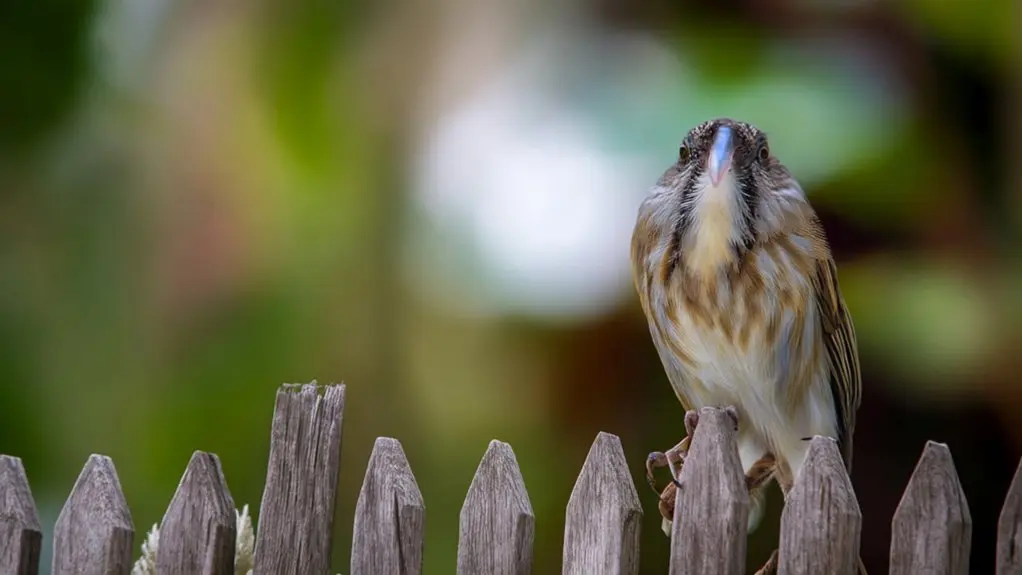
You might see birds clearly, but they view you through a sharper, broader spectrum, including ultraviolet light invisible to you. Their nearly panoramic vision and high cone cell density let them detect your movements and subtle color shifts quickly.
Birds can recognize intricate patterns and respond to contrasting colors on your clothing. Lighting and sudden movements influence their reactions, often triggering alertness or curiosity.
Understanding these visual nuances helps you respect their space and behavior. Explore how their vision shapes these interactions further.
How Birds’ Vision Differs From Humans
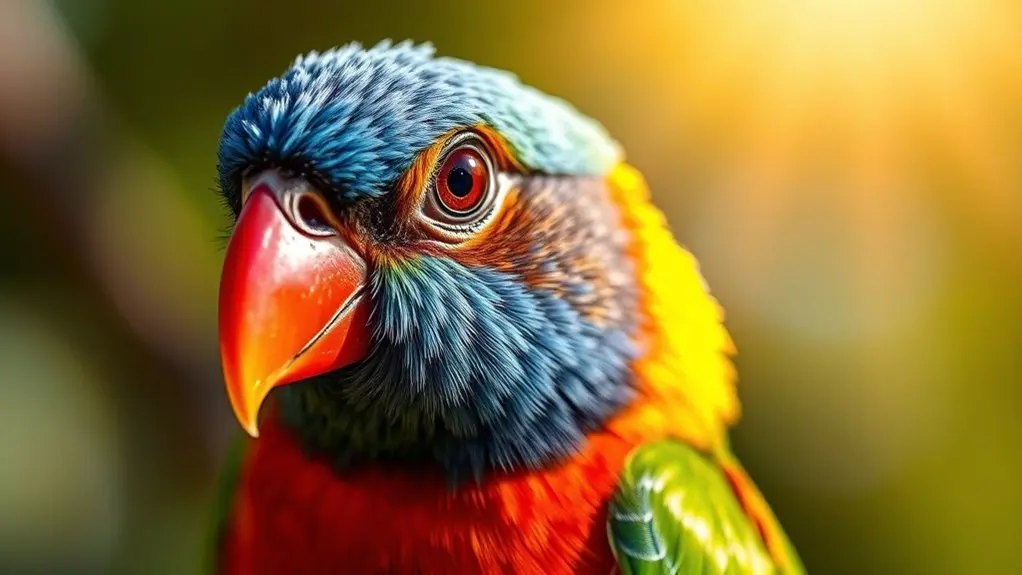
How exactly do birds see the world differently from you? Their eye structure is uniquely adapted to process a broader color spectrum, including ultraviolet light invisible to humans. You might notice that birds have four types of color receptors, compared to your three, enabling them to perceive hues you can’t even imagine.
Their eyes are positioned on the sides of their heads, which gives them a nearly panoramic field of view. The density of cone cells in their retinas is higher, so they detect movement and subtle color changes much faster and more accurately than you can.
Plus, birds perceive polarized light, a feature you don’t have, which helps them navigate and find food.
This intricate eye structure fundamentally changes how birds interpret their surroundings compared to your vision. It’s pretty amazing when you think about how different their world must look!
How Well Birds See Humans Near and Far
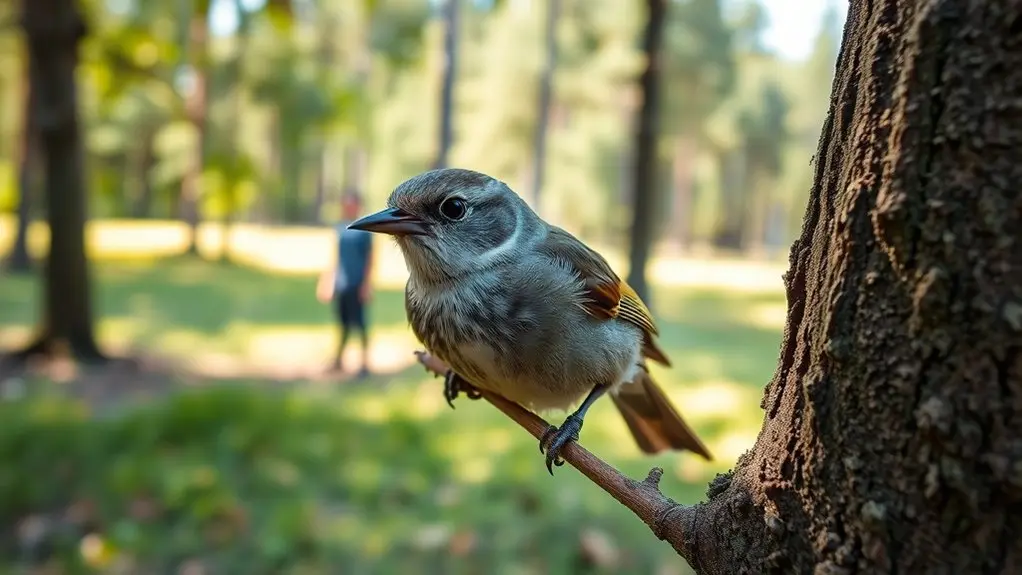
Although birds’ vision varies widely among species, many can see humans with remarkable clarity both near and far. Their advanced eye anatomy, including a high density of light-sensitive cells, allows birds to detect fine details even at great distances.
Feather structure also plays a role by minimizing glare and enhancing visual contrast. Side-positioned eyes grant a broad field of view, which is crucial for spotting humans and other threats. Raptors, in in particular, exhibit superior long-distance vision, capable of identifying prey or humans hundreds of meters away.
| Vision Aspect | Description |
|---|---|
| Near Vision | Clear, detailed view of humans close by |
| Far Vision | Varies; exceptional in raptors |
| Eye Anatomy | High cell density enhances acuity |
| Feather Structure | Reduces glare, improves contrast |
| Field of View | Wide due to lateral eye placement |
How Lighting, Movement, and Color Influence Bird Vision
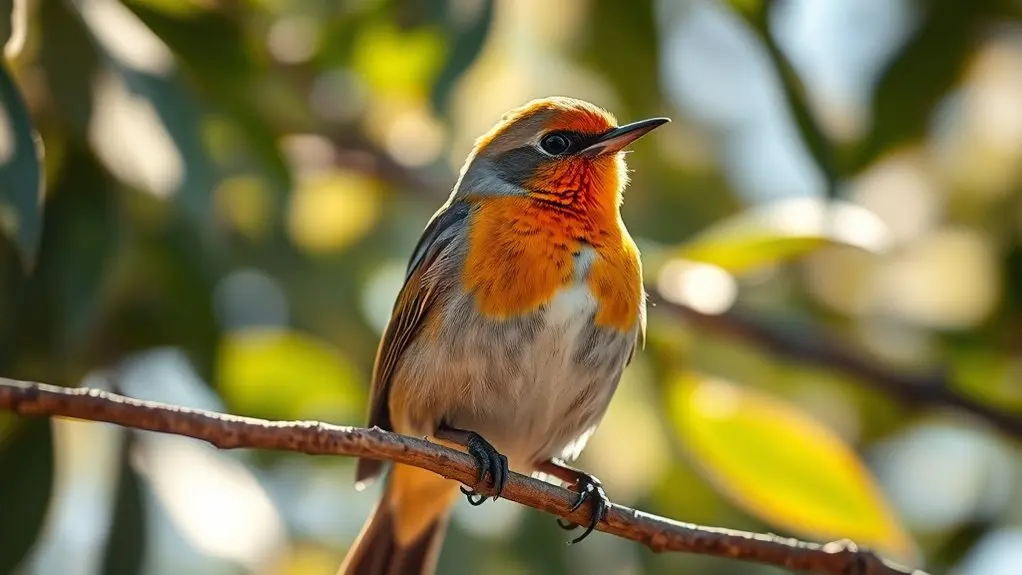
You’ll notice that lighting conditions dramatically shape how birds perceive their surroundings. This is especially true since many species see well in low light or twilight.
Their advanced color receptors let them detect hues, including ultraviolet patterns that are invisible to you. Because of this, certain colors stand out more vividly to them.
Movement, combined with these lighting and color cues, sharpens their ability to spot even slight changes in their environment.
Impact Of Lighting Conditions
When lighting shifts abruptly from bright sunlight to shadow or dusk, birds rely heavily on their advanced visual systems to interpret these changes. Their visual sensitivity allows them to detect subtle lighting nuances, which directly influence how they perceive movement and discern objects, including humans.
In bright daylight, birds excel at spotting rapid motion, but in dim or uneven lighting, their acuity diminishes. This makes it harder for them to track you accurately.
Shadows cast by your movements can trigger startle responses as they interpret these sudden contrasts as potential threats.
Also, some species perceive ultraviolet light, meaning changes in lighting impact their environment perception beyond human capabilities. Understanding these lighting effects can help you predict when birds are most aware of your presence.
Role Of Color Perception
Because birds possess four types of color receptors, including those sensitive to ultraviolet light, their perception of color extends far beyond human capabilities.
You’ll notice their color sensitivity allows birds to detect subtle shifts in hue and brightness, especially under bright lighting conditions.
Their ultraviolet perception reveals patterns on animals and objects invisible to you. This influences how they interpret their environment and recognize humans.
Movement further enhances their vision; even slight changes in color or motion can catch their attention quickly.
However, fluctuating lighting, such as glare or shadows, can alter color perception and motion detection. This impacts their ability to identify you from a distance.
Understanding these factors clarifies how birds rely on a complex interplay of color sensitivity, ultraviolet perception, and movement to navigate and interact with their surroundings.
Why Birds Notice Colors and Patterns on You
Although humans may not always realize it, birds perceive colors and patterns on you with remarkable detail. Their vision surpasses ours, detecting a broader spectrum, including ultraviolet light. This lets them discern subtle nuances in your clothing’s feather patterns or beak coloration if you wear accessories mimicking these features.
Birds see colors and patterns with extraordinary detail, including ultraviolet hues beyond human vision.
Birds use this sharp eyesight to identify specific colors and complex patterns, such as stripes or spots. This helps them recognize individuals or potential threats from a distance.
Bright or contrasting colors on you can either attract or repel them, depending on the species.
This sensitivity to vivid hues and precise pattern recognition plays a vital role in their interaction with humans. They evaluate your presence visually before deciding how to respond.
How Birds React Visually to Human Presence
Since birds primarily perceive humans as large, unfamiliar shapes, their initial visual reaction often ranges from cautious curiosity to alarm. Their exceptional visual acuity enables them to detect human presence from hundreds of meters away.
You should know that birds’ perception extends beyond visible light, including ultraviolet, revealing feather colors and patterns invisible to you, which influence their response.
Movement also plays a critical role.
Here’s how birds typically react:
- Sudden motions trigger flight or heightened alertness.
- Slow, steady movements may provoke curiosity rather than fear.
- Repeated harmless encounters cause habituation and reduced alarm.
- Bright or contrasting feather colors on you can intensify their vigilance.
Understanding these visual cues clarifies how birds interpret your presence in their environment.
What Understanding Bird Vision Teaches Us About Respecting Their Space
When you understand that birds perceive the world through highly developed vision, including ultraviolet wavelengths invisible to humans, you gain insight into how your presence affects them. This advanced sight contributes to their territorial awareness, enabling birds to detect even subtle movements and changes in their environment.
Sudden human motions or loud noises can disrupt bird communication, signaling threats and triggering stress responses. To respect their space, you must minimize abrupt actions and maintain a respectful distance. This allows birds to carry out natural behaviors undisturbed.
Minimize sudden movements and loud noises to avoid disrupting bird communication and stress responses.
Recognizing their wide visual fields and depth perception helps you avoid unintentionally invading their territory. By appreciating these visual capabilities, you foster coexistence that respects bird communication patterns and territorial boundaries.
Ultimately, this supports their well-being and habitat stability.
Frequently Asked Questions
Do Birds Recognize Individual Humans by Sight?
Yes, birds recognize individual humans by sight using bird recognition and visual memory. You’ll find they distinguish facial features and clothing, recalling specific people.
This influences their behavior based on past interactions and experiences with you. It’s pretty cool how they remember who’s friendly and who’s not. So, next time you see a bird acting differently around someone, it might just be because they recognize that person!
Can Birds See Humans at Night or in Low Light?
You know birds’ night vision can be up to ten times more sensitive than yours, but their visual acuity drops in low light.
Do Different Bird Species Vary in How Well They See Humans?
Yes, bird eyesight varies widely. You’ll notice avian perception differs between species like hawks, which have sharp vision, and smaller birds. This affects how clearly they see you depending on their visual acuity and environmental factors.
How Does Bird Vision Affect Their Ability to Find Food Near Humans?
You might think birds have X-ray vision, but their sharp eyesight lets them spot food near humans despite urban camouflage. Their predator detection helps them quickly differentiate between threats and tasty scraps in busy human environments.
Birds are really good at noticing even small movements or unusual shapes around them. This means they can find food that humans might overlook. Plus, their quick reactions keep them safe while they’re foraging close to people.
Are Birds Affected by Human-Made Visual Distractions Like Screens or Lights?
Yes, birds are affected by human-made visual distractions like screens and lights. You’ll notice these interfere with avian camouflage.
Combined with urban noise, they disrupt birds’ natural behaviors, navigation, and communication. This often causes confusion and stress.
Conclusion
When you step outside, remember you’re not just a passerby. You’re a vibrant beacon in a bird’s intricate world of color and motion. Their sharp vision is tuned to detect even subtle shifts in light and pattern. This symbolizes nature’s delicate balance between observer and observed.
By understanding how birds see you, you honor their space. It’s like fostering a silent dialogue where respect replaces disturbance. And in this exchange, coexistence takes flight in the shared spectrum of life.