
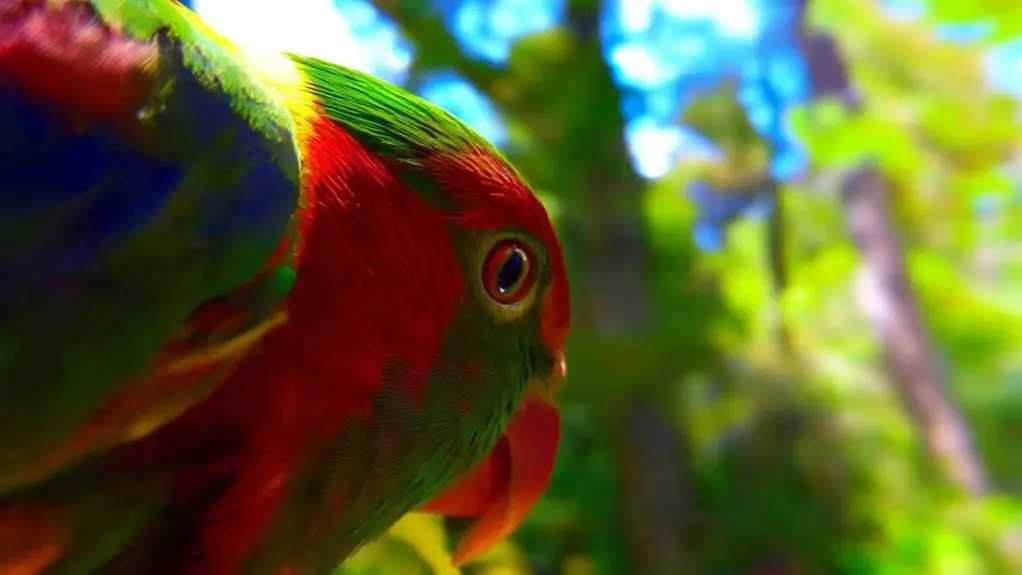
Yes, birds can see in color, but their vision goes far beyond what you experience. They have four types of cone cells, including ultraviolet-sensitive ones, allowing them to detect colors humans can’t, like UV reflections. Tiny oil droplets in their eyes filter light precisely, sharpening color distinction and enhancing visual acuity.
This complex system helps birds navigate, find food, and choose mates. It’s pretty amazing how all these adaptations work together. Explore further to uncover how these features shape their behavior and survival.
Why Birds Have More Cone Types for Better Vision
Although humans rely on three types of cone cells to perceive color, birds have evolved an additional ultraviolet-sensitive cone, giving them four distinct types. This cone diversity markedly enhances their ability to discriminate colors in the environment.
Each cone type responds to specific wavelengths, and the inclusion of the UV-sensitive cone expands the spectrum birds can detect beyond human visual limits.
Furthermore, oil droplets present in these cones act as filters, fine-tuning the wavelengths that reach the photoreceptors. This filtering sharpens color discrimination, allowing birds to perceive subtle differences in hues and patterns that would otherwise appear indistinguishable.
The result of this advanced cone diversity is superior visual acuity and a more complex perception of color. This is vital for tasks like foraging, mating, and navigation in their daily life.
Pretty amazing how evolution fine-tuned their vision to help them thrive!
How Birds See Colors Beyond Human Vision
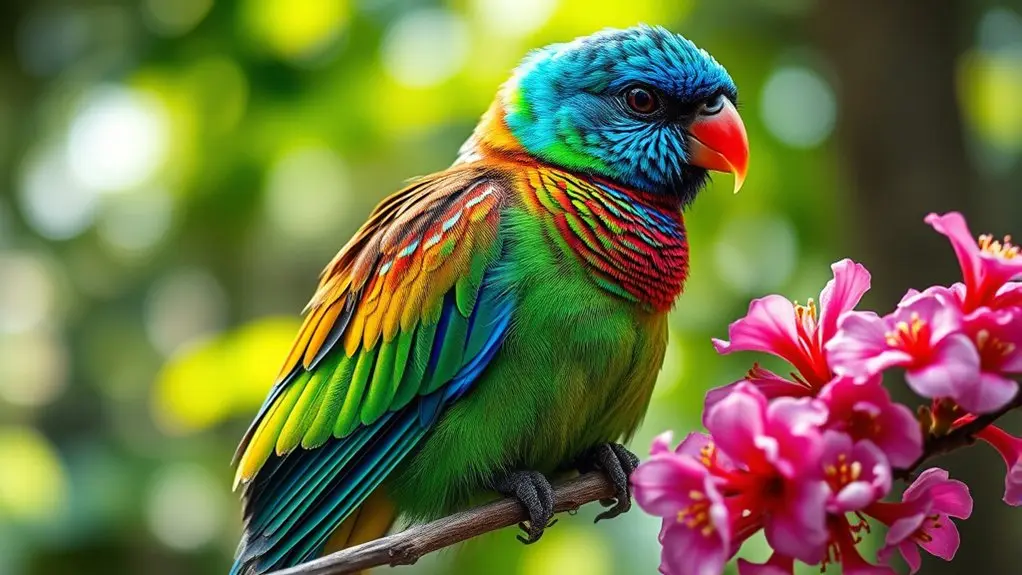
When you observe a bird’s vibrant plumage or watch it forage, you’re witnessing a visual world far richer than what your eyes can detect. Birds possess tetrachromatic vision, including an ultraviolet-sensitive cone that extends their color perception beyond the human spectrum.
This adaptation enhances their visual acuity, allowing them to discern subtle color differences invisible to you, such as the ripeness of berries or the presence of insects.
Their ability to perceive ultraviolet markings on feathers plays a critical role in mate selection, signaling health and core qualities.
This expanded color perception sharpens navigation and social interactions, making their environment appear more vivid and detailed.
Fundamentally, birds experience a spectrum of colors and visual nuances that surpass human capability, fundamentally altering their interaction with the world.
It’s pretty amazing how much more they see compared to us, right?
How Ultraviolet Light Expands Bird Color Perception
You actually have a fourth type of cone in your eyes that picks up ultraviolet light—a range that’s invisible to most humans.
This UV sensitivity really broadens your color perception. It lets you notice subtle variations and patterns that others just can’t see.
Ultraviolet Cone Function
Because most diurnal birds have a fourth type of cone cell sensitive to ultraviolet (UV) light, they see a broader spectrum of colors than we do. This UV cone lets them detect UV reflection, showing off intricate feather patterns that are invisible to our eyes.
Specialized oil droplets inside these cone cells filter incoming light, which sharpens their ability to tell UV wavelengths apart from visible colors. This refined perception helps birds pick up on subtle environmental cues, like UV-reflective plumage that signals mate quality or ripe fruit glowing under UV light.
Expanded Color Spectrum
How exactly does ultraviolet light broaden a bird’s color perception? Birds have a unique fourth cone cell that’s sensitive to UV light. This means their visible spectrum goes beyond what we humans can see.
This expanded color perception sharpens their visual acuity. It lets them spot UV-reflective markings on feathers and fruits that are invisible to us. Those markings are super important for mate selection because they signal health and fitness.
They also help when birds are foraging by showing ripeness or where prey might be hiding. Plus, many bird species can see UV reflections from insects, which makes hunting way easier.
The combo of UV-sensitive cones and special oil droplets in their eyes boosts their color discrimination and detail. This gives birds a richer, more vibrant view of their surroundings than what we experience.
Basically, this expanded spectrum changes how birds interact with their world.
How Oil Droplets Help Birds See More Colors
Although birds rely on specialized cone cells for color vision, their ability to perceive an expanded range of colors hinges on tiny oil droplets within these cells. These droplets contain carotenoid pigments that enhance color filtering by selectively absorbing specific wavelengths, sharpening spectral distinctions. This refined filtering boosts visual acuity, allowing you to discern subtle differences in hues, such as between ripe and unripe fruit or slight feather variations.
The diversity in oil droplet coloration broadens the spectrum birds can detect, including ultraviolet light invisible to humans. By improving spectral separation, oil droplets enable birds to see a more vivid, detailed world with heightened color discrimination. This supports tasks essential for survival and communication.
How Bird Eye Anatomy Supports Their Color Vision
When you examine a bird’s eye, you’ll notice it’s uniquely structured to maximize color detection and visual acuity. The retina contains a high density of cone cells, including an extra ultraviolet-sensitive cone, enabling birds to perceive colors beyond human capacity.
Tiny oil droplets within these cones filter specific wavelengths, enhancing spectral discrimination. This is crucial when interpreting feather coloration for mating or camouflage.
Tiny oil droplets fine-tune color perception, vital for decoding feather hues in mating and camouflage.
The variation in oil droplet pigmentation, influenced by carotenoids, sharpens this filtering. Additionally, the eye’s flattened shape and specialized lens placement optimize focus and color detection across the visual field.
This precise anatomy not only helps birds identify vibrant plumage but also supports migration navigation by detecting subtle environmental cues.
These adaptations ensure accurate orientation over vast distances. Together, they empower birds with extraordinary color vision. Pretty amazing how their eyes work, right?
How Owl Vision Differs From Other Birds’ Vision
You’ll notice that owls rely heavily on rod cells. These cells dominate their retinas and give them exceptional sensitivity in low-light conditions.
Unlike many birds that have multiple cone types for detecting color, owls trade off color vision to boost their night sight.
Their eye structure also includes a reflective layer called the tapetum lucidum, which helps them capture more light. However, this comes at the cost of limiting their ability to see a wide range of colors.
Nocturnal Adaptations
Because owls hunt primarily at night, their vision has evolved distinct adaptations that set them apart from diurnal birds. You’ll notice owls rely less on color and more on enhanced light sensitivity for nocturnal navigation. Their large eyes gather more light, and the tapetum lucidum reflects it to amplify vision in darkness.
Unlike other birds, owls lack UV-sensitive cones, limiting color perception but improving low-light detection. This adaptation supports camouflage strategies, allowing owls to blend into their environment unseen while hunting.
| Adaptation | Function | Emotional Impact |
|---|---|---|
| Large eyes | Maximize light intake | Awe at nature’s design |
| Tapetum lucidum | Amplifies dim light | Fascination with night vision |
| Rod cell density | Enhances sensitivity, no color | Respect for survival skills |
| Neural processing | Prioritizes movement detection | Wonder at sensory precision |
| Lack of UV cones | Limits color but aids stealth | Curiosity about trade-offs |
Rod Cell Dominance
Although many birds rely heavily on cone cells to perceive vibrant colors, owls’ vision prioritizes rod cells to excel in low-light conditions. Their retinal cone distribution is minimal, and they lack UV-sensitive cones found in other species. This restricts their color perception quite a bit.
Instead, owls have a remarkable density of rod cells that enable exceptional nocturnal vision. This rod dominance really boosts their ability to detect motion and shapes in near darkness, which is essential for night hunting.
Key features of owl rod cell dominance include:
- High rod-to-cone ratio emphasizing light sensitivity over color discrimination
- Large corneas and tapetum lucidum that amplify available light
- Retinal adaptations optimized for motion detection rather than color perception
You’ll notice this specialization makes owls outstanding nocturnal predators but limits their ability to see vibrant colors like diurnal birds. So, while they’re amazing at seeing in the dark, colorful scenes just aren’t their thing.
How Bird Color Vision Influences Their Behavior
When birds rely on their advanced color vision, including the ability to detect ultraviolet (UV) light, they gain essential advantages in their daily behaviors. Feather signaling plays a fundamental role, as UV-reflective markings on feathers communicate health and fitness to potential mates, influencing reproductive success. You’ll notice these visual cues shape social interactions and mate selection profoundly.
Additionally, birds use color vision to interpret migration cues. Subtle changes in the environment’s color spectrum help them navigate and time their journeys accurately. Detecting UV-reflective fruits and prey enhances feeding efficiency, while recognizing colorful predators improves survival.
This expanded color perception sharpens your understanding of how birds’ sensory abilities govern critical behaviors, from foraging to migration. It really shows the intricate link between color vision and avian ecology.
Why Understanding Bird Color Vision Matters for Science
Gaining a clear understanding of bird color vision allows scientists to design more effective conservation tools, such as UV-reflective window decals that reduce fatal collisions. By studying avian color perception, you gain insight into how birds use UV markings for communication and mate selection. This reveals evolutionary significance in their visual systems.
This knowledge also helps you interpret their foraging strategies, navigation, and predator avoidance more accurately. Understanding bird color vision matters for science because it advances bird-friendly design innovations to mitigate human-wildlife conflicts. It also illuminates evolutionary adaptations in sensory systems across species.
Plus, it enhances ecological interpretations by differentiating human and avian visual experiences. Such research deepens your grasp of natural selection’s role in shaping vision. This, in turn, informs both conservation and broader biological inquiries.
Frequently Asked Questions
Can Birds See Colors at Night Like They Do During the Day?
You can’t expect birds to see colors at night like they do during the day because their visual acuity relies on rod cells, not cones. Feather pigmentation doesn’t influence night color vision, which diminishes considerably after sunset.
Do Baby Birds Have the Same Color Vision as Adult Birds?
You won’t see a baby bird’s avian vision burst like a sunrise; their color perception starts muted, with fewer cone cells.
Over weeks, their vision sharpens, evolving gradually to match the vibrant spectrum adult birds enjoy.
How Does Bird Color Vision Affect Their Mating Choices?
You’ll see bird color vision enhances mate selection by detecting feather signals like UV-reflective markings. These signals reveal health and genetic fitness, guiding you to choose mates with superior qualities for better reproductive success.
It’s pretty fascinating how birds pick up on colors we often can’t see. This ability gives them an edge when it comes to spotting the best potential partners. So, they’re not just looking for pretty feathers—they’re reading important biological cues.
Can Birds Recognize Human-Made Colors and Patterns?
Birds can recognize human-made colors and patterns because their visual spectrum goes beyond ours, including ultraviolet light. This means they see a whole range of colors we can’t even imagine.
Feather coloration plays a vital role in how they perceive the world. It’s like saying, “a picture is worth a thousand words” but in their more detailed way.
Are There Differences in Color Vision Between Domesticated and Wild Birds?
You won’t notice major differences in visual acuity between domesticated and wild birds. But selective breeding affects feather pigmentation, which can influence how domesticated birds perceive colors compared to their wild counterparts.
It’s pretty interesting how changes in feather color might actually change color perception. So, even if their eyesight sharpness is similar, what they see might not be exactly the same.
Conclusion
So, yes, birds see colors you can only dream of, literally beyond your human spectrum. While you’re stuck with three cone types, birds juggle four or more, plus UV vision, and fancy oil droplets acting like natural Instagram filters.
Their eye anatomy is basically a high-tech color lab. Even owls, the night vision pros, play by different rules.
Understanding this colorful superpower isn’t just birdwatching fluff—it’s science peeking behind nature’s kaleidoscope. Who knew feathers held such visual secrets?