
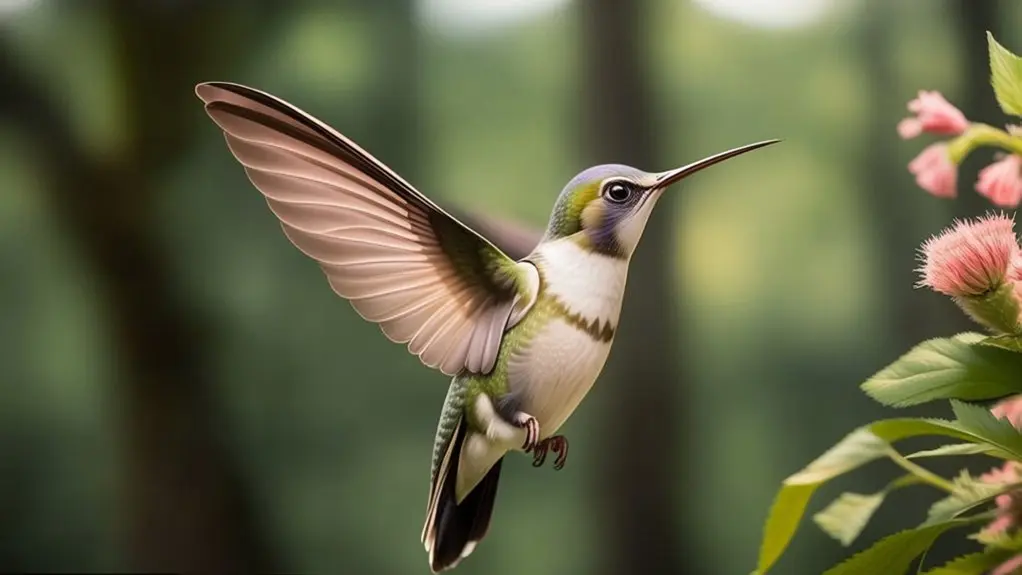
You might think all birds can hover, but most can’t fly in place because their wing structure and muscle power favor forward flight. Only a few, like hummingbirds, flap their wings rapidly in a figure-eight pattern to create lift on both strokes. This lets them hover precisely.
Ducks and pigeons use powerful pushes from wings and legs to lift vertically but don’t truly hover. It’s pretty interesting to see the difference in how birds manage to stay in the air.
Discover which wing shapes and motions make hovering possible and why most birds rely on forward momentum. There’s a lot more going on with bird flight than you might realize!
How Do Birds Generate Lift to Fly Up and Forward?
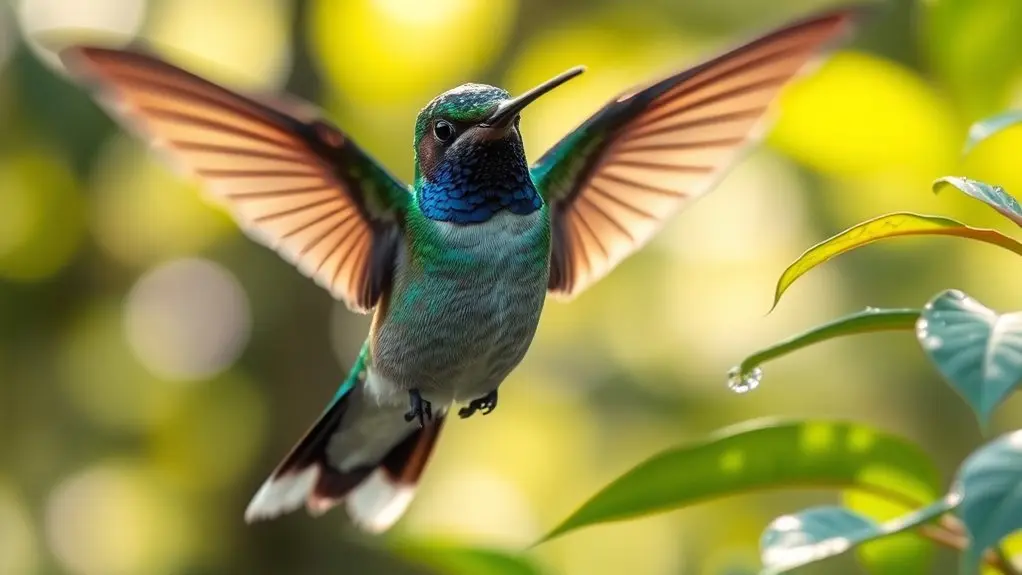
Although you mightn’t notice it, birds generate lift by manipulating the air pressure around their wings. Their wing feathers are finely adapted to optimize airflow, creating faster-moving air over the curved upper surface and slower air below. This difference in airspeed establishes a pressure difference that produces lift.
This feather adaptation is essential, especially for migratory behavior. Efficient lift and thrust generation enable long-distance travel. As you watch, birds adjust their wing shape and angle dynamically during flapping.
They deflect air downward to produce an upward reaction force. Their lightweight bones and powerful chest muscles provide the necessary force to sustain this lift.
The downward and forward wing motion not only lifts but also propels them forward. This ensures effective flight during migration and daily activity. It’s pretty amazing how their bodies are built for both power and efficiency.
Watching birds in flight is like seeing nature’s perfect engineering in action.
What Physical Features Help Birds Fly Straight Up?
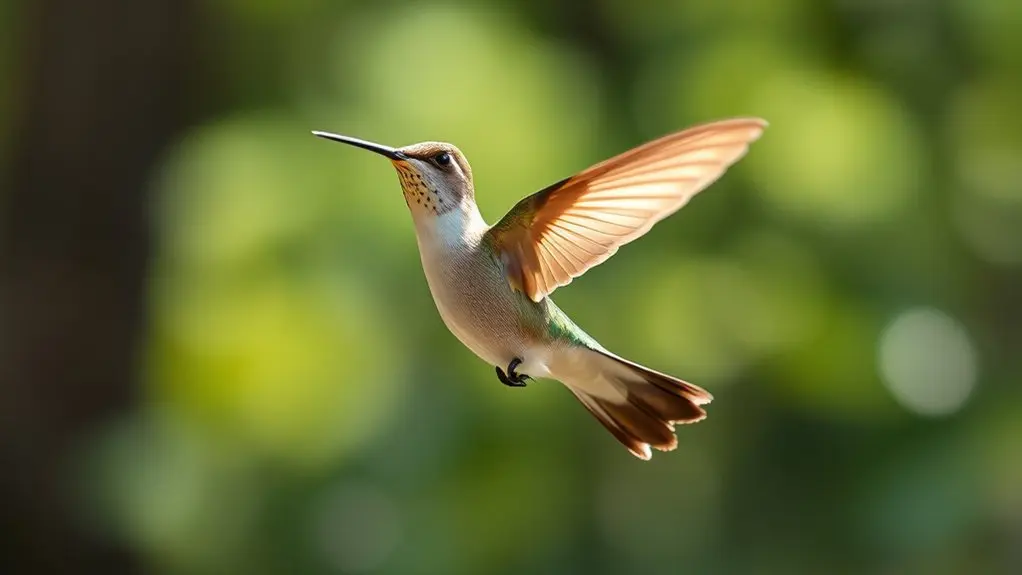
The ability of birds to generate lift and thrust during forward flight sets the stage for understanding how some species can fly straight up. Physical features such as lightweight, hollow bones reduce overall mass, enabling rapid vertical ascent. Large breast muscles power continuous wing flapping, with wing shape and angle adapted to produce lift on both downstroke and upstroke.
For example, hummingbirds’ wing mechanics allow them to hover and ascend vertically. Some birds, like pigeons, combine strong leg pushes with wing strokes to lift straight up.
Surprisingly, feather coloration sometimes correlates with nesting behaviors. Birds with vibrant feathers often use vertical flight to reach high nesting sites safely.
These precise adaptations collectively enable vertical flight by optimizing lift, thrust, and energy efficiency.
Why Can’t Most Birds Hover or Fly in Place?
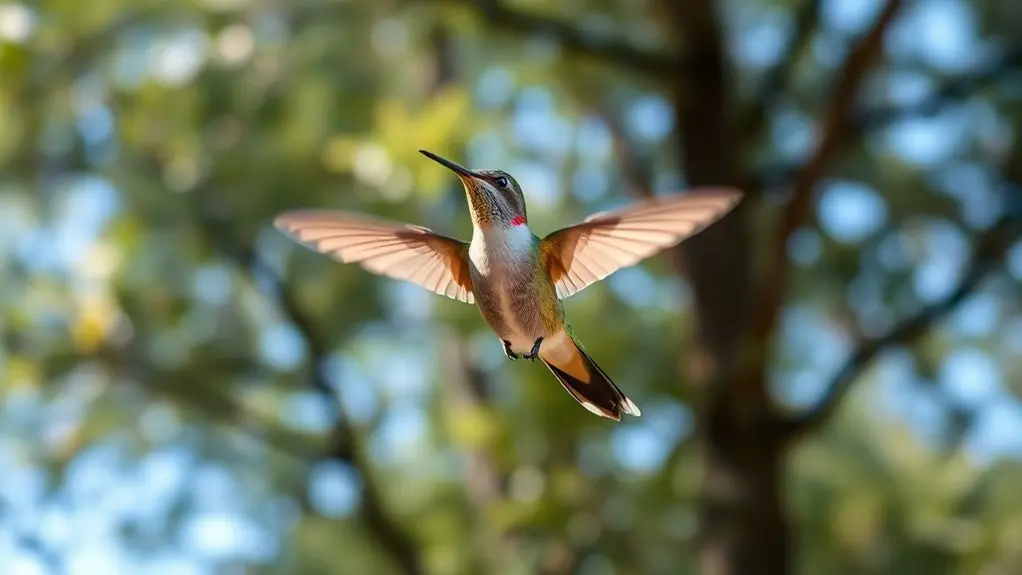
You can’t really expect most birds to hover because their wings and muscles just aren’t built for staying still in the air.
Unlike hummingbirds, which flap their wings super fast and create lift on both the up and down strokes, most birds need to keep moving forward to stay up.
Wing Structure Limitations
Since most birds have wing structures optimized for forward flight, they can’t hover or fly in place like hummingbirds do. Their wings lack the joint flexibility required for the rapid, figure-eight wing strokes essential to hovering. Feather flexibility also plays a role.
Hummingbirds possess highly adaptable feathers that adjust dynamically to airflow, enhancing lift during stationary flight.
In contrast, typical bird feathers are structured to maximize lift during forward motion. This limits their ability to generate sufficient lift without forward speed.
Interestingly, beak shape indirectly influences flight style. Species with streamlined beaks tend to favor fast, forward flight, which aligns with wing designs unsuited for hovering.
Muscle Power Requirements
Although many birds have strong wing muscles for flight, they don’t have the specialized muscle power needed to hover in place. Hovering requires continuous, rapid wingbeats and immense pectoral muscle strength, which most birds just don’t have.
Feather adaptations and flight speed also play a role. Faster flight tends to favor gliding over hovering because of energy limits.
Hummingbirds are unique in this way. They can generate enough muscle power to flap up to 80 times per second. The high energy cost and oxygen demand make sustained hovering impossible for most species.
| Bird Type | Wingbeat Frequency (Hz) | Muscle Adaptation |
|---|---|---|
| Hummingbird | 70-80 | Highly developed pectorals |
| Sparrow | 10-15 | Moderate muscle strength |
| Eagle | 5-7 | Strong muscles, low frequency |
| Pigeon | 10-12 | Balanced muscle and feather design |
| Albatross | 1-3 | Adapted for gliding, less muscle power |
Takeoff and Lift Differences
When a bird takes off, it needs to generate enough lift to overcome gravity, which usually means it has to keep moving forward. Most birds use their wing structure and feather adaptations to create this lift while flying ahead.
Their feathers are made to maximize airflow efficiency during forward flight, but they don’t support the quick, multidirectional wing strokes needed for hovering.
Unlike hummingbirds, whose special feathers and wing joints let them flap up to 80 times per second and hover in place, typical birds just can’t produce enough lift without moving forward.
Also, the beak’s role in aerodynamics is pretty minor. Its shape is more about feeding than helping with flight mechanics.
All in all, birds’ muscles and skeletons are built for taking off and flying forward. This setup limits their ability to hover or fly in place.
Which Birds Can Hover or Take Off Vertically?
You’ll notice hummingbirds can hover in place by flapping their wings super fast—up to 80 times per second! They also keep their bodies tipped up just right to get the best lift.
Ducks like wigeons and mallards, on the other hand, take off vertically in a different way. They slap their wings on the water while pushing off with their tail feathers to launch straight up.
Then there are pigeons. They manage vertical takeoff by coordinating strong wing beats with pushes from their feet when they launch off a perch. It’s pretty cool how different birds have their own special tricks for vertical flight!
Hummingbird Vertical Flight
How do hummingbirds manage to hover effortlessly in midair and take off vertically without any runway? Their secret lies in rapid wing beats, up to 80 times per second, combined with specialized feather adaptations.
Unlike typical birds, hummingbirds generate lift on both the downstroke and upstroke, which allows stable hovering.
Their body tilts upward, positioning wings parallel to the ground to optimize vertical lift. This setup means they don’t need to run or jump to take off. Pretty cool, right?
These feather adaptations, along with high-frequency wing beats, ensure remarkable energy efficiency even though their muscles work really hard.
Duck Vertical Takeoff
Ever wondered which birds can take off vertically without a running start? Puddle ducks, such as mallards and teals, uniquely achieve this by combining feather adaptations with beak functionality to aid in stability and direction.
Key aspects of duck vertical takeoff include:
- Powerful wing slaps against water generate upward thrust.
- Tail feathers push against the water surface, enhancing lift.
- Feather adaptations reduce drag, allowing efficient vertical ascent.
- Beak functionality assists in maintaining balance during takeoff.
This vertical lift mechanism enables puddle ducks to launch directly upward from aquatic environments, escaping predators swiftly. Unlike other duck species, their specialized wing and tail feather coordination supports this unique takeoff style.
They shift smoothly from vertical to horizontal flight once airborne.
Pigeon Lift Techniques
Although pigeons can’t hover like hummingbirds, they achieve vertical takeoff through a precise combination of wing flapping and strong leg pushes against their perch or the ground.
You’ll notice their feather ergonomics optimize airflow and lift generation during powerful downward wingbeats. Their robust wing muscles coordinate with rigid, streamlined feathers to maximize thrust.
At the same time, their legs provide a forceful push, propelling them vertically. Interestingly, while their beak functions primarily in feeding, its streamlined shape also contributes minimally to aerodynamic efficiency during takeoff.
Unlike true hovering species, pigeons rely on this coordinated wing-foot synergy to lift off from a standing position.
Understanding pigeon lift techniques reveals how subtle anatomical adaptations enable vertical flight without hovering, emphasizing precise biomechanical integration rather than specialized hovering muscles.
It’s pretty fascinating how these birds manage vertical lift without the fancy hovering skills some other birds have.
What Makes Hummingbirds Special for Flying Straight Up?
Because hummingbirds flap their wings up to 80 times per second, they generate continuous lift on both the downstroke and upstroke. This lets them fly straight up with remarkable precision. You’ll notice their wing muscles are finely tuned for exact control, allowing vertical ascent without jumping.
Hummingbirds achieve precise vertical flight by generating continuous lift with rapid, finely controlled wing beats.
Their body tips upward, aligning wings parallel to the ground to maximize lift. This unique method differs from typical bird flight patterns.
Key features include:
- Rapid, sustained wing beats create helicopter-like hovering.
- Lightweight, streamlined bodies reduce air resistance.
- Powerful chest muscles support intense wing flapping.
- Feather coloration often signals health, helping attract mates and boost nest-building success.
These adaptations make hummingbirds exceptional at vertical flight. It’s a perfect mix of physics and biology working together.
Which Ducks Can Take off Vertically From Water?
How do some ducks manage to take off vertically from water? Certain puddle ducks like wigeons, pintails, mallards, and teals use specialized feather adaptations that enable a powerful water propulsion launch. They slap their wings against the water surface while simultaneously pushing off with their tail feathers.
This coordinated action generates enough thrust to propel their bodies straight up before shifting to forward flight. Not all duck species possess these adaptations. It’s specific to puddle ducks that require rapid escape mechanisms from predators.
The combination of wing slapping and tail feather push-off maximizes water propulsion, allowing a near-vertical lift-off. This precise biomechanical strategy highlights how feather structure and movement integrate to overcome water resistance and achieve vertical takeoff directly from the water’s surface.
How Do Pigeons Use Wings and Feet to Launch?
When pigeons prepare to take off, they coordinate powerful wing flaps with a strong push from their feet against the perch or ground. This synergy between wings and feet shows just how advanced their flight mechanics are. Their feathers are specially adapted to help generate lift as the wings flap vigorously.
Here’s how they launch:
- Feet push forcefully against the surface, giving that initial thrust.
- Pigeons do a slight vertical jump to add momentum.
- Wings flap rapidly, creating upward lift by positioning their feathers just right.
- The combined force beats gravity, letting them lift off vertically.
You’ll notice their feet act like a powerful boost, while their feather setup optimizes aerodynamic efficiency. This precise coordination lets pigeons launch straight up from a standing position, showing off some pretty impressive control over flight.
How Do Wing Shape and Flapping Affect Vertical Takeoff?
Although wing shape varies widely among bird species, it plays a crucial role in determining how effectively a bird can achieve vertical takeoff. Birds with broader, rounded wings, like hummingbirds, exploit wing flexibility and feather aerodynamics to generate lift on both downstroke and upstroke.
This dual-lift mechanism allows them to hover and ascend vertically.
Rapid flapping, reaching up to 80 beats per second, optimizes the wing’s angle of attack, efficiently deflecting air downward to produce upward thrust.
Wing flexibility enhances the dynamic adjustment of wing curvature, improving airflow control and lift generation.
Feather aerodynamics, including the precise alignment and spacing of feathers, reduces drag and maximizes lift during each flap.
Together, these factors enable certain birds to lift vertically from a stationary position with remarkable efficiency.
It’s pretty amazing how all these elements work together so seamlessly.
Why Thrust and Pushing Off the Ground Matter Most
Because birds must overcome gravity to take off or hover, generating thrust through wing flapping is vital for creating the forward and upward force needed for flight. You’ll notice that pushing off the ground or a perch adds essential extra force, enabling a more efficient lift.
Without this combined effort, birds can’t achieve vertical takeoff or sustained hovering, which is why thrust and push-off matter most.
Think about it like this: wing-generated thrust propels birds forward and upward, which is key for beating gravity. Then, foot push-off gives an extra boost right at takeoff, making the whole process smoother.
It’s this teamwork between wings and feet that really gets birds airborne.
Also, feather coloration often links to aerodynamic efficiency, which can influence thrust. Migration patterns play a role too because they affect muscle strength, impacting a bird’s ability to generate thrust.
All these factors come together to help birds master the physics of flight.
Frequently Asked Questions
How Long Can Birds Typically Hover in One Spot?
You’ll find that most birds hover briefly, seconds at most. This is influenced by feather coloration and nesting habits tied to energy use.
Only hummingbirds can sustain hovering for up to 30 minutes. That’s thanks to their specialized wing muscles and unique metabolic adaptations. Pretty amazing, right?
Do Birds Use Their Tail Feathers When Hovering?
Yes, you rely on tail coordination and feather structure when hovering. Birds adjust their tail feathers precisely to stabilize, steer, and maintain balance.
They use intricate feather positions to control lift and center of gravity during in-place flight. It’s pretty amazing how they manage to stay so steady in one spot.
Can Environmental Conditions Affect a Bird’s Ability to Hover?
You’ll find environmental conditions sculpt migration patterns and nesting behaviors, as wind and turbulence challenge a bird’s hover. Calm air acts like a steady hand, enabling precise flight control, while harsh weather disrupts their stationary flight.
It’s pretty clear that when the wind picks up, hovering gets a lot trickier for birds. They have to work harder to stay in one spot, which can affect where and when they decide to settle or move on. So yeah, the weather really does play a big role in how birds manage to hover.
How Do Birds Conserve Energy During Hovering?
You conserve energy during hovering by relying on feather adaptations that optimize airflow and enhance lift. These, combined with specialized wing muscles, guarantee high energy efficiency. This lets you sustain rapid wing beats with minimal fatigue.
It’s pretty amazing how these natural features work together so smoothly. Birds don’t just flap their wings wildly—they have a system that makes every movement count. That’s how they manage to hover without burning out quickly.
Are There Any Birds That Hover Underwater?
Yes, diving petrels hover underwater using rapid wing beats to maintain position while hunting. This unique avian adaptation is pretty fascinating. It shows how some birds have evolved to master aquatic environments.
This behavior is quite different from things like bird migration or avian communication. Instead, it highlights specialized flight mechanics underwater. It’s a neat example of how diverse bird abilities can be.
Conclusion
You might think all birds can simply hover or fly in place, but most can’t. They rely on forward motion to generate lift.
Yet, hummingbirds defy this norm by using rapid wing beats and unique muscle control to hover effortlessly. It’s pretty amazing to watch.
Meanwhile, ducks and pigeons combine wing power with ground or water push-offs for vertical takeoff. This shows how specialized anatomy and mechanics dictate each bird’s flight capabilities.
So, vertical flight is really a remarkable exception, not the rule.