
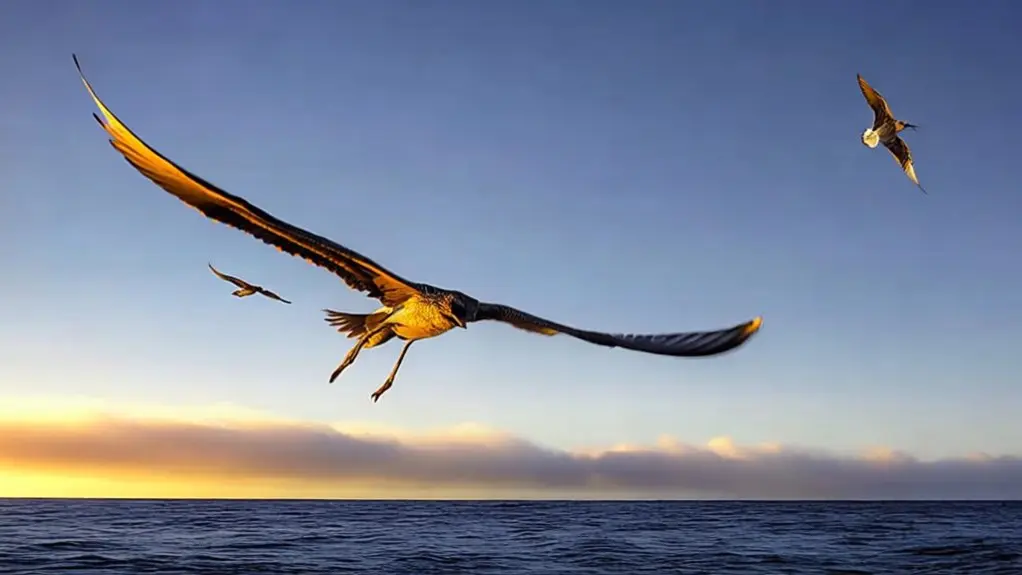
Yes, certain bird species can fly nonstop from Europe to America, covering over 6,000 miles across the Atlantic. Birds like whimbrels, northern shovelers, and Caspian terns rely on innate navigation systems, magnetoreceptors, and environmental cues such as wind patterns and ocean currents to sustain these long migrations.
Their routes often include key stopovers in Greenland and Iceland for rest and refueling. If you want to understand how they manage these feats and the challenges they face, there’s much more to explore.
What Is the Maximum Distance Birds Fly From Europe to America?

Although the maximum distance birds fly from Europe to America varies by species, some migratory birds cover remarkable distances exceeding 6,000 miles. You’ll find that species like the northern shoveler and red-breasted merganser undertake these transoceanic flights, relying on specific adaptations.
Some migratory birds, like the northern shoveler, fly over 6,000 miles across the Atlantic with amazing adaptations.
Their feather coloration plays a crucial role in camouflage and thermoregulation during long flights, optimizing energy efficiency.
Nesting behaviors influence migration timing, as birds must align their arrival with suitable breeding conditions on either continent. For example, precise nesting site selection ensures reproductive success after exhaustive journeys.
Understanding these factors helps you appreciate how evolutionary traits support such extreme migrations.
These adaptations enable birds to traverse vast distances across the North Atlantic Flyway with remarkable endurance and precision. It’s pretty amazing when you think about the challenges they overcome to make these incredible journeys.
Which Bird Species Regularly Migrate From Europe to America?

When you examine transatlantic bird migration, several species stand out for their regular journeys between Europe and America. These birds show distinct migration timing that lines up perfectly with their breeding behaviors, which are really important for their survival.
You’ll find species that breed in Europe and then head over to North America for the winter, showing just how precise their migratory patterns are and how much they depend on seasonal resources.
Some key species include the northern shoveler and red-breasted merganser. These birds breed in Europe and then migrate westward when winter comes.
There’s also the great black-backed gull, which you can find along both coasts, showing continuous movement between the continents.
Then there are the whimbrels, shorebirds known for their long annual migrations between breeding and wintering sites.
The Caspian tern is another interesting one, making extensive flights that connect the two continents.
Key Migration Routes Linking Europe and North America

You’ll find that transatlantic bird pathways mainly involve seabirds and waterfowl migrating between Europe and North America. These species often use ecological corridors and wind patterns to navigate the vast ocean.
Along the way, they make important stopovers in places like Greenland and Iceland to rest.
It’s pretty fascinating how understanding these shared migration routes shows us just how birds manage such extensive journeys across continents. They really have a knack for finding the best paths and resting spots during their long trips.
Transatlantic Bird Pathways
Because some bird species naturally migrate between Europe and North America, transatlantic bird pathways form essential migration corridors across the Atlantic Ocean. These routes take advantage of favorable wind patterns and ecological stopovers like Greenland. This helps species such as northern shovellers and red-breasted mergansers sustain long flights.
Their feather waterproofing is really important. It maintains insulation and buoyancy during oceanic crossings. Plus, flight speed variations help birds adapt to changing weather conditions. This way, they can optimize energy use throughout the journey.
Key features of transatlantic bird pathways include:
- Utilization of island chains and Greenland for rest and refueling
- Adaptation to wind currents to minimize energy expenditure
- Species overlap on both continents, like the Caspian tern and great black-backed gull
- Reliance on feather waterproofing for protection against harsh marine environments
Shared Species Migration
Although the vast Atlantic Ocean separates Europe and North America, several bird species maintain continuous migratory connections between the two continents. Species like northern shovelers and red-breasted mergansers exhibit precise migration timing, traveling between northern Eurasian and North American breeding grounds.
Their breeding behavior adapts to seasonal changes, ensuring reproductive success in distinct but ecologically similar habitats.
You’ll also notice Caspian terns and great black-backed gulls spanning both continents, highlighting their long-distance flight capabilities. These birds link European breeding sites with North American wintering areas, crossing the Atlantic during predictable migration windows.
What Wind Patterns Help Birds Fly From Europe to America?
When migrating from Europe to America, birds rely heavily on prevailing wind patterns to conserve energy during their extensive transatlantic flights. You’ll notice that wind flow and seasonal timing are critical factors influencing their route choices.
Birds take advantage of westerly winds in the mid-latitudes, providing favorable tailwinds for efficient flight.
The jet stream’s high-altitude currents can offer strong assistance depending on altitude and season. Trade winds during specific seasons create favorable conditions for crossing the Atlantic.
Birds also time their departures precisely to coincide with these wind patterns, maximizing energy conservation. It’s pretty amazing how they make the most of nature’s help!
How Do Birds Navigate Long-Distance Europe-to-America Flights?
You rely on innate navigational mechanisms encoded in a bird’s genetics that guide their transatlantic flights without prior experience. Basically, birds are born with a built-in GPS that helps them find their way across the ocean.
They combine different environmental cues, like the position of the stars, the Earth’s magnetic field, and even geographic landmarks when they can see them. This mix of signals helps them stay on the right path over such long distances.
These adaptations have evolved over time to fine-tune their ability to sense changes in the atmosphere. In the end, it’s this incredible natural toolkit that ensures they can successfully navigate from Europe to America.
Innate Navigational Mechanisms
Because birds rely on a combination of innate magnetic compass senses and celestial navigation, they can accurately orient themselves during long-distance flights from Europe to America.
You’ll find that many migratory birds inherit genetically programmed routes, enabling them to navigate without prior experience. Their magnetic orientation allows them to detect Earth’s magnetic field, while celestial navigation uses the sun’s position to maintain direction.
These mechanisms are hardwired, ensuring young birds succeed on their first migration.
Key innate navigational features include:
- Detection of Earth’s magnetic field for directional cues
- Use of sun positioning for precise celestial navigation
- Genetically encoded migratory routes guiding transoceanic flights
- Innate behaviors refined by environmental input to enhance accuracy
Together, these mechanisms enable reliable, long-distance navigation across the Atlantic.
Environmental Cues Utilized
Although innate orientational mechanisms provide a foundational sense of direction, birds also rely heavily on environmental cues to successfully complete long-distance flights from Europe to America.
Magnetic orientation allows them to detect Earth’s magnetic field, acting as a natural compass for precise orientation during transatlantic journeys.
Celestial cues, including the sun’s position during the day and stars at night, help maintain accurate bearings over vast oceanic expanses where landmarks are absent.
Additionally, birds respond to seasonal photoperiod changes, signaling when to begin migration and influencing directional decisions.
They integrate olfactory signals and environmental factors such as wind patterns and ocean currents, optimizing flight efficiency.
Evolutionary Adaptations Explained
When traversing the vast expanse between Europe and America, birds rely on evolutionary adaptations that finely tune their sensory and physiological systems for long-distance flight. Genetic adaptations have embedded innate navigation programs, enabling species like the Caspian tern to execute precise transatlantic journeys.
Sensory enhancements include magnetoreceptors in the brain, allowing birds to detect Earth’s magnetic field for accurate orientation. These adaptations work in concert with environmental cues and strong flight endurance, ensuring survival over immense distances.
Genetic adaptations encode migratory instincts and timing. Magnetoreceptors permit magnetic field detection for navigation.
Directional instincts guide alignment with sun and celestial cues. Physiological endurance supports sustained flight over oceanic flyways. Together, these traits optimize navigation and energy efficiency during Europe-to-America flights.
How Climate and Weather Affect Transatlantic Migration
If you want to understand how birds manage the challenging transatlantic journey, you need to take into account the critical role of climate and weather. Weather variability directly influences migration timing and route selection, as birds rely on favorable wind currents to optimize energy efficiency.
For instance, advantageous jet stream conditions can substantially lower energy expenditure, enhancing survival rates during the crossing.
However, extreme weather events like storms or hurricanes disrupt these routes, causing delays or mortality. Additionally, climate change alters wind patterns and temperature regimes, shifting traditional migration timing and routes.
This shifting variability means birds must continuously adjust their journey strategies to cope with evolving atmospheric conditions.
It’s pretty fascinating how this shows the dynamic interaction between avian navigation and the atmospheric environment during transatlantic migration. Birds really have to be flexible and responsive to what the weather throws at them.
Challenges Birds Face Flying From Europe to America
Understanding how weather and climate influence bird migration helps reveal the many challenges birds face when flying from Europe to America. You’ll see that bird orientation and wind assistance are vital, yet not always reliable because of unpredictable weather and vast ocean crossings.
Birds have to manage their energy and direction expertly over thousands of kilometers without frequent rest stops. On top of that, human-made structures increase collision risks, making their journey even more complicated.
Key challenges include:
- Orienting across extensive open ocean stretches with limited landing options
- Facing strong wind patterns and storms that disrupt wind assistance
- Crossing multiple ecological barriers that require precise bird navigation
- Avoiding collision hazards from tall buildings, wind turbines, and communication towers
All these obstacles mean birds need exceptional physiological and navigational adaptations to succeed in their transatlantic migration. It’s pretty amazing how they manage it!
How Ancient Migration Patterns Shaped Transcontinental Flights
Since ancient times, birds have developed complex migration patterns that span continents, including transatlantic flights between Europe and America. Genetic markers reveal that species like the northern shoveler and red-breasted merganser possess evolutionary adaptations shaped by these ancient routes.
Migration timing, synchronized with seasonal wind currents and resource availability, plays a critical role in enabling successful transoceanic crossings.
Fossil records and genetic evidence confirm that these long-distance behaviors evolved over thousands of years. These changes refined innate navigation skills essential for crossing vast oceanic barriers.
By understanding these ancient migration patterns, you get a clearer picture of how certain bird species maintain populations on both continents.
This shows their evolutionary resilience and ecological connectivity across Europe and North America. It’s pretty amazing how migration timing and genetic heritage come together to shape these transcontinental flights.
Conservation Efforts Supporting Europe-to-America Migrants
The remarkable migratory journeys between Europe and America rely heavily on intact habitats and coordinated efforts across borders. Habitat restoration plays a critical role in maintaining essential stopover sites, while international agreements establish protected corridors that guarantee safe passage.
Migratory journeys between Europe and America depend on intact habitats and international cooperation for safe passage.
You can see these strategies in action through projects reintroducing species like the northern bald ibis. These projects provide valuable insights into supporting transatlantic migrants.
Additionally, tracking data refines conservation priorities by identifying precise migratory routes.
To support these Europe-to-America travelers, consider these key conservation efforts:
- Habitat restoration to secure crucial stopover and breeding sites
- International agreements fostering cross-border protection
- Species reintroduction programs aiding migration success
- Research and monitoring to adapt strategies based on migratory data
Frequently Asked Questions
What Do Birds Eat During Their Europe-To-America Migration?
You’ll see bird feeding habits include eating insects, small fish, crustaceans, and sometimes small mammals during migration flight strategies. They also stop to consume seeds, berries, and aquatic invertebrates, optimizing energy for their transatlantic journey.
Birds really mix it up when it comes to food. They go for whatever gives them the best boost, whether that’s a quick snack or a big meal to fuel the long flight ahead. It’s all about keeping their energy up and making sure they can make it across the ocean.
How Long Does the Europe-To-America Flight Take for Birds?
You won’t believe it, but birds master migration navigation and bird flight speed to complete the Europe-to-America journey in about 7 to 14 days.
Their precision depends on weather, stamina, and strategic stopovers en route. It’s pretty amazing how they manage all that.
They really know how to make the most of their trip!
Do Birds Fly Non-Stop or Rest During Transatlantic Migration?
You’ll find that during transatlantic migration, bird flight endurance varies. Some fly non-stop using fat reserves, while others rest strategically.
Migration navigation adapts to energy needs, balancing continuous flight and resting for survival and efficiency. It’s pretty amazing how birds manage their journeys!
Are There Any Predators Waiting for Birds Along the Migration Route?
Like shadows lurking at dusk, predators await birds along migration routes. You must master predator avoidance by timing migration precisely. This helps minimize exposure to raptors, terrestrial hunters, and aquatic threats.
Doing this ensures safer transatlantic journeys. It’s all about knowing when and where to fly. That way, you stay one step ahead of danger.
How Do Young Birds Learn the Europe-To-America Migration Path?
You learn the Europe-to-America migration path through a mix of innate migration navigation and young bird training. This involves using genetic cues, environmental signals, and visual landmarks. Over time, you gradually refine your route.
It usually takes multiple migratory seasons and experience to get it just right. Young birds rely on both nature and a bit of guidance as they figure things out. So, it’s a blend of inborn instinct and learning from the world around them.
Conclusion
You might be surprised to learn that some bird species, like the Arctic tern, can fly over 3,000 miles nonstop from Europe to America during migration. This incredible journey showcases their extraordinary navigation skills and endurance.
Understanding these transatlantic flights reveals a lot about bird physiology and how they adapt to their environment. By appreciating these facts, you’re better equipped to support conservation efforts that protect these remarkable travelers.
These birds face challenges from climate change and human-made obstacles on their epic routes. It’s pretty amazing to think about what they go through to complete such incredible journeys.