
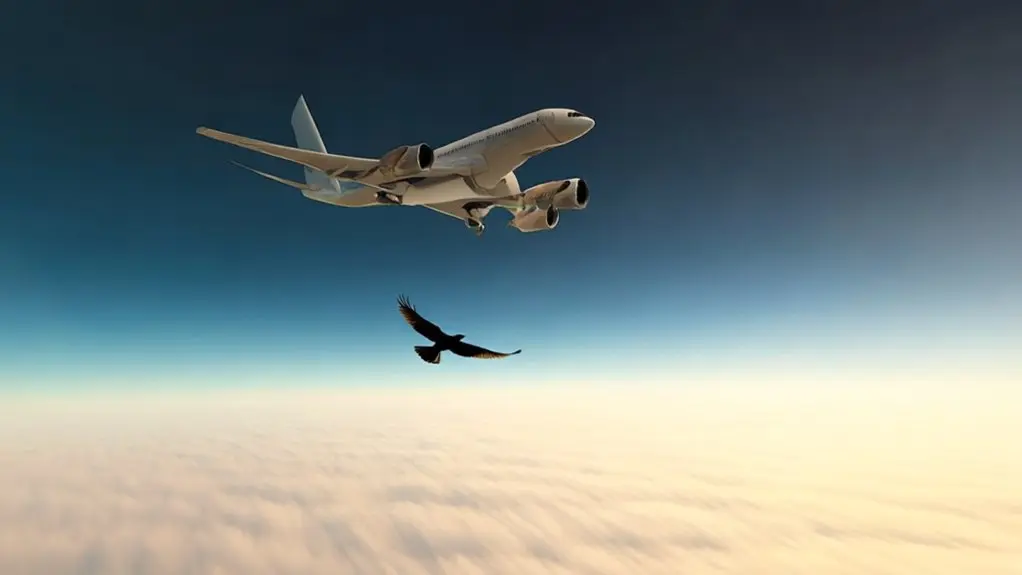
You might be surprised that some birds, like Rüppell’s vulture, fly higher than many commercial airplanes. They soar up to 11,300 meters where oxygen is scarce and the air is thin.
Specialized adaptations, such as highly efficient oxygen uptake and the use of thermals, help these birds endure extreme cold and low pressure. Their flight surpasses many jets cruising at 9,000 to 12,000 meters.
Exploring how they manage these challenges reveals fascinating insights into nature’s high-altitude flight mastery. It’s pretty amazing what these birds can do!
Which Birds Are Known to Fly Higher Than Airplanes?
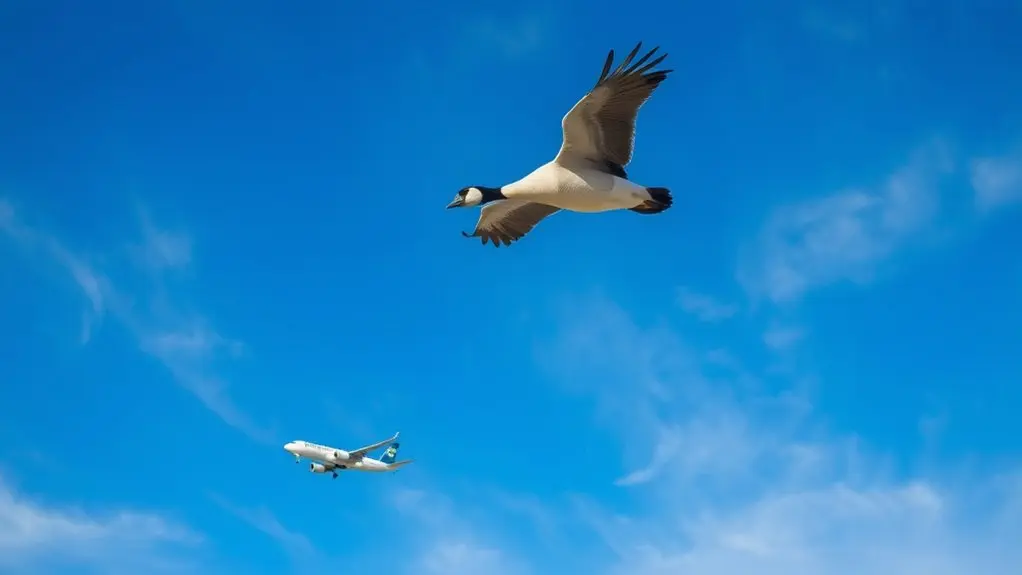
Although airplanes dominate the skies, certain bird species can fly at altitudes that surpass typical commercial flight levels. During bird migration, species like the Rüppell’s vulture demonstrate extraordinary flight endurance, reaching heights of 11,300 meters, higher than most commercial jets.
The bar-headed goose also impresses, soaring over the Himalayas at altitudes above 7,300 meters. Alpine choughs show remarkable adaptation, nesting at 6,500 meters and flying over Mount Everest at 8,200 meters.
Meanwhile, the Andean condor soars at around 6,500 meters during migration.
These birds possess physiological traits, such as specialized hemoglobin, that enhance oxygen uptake and sustain prolonged flight in thin air. Their ability to maintain flight at these extreme altitudes reveals a unique interplay between evolutionary adaptation and the demands of long-distance migration.
Which Bird Species Hold the Highest Flight Records?

When you examine the highest flight records among birds, the Rüppell’s vulture stands out by reaching an incredible altitude of 11,300 meters (37,100 feet). That’s the highest confirmed flight recorded for any bird.
The Rüppell’s vulture soars to an astounding 11,300 meters, the highest known bird flight.
This species exploits thermal currents to maximize its soaring efficiency, supporting its predatory behaviors at extreme heights.
Other birds also demonstrate remarkable altitude capabilities. The bar-headed goose follows rigorous migration patterns, flying over Mount Everest at 7,300 meters.
The Alpine chough nests at 6,500 meters and has been spotted soaring at 8,200 meters, maneuvering through thin air with precision.
The Andean condor uses thermals to soar around 6,500 meters, optimizing energy use during foraging.
These flight records really highlight the amazing adaptations birds have. They enable them to thrive in low-oxygen environments while still maintaining survival behaviors.
Why Do Some Birds Fly Over Mountains Like the Himalayas?

Because flying over towering mountain ranges like the Himalayas demands exceptional endurance and specialized adaptations, only certain bird species undertake these high-altitude journeys. You’ll find birds like the bar-headed goose using this route during avian migration to reduce travel distance and avoid predators.
Others, such as the Himalayan snowcock, engage in mountain nesting at extreme elevations above 8,000 meters. They exploit breeding sites that are inaccessible from lower altitudes.
| Bird Species | Adaptation Purpose |
|---|---|
| Bar-headed Goose | Efficient oxygen transport |
| Himalayan Snowcock | Mountain nesting, high flight |
| Alpine Chough | Traversing rugged terrain |
These adaptations let you witness birds mastering high-altitude flight while balancing survival and reproductive needs in the Himalayas’ challenging environment. It’s pretty amazing how they manage it all up there!
How Do Birds Manage Oxygen at Extreme Altitudes?
The ability of birds like the bar-headed goose to soar over the Himalayas depends heavily on their remarkable oxygen management at extreme altitudes. You’ll notice how their aerobic capacity excels despite thin air, thanks to oxygen sensors triggering precise physiological responses.
They absorb oxygen more efficiently using specialized hemoglobin with higher affinity, ensuring muscles get enough fuel.
Key factors include larger lungs and heightened hypoxic ventilatory responses, enabling deeper, more frequent breaths. Mitochondria are positioned near veins for rapid oxygen transfer during low-oxygen stress.
Plus, proteins like cytochrome c oxidases protect cells from oxidative damage, maintaining cellular function.
All these systems work together. It’s pretty amazing how birds manage oxygen so well, especially when you think about how airplanes need engines and pressurized cabins to do the same thing.
What Physiological Adaptations Help Birds Fly So High?
You’ll notice that birds flying at extreme altitudes rely on enhanced oxygen transport. This includes specialized hemoglobin that binds oxygen more efficiently in thin air.
Their lung function also adapts, with larger lungs and increased breathing rates to maximize oxygen uptake.
On a cellular level, there are cool adaptations too. For example, mitochondria placement and protective proteins help maintain muscle function even when oxygen is scarce.
All these changes work together to help birds soar so high!
Enhanced Oxygen Transport
How do birds manage to thrive in oxygen-thin air at extreme altitudes? Their enhanced oxygen transport system plays an essential role. You’ll notice their hemoglobin exhibits higher oxygen affinity, boosting oxygen exchange efficiency even when atmospheric oxygen is scarce.
This adaptation allows birds to extract more oxygen per breath, which is indispensable for sustained high-altitude flight.
Key features include:
- Hemoglobin efficiency: Specialized hemoglobin binds oxygen more tightly, making it easier to pick up oxygen in thin air.
- Increased lung capacity: Larger lungs and frequent, deeper breaths help maximize oxygen intake.
- Optimized cellular oxygen delivery: Mitochondria near veins enable swift oxygen transfer to muscles.
All these physiological traits work together to guarantee birds maintain an adequate oxygen supply. This supports their endurance and muscle function, even when they face low oxygen conditions above most airplanes.
Specialized Lung Function
Although oxygen becomes scarce at high altitudes, birds have specialized lung functions that help them extract and use oxygen really efficiently. Their lung efficiency comes from respiratory adaptations like larger lung volume and stronger hypoxic ventilatory responses, which allow them to take deeper, faster breaths.
Their hemoglobin has a high oxygen affinity, which further boosts oxygen uptake in thin air. Plus, you’ll find mitochondria located closer to veins in flight muscles, enabling rapid oxygen transfer. All these physiological traits work together to optimize oxygen delivery and keep them flying at extreme altitudes.
| Adaptation | Function | Benefit |
|---|---|---|
| Larger lungs | Increased surface area | Maximizes oxygen intake |
| High hemoglobin affinity | Stronger oxygen binding | Efficient oxygen absorption |
| Enhanced ventilatory response | Deeper, frequent breaths | Meets increased oxygen demand |
| Mitochondria proximity | Rapid oxygen transfer | Supports muscle metabolism |
| Cytochrome c oxidases | Reduce oxidative damage | Maintains cell health |
Cellular Hypoxia Adaptations
When birds soar at extreme altitudes, their cells face severe hypoxia. Yet, they’ve evolved remarkable physiological adaptations to cope with this challenge. These adaptations optimize cellular respiration and maintain mitochondrial efficiency despite low oxygen availability.
You’d observe that their mitochondria are strategically positioned closer to veins. This positioning enables rapid oxygen transfer to muscle cells. Additionally, specialized proteins like cytochrome c oxidases minimize oxidative damage, preserving cellular function under hypoxic stress.
Key adaptations include hemoglobin with higher oxygen affinity, enhancing oxygen absorption in thin air. They also have enlarged lungs and intensified hypoxic ventilatory responses to increase oxygen intake.
Plus, mitochondrial proximity to veins boosts energy production efficiency during flight. Together, these traits allow birds to sustain powerful muscle activity and energy metabolism in oxygen-scarce environments.
This supports their high-altitude flight in a way that’s truly impressive.
How Do Weather and Air Density Affect Bird Flight Altitude?
You’ll notice that air density goes down as you go higher up, which means birds can’t generate as much lift and can’t fly as high.
Weather plays a big role too—things like thermals and low-pressure systems actually help birds rise with less effort.
On the flip side, rain and strong winds usually make them stay closer to the ground.
When you think about it, these atmospheric factors show how birds cleverly adjust their flight height to save energy and stay safe.
Air Density Effects
As air density decreases with altitude, birds face significant challenges in generating enough lift to sustain flight. This reduction impacts bird migration and flight mechanics directly, forcing birds to adapt their altitude to maintain efficient movement.
Thinner air means less oxygen, straining respiratory systems and limiting how long birds can soar at high elevations.
You’ll notice birds often fly lower before rain, as decreased air density reduces lift, complicating soaring.
Consider these key effects of air density on bird flight:
- Reduced lift at higher altitudes restricts maximum flight height.
- Lower oxygen levels challenge respiratory efficiency during high-altitude flight.
- Birds adjust altitude based on air density to optimize energy use and flight safety.
Understanding these factors helps explain why birds rarely reach altitudes typical of airplanes.
Weather Impact on Flight
How do weather patterns influence the altitudes at which birds choose to fly? During bird migration, wing flexibility helps birds adjust to changing air densities and weather. Thermals and low-pressure systems provide lift, enabling higher altitudes and energy conservation.
However, before storms or rain, birds fly lower due to decreased air density and reduced lift. High wind speeds, particularly in jet streams, disrupt stability and navigation, prompting altitude adjustments.
| Weather Condition | Effect on Flight Altitude | Reason |
|---|---|---|
| Thermals | Increase altitude | Provide lift and energy savings |
| Low-pressure | Increase altitude | Enhance soaring opportunities |
| Approaching rain | Decrease altitude | Reduced air density, lift loss |
| Jet streams | Avoid high altitude | Dangerous wind speeds |
You see, weather directly shapes flight altitude strategies. It’s pretty fascinating how birds adapt to all these changing conditions!
What Risks Do Birds Face When Flying at High Altitudes?
Although birds have evolved remarkable adaptations for high-altitude flight, they still face significant risks when soaring at extreme elevations. You have to understand their altitude limitations because oxygen deprivation becomes a real threat beyond certain points. Hypoxia can cause severe physiological stress, messing with muscle function and cognition.
This often forces birds to come down or risk fatal outcomes. On top of that, environmental challenges make things even harder. For example, extreme cold affects their metabolic rates and energy conservation.
Low air pressure also reduces oxygen availability, which ups the risk of hypoxia. Then there are the high wind speeds in jet streams that can cause fatigue and disorientation. Even species with specialized adaptations can only handle flight within certain limits.
When those limits are pushed too far, injury or death becomes a real risk. It really shows how delicate the balance is that birds have to maintain to survive up there.
How Do Birds Use Thermals and Air Currents to Gain Altitude?
You’ll notice that birds expertly use thermal riding techniques by circling within rising columns of warm air to gain altitude without using much energy.
They read visual cues and sense changes in air currents to navigate these invisible pathways with precision. This skill lets them adjust their flight patterns on the fly, optimizing lift and saving energy during long flights.
Thermal Riding Techniques
When birds encounter rising warm air currents known as thermals, they take advantage of these natural elevators to gain altitude without expending energy through wing flapping. You’ll notice that birds like raptors and vultures circle within thermals, using their specialized wing morphology to maximize lift while minimizing drag.
Their feather adaptations also play a vital role, allowing subtle control over airflow. This technique lets them soar to impressive heights, sometimes above 8,000 meters, surpassing many commercial airplanes.
By efficiently riding thermals, you observe how birds conserve energy during long migrations or hunting flights. It’s pretty amazing when you think about how effortlessly they do this.
Key aspects include circling behavior to remain within the thermal’s uplift zone, wing shape optimized for gliding and soaring, and feather structures enabling precise aerodynamic adjustments. This mastery of thermal riding is essential for altitude gain with minimal energy use.
Air Currents Navigation
Building on how birds skillfully ride thermals to conserve energy, understanding their navigation through various air currents reveals even more about their flight efficiency. You’ll observe that birds adjust their flight paths to exploit rising warm air columns, or thermals, which can extend thousands of meters high.
By circling within these updrafts, they gain altitude without flapping, a vital adaptation during long migration patterns. Predatory birds like eagles and vultures excel at detecting these air currents, enabling them to soar at impressive heights while conserving energy for hunting.
This navigation through thermals allows them to reach altitudes that often surpass those flown by airplanes without engine power, demonstrating a remarkable interplay between atmospheric conditions and avian flight behavior.
How Do Bird Flight Altitudes Compare to Commercial Airplanes?
Several bird species can reach remarkable altitudes that rival or even exceed those of many commercial airplanes. Your understanding of bird flight stamina and feather structure reveals how species like the Rüppell’s vulture soar to 37,100 feet, surpassing typical airplane cruising altitudes.
While commercial jets generally cruise between 30,000 and 40,000 feet, some birds achieve extraordinary heights through physiological adaptations.
The bar-headed goose flies over Mount Everest, exceeding 8,800 meters. The Rüppell’s vulture holds the highest confirmed flight at 11,300 meters. Most airplanes still operate above the maximum altitude of birds, avoiding fast jet streams.
You see, birds rely on specialized feather structure and stamina, whereas planes depend on engineered engines and aerodynamics for altitude. It’s pretty fascinating how nature and technology take such different paths to the sky.
What Can High-Flying Birds Teach Us About Aviation?
Although aircraft rely on advanced engineering to conquer the skies, high-flying birds like the Rüppell’s vulture demonstrate natural adaptations that aviation can learn from. Their feather structures optimize aerodynamics and insulation, enabling efficient flight at altitudes exceeding 37,000 feet.
You can observe how these birds exploit atmospheric thermals to conserve energy, a strategy that could inspire more sustainable flight paths for aircraft.
Additionally, migration patterns reveal precise navigation and endurance mechanisms that improve resilience in harsh environments. Birds like bar-headed geese possess hemoglobin with higher oxygen affinity, a physiological adaptation informing bio-inspired oxygen transport technologies.
Studying these features offers valuable insights into enhancing aircraft performance in low-oxygen conditions, improving both human and machine endurance at high altitudes.
Frequently Asked Questions
Can Birds See Airplanes While Flying at High Altitudes?
You can observe that birds’ eyesight is sharp enough to spot airplanes during flight navigation at high altitudes, especially species like Rüppell’s vulture. These birds soar near or above typical airplane cruising heights, which helps them detect aircraft visually.
It’s pretty impressive when you think about it. Their vision is finely tuned to spot even distant objects while they’re gliding in the sky. So, yeah, some birds really do see airplanes while flying way up high.
Do Birds Communicate Differently When Flying Above Clouds?
You’ll notice bird communication shifts during cloud navigation; they rely more on visual cues and synchronized flight patterns since vocal signals weaken at high altitudes.
Birds adapt their calls to carry through thinner, less dense air efficiently. It’s like they’re switching up their language to make sure they stay connected while flying above the clouds.
How Do Bird Migration Patterns Change With Altitude?
You’ll notice bird migration patterns shift with altitude adaptation. They modify migratory behavior by selecting altitudes that optimize oxygen use and energy. Birds respond to atmospheric conditions like wind and temperature to improve flight efficiency and survival.
It’s pretty interesting how they adjust on the fly, literally, to make their journey easier. This flexibility helps them manage the challenges of long-distance travel better. So, altitude isn’t just about height—it’s about finding the best spot to keep going strong.
Are There Any Historical Incidents Involving Birds and Airplanes?
You picture a soaring Rüppell’s vulture clashing with a jet at 11,300 feet. This bird species has unique flight altitude abilities.
That 1973 collision highlights some rare and dangerous intersections between avian flight and human aircraft paths. It’s wild to think about how birds and planes can end up in the same airspace like that.
Can High-Altitude Bird Flight Affect Local Ecosystems?
Yes, you’ll see avian adaptations enable high-altitude flights, which affect local ecosystems by altering predator-prey interactions, redistributing nutrients, and influencing community dynamics.
These changes cause notable ecosystem impacts in mountainous and migratory regions. It’s pretty fascinating how birds can shape their environment just by flying high!
Conclusion
You might be surprised to learn that some birds soar higher than airplanes, defying gravity with remarkable physiological adaptations. Their mastery of thin air and oxygen scarcity offers a natural blueprint for aviation advancements.
Like silent sentinels riding invisible thermal highways, these avian athletes push the limits of altitude, revealing nature’s own high-flying secrets. Observing them closely, you gain insight into the intricate dance between biology and physics at extreme heights.