
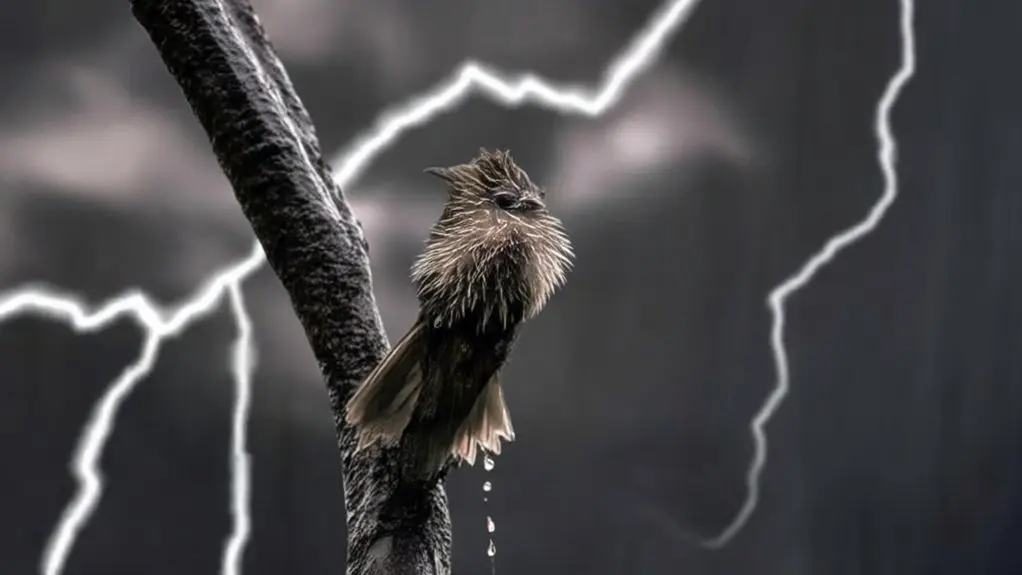
You might think a bird’s feathers or small size protect it from lightning, but they don’t. Both flying and perched birds, especially on tall or isolated spots during storms, can get struck. Lightning targets the highest conductive points, and intense electrical fields in storm clouds increase risk at altitude.
Even wet feathers can conduct electricity, leading to injury or death. Understanding how lightning affects birds’ behavior and habitats sheds light on their vulnerability and safety measures. It’s pretty interesting when you think about how exposed they can be during a storm. So, birds aren’t as safe from lightning as we might assume.
How Lightning Strikes Affect Birds in Flight and Perching
Although lightning primarily targets tall structures and isolated objects, birds in flight or perched outdoors aren’t immune to strikes during thunderstorms. Your risk increases with altitude since birds flying at higher flight altitudes may encounter electrical discharges more readily.
Feather insulation provides some protection by preventing direct electrical conduction to the bird’s body, but it doesn’t eliminate vulnerability.
Feather insulation offers partial defense against electrical conduction but cannot fully protect birds from lightning strikes.
Birds perched in open areas or isolated locations lack shielding, making them susceptible when lightning strikes nearby. Injury or death can result from the intense electrical current traveling through or around the bird.
While strikes on birds remain rare compared to other storm hazards, understanding how feather insulation and flight altitude influence exposure is vital. It helps us evaluate their lightning strike risk during severe weather events.
Why Birds Are Vulnerable to Lightning Strikes During Storms
You’re at risk of lightning strikes when you’re perched on tall, isolated structures. Birds face the same kind of danger because of where they choose to live and how electricity travels through their bodies.
Storms can be tricky, too. Lightning doesn’t always hit directly under clouds; it can strike far away, which makes things even more dangerous for birds sitting out in the open or up high.
Knowing these details helps explain why birds are especially vulnerable when thunderstorms roll in.
Bird Physiology and Conductivity
When lightning strikes during storms, birds face significant risk due to their unique physiology and conductive properties. Their feather insulation, while effective against cold and water, doesn’t prevent electrical conduction, especially when moisture conductivity increases as feathers become damp.
The moist skin beneath the feathers enhances the bird’s overall body conductivity, allowing electrical charges to pass through more easily.
Despite their small size and lightweight bones, birds have tissue and fluids that conduct electricity efficiently. This combination means that when lightning seeks a path to the ground, the electrical current can rapidly move through the bird’s body, causing severe injury or death.
Understanding these physiological traits highlights why birds are vulnerable during electrical storms, even though their size might suggest otherwise.
Storm Behavior and Lightning Patterns
Understanding the physiological reasons behind birds’ susceptibility to electrical currents leads us to examine how storm behavior and lightning patterns increase their risk. During storms, atmospheric charges build up within cloud formations, creating intense electrical fields.
Lightning frequently occurs at mid to high altitudes, precisely where many birds fly during thunderstorms. These electrical charges and turbulent air currents heighten the probability of a lightning strike.
As a result, birds maneuvering through or near electrically active cloud formations face increased exposure to lightning bolts. Storm dynamics cause lightning to strike unpredictably across altitudes, meaning birds can’t avoid these hazardous electrical discharges.
Habitat and Perching Risks
Although birds have evolved to seek elevated perches for safety and observation, these habitats increase their risk during thunderstorms. Birds often choose tall, isolated objects like trees or poles, which lightning targets. Large species gathering densely in elevated habitats compound vulnerability.
During storms, birds perch in exposed locations, which heightens their risk and can cause potential habitat disruption. Nest safety also becomes compromised because lightning strikes may damage nesting sites.
| Perching Behavior | Risk Factor |
|---|---|
| Tall, isolated perches | High lightning strike probability |
| Dense flocking | Increased collective vulnerability |
| Exposed perches | Elevated risk during storms |
| Nesting in trees | Potential habitat disruption |
| Seeking shelter | May lead to unsafe perches |
Understanding these perching risks helps explain why birds face significant lightning threats in storm conditions. It’s pretty clear that their natural habits sometimes put them right in the path of danger.
Debunking Common Myths About Birds and Lightning
Because lightning can strike objects at various altitudes, you should know that birds aren’t exempt from this danger. One common myth claims that birds are immune due to their small size or feather insulation, but lightning’s electrical charge doesn’t discriminate based on these factors. Feather insulation primarily protects against temperature and moisture, not electrical currents.
Another misconception suggests that nesting habits shield birds from lightning. However, birds often nest in elevated locations like tall trees, which actually increases their exposure risk. Scientific records confirm that birds, including large species, have been struck both in flight and while perched.
Understanding these facts helps dispel inaccurate beliefs. It emphasizes that birds’ vulnerability to lightning aligns with physical and environmental conditions, not myths surrounding their biology or behaviors.
Why a Bird’s Height and Location Matter for Lightning
You’ll notice that birds perched up high face a greater risk of lightning strikes. That’s because being at higher elevations means they’re more exposed to electrical discharge.
Think about it—if a bird is sitting on a tall tree or a pole, it’s more likely to get struck compared to one closer to the ground.
Height Influences Strike Risk
When birds perch on tall, isolated objects, their risk of lightning strikes goes up a lot because they’re higher up. Lightning usually hits the tallest conductive points, so height really matters when it comes to how likely a strike is.
If you think about migration patterns and nesting habits, it makes sense why some birds are at greater risk. Birds that nest or rest on high structures during storms are definitely more vulnerable.
Flock behavior also plays a part. When lots of birds gather at higher altitudes at the same time, the overall strike risk increases. Even smaller birds down low can be affected if they’re close to tall objects during electrical storms.
Location Affects Lightning Probability
While height plays a significant role in a bird’s risk of lightning strikes, location also strongly influences the probability of being struck. Lightning doesn’t exclusively target tall objects; proximity to storm clouds is crucial. Birds flying along migratory routes at high altitudes face increased exposure to lightning activity.
Similarly, large waterfowl soaring at these heights are at heightened risk. Urban nesting birds, despite often being closer to ground level, encounter unique risks due to localized storm patterns and conductive structures.
Consider these factors affecting lightning probability:
- Birds on migratory routes flying near storm clouds have elevated strike risk.
- Urban nesting exposes birds to lightning influenced by man-made conductive materials.
- Birds perched over open water or open landscapes face variable strike probabilities depending on storm proximity.
Your understanding of location clarifies why birds’ lightning risk varies beyond just height.
Effects of Nearby Lightning Strikes on Birds
Although birds rarely suffer direct lightning strikes, they can experience significant effects from nearby discharges. Lightning generates ground currents that spread electrical charges through the soil and vegetation, which can shock or disorient birds in proximity. Feather conductivity plays a role, as wet feathers may transmit electrical energy, increasing vulnerability.
Large birds or dense flocks are particularly susceptible to these electrical disturbances. Additionally, lightning can impact nesting safety by damaging habitats or inducing ground currents that disrupt nesting sites.
Studies reveal that birds close to strikes often show signs of distress, such as sudden disorientation or impaired movement.
Understanding these effects is vital for evaluating lightning’s indirect impact on avian populations and their habitats. It really emphasizes the need for further research into the environmental consequences of lightning near bird communities.
There’s still a lot to learn about how these electrical events affect birds in the wild.
Can Bird Behavior Reduce the Risk of Lightning Strikes?
Since bird behavior influences their exposure during storms, understanding these patterns helps assess how they might reduce lightning strike risks. Birds adjust their flight altitudes and often avoid tall, isolated structures, which decreases their direct exposure to lightning.
Birds change flight altitude and avoid tall structures to lower their lightning strike risk during storms.
Their feather insulation offers some protection by limiting electrical conductivity, but it doesn’t fully prevent strikes.
Many species seek shelter in dense foliage or lower altitudes during thunderstorms, which further reduces their risk. However, lightning strikes are still largely unpredictable and can affect birds no matter what they do.
Avoidance of tall, isolated perches during storms, seeking shelter under dense foliage to minimize exposure, and adjusting flight altitudes to stay away from lightning channels are all smart moves. These adaptive behaviors help lower the risk but don’t completely eliminate the chance of lightning striking birds.
Protecting Birds by Understanding Lightning Risks
Understanding lightning risks is essential if you want to protect birds from strikes during storms. You need to recognize that birds perched on tall or isolated objects face higher strike risks, especially during peak storm seasons aligned with migratory patterns.
Effective nest protection involves managing habitats to reduce these perching sites, minimizing exposure to lightning. Additionally, large flocks increase risk, so monitoring migratory behavior can help predict when and where birds are most vulnerable.
You should also consider ground currents caused by lightning, which can harm birds nearby.
Frequently Asked Questions
Can Lightning Strikes Cause Long-Term Health Issues in Birds?
You won’t find conclusive evidence linking lightning strikes to long-term health issues in birds, despite their electrical conductivity and nesting behaviors increasing strike risk. Acute injuries dominate, while persistent effects remain poorly documented or studied.
Do Different Bird Species Have Varying Lightning Strike Risks?
You might think bird nesting sites alone dictate lightning risk, but aerial agility and habitat matter more. Species with poor maneuverability or nesting in open, elevated areas face higher strike chances, regardless of size.
It’s not just about where they build their nests. How well a bird can dodge a strike in flight plays a big role too. So, even smaller birds aren’t always safer if they can’t move quickly in stormy skies.
How Do Lightning Strikes Affect Bird Populations Overall?
You’ll find lightning strikes rarely impact bird populations overall because birds adjust flight altitude and nesting locations to avoid storms. Their mobility and reproductive rates help populations recover quickly, minimizing long-term effects on species stability.
Are Nocturnal Birds More or Less Vulnerable to Lightning?
Imagine a ship riding waves; your nocturnal birds’ vulnerability depends on bird nesting height and flight altitude, not time. Lightning targets tall structures and flight paths, so their risk varies with habitat, not darkness or activity period.
Think about it this way: it’s not about whether the bird is active at night or day. Instead, it’s where they are when the lightning strikes. So, whether a bird is nocturnal or diurnal doesn’t really change its chance of getting caught in lightning.
Can Weather Warnings Help in Protecting Birds From Lightning?
You can use weather warnings to enhance lightning safety by adjusting bird migration routes and timing. These alerts help reduce birds’ exposure to storms. That way, conservation efforts become more targeted and effective.
Conclusion
You might think birds are safe from lightning, but the truth is their height and location can put them right in the line of fire. While direct strikes are rare, nearby lightning can still cause harm. Understanding these risks helps you see why birds’ behavior matters during storms.
By knowing the facts, you can separate lightning myths from reality. Because when it comes to nature, it’s best not to jump the gun.