
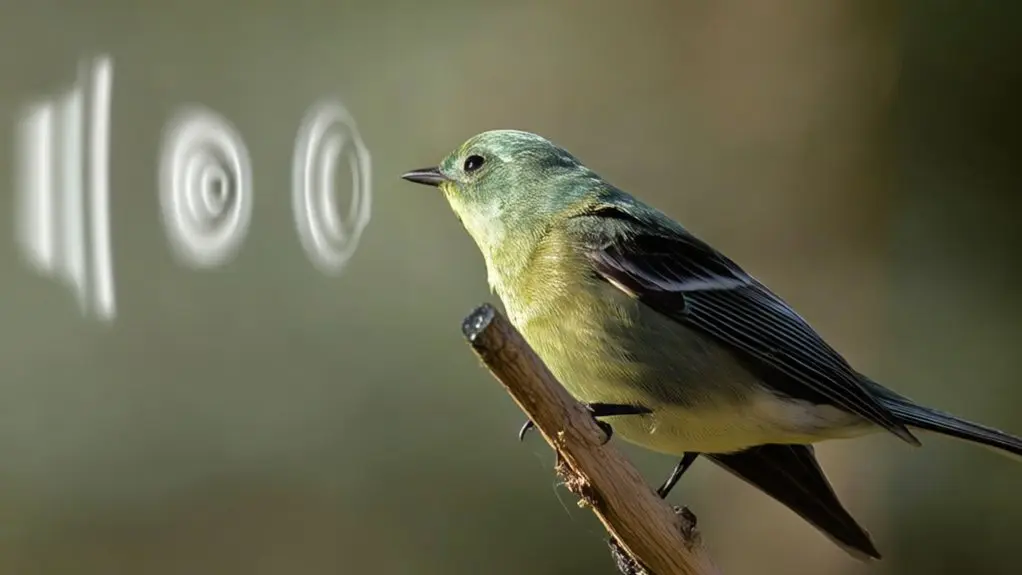
You can’t rely on ultrasonic sounds to deter birds because their hearing typically ranges between 1 and 4 kHz, with sensitivity dropping sharply beyond 5 kHz. Sounds above 20 kHz, ultrasonics, are inaudible to them due to inner ear limitations.
Ultrasonic devices emit signals birds simply can’t detect, making them ineffective for control. However, using specific audible frequencies and combining sound with visual cues can considerably enhance deterrence strategies.
Exploring these methods reveals why ultrasonic isn’t your best option.
Bird Hearing Range and Sensitivity
Although birds typically hear frequencies between 1 and 4 kHz, they can detect ultrasonic sounds up to about 20 kHz. However, their sensitivity diminishes at these higher frequencies.
You should know that feather structure plays an indirect role in hearing. While feathers don’t affect auditory range, they contribute to flight efficiency during migration patterns, which rely heavily on auditory cues within the primary hearing spectrum.
Birds depend on sounds in their effective range for navigation and communication during migration. Ultrasonic frequencies above 20 kHz fall beyond their hearing capabilities, making these sounds ineffective as deterrents.
When you consider bird hearing range and sensitivity, it’s clear that their auditory system prioritizes frequencies essential for survival rather than ultrasonic sounds. This explains their limited response to high-frequency stimuli.
What Ultrasonic Sounds Are and Why Birds Can’t Hear Them
You’re dealing with ultrasonic sounds when frequencies go beyond 20 kHz. That’s way higher than what most birds can hear.
Birds usually catch sounds between 1 and 4 kHz, so anything ultrasonic is totally out of their range.
Because of this, ultrasonic devices don’t really affect bird behavior at all—those high-frequency sounds just fly right under their radar.
Ultrasonic Sound Definition
How do ultrasonic sounds differ from the noises you hear every day? Ultrasonic sounds are high-frequency sound waves above 20,000 Hz, which is beyond human hearing.
Birds typically perceive frequencies between 1 to 4 kHz and can detect up to around 20 kHz, but not beyond.
Here’s why this matters: Ultrasonic communication involves frequency modulation at levels above what birds can detect, so these sounds are inaudible to them.
Most pest birds lack the auditory range to perceive ultrasonic frequencies, which limits their response to these sounds.
Ultrasonic bird deterrents operate above 20 kHz, making them ineffective since birds can’t hear them.
Understanding these points helps clarify why ultrasonic sounds don’t impact avian behavior the way they do with other species.
It’s pretty interesting how different animals experience sound so differently!
Birds’ Hearing Frequency
Understanding the specific hearing range of birds reveals why ultrasonic sounds remain undetectable to them. Birds generally perceive sounds between 1 and 4 kHz, with some sensitivity extending up to about 20 kHz.
Ultrasonic frequencies exceed 20 kHz, placing them beyond the auditory limits of most bird species.
Their auditory anatomy, adapted for lower frequencies, can’t register these high-pitched sounds. This limitation explains why ultrasonic devices designed to deter pests fail to impact birds, as they simply don’t detect these signals.
During bird migration, this hearing range allows them to navigate and respond to environmental cues.
Additionally, the feather structure plays a role in sound transmission but doesn’t enhance sensitivity to ultrasonic frequencies. So, ultrasonic sounds remain imperceptible and ineffective for influencing bird behavior.
It’s just not something birds can hear or respond to.
Limitations Of Ultrasonics
Although ultrasonic sounds operate above 20 kHz and remain inaudible to humans, they also fall outside the hearing range of most birds. Their hearing anatomy limits sound perception to frequencies below approximately 4-5 kHz.
So, here’s why ultrasonic sounds don’t affect birds:
First, birds like pigeons and sparrows lack the auditory sensitivity to detect ultrasonic frequencies. Their inner ear structures just can’t process sounds above their biological threshold.
Scientific studies confirm birds don’t perceive ultrasonic signals. That means these sounds neither alter their behavior nor cause discomfort.
Ultrasonic deterrent devices emit high-frequency noise inaudible to birds. Because of this, they’re pretty ineffective for bird control.
Understanding these limitations helps explain why ultrasonic methods fail in managing bird populations.
Why Ultrasonic Bird Repellers Don’t Work
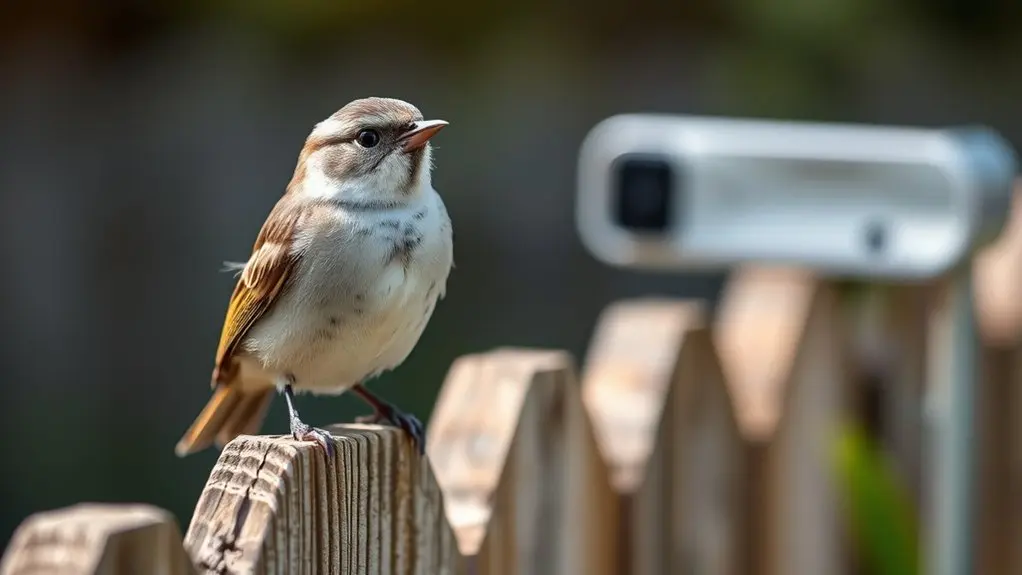
Since birds typically can’t hear sounds above 20 kHz, ultrasonic bird repellers fail to produce any audible deterrent effect on them. These devices emit high-frequency signals that fall outside the bird’s hearing range, which is generally between 1 and 4 kHz.
Because birds don’t perceive these sounds, they neither react nor avoid the treated areas.
Also, ultrasonic repellents overlook critical ecological factors like habitat destruction and food scarcity that influence bird presence. Birds are more likely to return despite these sounds because their biological needs remain unmet by ultrasonic deterrents.
Research also shows birds quickly habituate to such stimuli, further diminishing any short-term impact.
Bird Distress and Predator Calls as Effective Sound Deterrents
You’ll notice birds really react to distress calls. These sounds signal immediate danger and often provoke mobbing behavior, where birds gang up to drive away threats. It’s quite fascinating to see.
Then there are predator calls, like those made by hawks or cats. These activate birds’ innate fear circuits, causing them to quickly avoid the area. It’s a natural and effective response.
Compared to ultrasonic signals, these natural sound cues work much better. They tap into survival instincts across many bird species, making them a powerful deterrent.
Distress Calls Explained
When birds perceive a threat, they emit distress calls that signal danger to nearby individuals, triggering a natural mobbing response. These vocalizations serve as an alarm, prompting other birds to approach and collectively confront the threat. You’ll notice that feather patterns often change subtly during these encounters, enhancing communication and urgency.
Just like migration triggers guide birds to respond to environmental cues, distress calls activate survival behaviors.
Here’s what you should know:
- Distress calls mimic natural sounds that prompt birds to mob predators or threats.
- Repeated playback of these calls confuses pest birds, causing them to disperse fearing an unseen predator.
- This method offers a humane way to deter birds without harm.
Understanding distress calls helps you implement effective, science-backed bird deterrence strategies.
Predator Call Impact
Distress calls not only alert nearby birds to danger but also play a significant role in deterring pest species through sound-based strategies. By using predator mimicry and distress call propagation, you can tap into birds’ social and aggressive behaviors. Recorded hawk or falcon calls trigger instinctive fear in pest birds, making them scatter.
Distress calls encourage mobbing behavior, which draws birds toward perceived threats and boosts deterrent effectiveness. The key to success is authentic playback and targeting specific species. Once these calls stop without any real threat, birds quickly disperse, so these sounds make for a dynamic control method.
| Factor | Impact on Deterrence |
|---|---|
| Predator mimicry | Triggers fear and dispersal |
| Distress call propagation | Encourages mobbing and alertness |
| Playback authenticity | Ensures realistic threat simulation |
| Species-specific targeting | Maximizes deterrent efficiency |
Effective Sound Frequencies for Bird Deterrents
Although ultrasonic sounds above 20 kHz are commonly marketed for bird deterrence, they fall outside the typical hearing range of most bird species, including common pests like pigeons and sparrows. To effectively manage bird migration and nest management, you should focus on sound frequencies within birds’ audible range.
Studies indicate birds primarily hear frequencies between 1 and 4 kHz. Here’s what you need to know:
- Frequencies between 1-4 kHz align with birds’ natural hearing sensitivity, making deterrents more perceptible.
- Ultrasonic sounds above 20 kHz are ineffective since most birds can’t detect them.
- Employing sounds within audible ranges can disrupt nesting and discourage migratory stopovers.
Using these scientifically grounded frequencies increases your chances of successful bird deterrence without relying on inaudible ultrasonic noise. It’s a smarter approach that really works.
Combining Sound and Visual Deterrents for Better Results
Sound frequencies alone often don’t achieve the desired level of bird deterrence because birds quickly adapt to auditory stimuli.
By combining sound deterrents with visual cues, you engage multiple senses, enhancing birds’ flight responses.
Visual decoys like predator models or reflective surfaces, when paired with distress calls or predator sounds, trigger innate aversion behaviors.
This multisensory approach reduces habituation, as birds are less likely to ignore stimuli that vary in form and timing.
Proper synchronization of sound and visual deterrents creates a more intimidating environment, increasing the likelihood that birds will permanently leave the area.
Integrating these methods addresses different behavioral triggers, improving long-term effectiveness.
Using both auditory and visual cues together offers a scientifically supported strategy for robust bird deterrence through habituation prevention.
It’s a smart way to keep your space bird-free for good.
Effective Bird Control Methods Beyond Ultrasonic Repellers
When you’re looking for reliable bird control beyond ultrasonic repellers, combining physical barriers, visual deterrents, and behavior modification techniques gives you the best results. Birds’ feather patterns and migratory habits affect how they respond to different methods, so it really helps to tailor your approach.
Effective bird control blends barriers, visual cues, and behavior changes tailored to bird habits for best results.
Here are some effective strategies to consider:
- Physical Barriers: Use netting and bird spikes to block access to nesting and roosting sites. This prevents perching without harming the birds, which is a big plus.
- Visual Deterrents: Decoys and reflective objects take advantage of birds’ visual sensitivity. They disrupt normal behavior by mimicking predators or creating discomfort.
- Behavior Modification: Change habitat features that attract birds, like food sources or shelter. This reduces the chance they’ll keep coming back.
By combining these methods, you respect birds’ natural behaviors while making sure they stay away for good.
This approach works way better than ultrasonic devices alone.
Frequently Asked Questions
Can Ultrasonic Sounds Harm Birds’ Hearing or Health?
You won’t find evidence that ultrasonic technology harms birds’ hearing or health, as their bird communication relies on lower frequencies. Ultrasonic sounds exceed their range, so they don’t disrupt or damage avian auditory systems.
In other words, birds simply can’t hear these high-frequency sounds, which means their ears aren’t affected by them. So, ultrasonic sounds don’t pose a risk to birds in terms of hearing or overall health.
Are Any Bird Species Exceptions to Ultrasonic Hearing Limits?
Do any bird species defy known hearing adaptations? No, you won’t find exceptions. All studied bird species show limits below ultrasonic ranges.
Their auditory systems aren’t adapted for ultrasonic frequencies. This confirms consistent hearing constraints across species. So, when it comes to ultrasonic hearing, birds are pretty much on the same page.
How Do Ultrasonic Devices Affect Other Wildlife Around Birds?
Ultrasonic energy primarily affects insects and rodents, leaving bird communication mostly intact. You’ll notice that while birds remain unaffected, some small mammals and insects nearby might alter their behavior due to sensitivity to ultrasonic frequencies.
These creatures pick up sounds we can’t hear, which can make them act differently. But birds? They usually carry on like nothing’s changed. It’s pretty interesting how different animals respond to these sounds!
Can Birds Habituate to Ultrasonic Deterrents Over Time?
Like a whisper lost in a storm, birds do habituate to ultrasonic deterrents over time. Their bird communication and predator avoidance adapt, rendering fixed-frequency sounds ineffective. They learn these signals pose no real threat.
It’s kind of like when you hear a noise repeatedly and eventually stop noticing it. Birds pick up on that too, so using just one constant frequency won’t keep them away forever. Mixing things up or combining methods might work better in the long run.
Are There Legal Restrictions on Using Ultrasonic Bird Repellers?
You’ll find legal regulations on ultrasonic device restrictions vary widely. Some states or localities limit usage due to noise or wildlife impact concerns.
Conclusion
You might think ultrasonic bird repellers work like a silent alarm, but birds simply don’t hear those high frequencies. It’s like trying to whisper in a language they can’t understand. Studies show birds hear between 1 kHz and 4 kHz, missing ultrasonic sounds above 20 kHz entirely.
Instead, using distress calls within their audible range is like speaking their language and effectively deters them. Combining sound with visual cues boosts success. So, don’t rely on ultrasonic alone.