
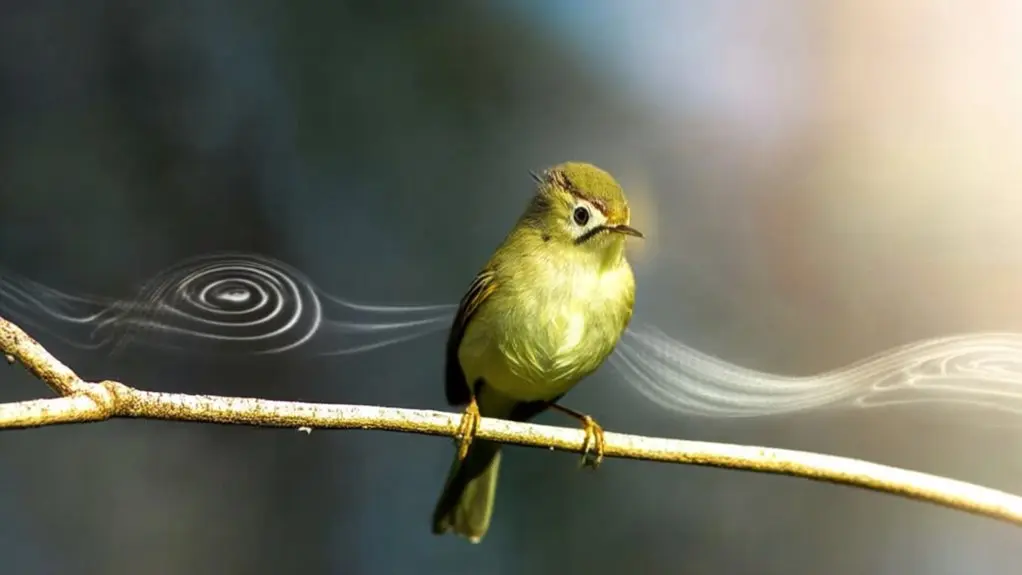
You might think birds hear high-frequency sounds easily, but most detect only up to about 20 kHz, which is within the human audible range. Their hearing focuses on sounds that are essential for communication and survival. They rarely perceive ultrasonic frequencies above this.
Even when birds react to ultrasonic devices, it’s usually because of vibrations, not actual hearing. Some species can push this range a little bit, but true ultrasonic perception is generally absent.
Looking into how birds respond gives us some surprising insights into their hearing limits and behavior. It’s pretty interesting once you dig into it!
Bird Hearing Frequency Range

Most birds hear sounds primarily within a frequency range of 1 kHz to 4 kHz, which closely aligns with the human auditory spectrum. This range effectively supports their communication and environmental awareness.
Birds primarily hear between 1 kHz and 4 kHz, matching the human auditory range for effective communication.
While some species detect sounds up to around 20 kHz, they rarely perceive ultrasonic frequencies beyond this.
Your understanding of bird hearing deepens when considering feather sensitivity and wing vibrations, which complement auditory input. These mechanical stimuli provide tactile feedback, enhancing spatial orientation and detection of nearby movements.
Feather sensitivity allows birds to sense subtle vibrations caused by air disturbances, while wing vibrations contribute to proprioception during flight.
Together, these sensory modalities work alongside the auditory system. It’s clear that hearing is part of a multimodal sensory network rather than relying solely on high-frequency sound detection.
Which Birds Can Detect High or Ultrasonic Sounds?

While birds primarily rely on sound frequencies between 1 kHz and 4 kHz, certain species extend their hearing capabilities to higher frequencies approaching 20 kHz. These species use this extended range to enhance avian communication and predator detection. It allows them to perceive subtle environmental cues.
However, no birds are known to detect ultrasonic sounds above 20 kHz, as their auditory systems lack the necessary anatomical adaptations. Although some birds like oilbirds and swiftlets employ echolocation, their clicks remain within the human audible range, not ultrasonic. This means ultrasonic bird deterrents generally fail.
Understanding which birds detect higher frequencies clarifies how avian communication and predator detection optimize survival. But it also confirms that true ultrasonic hearing remains beyond avian capacity.
Why Birds Usually Can’t Hear Ultrasound

You probably won’t hear birds responding to ultrasound because their hearing range usually tops out around 20 kHz, which is way below ultrasonic frequencies. Their ears are tuned to pick up sounds within their natural vocal range, so higher frequencies just don’t register.
Instead, if birds do react to ultrasound, it’s likely due to non-auditory reasons rather than actual hearing. In other words, their bodies might respond in some way, but not because they’re really hearing those high-pitched sounds.
Bird Hearing Frequency Limits
How far can birds hear into the high-frequency spectrum? Most birds detect sounds between 1 and 4 kHz, with some extending up to around 20 kHz. However, ultrasonic frequencies above 20 kHz generally fall outside their auditory range.
This limitation comes from evolutionary adaptations that fit their ecological needs. Birds’ auditory systems evolved to focus on sound frequencies important for communication, navigation, and predator awareness, not ultrasonic signals.
These sound frequency limits reflect selective pressures that optimize energy and neural resources for picking up biologically relevant sounds.
So, birds usually don’t have the anatomical and neurological setup needed to process ultrasonic sounds.
Understanding these constraints helps explain why ultrasonic perception is rare among birds. It really shows how evolutionary adaptations shape the boundaries of auditory capacity in avian species.
Ultrasonic Sound Perception
Birds’ auditory systems are finely tuned to detect frequencies primarily between 1 and 20 kHz, which limits their ability to perceive ultrasonic sounds above this range. Ultrasonic frequencies, exceeding 20 kHz, fall beyond the typical hearing capacity of most bird species. Their vocalizations rarely extend into these high frequencies.
Unlike bats, birds don’t have the specialized cochlear structures needed for ultrasonic perception. You might expect birds to detect ultrasound, but scientific evidence shows they don’t hear these sounds in the usual way.
However, some birds may show behavioral responses to ultrasonic stimuli through non-auditory mechanisms. This might be linked to feather sensitivity. Feathers can detect vibrations and air pressure changes, offering an alternative sensory pathway. But this doesn’t mean birds truly hear ultrasound.
Physiological Reactions Not Auditory
Although ultrasonic sounds fall well beyond the typical avian hearing range of 1 to 20 kHz, you might notice some birds exhibiting stress or distress when exposed to these frequencies. This reaction isn’t due to auditory perception but rather physiological stress triggered by sensory vibrations. Birds lack the inner ear structures necessary to detect ultrasound, so these high-frequency sounds induce vibrational effects that cause discomfort.
These non-auditory responses explain why birds react despite not “hearing” ultrasound.
| Factor | Explanation | Outcome |
|---|---|---|
| Hearing Range | 1–20 kHz typical | Ultrasound inaudible |
| Inner Ear Anatomy | Not adapted for high frequencies | No true auditory response |
| Sensory Vibrations | Cause physiological stress | Behavioral distress |
Understanding this helps clarify why birds usually can’t hear ultrasound despite their reactions.
How Birds React to Ultrasonic Sounds
When exposed to ultrasonic sounds, birds often display negative reactions. However, these responses rarely stem from actual hearing perception. Most birds hear between 1–4 kHz, with some detecting up to 20 kHz, but ultrasonic frequencies above this range fall outside their auditory sensitivity.
Despite this, birds like blue-throated hummingbirds produce ultrasonic vocalizations, yet can’t hear beyond about 7 kHz. This suggests they’ve limited ultrasonic communication capability. It’s pretty interesting that they make these sounds even if they can’t fully hear them.
Blue-throated hummingbirds produce ultrasonic sounds despite limited hearing beyond 7 kHz, hinting at unique communication traits.
Studies, including Dr. Whitford’s experiments, indicate that birds’ adverse reactions to ultrasonic sounds likely result from physiological effects such as vibrations or stress rather than auditory processing.
So, while bird vocalization occasionally involves ultrasonic components, these sounds don’t considerably influence behavior through hearing.
Your observations should distinguish between behavioral responses and true auditory perception when evaluating ultrasonic impacts on birds. It’s important to keep this in mind when studying or interacting with birds around ultrasonic sounds.
Common Myths About Birds and Ultrasound
Since ultrasonic frequencies lie beyond the auditory range of most birds, claims that ultrasonic devices effectively deter them stem from common misconceptions.
You should know that most birds hear within 1–4 kHz, occasionally up to 20 kHz, but not beyond into the ultrasonic range.
While some species produce ultrasound vocalizations, these sounds are typically within human hearing and serve specialized communication or echolocation functions, not deterrence.
Ultrasound production in birds is limited and doesn’t imply they perceive or respond to ultrasonic stimuli as deterrents.
The myth that ultrasonic devices influence bird behavior ignores established auditory limits.
Understanding bird vocalization and hearing ranges clarifies that ultrasonic deterrents lack scientific support, as birds rely on their natural hearing spectrum rather than ultrasonic frequencies for communication and environmental awareness.
How Ultrasonic Devices Keep Birds Away
You might think that ultrasonic devices keep birds away just by sound alone, right? But it turns out there’s more going on than just what the birds can hear.
Research actually shows that birds often react to vibrations or even physiological stress caused by ultrasonic frequencies above 20 kHz. So, even though birds don’t really pick up those ultrasonic sounds well, these other effects help explain why ultrasonic technology works so well to keep them at bay.
Ultrasonic Sound Effects
Although ultrasonic bird deterrent devices emit sounds above 20 kHz, a frequency range beyond what most birds can hear, their effectiveness remains questionable. You should understand that birds primarily rely on bird vocalization within the audible range for communication, and ultrasonic communication is uncommon.
Studies, including Dr. Whitford’s, indicate many birds cannot detect ultrasonic frequencies, though some may respond to vibrations indirectly.
| Aspect | Ultrasonic Devices | Bird Hearing Capabilities |
|---|---|---|
| Frequency Range | > 20 kHz | Typically < 20 kHz |
| Perception Mechanism | Vibrations, not hearing | Auditory detection of vocalization |
| Response Type | Physiological or avoidance | Communication via vocal sounds |
This data suggests ultrasonic deterrents lack consistent impact on bird behavior. So, while they might seem like a clever idea, they don’t always deliver the results people hope for.
Bird Response Mechanisms
Understanding how ultrasonic devices influence bird behavior means looking at the specific ways birds respond. Most birds can’t hear ultrasonic frequencies directly. Instead, they react through behavioral conditioning and their sensitivity to environmental vibrations.
Ultrasonic waves create subtle vibrations that travel to their feathers or the environment around them. Birds pick up on these vibrations as signals of discomfort or stress.
Over time, they learn to connect these cues with negative experiences, which makes them want to avoid the source.
So, the deterrent effect doesn’t come from birds hearing the sound itself. It’s more about physiological stress and learned behavior in response to these vibrations.
Frequently Asked Questions
Can Bird Hearing Change With Age or Environment?
Yes, you’ll notice bird hearing changes with age or environment due to evolutionary adaptation and sensory plasticity. These processes adjust their auditory sensitivity, especially to high-frequency sounds. This helps ensure survival despite noise pollution or aging effects.
Do Baby Birds Hear High Frequencies Differently Than Adults?
You’ll find avian hearing in baby birds closely matches adults, with sound perception mostly between 1-4 kHz. While young birds might detect slightly higher frequencies early on, their overall high-frequency hearing remains quite similar.
It’s pretty interesting how their hearing develops, isn’t it? Even though babies might pick up on some sounds a bit differently, the range doesn’t change much as they grow. So, when it comes to hearing, baby birds and adults aren’t all that different after all.
How Does Bird Hearing Impact Their Mating Calls?
Like decoding Morse code, your bird’s hearing sharpens vocalization patterns vital for attracting mates and detecting predators. This acute auditory skill guarantees they respond precisely, enhancing reproductive success and survival.
They do this through nuanced call interpretation and environmental awareness. It’s pretty amazing how their hearing helps them navigate complex social and natural settings. Birds rely on these sounds to find the right partner and stay safe at the same time.
Are There Any Risks to Birds From Human-Made Ultrasound?
You won’t find ultrasound interference considerably disrupting bird communication, as birds can’t hear ultrasonic frequencies. Human-made ultrasound poses minimal risks, lacking auditory impact or physiological harm. This means bird communication remains largely unaffected by these sounds.
Can Birds With Hearing Loss Still Communicate Effectively?
You’d think birds with hearing loss couldn’t communicate. Yet, they often do, relying on vocal mimicry and visual cues to compensate.
However, their predator detection might falter. This shows how auditory deficits can subtly challenge their survival strategies.
Conclusion
You might expect birds to hear every high-pitched sound. Yet, their hearing rarely reaches ultrasonic levels, unlike some mammals. While they do react to certain ultrasonic devices designed to deter them, their perception remains limited.
This contrast between what you might expect and reality really shows how complex avian hearing is. Understanding these nuances helps you see why ultrasonic sounds often don’t affect birds as much as you’d think. It reveals the delicate balance in their auditory world.