
Birds of Paradise tolerate temperatures just above freezing (24°F/-4°C) but can’t withstand prolonged cold without damage. If exposed to frost, their leaves, stems, and roots can suffer irreversible injury, risking plant death. You should protect them by creating sheltered microclimates, mulching roots, or moving them indoors before temps drop below 55°F.
Proper care indoors includes bright light, moderate watering, and humidity control to support recovery. To understand detailed winter care and damage management, keep exploring effective strategies.
Cold Hardiness Limits of Birds of Paradise
Although Birds of Paradise can tolerate temperatures down to 24°F (-4°C), they remain vulnerable to freeze damage even in relatively mild climates. As a plant native to South Africa, their bird adaptation involves broad, thin leaves optimized for warmer environments, which compromises their cold tolerance.
Birds of Paradise tolerate mild cold but are vulnerable due to their broad, thin leaves adapted to warmth.
This limits their climate resilience, making them sensitive to prolonged freezing.
When exposed to freezing conditions beyond their threshold, you’ll notice leaf tip browning and stem dieback, signs of cellular damage. While brief cold snaps may be survivable, extended exposure typically results in irreversible injury or death.
To enhance their survival, you need to select sites with microclimates that reduce freeze risk and apply winter protection strategies.
Understanding these cold hardiness limits is essential for maintaining healthy Birds of Paradise in cooler regions.
Recognizing Freeze Damage on Leaves and Stems
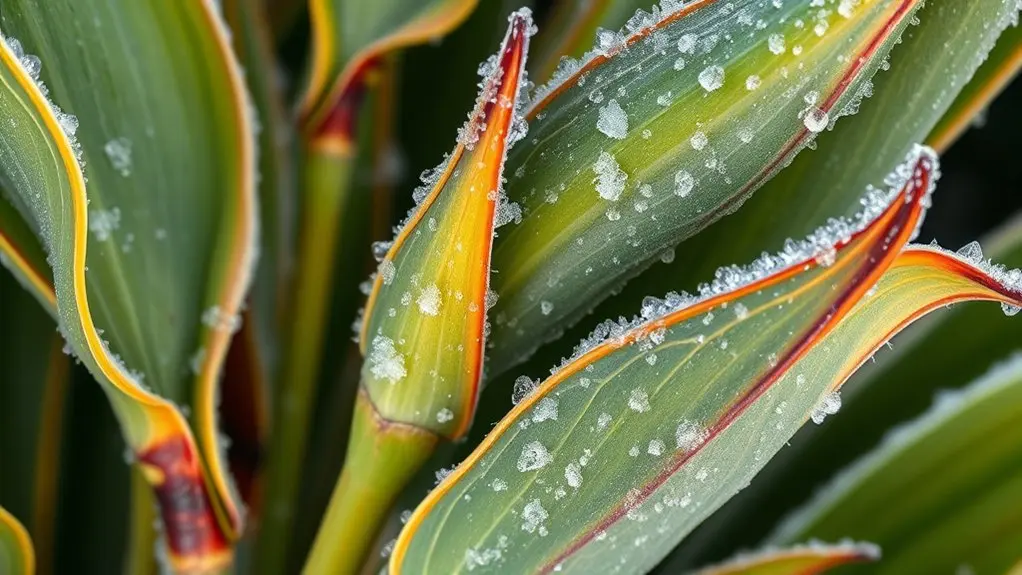
You’ll first notice freeze damage on Bird of Paradise leaves as tattered, brownish-yellow tips or curling edges.
When the cold stress sticks around, the stems might start turning brown or black. They can get limp and develop soft spots too.
Catching these signs early really helps you give the right care and support the plant’s recovery.
Early Leaf Damage
How can you identify early freeze damage on your Bird of Paradise? Look closely for tattered, brownish-yellow tips and edges on the leaves, which indicate initial cold injury. Leaf browning typically begins at the margins and progresses inward as frost tolerance is exceeded.
This damage causes leaves to die back gradually, often requiring you to prune affected areas to prevent further decline. Early signs also include discoloration along leaf veins, signaling freeze stress. Prompt recognition of these symptoms allows you to implement protective measures before damage worsens.
While stems may eventually show injury, focusing on leaf condition provides the earliest and most reliable indicators of frost tolerance limits being surpassed in your Bird of Paradise during colder periods. So, keep a close eye on those leaves!
Stem Injury Signs
When freezing temperatures affect your Bird of Paradise, stem injury often appears as brown or black discoloration starting at the tips or along the stem length. This discoloration signals the beginning of tissue death caused by frost exposure.
You might also notice soft, mushy spots or sunken bark areas along the stem, which means the cells are getting damaged.
Severely injured stems lose their firmness, becoming limp and likely to collapse.
Early signs can be pretty subtle, like dieback or browning at the base of the stem. But if you don’t catch it early, these symptoms usually get worse over time.
Complete tissue death shows up as continuous brown or black discoloration from the base all the way to the tip. The stem also softens and may collapse completely.
Spotting these signs early on helps you figure out how bad the freeze damage is and what steps you need to take to care for your Bird of Paradise.
Progressive Freeze Effects
Following the identification of stem injury signs, it becomes important to observe how freeze damage progresses on both leaves and stems.
Initially, you’ll notice leaf browning starting at the edges, presenting as tattered, brownish-yellow tips. This symptom worsens over time, reflecting limited frost resistance.
Prolonged cold exposure causes leaves to die back entirely, often necessitating pruning to encourage recovery.
On stems, severe freeze effects show up as brown or black discoloration, limpness, and soft spots. These are indicators of near-fatal damage.
These progressive symptoms impair the plant’s vascular system and root health, which compromises its overall well-being.
Recognizing these stages early lets you intervene in time and improve the plant’s chances of survival.
Understanding progressive freeze effects helps you assess the extent of cold injury and take the right protective steps for your Birds of Paradise.
Should You Move Your Bird of Paradise Indoors for Winter?
Although Bird of Paradise plants thrive in tropical climates, you should move yours indoors before temperatures consistently drop below 55°F to prevent cold damage. These plants can’t withstand freezing conditions typical of zones colder than 10-11, and prolonged exposure risks irreversible harm to leaves and roots.
When relocating indoors, place your Bird of Paradise near a south- or west-facing window to guarantee bright, direct light essential for photosynthesis during winter. Just like birdwatching tips emphasize ideal birdhouse placement for shelter and sunlight, positioning your plant correctly indoors maximizes its survival chances.
Proper indoor positioning compensates for reduced outdoor light and temperature fluctuations, maintaining the plant’s physiological processes. If you skip this step, your plant could suffer cold stress, leaf necrosis, and eventually die.
How to Move and Care for Birds of Paradise Indoors
You’ll want to place your Bird of Paradise near a south- or west-facing window so it gets plenty of bright, natural light, especially during the winter months. Bright light is key for keeping it happy indoors.
Try to keep the indoor temperature between 65°F and 75°F—this range is just right for the plant to thrive without any stress.
When it comes to watering, cut back a bit in winter. Only water when the top 1-2 inches of soil feel dry to the touch. This way, you’ll avoid overwatering and keep your plant healthy while it’s inside.
Indoor Light Requirements
Because Birds of Paradise thrive on bright light, providing 12-14 hours of direct sunlight or full-spectrum grow lights daily is essential when moving them indoors. Guaranteeing adequate indoor light mimics their natural environment, supporting photosynthesis and flowering.
Position your plant near a south- or west-facing window to maximize natural illumination.
If natural light is insufficient, supplement with grow lights 12-18 inches above the foliage.
Rotate the plant regularly to promote even growth and prevent legginess caused by uneven light distribution.
Key considerations for indoor light requirements include:
- 12-14 hours of daily light exposure
- Placement near south- or west-facing windows
- Use of full-spectrum grow lights when natural illumination is limited
- Positioning grow lights 12-18 inches above foliage
- Regular rotation to ensure uniform light distribution
Watering And Temperature
When should you move your Bird of Paradise indoors to guarantee its survival? You want to relocate it before night temperatures drop below 55°F to avoid cold stress.
Once inside, place the plant near south- or west-facing windows so it gets plenty of bright, direct light.
Adjust its watering by letting the top 1-2 inches of soil dry out completely before watering again. This helps reduce the risk of root rot while the plant is dormant.
Keep the indoor temperature between 65°F and 75°F to support its natural processes.
Also, try to boost humidity using humidifiers or pebble trays to mimic its native tropical environment.
Before bringing it indoors, give the plant a good rinse and check for pests.
Prune any damaged leaves to help it make a healthy transition.
Following this watering routine and temperature range will really help your Bird of Paradise survive and thrive indoors during winter.
Overwintering Birds of Paradise Outdoors: Tips and Risks
Although Birds of Paradise can tolerate temperatures down to about 24°F (-4°C), even brief exposure to freezing conditions can severely damage their tissues.
Birds of Paradise withstand temperatures near 24°F but remain vulnerable to quick freezing damage.
When overwintering outdoors, effective bird protection relies heavily on microclimate management to reduce cold stress. You should select sheltered sites near walls or windbreaks to create warmer microenvironments.
Without proper precautions, prolonged freezing can kill leaves, stems, and roots. To enhance survival chances, consider these tips:
- Plant in locations with natural wind protection
- Apply thick mulch around the root zone
- Use breathable covers during cold snaps
- Avoid low-lying frost pockets
- Monitor local temperatures closely
Implementing these measures helps reduce risks but doesn’t guarantee survival below USDA zone 10 where damage is common without additional protection.
Protecting Outdoor Birds of Paradise From Frost and Freeze
If temperatures drop near or below 24°F (-4°C), you need to take immediate steps to protect outdoor Birds of Paradise from frost and freeze damage. Start by choosing cultivars known for slightly higher cold tolerance.
Plant them in sheltered, sunny spots near structures or other plants to create a microclimate that helps reduce the risk of cold injury.
Apply 2-3 inches of organic mulch around the roots to insulate and keep the soil temperature steady.
When cold spells hit, use frost cloth or breathable fabric covers to shield the leaves and stems. This way, you protect the plant without trapping moisture, which can cause disease.
Make sure to remove any frost-damaged foliage quickly to reduce stress on the plant.
Keep an eye out for pest infestations since weakened plants are more vulnerable.
Using all these strategies together really boosts your Birds of Paradise chances of surviving the freeze and staying healthy.
Transplanting and Root Care Before Winter
Protecting your Birds of Paradise from frost damage is only part of winter care. Addressing their root health before the cold sets in can really improve their chances of survival. Proper root excavation during transplanting is super important to avoid injuring those large, fleshy roots that help the plant take up nutrients.
You should also remove older, damaged leaves to minimize transplant shock and encourage strong root growth. When handling the roots, be gentle and replant the plant at the same soil depth it was originally at to keep it stable.
After transplanting, water the plant thoroughly but don’t overdo it—too much moisture can lead to root rot.
If the ground is frozen or too cold, potting the plant is a good idea. This way, you can better control the soil temperature and moisture levels.
Carefully excavate roots to prevent damage
Optimize transplant timing before severe cold
Remove damaged foliage to reduce shock
Replant at consistent soil depth
Control watering to avoid root rot
Managing Freeze Damage and Encouraging Recovery
When freeze damage occurs on your Bird of Paradise, you’ll first notice tattered, brownish-yellow leaf edges. These may worsen into leaf and stem dieback.
Severe cold exposure compromises frost resilience, often causing brown or black stems, limpness, and soft trunk spots. These signs mean the plant’s cold tolerance limits have been exceeded.
To manage freeze damage, promptly remove affected leaves without cutting into the trunk. This helps minimize further injury and reduces the risk of infection.
Mulching and protecting roots can enhance recovery by maintaining soil temperature and moisture. This support encourages regrowth over the following seasons.
Early detection of cold damage symptoms is essential because it lets you act quickly. Acting fast improves your plant’s chances of revival.
Understanding and addressing freeze effects scientifically can boost your Bird of Paradise’s resilience to cold stress. So, keep an eye out and take care to help your plant bounce back.
Seasonal Care Strategies for Thriving Birds of Paradise
After addressing freeze damage, maintaining ideal conditions throughout the colder months supports your Bird of Paradise’s long-term health and vigor. Unlike bird migration where species relocate to preserve feather coloration and survival, your plant requires strategic care to endure winter.
Focus on minimizing stress from cold and moisture fluctuations by employing these practices:
- Select microclimates with natural windbreaks or sun exposure for planting.
- Apply mulch to insulate roots against temperature extremes.
- Shelter plants near walls or move them indoors to maintain 65°F–75°F.
- Provide bright, indirect light indoors to promote photosynthesis without stress.
- Reduce watering and avoid fertilization to prevent root rot during dormancy.
These tactics simulate natural protective behaviors seen in birds, ensuring your Bird of Paradise thrives despite seasonal challenges.
Long-Term Tips to Keep Your Bird of Paradise Healthy Through Winter
Although Birds of Paradise are resilient, maintaining their health throughout winter requires consistent care and attention to environmental conditions. To support bird adaptation to colder months, regularly inspect and prune dead or damaged leaves. This reduces stress and promotes vitality.
Apply a thick layer of mulch around the roots to insulate against cold soil temperatures. It mimics natural ground cover during seasonal migration.
Indoors, make sure the plant gets bright, indirect light and keep temperatures stable between 65°F and 75°F.
Reduce watering frequency and avoid fertilizing to prevent root rot and encourage dormancy.
For outdoor plants, protect them with frost covers or mulch during cold snaps.
These long-term strategies help the plant survive by addressing its physiological needs during winter dormancy and environmental changes.
Frequently Asked Questions
Can Birds of Paradise Flower During Winter Indoors?
Yes, you can encourage Birds of Paradise to flower indoors during winter by providing sufficient indoor lighting and maintaining precise temperature regulation between 65°F and 75°F.
This helps create ideal conditions for blooming despite limited natural sunlight. Just make sure your plant gets enough light and stays cozy.
With a little extra care, your Birds of Paradise can still put on a beautiful show even when it’s cold outside.
What Soil Type Is Best for Winter Care?
You’ll want soil with excellent drainage, usually over 60% sandy or loamy. This helps meet nutrient requirements and keeps root rot at bay.
Adding organic compost is a great idea because it boosts fertility. Mulching is also important since it maintains temperature. That’s vital for protecting roots during winter’s cold, moist conditions.
How Often Should I Fertilize in Winter?
You should reduce seasonal fertilization during winter, applying a balanced, diluted fertilizer only sparingly or when new growth appears. This respects the plant’s slowed growth cycle, preventing nutrient overload and stress during dormancy.
Just remember, plants aren’t growing as much in winter, so they don’t need as many nutrients. It’s better to hold back a bit and feed them more once you see them starting to grow again. This way, you keep your plants healthy without overdoing it.
Do Birds of Paradise Attract Pests in Winter?
Yes, Birds of Paradise can attract seasonal pests in winter. You should prioritize pest prevention by regularly inspecting and cleaning leaves.
Also, maintaining proper humidity and ensuring good airflow helps minimize infestations from pests like scale and mealybugs. It’s all about keeping your plant environment balanced and healthy.
Can Pruning Help Birds of Paradise Survive Winter?
You might think pruning harms your plant, but proper pruning techniques actually boost winter protection by removing damaged parts.
It encourages resilient growth and improves airflow, which reduces fungal risks. This can really enhance your Bird of Paradise’s chances of surviving the cold months.
Conclusion
You can help your Bird of Paradise survive winter by understanding its cold hardiness limits and recognizing early freeze damage. Moving it indoors or providing proper outdoor protection is essential since “an ounce of prevention is worth a pound of cure.”
Careful transplanting, root management, and seasonal strategies will support recovery and growth. With detailed attention and timely action, you’ll maintain a healthy plant through winter’s challenges.
This way, you’ll ensure it thrives year after year.