
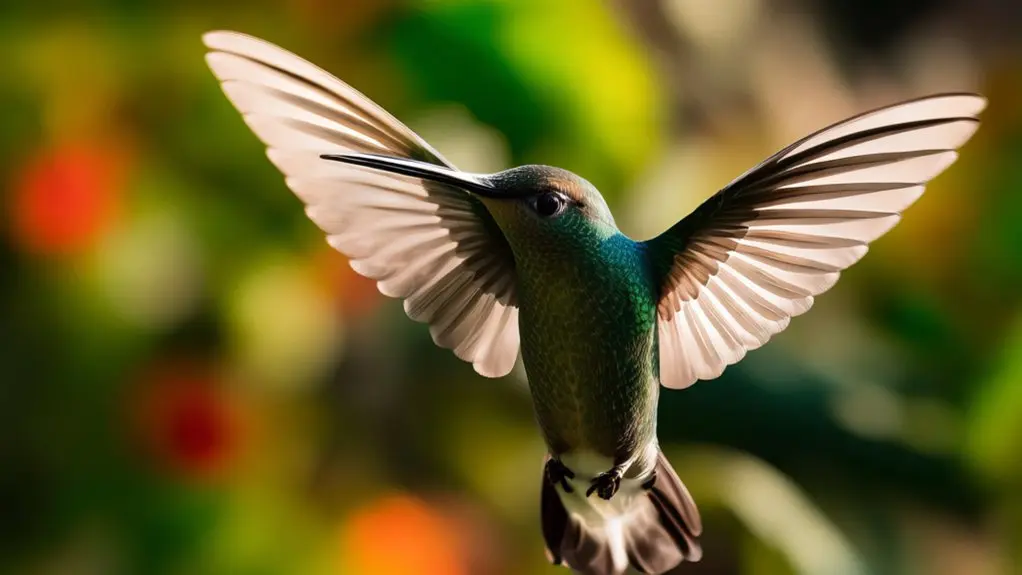
You can only see true, sustained backward flight in hummingbirds, thanks to their unique wing anatomy and rotator cuff joint. These features enable rapid, figure-eight wingbeats and precise multidirectional movement.
Other birds, like warblers or herons, can flutter backward briefly but don’t have the muscle or wing structure for continuous backward flight. Sometimes, environmental factors like wind create illusions of backward movement.
If you want to understand exactly why hummingbirds are unique and how to spot these amazing feats, there’s more to uncover.
Which Birds Can Actually Fly Backwards?
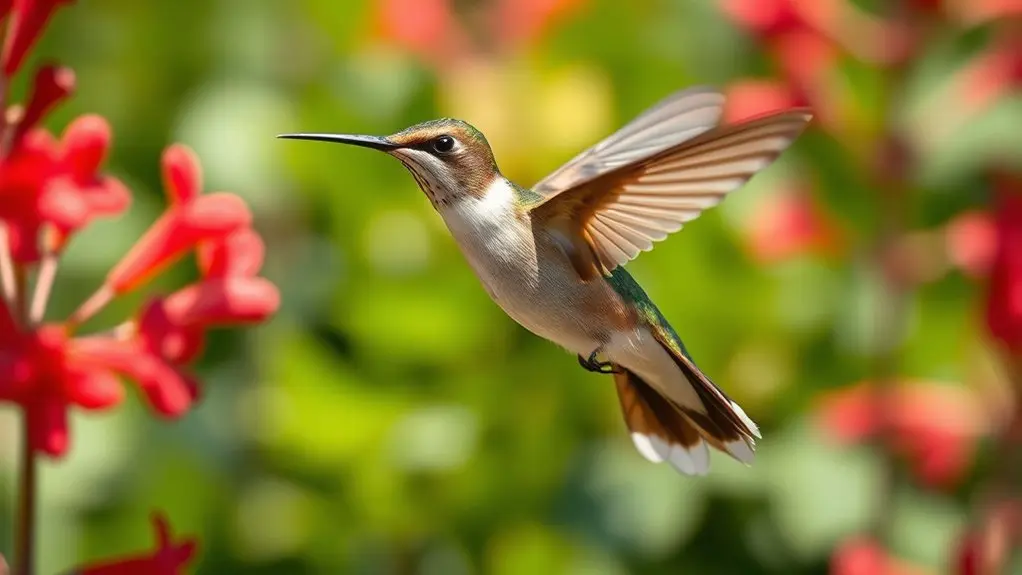
Although many birds can flutter backward briefly, only hummingbirds can sustain true backward flight. Their unique wing morphology, characterized by a rotator cuff joint, enables multidirectional wing movement essential for this flight mechanics feat.
Unlike other birds, hummingbirds flap their wings in a precise figure-eight pattern, generating lift on both the upstroke and downstroke. This continuous lift production allows sustained backward propulsion, a capability unmatched by warblers, egrets, or herons.
Hummingbirds’ figure-eight wing motion creates lift on both strokes, enabling unique sustained backward flight.
Those birds can only perform brief backward fluttering as defensive maneuvers. So, when you see a bird flying backward for more than a moment, it’s almost certainly a hummingbird.
Understanding these specialized anatomical adaptations really clarifies why hummingbirds alone achieve controlled, prolonged backward flight. It highlights the intricate relationship between wing structure and flight dynamics in avian species.
Pretty amazing how nature designs such unique features!
Can Other Birds Briefly Fly Backwards?
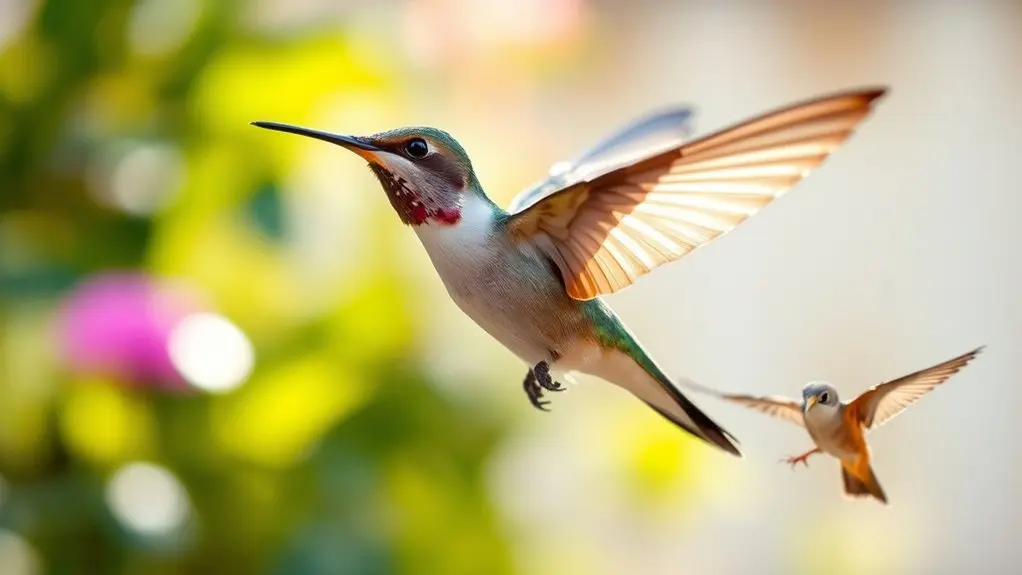
When you observe birds like warblers, egrets, or herons moving briefly backward, it’s usually a quick flutter rather than sustained flight. This brief backward movement serves primarily as an evasive or defensive maneuver rather than intentional flight.
Unlike hummingbirds, these species lack specialized wing mechanics necessary for continuous backward flight. Their wing structure and muscle arrangement limit them to momentary backward motions, often triggered by environmental factors like wind or sudden obstacles.
Such movements rarely influence their migration patterns, as long-distance travel depends on forward flight efficiency.
Similarly, during breeding behaviors, brief backward fluttering may help avoid predators or navigate confined spaces but doesn’t play a significant role in courtship or nesting.
Understanding these constraints clarifies why only hummingbirds have evolved true backward flight capabilities.
Why Can Only Hummingbirds Fly Backwards?
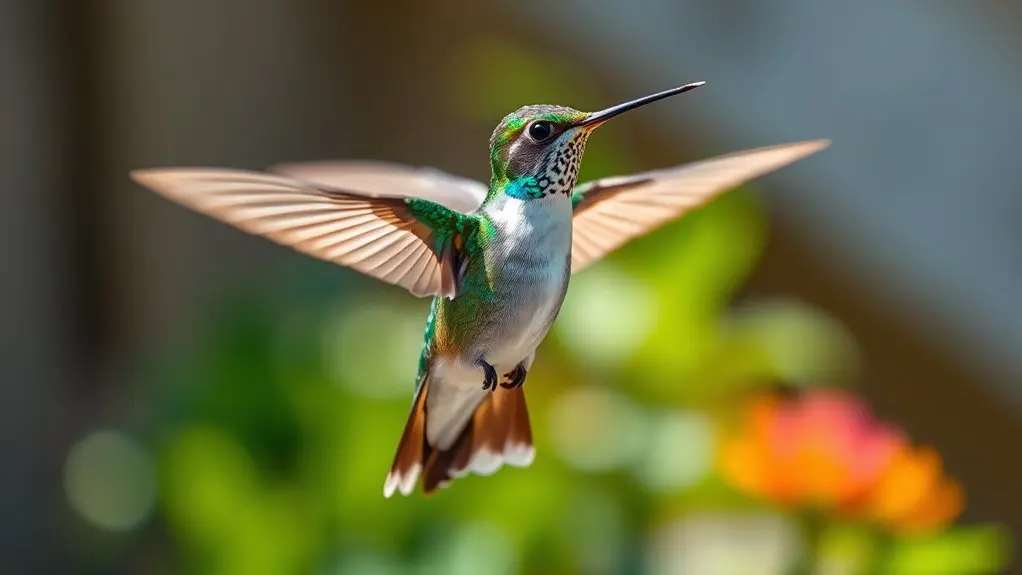
Because hummingbirds possess a uniquely flexible shoulder joint called the rotator cuff, their wings can rotate through a full range of motion that most other birds just don’t have. This special wing structure lets them move their wings in a figure-eight pattern, which is key to how they fly.
Unlike other birds that mainly rely on forward wing strokes, hummingbirds generate lift on both the forward and backward strokes by carefully controlling how their wings are oriented. Their wings flap super fast—over 50 times per second—which lets them maneuver in all kinds of ways and hover steadily.
This unique setup is what makes it possible for hummingbirds to fly backwards. It allows them to create thrust and lift in both directions.
Other birds don’t have this kind of rotator cuff flexibility or wing design, so they mostly fly forward and can’t keep flying backwards like hummingbirds do.
How Hummingbird Wings Enable Backward Movement
The unique flexibility of hummingbird shoulder joints allows their wings to move through a figure-eight pattern that generates lift on both the upward and backward strokes. This wing flexibility is critical because it enables the wings to invert and twist, producing aerodynamic forces necessary for backward flight.
Hummingbird shoulder flexibility enables figure-eight wing motion, creating lift on both upward and backward strokes.
The rotator cuff muscles help with multi-directional wing movement, giving you precise flight control.
Flight mechanics here rely on rapid wing beats, over 50 times per second, which generate continuous lift during both stroke phases. This bidirectional lift lets you maneuver backward smoothly, unlike most birds whose wing motion only produces forward thrust.
By coordinating this complex wing motion, hummingbirds achieve remarkable control and stability.
It’s a sophisticated integration of wing flexibility and flight mechanics that’s essential for their unique backward movement. Pretty amazing how evolution shaped such a precise flying machine, isn’t it?
How Hummingbird Anatomy Powers Their Flight
Although hummingbird flight may seem effortless, it depends on a finely tuned anatomical design that powers their extraordinary aerial abilities. You’ll notice their wing flexibility, enabled by a specialized rotator cuff joint, allows multidirectional rotation critical for complex maneuvers.
Their powerful pectoral muscles, which account for about 30% of their body weight, drive wing beats exceeding 50 times per second with remarkable muscle efficiency. This rapid contraction sustains energy-intensive flight while minimizing fatigue.
The unique figure-eight wing motion generates lift in both forward and backward directions, supported by long, lightweight bones that reduce inertia and enhance maneuverability.
Together, these precise anatomical features create an optimized system, enabling hummingbirds to perform sustained, acrobatic flight patterns that few other birds can match.
Why Hummingbirds Need to Fly Backwards to Feed
When you observe hummingbirds feeding, you’ll see they often fly backwards to position themselves precisely without harming delicate petals or disturbing nectar. This backward flight relies on their feather flexibility and flight stability to maneuver efficiently in complex floral environments.
Hummingbirds fly backwards to delicately position themselves without damaging petals or nectar.
You’ll notice this behavior allows them to approach flowers closely without damaging petals and access nectar deep within narrow corollas.
They also maintain flight stability while hovering and retreating, which helps them conserve energy by minimizing unnecessary movements. Plus, they can quickly retreat backward after feeding to sustain their feeding rhythm.
Their ability to fly backwards is essential because it optimizes nectar extraction while preserving delicate flower structures. The combined feather flexibility and advanced motor control enable precise adjustments in flight, ensuring hummingbirds feed efficiently and safely in diverse floral habitats.
Why Wind Creates Illusions of Backward Flight
When you watch birds flying into strong headwinds, it can look like they’re moving slower or even flying backward. That happens because the wind affects how fast the bird moves over the ground.
So, from where you’re standing, it changes how you see the bird’s direction.
Basically, the wind messes with the bird’s ground speed, which tricks your eyes. Even though the bird is definitely moving forward, the way the wind pushes against it can create this weird illusion of backward flight.
Once you get this, it makes a lot more sense why wind can play tricks on what you see.
Wind Effects On Perception
How does wind influence your perception of a bird’s flight? Wind distortion can really mess with how you see things, sometimes making it look like a bird is flying backward. When strong winds blow, sometimes as fast as 100 kph, your brain tries to make sense of the bird’s movement based on the wind and the surroundings, not the bird’s actual path.
This can cause a gap between what’s really happening and what you think you’re seeing.
There are a few key things that cause these illusions. Wind speed can change how fast the bird looks like it’s moving. Where you stand also affects the angle you see the bird from. Plus, there’s the relative motion between the bird, the wind, and the environment itself.
Visual cues can get distorted because the background moves with the wind, which tricks your eyes. Sometimes, your brain misreads which way the bird is actually flying due to these changing points of reference.
Knowing how wind affects perception makes it easier to understand why birds seem to break the rules of physics but in reality, they’re not flying backward at all.
Relative Motion Explained
Why does a bird sometimes appear to fly backward despite moving forward? This happens because of perception illusions caused by relative motion.
When wind blows in a certain direction, it changes the bird’s actual velocity vector.
You see the combined effect of the bird’s flight speed and the wind’s velocity through vector addition. If the wind’s speed opposes the bird’s movement strongly enough, the bird may seem to move backward from your viewpoint.
Environmental factors like wind speed and direction have a big impact on this visual perception.
Your brain interprets the bird’s position changes against the background, which can lead to misreading its true path.
Understanding relative motion helps explain why wind creates these illusions of backward flight, even though the bird is actually moving forward.
Are There Birds That Fly Backwards in the UK?
You won’t find hummingbirds flying around in the wild here in the UK. That’s because they’re native to the Americas and have special wing structures that let them fly backwards for a while.
If you think you’ve seen a hummingbird, it’s probably a hummingbird hawkmoth instead. These moths look a lot like hummingbirds but can’t actually fly backwards.
Birds native to the UK just don’t have the right anatomy to fly backwards. Sometimes you might catch a quick backward movement, but that’s usually just a defensive move—not real sustained backward flight.
Hummingbird Presence In UK
Where can you find birds that fly backwards in the UK? The answer is that true hummingbirds, known for their backward flight, are absent from the UK’s forest canopies due to unsuitable climate and habitat.
These birds are native to the Americas and don’t participate in bird migration to the UK.
However, you might encounter creatures resembling hummingbirds:
- Hummingbird hawkmoths, insects often mistaken for hummingbirds
- No native UK bird species capable of backward flight
- Limited sightings of actual hummingbirds, usually escapes or misidentifications
- UK’s temperate environment unsuitable for hummingbird survival
- Visual confusion in dense forest canopies leading to misreports
Hummingbird Hawkmoth Confusion
Although true hummingbirds don’t inhabit the UK, you might easily mistake the hummingbird hawkmoth for one because of its striking resemblance and similar flight behavior.
Unlike birds, the hawkmoth is an insect with specialized wing movements that allow brief backward flight. This mimics the hummingbird’s flight patterns pretty closely. But there are some clear differences to spot.
Feather coloration, which is a key identifier in birds, contrasts with the hawkmoth’s scaled wings. Also, their migration patterns aren’t the same. Hummingbirds migrate across continents, while hawkmoths tend to have more localized seasonal movements.
| Feature | Hummingbird | Hummingbird Hawkmoth |
|---|---|---|
| Taxonomy | Bird | Insect |
| Flight Ability | Hover, backward flight | Hover, brief backward flight |
| Wing Structure | Feathers | Scales |
| Migration Patterns | Long-distance migration | Localized seasonal shifts |
Native Bird Species Limitations
While some UK birds can briefly maneuver backward during evasive actions, none have the wing shape needed for sustained backward flight like hummingbirds. Their feather structure and flight mechanics limit their ability to reverse continuously. So, any backward movements are usually just momentary and defensive.
Think about this: warblers and herons can only fly backward for a very short time. Sustained backward flight needs special wing joints that UK birds just don’t have.
Hummingbirds are different because their unique feather structure lets them fly truly backward.
Sometimes, what looks like backward flight is just a visual trick. But no native UK species actually perform intentional, continuous backward flight.
Knowing these facts helps explain why UK birds can’t match hummingbirds when it comes to flying backward.
Hummingbird or Hummingbird Moth: How to Tell Them Apart
Even if you’re familiar with hummingbirds, distinguishing them from hummingbird moths can be challenging because they’re similar in size and both hover around flowers.
One way to tell them apart is by looking at their feathers. Hummingbirds have iridescent, brightly colored feathers, while moths have fuzzy, scaled wings.
Feathers reveal the difference: hummingbirds shine with iridescence, while moths sport fuzzy, scaled wings.
Another key difference is the antennae. Hummingbird moths have noticeable antennae, but birds don’t.
You might also notice their flight speeds are different. Hummingbirds flap their wings rapidly with a unique figure-eight motion that lets them fly backward.
On the other hand, hummingbird moths can hover too, but they can’t fly backward like hummingbirds because their wing structure isn’t built for that.
Frequently Asked Questions
Can Hummingbirds Hover in Place for Long Periods?
You can observe hummingbirds hover in place for long periods by understanding bird flight mechanics. Their rapid, figure-eight wing motion and precise adjustments in hummingbird behavior generate continuous lift. This enables sustained stationary flight despite its high energy demands.
It’s pretty amazing how they manage to stay still in the air like that, isn’t it? Their wings move so fast and in such a unique pattern that it keeps them perfectly balanced. This takes a lot of energy, but hummingbirds are built for it!
Do Hummingbirds Migrate Long Distances?
Yes, hummingbirds migrate long distances, relying on advanced bird migration patterns and hummingbird navigation skills. You’ll see them use visual cues and Earth’s magnetic field to travel solo, covering thousands of miles efficiently each season.
It’s pretty amazing how these tiny birds manage such a huge journey all by themselves. They really know their way around!
How Fast Can Hummingbirds Flap Their Wings?
Wondrous wing beat frequency whizzes wildly as hummingbirds flap over 50 times per second. You’ll find their flight mechanics finely tuned, powered by massive muscles, enabling rapid, precise movements like hovering and backward flight.
It’s pretty amazing how they manage such speed and control. Their wings move so fast it almost looks like a blur! This lets them zip around flowers and feeders with ease.
What Do Hummingbirds Eat Besides Nectar?
Besides nectar, you’ll find hummingbirds eating small insects like ants and beetles. These little bugs complement nectar by providing essential amino acids.
This helps hummingbirds get balanced nutrition, which is great for their role as pollinators. Plus, it supports their high metabolic demands in a precise and efficient way.
Are Hummingbirds Attracted to Specific Flower Colors?
Imagine you plant red tubular flowers in your garden; hummingbirds will be drawn to them due to their flower color preferences. You’ll notice how their hummingbird visual cues help them identify bright, contrasting colors for efficient nectar feeding.
They really love those vibrant shades because it makes finding food easier. It’s like they have a built-in radar for the best nectar spots. So, adding red flowers can turn your garden into a hummingbird hotspot!
Conclusion
Imagine watching a hummingbird hover like a tiny helicopter, darting backwards with precision unmatched by any other bird. Its unique wing structure lets it defy typical avian limitations, much like a skilled dancer moving fluidly against the current.
While most birds can only briefly glide backward, hummingbirds rely on this remarkable ability to feed efficiently. Understanding this delicate balance between anatomy and behavior highlights nature’s intricate engineering at its finest.