
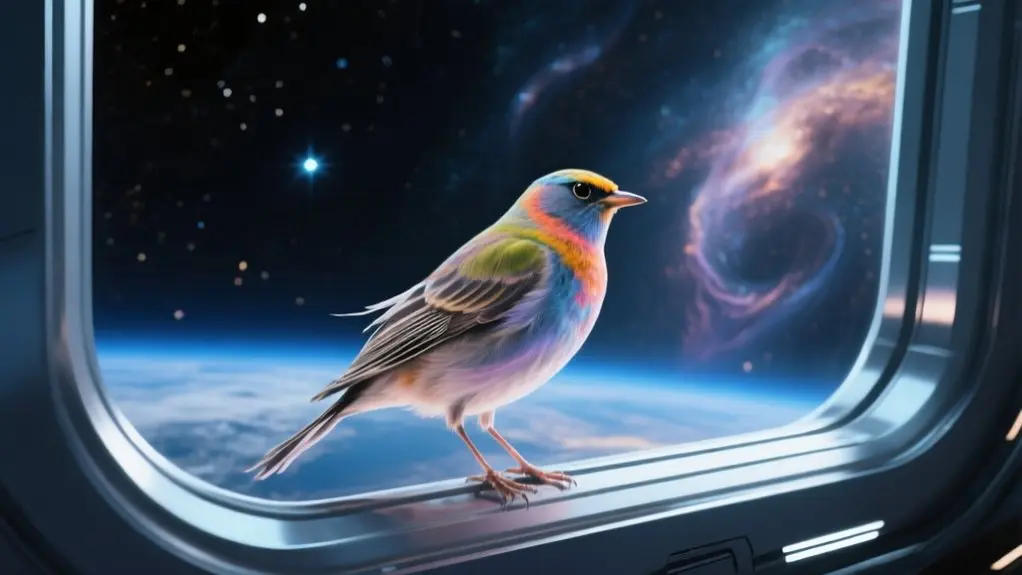
You can’t expect birds to fly in space because their flight relies entirely on air and gravity. Both of these are missing beyond Earth’s atmosphere. Bird wings generate lift and thrust by manipulating airflow, which is absent in a vacuum.
Without atmospheric pressure, oxygen, and gravity, their muscles can’t function. Plus, the aerodynamic forces just stop working. This means wings become ineffective, making natural flight impossible.
If you dig into the specifics, it’s clear why bird flight mechanics fail completely outside Earth’s environment. Simply put, space just isn’t the right place for birds to spread their wings.
Why Do Birds Need Air to Fly?
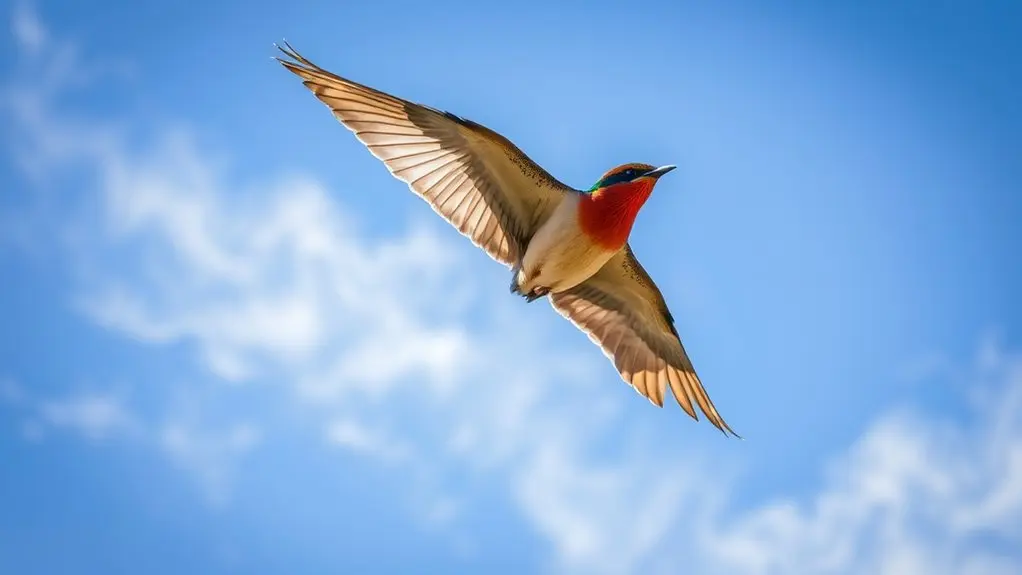
Although you mightn’t realize it, birds depend entirely on air to fly. Air provides the oxygen essential for powering flight muscles, enabling sustained energy output. The feather structure plays a critical role by interacting with airflow to generate lift.
The beak function, though not directly involved in flight mechanics, supports aerodynamics by minimizing drag.
Birds extract oxygen efficiently through their lungs, aided by hollow bones and air sacs that reduce weight and optimize respiratory efficiency. Without air, the muscular contractions necessary for wing movement would cease, and the aerodynamic forces that feathers manipulate wouldn’t exist.
This interdependence on air shows why flight can’t happen in a vacuum. Neither the metabolic nor mechanical needs for flight can be met without atmospheric air.
How Do Gravity, Lift, Drag, and Thrust Work in Bird Flight?
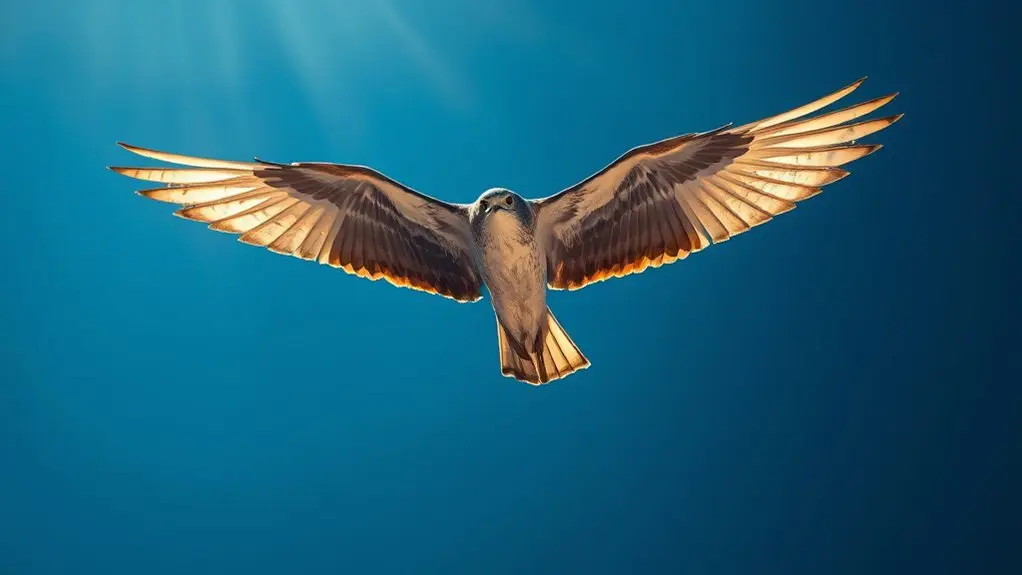
When you observe a bird in flight, you’re witnessing a complex interaction of forces. Gravity pulls it downward, while lift generated by wing movement counters this pull to keep it airborne. The bird’s wing structure plays a critical role in this process. Its shape and flexibility optimize lift production through precise airflow manipulation.
Drag is the air resistance opposing motion, and it slows the bird down. But flight biomechanics help reduce drag by streamlining the body and adjusting wing angles. Thrust propels the bird forward. This thrust comes from flapping or gliding motions that overcome drag.
During takeoff, lift and thrust need to work together to surpass gravity so the bird can ascend successfully. When you understand how these forces interact, it’s easier to see how birds achieve such efficient flight. It really highlights the sophisticated biomechanics behind how birds move through the air.
How Do Birds Generate Lift and Thrust on Earth?
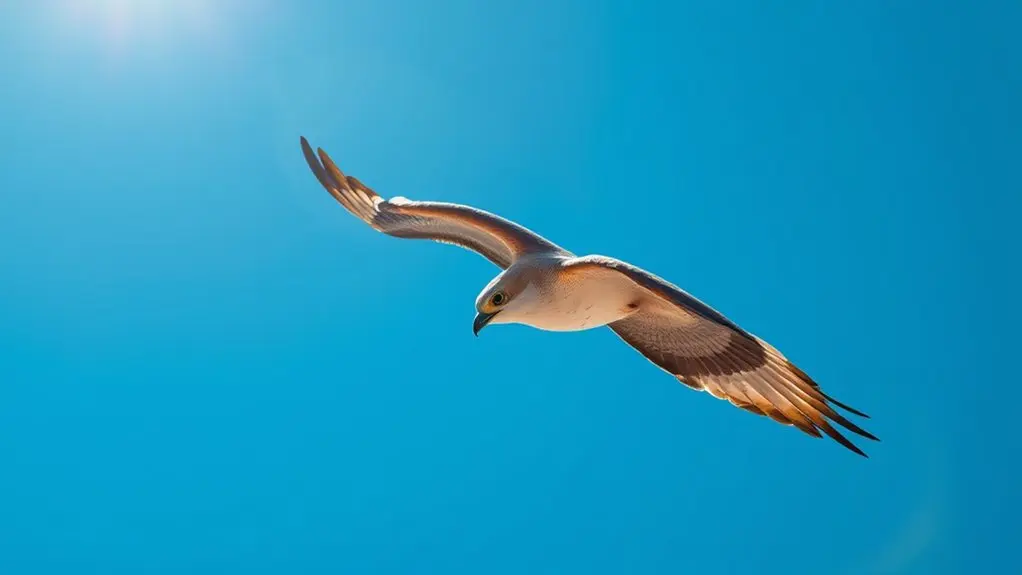
Understanding the interplay of forces like gravity, lift, drag, and thrust sets the stage for examining how birds actively generate lift and thrust on Earth. You’ll find that birds rely on specialized anatomy and biomechanics to optimize flight efficiency.
Feather flexibility allows subtle adjustments to airflow, enhancing lift and minimizing drag. Wing shape is critical. Curved upper surfaces accelerate airflow, creating pressure differentials that produce lift.
The pectoralis major muscle powers the downstroke, generating thrust by moving wings downward and forward. The supracoracoideus muscle lifts wings during the upstroke via tendon mechanics, preparing for the next power stroke.
Large keel bones anchor these muscles, providing structural support essential for sustained flight.
This precise coordination of morphology and muscular action enables birds to overcome gravity and propel themselves effectively through Earth’s atmosphere. It’s pretty amazing how all these parts work together so seamlessly.
Why Does Space’s Vacuum Make Bird Flight Impossible?
Since space lacks air molecules, birds can’t generate the airflow necessary to produce lift through wing movement. Without air, the aerodynamic forces that enable lift and thrust become nonexistent, making flight mechanics ineffective.
Also, the vacuum environment prevents bird flight muscles from functioning properly, as they require oxygen, which is absent in space, to sustain energy production.
Birds’ hollow bones, adapted for buoyancy in Earth’s atmosphere, offer no structural advantage in a vacuum, which undermines their support system.
The absence of atmospheric drag further eliminates any resistance needed for controlled wing strokes.
These factors together make natural bird flight impossible in space. So, surviving or flying there would need huge cosmic adaptations or artificial setups to mimic Earth-like atmospheric conditions.
How Does Lack of Atmosphere Stop Birds From Flying?
Although you might imagine birds effortlessly soaring through space, the lack of atmosphere makes this impossible by eliminating the essential conditions for flight. Flight depends on the interaction between a bird’s wing structure and the surrounding air to generate lift and thrust.
In space, the absence of atmospheric pressure disrupts these aerodynamic forces, preventing flight. No air particles exist for airflow over the bird wing structure to create lift.
Without atmospheric pressure, the bird can’t develop necessary aerodynamic forces. Lack of air means no drag or resistance for controlled wing flapping.
The vacuum also prevents oxygen intake, disabling muscle function needed for flight. Weightlessness removes gravitational pull, eliminating directional control mechanisms.
Why Can’t Birds Adapt to Fly in Space?
You can’t really expect birds to adapt to flying in space because their whole flight depends on gravity and air—and both of those are missing out there.
Without gravity, their muscles and bones don’t get the mechanical support they need to move their wings and stay stable.
Plus, since there’s no air, there’s no pressure difference to create lift, which means traditional flight just can’t happen.
Lack Of Gravity
Because birds depend on gravity to generate lift, they can’t produce the necessary aerodynamic forces to fly in space. Their feather structure and muscle coordination evolved for Earth’s gravity, which is essential for bird migration and controlled flight.
In microgravity, these adaptations become ineffective.
You’ll find these key limitations: lack of gravitational force disrupts lift generation, and the absence of airflow prevents aerodynamic wing function. Flight muscles can’t perform Earth-like strokes, and birds can’t stabilize, perch, or land without gravity. Plus, their feather design is optimized for gravity-dependent air resistance.
Without gravity, the biomechanical and aerodynamic principles that underpin flight break down completely. So, birds just can’t adapt to the space environment despite their evolutionary finesse on Earth. It’s a whole different ballgame out there!
Absence Of Air
How can birds possibly fly where there’s no air to push against? Flight depends on aerodynamic lift generated by airflow over wings, which is absent in space. Birds rely on manipulating wing angles and thrust production, mechanisms enabled by air resistance.
Their feather adaptations, optimized for controlling airflow during bird migration, become ineffective without an atmosphere.
The lightweight skeleton and hollow bones improve flight efficiency on Earth but offer no advantage in a vacuum. Without air, birds can’t engage their flight muscles effectively or generate lift and drag forces essential for controlled movement.
Space lacks the environmental parameters like airflow, lift, and drag that underpin avian flight mechanics.
What Are the Limits of Bird Flight Beyond Earth’s Atmosphere?
You can’t ignore the absence of gravity when thinking about bird flight beyond Earth’s atmosphere because it completely changes how forces act on a bird’s body.
Plus, without air, wings just can’t generate lift or thrust. That means the usual mechanics birds depend on for controlled movement simply don’t work.
Gravity’s Role Absent
Why can’t birds sustain flight beyond Earth’s atmosphere? Their flight mechanics depend heavily on gravity to generate lift and maintain stability. Without gravity, the essential force balance that enables controlled movement just collapses, making traditional flight impossible.
Think about this: gravity provides the downward pull necessary for lift generation. Without it, the aerodynamic forces birds rely on get all messed up.
Plus, flight mechanics need atmospheric air particles, which are missing in space.
Also, without gravity-driven buoyancy, birds can’t achieve thrust or lift. In microgravity, birds would simply float or drift uncontrollably.
So, the lack of gravity basically wipes out the fundamental principles of bird flight. That’s why they can’t sustain flight beyond Earth’s atmosphere.
Space environments just make their natural flight mechanics totally ineffective.
Wing Mechanics Without Air
Where do bird wings lose their function beyond Earth’s atmosphere? Bird wings depend entirely on air to generate lift and thrust through specialized wing adaptation. Their flight mechanics manipulate air currents and resistance, enabling controlled movement.
But in the vacuum of space, the absence of atmosphere eliminates aerodynamic forces critical for flight. Without air pressure, wings can’t produce lift or stabilize motion, making those intricate wing adaptations useless.
So, flight mechanics designed for atmospheric conditions just don’t work beyond Earth’s atmosphere. You can’t expect bird wings to function in space because their ability to interact with air, which is essential for lift and thrust, isn’t there.
This basic limitation means birds are restricted to environments with air, making flight impossible in the vacuum of space.
Frequently Asked Questions
Can Birds Survive in Space Without Air?
You can’t expect birds to survive in space without air since their avian adaptation relies on oxygen-rich environments. Their bird metabolism demands constant oxygen intake, which space lacks. That makes survival impossible without artificial life support systems.
Think about it—birds need air to breathe, just like we do. Without it, their bodies simply can’t function properly. So, unless we provide something like a space suit or a controlled habitat, they wouldn’t make it out there.
Do Birds Need Special Suits to Go to Space?
You’ll need special suits if you want birds to survive space, as avian navigation and bird migration rely on Earth’s atmosphere. These suits protect their unique anatomy, ensuring oxygen, pressure, and radiation regulation for survival beyond Earth.
Basically, birds need the right environment to keep doing what they do best. Without these suits, space would be way too harsh for them. So, yes, special gear is a must for birds venturing into space.
Has Any Bird Ever Been Sent to Space?
No bird has ever been sent to space, so you won’t find data on bird migration or avian navigation beyond Earth. Their flight mechanisms rely on gravity and atmosphere, conditions absent in space environments.
Basically, birds need air to fly and gravity to guide them, and since space doesn’t have those, it’s not really a place for birds to navigate. So, scientists haven’t sent birds up there to study how they might handle it. It’s just not practical or useful for understanding their natural behaviors.
How Do Space Conditions Affect Bird Physiology?
You’d find it striking that bird migration relies on gravity, which space lacks. Space conditions hinder avian adaptations, disrupting muscle function and orientation. This causes physiological stress that prevents birds from maintaining flight or normal bodily functions in microgravity.
It’s pretty wild to think about how much gravity affects birds. Without it, their usual ways of moving and navigating just don’t work the same. So, in space, birds really struggle to do what they normally do on Earth.
Could Birds Use Rockets to Fly in Space?
You can’t rely on rockets for bird migration or avian navigation because birds lack propulsion and life support systems. Their biological adaptations are Earth-specific, making rocket-assisted space flight impossible and incompatible with their natural navigation methods.
In other words, birds just aren’t built for space travel. Their bodies and instincts evolved to help them fly in the atmosphere, not beyond it. So, using rockets isn’t something that fits with how birds naturally move and survive.
Conclusion
You can’t teach an old bird new tricks. Birds rely on air to generate lift and thrust, which makes flight in space impossible. Without an atmosphere, the forces of gravity, drag, and lift that enable flight just vanish.
That leaves birds unable to maneuver or keep moving. Even though evolution is pretty adaptable, the vacuum of space throws up some physical barriers that are way too tough to overcome.
Understanding these limits really shows how much bird flight depends on Earth’s environment. It highlights the big challenges that come with trying to fly beyond our atmosphere.