
You can’t fly in zero gravity because birds depend on gravity to generate lift and maintain orientation. Their wing movements push against air and gravity to create thrust and stability, which vanish in microgravity. Without these forces, wings produce no lift, causing birds to float passively and lose balance.
Flight mechanics and feather function break down, making active flight impossible. It’s pretty fascinating when you think about it—gravity plays a huge role in how birds fly. Exploring how gravity affects flight reveals deeper insights into bird physiology and space biology.
Why Birds Need Gravity to Fly
How exactly does gravity enable birds to fly? Gravity provides the essential downward force that bird wings push against to generate lift. Without this opposing force, their feather adaptation, designed to optimize airflow and reduce drag, loses effectiveness.
You rely on gravity to maintain orientation and stability, which is vital for controlled flight and precise migration patterns. In zero gravity, the absence of weight means wings can’t push against either air or surface, disrupting lift generation and balance.
Feather adaptation alone can’t compensate for the lack of gravitational pull, making flight mechanics ineffective. So, gravity is indispensable not only for producing lift but also for enabling birds to navigate long distances efficiently during migration by maintaining proper directional control.
How Lift Works for Birds on Earth
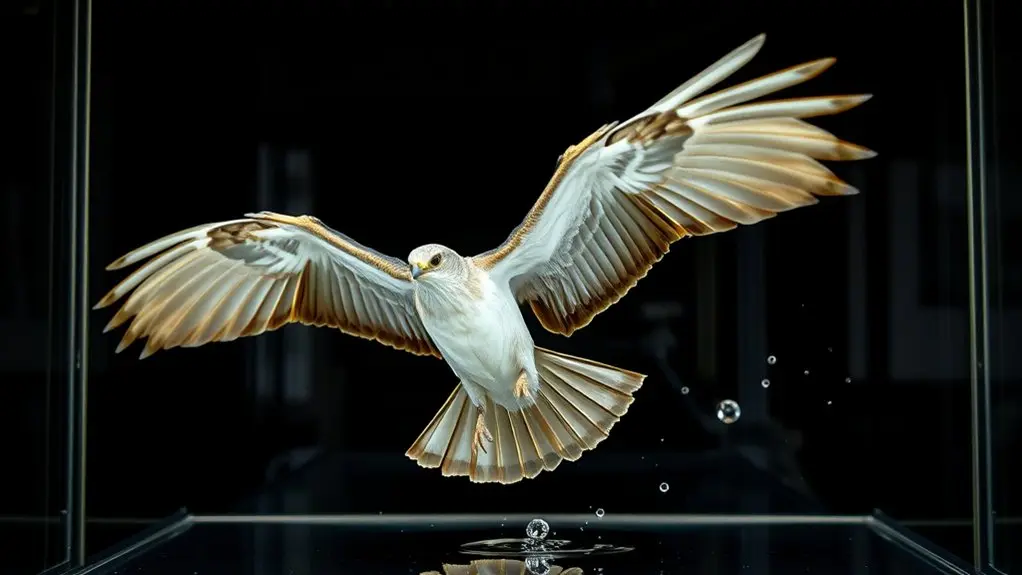
You generate lift by moving air over your wings. The curved upper surface creates lower pressure compared to the flatter underside. This difference in pressure produces an upward force that’s essential for flight.
Plus, the shape of your wings helps keep the airflow smooth and efficient.
When you flap, you push air downward. And because of Newton’s third law, that downward push actually propels you upward. It’s a neat way birds use physics to stay in the air!
Lift Generation Mechanics
Although flight may seem effortless, birds generate lift through precise wing movements that manipulate air pressure. You’ll notice that feather adaptability allows subtle changes in wing surface, optimizing airflow. Beak functionality plays a minor aerodynamic role, reducing drag during flight.
Lift arises by pushing air downward, creating a pressure difference that elevates the bird.
| Factor | Mechanism | Effect |
|---|---|---|
| Wing Movement | Flapping to accelerate airflow | Increased lift |
| Wing Shape | Curved upper surface | Lower pressure above |
| Feather Adaptability | Adjusts surface area | Fine-tunes airflow |
| Beak Functionality | Streamlined to reduce drag | Enhanced flight efficiency |
This nuanced interaction between wing dynamics and morphology enables birds to generate sufficient lift for takeoff and sustained flight. It’s pretty amazing how all these factors work together so smoothly, isn’t it?
Wing Shape Importance
Because wing shape directly influences airflow patterns, it plays a crucial role in how birds generate lift on Earth. When you analyze lift generation, you must consider wing flexibility and feather aerodynamics, which optimize pressure differences.
Key factors include:
- Curved upper wing surfaces (airfoil) accelerate airflow, reducing pressure above the wing
- Wing length, width, and curvature specialize lift for distinct flight styles
- Dynamic wing angle adjustments enhance lift and thrust control
- Wing flexibility allows subtle shape changes to maintain aerodynamic efficiency
- Feather aerodynamics minimize drag while maximizing lift by smoothing airflow
Role Of Airflow
Wing shape sets the stage for how air moves over a bird’s wings, directly affecting lift production. You’ll notice airflow patterns accelerate over the curved upper surface, lowering pressure relative to the flatter underside. This pressure difference generates lift, a fundamental principle in wing aerodynamics.
When you flap wings rapidly, you increase airflow velocity, enhancing lift vital for takeoff and sustained flight. Additionally, hot air thermals create rising currents birds exploit to conserve energy. Understanding these airflow dynamics clarifies how birds generate upward force on Earth.
| Factor | Effect on Lift |
|---|---|
| Curved Wing Top | Accelerates airflow, lowers pressure |
| Flat Wing Bottom | Maintains higher pressure |
| Wing Flapping | Increases airflow speed, boosts lift |
| Airflow Direction | Front to back flow aids lift creation |
| Thermals | Provide rising air currents for lift |
How Zero Gravity Affects Bird Flight and Behavior
You can’t really depend on the usual wing movements to create lift when there’s no gravity or atmospheric air around. So, the way birds normally fly just doesn’t work in zero gravity.
You’ll notice that birds start to lose their natural sense of orientation and balance because the gravitational cues they rely on are missing. Because of this, their behavior changes—they go from actively controlling their flight to just floating passively.
This shows a big disruption in how they instinctively navigate and use their muscles.
Flight Mechanics Without Gravity
Although birds depend heavily on gravity and air resistance to generate lift and control their flight, zero gravity eliminates these essential forces, rendering their typical wing movements ineffective. Without gravity, you’d see no downward force, so birds can’t produce lift or stabilize their flight.
Feather durability becomes less relevant as aerodynamic stresses vanish.
But the absence of gravity also disrupts balance and orientation, which are paramount to flight mechanics and nesting habits.
Key impacts include:
- No lift generation from wing flapping
- Loss of directional control without gravity or air resistance
- Passive floating replaces active flight
- Disruption of balance affecting posture and movement
- Altered nesting habits due to lack of gravitational cues
You’d find that traditional flight capabilities are virtually nullified in zero gravity environments. It really changes everything about how birds move and live.
Behavioral Changes In Microgravity
When birds enter microgravity environments, their innate flight behaviors undergo significant alterations due to the absence of gravitational cues and air pressure. You’ll observe that sensory disruption impairs their balance and navigation, as gravity-dependent vestibular inputs become unreliable.
Without air pressure, wings fail to generate lift, forcing birds to rely on neural adaptation to adjust motor control and spatial orientation. This neural plasticity attempts to compensate for disrupted proprioceptive feedback and altered muscular demands, but instinctual flight patterns deteriorate.
Behavioral changes include increased disorientation and erratic movement, reflecting the struggle to reconcile absent gravitational inputs. It’s pretty clear that without gravity, birds really have to work hard to keep their bearings.
Studying bird embryos in space reveals how early development adapts under these constraints. This research provides insights into the mechanisms underlying sensory disruption and neural adaptation in microgravity.
It’s fascinating to see how life tries to adjust even in such a challenging environment.
Bird Embryo Experiments in Space: Insights and Challenges
Since managing adult birds in microgravity presents significant challenges, researchers have turned to bird embryos to study developmental biology in space. These experiments reveal how microgravity influences avian migration instincts and feather adaptation at early stages.
You’ll find that American astronauts transported 32 chicken embryos on Discovery STS-29 for biological assays. Russian teams studied Japanese quail eggs to assess embryonic growth under space conditions.
Embryos simplify handling and reduce complexity compared to adult birds in microgravity. Observations provide data on developmental alterations in space environments.
Results inform how spaceflight may affect fundamental avian physiological processes. It’s pretty fascinating how much we can learn from these tiny embryos about the effects of space travel.
Why We Haven’t Sent Adult Birds to Space
Handling bird embryos in space offers valuable insights, but adult birds present far greater challenges that have prevented their inclusion in space missions. You have to consider that adult birds rely heavily on aerial navigation, which depends on gravity and atmospheric conditions that aren’t there in space. Without air, their feathers, which are adapted for lift and maneuvering, don’t work, making flight impossible.
On top of that, supporting adult birds biologically in microgravity is really complex. They need to breathe and live in conditions that just don’t match the vacuum of space. There are also ethical and logistical issues since adult birds can’t adapt or function well in microgravity, which puts their welfare at risk.
Because of all this, space agencies focus on embryos or eggs instead. These develop without needing to fly or breathe air, making it easier to study bird development in a controlled way without the headaches of keeping adult birds alive in space.
Bird Flight Inside Space Stations
Although you might expect birds to fly naturally, they can’t do so inside space stations because flight depends on gravity and an atmosphere, both absent in microgravity environments. Without gravity, the lift generated by wing flapping is nullified. So, birds simply float passively, unable to perform active flight.
Consider these factors in bird flight inside space stations:
Feather maintenance becomes challenging without gravity’s influence on feather alignment. Nest building is impractical as materials float and lack stable support.
Weightlessness causes birds to experience constant free-floating, disrupting normal flight mechanics.
Wing movements produce no lift, making traditional flying motions ineffective. Experiments focus on bird embryo development rather than adult flight capabilities.
It’s pretty interesting how different things get when gravity isn’t around!
Frequently Asked Questions
What Types of Birds Are Best Suited for Flying on Earth?
You’ll find birds with wing span efficiency, like albatrosses, excel in sustained flight.
Those with durable feathers and strong muscles, such as hawks, handle powerful, long-distance travel. They really optimize flight performance on Earth’s atmosphere.
How Do Birds Navigate During Long Migrations?
You rely on avian sensory systems and migratory instincts. You interpret magnetic fields, analyze visual cues, and recall landmarks.
This precise integration guides your long migrations. It ensures accurate navigation across vast distances and complex environments.
Can Birds Adapt to Other Planets With Different Gravities?
You can expect birds to adapt through avian evolutionary adaptations, modifying their bird flight mechanics to suit varied gravities. These changes optimize lift and control, ensuring survival in differing planetary environments with unique gravitational forces.
Basically, birds would tweak how they fly to handle different levels of gravity. It’s all about making sure they can still get off the ground and stay in control no matter where they are. So, their bodies and wings might evolve in some pretty interesting ways to fit the new conditions.
What Physical Changes Occur in Birds After Long Flights?
You’ll see bird wing structure weaken, like a frayed sail, and feather flexibility diminish after long flights. Muscle fatigue sets in, feathers wear down, and energy reserves deplete, reducing aerodynamic efficiency and flight performance noticeably.
It’s kind of like when you’ve been running for a long time—your muscles get tired, and you don’t move quite as smoothly. Birds experience the same thing, but with their wings and feathers, which are super important for flying well. So after a long flight, they need some serious rest to bounce back.
How Do Birds Communicate While Flying in Flocks?
You’ll notice birds use bird song and visual signals to maintain flock coordination. These vocalizations and movements help synchronize flight patterns, alert others to threats, and guarantee cohesive, dynamic formations.
This is vital for efficient group flight behavior. It’s pretty amazing how they manage to stay so perfectly in sync while flying together. Birds really have a natural way of communicating on the fly!
Conclusion
You might think birds could soar effortlessly in zero gravity, but without Earth’s pull, their flight mechanics become a tangled web. Gravity is the invisible thread that allows lift and control, so zero gravity disrupts these forces, grounding their natural flight.
While embryo studies reveal some adaptation, adult birds face challenges in space’s weightless environment. Until we crack this code, birds will remain earthbound despite the stars calling.