
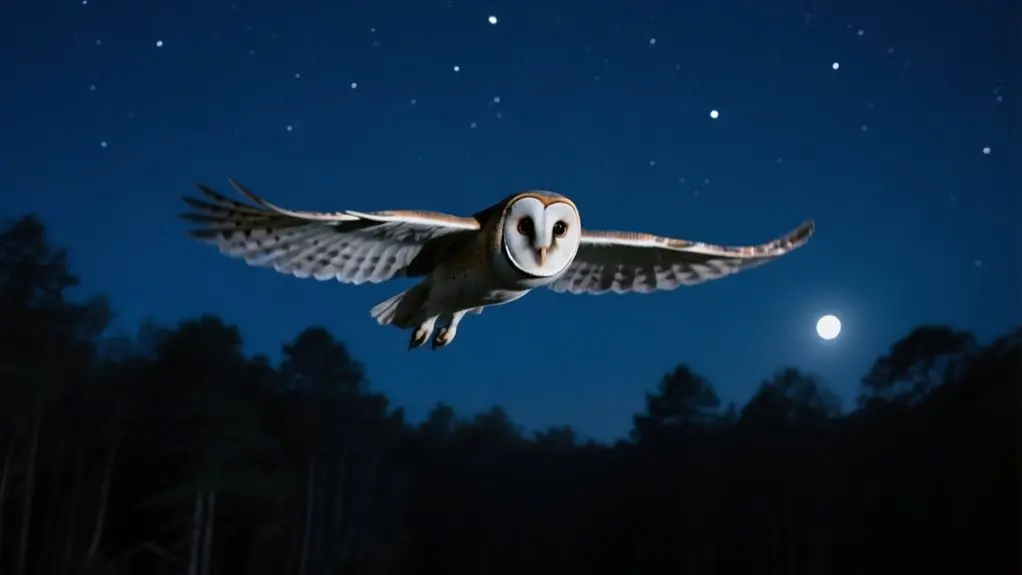
Yes, birds can fly in the dark thanks to specialized adaptations. They have large eyes with many rod cells that boost low-light vision, enabling navigation by stars and Earth’s magnetic field. Night flights save energy by avoiding daytime heat and predators.
Silent flight feathers help maintain orientation without noise. Various species use these mechanisms differently. Understanding these strategies reveals how birds master nocturnal travel and cope with unique risks.
How and Why Birds Fly in the Dark
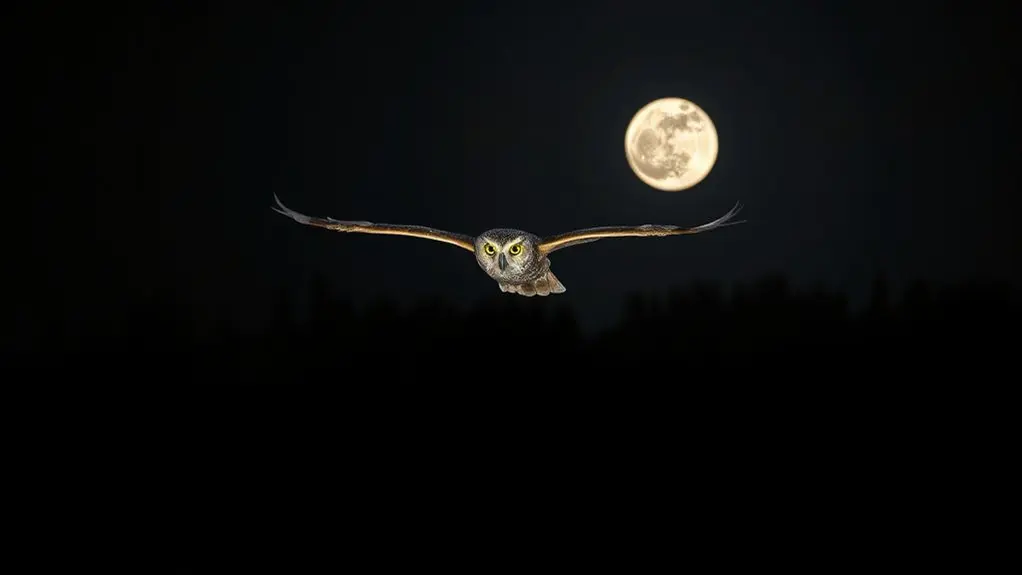
Although you might assume birds only migrate during the day, many species actually fly at night to conserve energy and evade predators. Their feather structure plays a vital role in optimizing flight biomechanics, enabling efficient nocturnal travel. Feathers reduce drag and provide lift, while subtle modifications help minimize noise, which is essential for stealthy night flights.
Night migrants benefit from calmer air and reduced turbulence, which decreases energy expenditure. Birds rely on stellar navigation, using constellations for orientation. Their flight biomechanics adapt to maintain stability in low-light conditions.
Communication via high-pitched vocalizations helps maintain flock cohesion during these flights. Collectively, these adaptations in feather structure and flight biomechanics allow birds to navigate vast distances under cover of darkness effectively.
Birds Active at Night: Who They Are and Why
You’ll find that several bird species, like owls, nightjars, and some migratory songbirds, are active during the night. This is mainly because they’ve special adaptations, such as better vision and magnetic sensing. These help them get around, find food, and communicate even when it’s really dark.
It’s pretty interesting to see how their nocturnal habits come about. Things like avoiding predators and dealing with environmental challenges play a big role in shaping when and how these birds are active.
Understanding this gives us a clearer picture of their unique lifestyles.
Nocturnal Bird Species
When you observe birds active during the night, you’ll find species like owls, nightjars, nighthawks, and certain migratory songbirds such as thrushes and warblers. These nocturnal birds have some pretty unique adaptations in feather coloration and nesting behaviors that help them thrive in the darkness.
Owls, for example, have large eyes that enhance their vision in low light. Nightjars rely on their camouflage during the day to stay hidden from predators. Migratory songbirds navigate at night using the stars, which is pretty amazing.
Waterbirds like petrels also fly at night, which helps them avoid predators. It’s fascinating how different birds have evolved various tricks to make the most of nighttime.
| Species | Adaptation | Behavior |
|---|---|---|
| Owls | Large eyes, rods | Silent hunting |
| Nightjars | Camouflaged feathers | Dusk and night feeding |
| Nighthawks | Cryptic coloration | Insectivorous at night |
| Migratory songbirds | Internal compass | Star-guided flights |
| Waterbirds | Nocturnal flight | Predator avoidance |
Reasons For Night Activity
Because many bird species have evolved specialized adaptations for low-light conditions, they actively engage in nighttime behaviors that serve specific ecological and physiological purposes. You’ll find that bird migration often occurs at night, utilizing celestial cues such as stars and the moon, along with Earth’s magnetic field, to navigate accurately.
Flying during cooler, calmer hours helps birds conserve energy and reduces exposure to daytime predators. Additionally, nocturnal predators influence this behavior by limiting daytime activity for some species.
Seasonal factors like breeding cycles and food availability further prompt extended nocturnal flights.
To support these demanding journeys, birds build fat reserves and develop endurance. They often travel in groups while communicating vocally to maintain coordination during night migration.
It’s quite fascinating how these adaptations come together to make night activity possible for so many birds.
How Birds See at Night
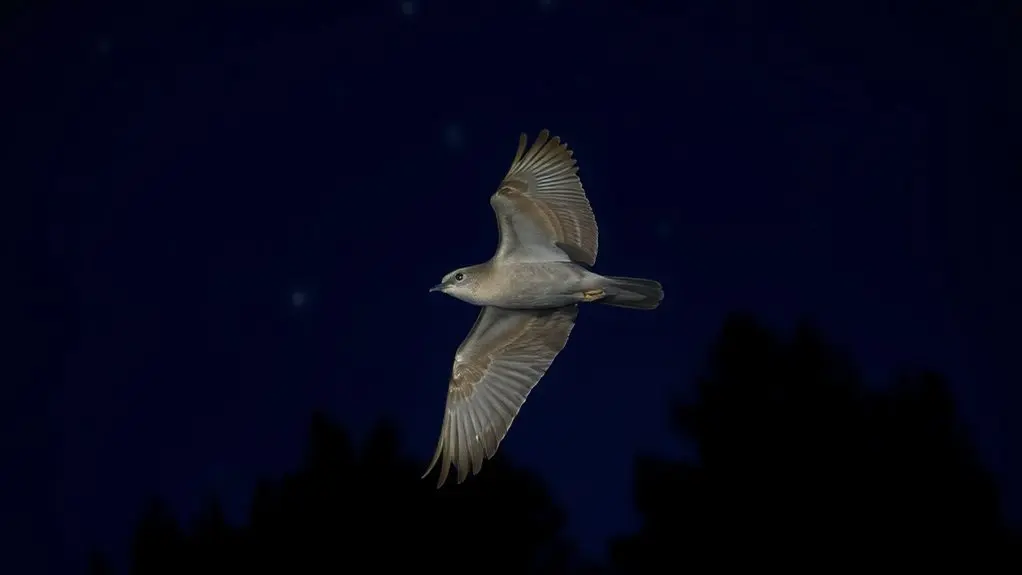
Although birds don’t see in complete darkness, their eyes are highly adapted to function in low-light conditions. Unlike your daytime vision, which relies heavily on color perception through cones, birds’ night vision depends on rods, retinal cells specialized for dim light.
You’ll notice three key adaptations:
- High rod density increases sensitivity to low light, allowing clearer images at dusk or dawn.
- Larger eyes and wider pupils maximize light intake, improving vision under dark conditions.
- Reduced cone cells, especially in nocturnal birds like owls, limit color perception but enhance night sight.
While birds don’t perceive vivid colors at night, these adaptations let them navigate and forage effectively in low-light environments.
Navigational Adaptations for Night Flight
Guiding through the night sky requires birds to rely on a combination of sophisticated sensory mechanisms and environmental cues. You’ll find that many nocturnal birds utilize stellar navigation, recognizing constellations and star patterns to orient themselves precisely.
Many nocturnal birds navigate the night by recognizing constellations and star patterns with remarkable precision.
Their specialized magnetic receptors, including magnetite particles and cryptochromes, detect Earth’s magnetic field, providing another reliable navigational reference.
Visual cues such as coastlines, rivers, and city skylines serve as critical landmarks. This is enhanced by birds’ ability to perceive subtle variations in color vision even in low light. It’s pretty amazing how they use these features to stay on course.
Additionally, feather structure plays a role in silent flight, allowing birds to maintain steady orientation without noise interference.
Horizon glow and familiar landforms act as natural beacons. They guide you as you traverse unfamiliar terrain during night migration.
How Birds Communicate While Flying at Night
When birds take to the night sky, they rely heavily on high-pitched calls and songs, often beyond the range of human hearing, to communicate effectively. These vocalizations are a critical part of flight acoustics and help maintain group cohesion during nocturnal flight.
Here’s how they do it:
- Birds emit species-specific flight calls and bird songs, which you can identify using sonogram analysis.
- Nocturnal flight calls (NFC) coordinate migration by making sure individuals don’t get separated in low visibility.
- Advances in microphone technology have allowed researchers to study these subtle acoustic signals. This has revealed some pretty complex communication patterns.
Why Night Flight Saves Energy and Avoids Predators
Beyond communication, birds choose to fly at night to optimize their energy use and reduce the threat of predators. Cooler temperatures and calmer air decrease atmospheric resistance, which helps you conserve energy during long flights.
Flying at night also matches their altered sleep patterns. This way, birds can rest during the day and migrate efficiently when it’s dark out.
By avoiding daytime predators like raptors, nocturnal flight lowers the risk of being caught. Instead of relying on vision, birds navigate using their other senses, which works well in the dark.
| Factor | Benefit |
|---|---|
| Cooler Air | Less turbulence, reduced exertion |
| Nighttime Feeding | Supports altered sleep patterns |
| Reduced Predation | Avoids daytime visual hunters |
| Efficient Migration | Longer distances with less fatigue |
All these factors together make night flight a smart survival strategy.
How Birds Find Their Way Using Stars and Earth’s Magnetic Field
Although flying in darkness challenges visual navigation, birds effectively use star patterns and the Earth’s magnetic field to find their way. You can see this in how they rely on celestial cues and magnetic sensing mechanisms.
Specifically, they align their flight paths with constellations, using an internal stellar compass to figure out direction during night flights. Specialized receptors in their eyes and brain detect star positions and movements, which helps them stay oriented precisely.
Birds use an internal stellar compass and specialized receptors to navigate by constellations during night flights.
They also sense the Earth’s magnetic field through magnetite particles and cryptochromes in their bodies. This gives them a steady directional reference even when stars aren’t visible.
On top of that, birds combine information from both the stars and magnetic sensing. This teamwork allows them to navigate long distances accurately during migration.
Risks Birds Face During Night Flight
When you watch birds flying at night, you’ll see they face all kinds of natural hazards. Storms and predators, for example, can really wear them out and even lead to death. But that’s not all.
You also have to think about human-made dangers. Things like brightly lit buildings, wind turbines, and power lines can confuse or hurt these birds.
Natural Nighttime Hazards
Because birds rely heavily on navigation cues during night flights, natural and man-made hazards pose significant risks to their safety. Your understanding of bird migration strategies and nocturnal bird behaviors helps explain why these risks are critical.
Natural nighttime hazards include severe weather conditions like storms, strong winds, fog, and heavy rain. These can disorient you, forcing abrupt route changes or unsafe landings. That increases exhaustion and accident risks.
Wind farms present physical collision risks. Rotating blades can cause serious injury or mortality, especially for nocturnal migrants flying at altitudes that intersect turbine zones.
Natural obstacles such as dense fog reduce visibility, impairing your ability to detect terrain or other birds. This can lead to collisions or navigational errors.
These hazards challenge your survival during night flights. So, they require adaptive responses within your migratory behaviors.
Human-Made Flight Threats
Alongside natural challenges, human-made flight threats considerably impact birds during their nocturnal journeys. Urban glow and light pollution from cities disrupt birds’ natural navigation cues, causing disorientation and increasing collision risks with buildings.
Wind turbines and tall structures further elevate the danger of injury or mortality during night migration.
You should also be aware that bird strikes with aircraft pose significant fatalities and safety hazards, especially when birds are drawn to illuminated runways or flight paths. These artificial factors force birds into hazardous conditions, complicating their ability to fly safely in the dark.
Conservation efforts like Lights Out campaigns aim to reduce urban glow and minimize light pollution. This helps protect nocturnally migrating birds by restoring safer flight environments during their night travels.
It’s a step in the right direction to keep our feathered friends safer as they navigate the night skies.
Human Impact on Nocturnal Bird Flight
How do human activities affect nocturnal bird flight? You should understand that urban lighting and wind turbines markedly impact these birds.
First, artificial lighting from city skyscrapers disrupts natural navigation cues, leading to disorientation and fatal collisions with buildings.
Second, wind turbines situated along migration routes pose collision risks to nocturnal species like owls and seabirds, causing injury and mortality.
Third, light pollution increases energy expenditure as birds struggle to reorient themselves during migration.
Additionally, human-related hazards such as bird strikes near airports add to mortality rates.
To mitigate these effects, conservation efforts like Lights Out campaigns reduce urban lighting during peak migration, helping nocturnal birds navigate more safely.
Recognizing these impacts is essential for protecting nocturnal avian populations.
Frequently Asked Questions
Do All Bird Species Have the Ability to Fly at Night?
You won’t find all bird species capable of nocturnal flight; only specific ones, like migratory birds during bird migration and true nocturnal flyers, possess the necessary adaptations to navigate and fly effectively in darkness.
These birds have special skills that help them see or sense their way around at night. So, flying in the dark isn’t something every bird can do — it’s pretty unique to certain types.
Can Birds Get Lost During Night Migration?
Yes, birds can get lost during night migration when disruptions in bird navigation occur. Changes in migration patterns caused by environmental factors or artificial lights can interfere with their ability to use celestial and magnetic cues accurately.
It’s pretty fascinating how birds rely on the stars and the Earth’s magnetic field to find their way. But when something throws them off—like bright city lights or sudden weather changes—they might end up off course. So, yeah, getting lost during night migration is definitely something that can happen.
How Do Weather Conditions Affect Night Flying Birds?
Imagine steering through a maze blindfolded; weather dictates your migration timing and flight altitude. Storms force birds to pause or descend, while calm nights let them soar higher and longer, optimizing energy during their nocturnal journey.
It’s like the sky sets the rules for when and how they fly. When conditions are rough, birds play it safe and wait it out. But when the air is still and clear, they take full advantage and travel farther.
Do Baby Birds Learn to Fly at Night?
You won’t see baby birds learn to fly at night because bird song patterns and nesting behaviors promote daytime activity. They rely on daylight for visual cues and parental guidance, essential for developing flight skills safely.
Birds need good light to see where they’re going and to avoid danger. Plus, their parents are usually more active during the day, helping their chicks practice flying. So, it just makes sense that baby birds take their first flights when the sun is up!
Are Nocturnal Birds More Vulnerable to Window Collisions?
Yes, nocturnal birds are more vulnerable to window collisions because urban lighting distorts their natural navigation cues. This makes it harder for them to find their way around safely.
Plus, the lights attract them toward reflective surfaces like windows. Once there, they can’t easily detect dangers or escape effectively. So, it really increases their risk of getting hurt.
Conclusion
You might be surprised to learn that nearly 50% of bird species migrate at night, using stars and Earth’s magnetic field to navigate. This remarkable adaptation helps them avoid predators and conserve energy.
Understanding these sophisticated strategies shows how evolved and resilient birds are in darkness. By appreciating their night flight, you can better grasp the delicate balance they maintain and how human activity might disrupt this essential behavior.