
You can’t find true periods in birds because they don’t have a uterus or shed a uterine lining like mammals do. Instead, female birds primarily use their left ovary to produce eggs through ovulation. These eggs then develop and are laid without any menstrual bleeding.
Their egg formation is carefully controlled by hormones and environmental cues. This results in a daily cycle of egg development rather than menstrual cycles.
If you’re curious, keep exploring to understand how this intricate process unfolds in birds. It’s pretty fascinating once you dive into the details!
Do Birds Have Periods? The Simple Answer
Although you might assume birds have periods like mammals, they actually don’t experience menstrual cycles or shed uterine lining. Instead, female birds produce eggs through ovulation, primarily in the left ovary, without any bleeding associated with menstruation.
Their reproductive cycle responds to environmental cues, such as daylight length, rather than hormonal cycles that cause menstruation. Feather coloration and bird migration are closely linked to these environmental signals, influencing reproductive timing and readiness.
For example, changes in daylight trigger migration patterns and feather molts, which coincide with peak breeding periods. This ensures egg laying occurs under favorable conditions.
How Bird Reproduction Differs From Mammalian Menstruation
You’ll notice that bird reproduction is quite different from mammals because birds typically have just one functional ovary and oviduct, while mammals have a pair of ovaries.
Instead of going through a menstrual cycle, birds experience a seasonal reproductive cycle. During this time, eggs form and get laid without the shedding of a uterine lining.
This lack of a menstrual cycle really shows the key differences in how birds and mammals handle reproduction.
Ovarian Function Differences
How does bird ovarian function differ fundamentally from that of mammals? In birds, typically only the left ovary is functional, unlike mammals that have two active ovaries. This anatomical difference influences avian fertility and reproductive timing, as birds release eggs periodically without a hormonal cycle inducing menstruation.
Instead of shedding the uterine lining through bleeding, birds produce eggs encased in shells. This reflects a reproductive system optimized for egg production rather than lining regeneration.
Follicles in the avian ovary develop and ovulate eggs in a cycle distinct from the mammalian menstrual cycle, lacking the uterine shedding phase.
Egg Formation Process
Where does the egg formation process in birds diverge from mammalian menstruation? Unlike mammals, birds don’t shed their uterine lining. Instead, they produce eggs through oviposition.
Female birds develop primarily the left ovary and oviduct, where follicles mature into eggs without monthly tissue breakdown.
Over about 24 hours, the egg undergoes ovulation and fertilization if sperm is present. Then, the shell is deposited externally, which means there’s no bleeding or menstruation involved.
This process aligns with environmental cues, influencing nesting behaviors rather than menstrual cycles.
Also, feather coloration often signals reproductive readiness. It plays a role in attracting mates during the breeding season.
Unlike mammalian menstruation, bird reproduction centers on egg formation and laying, integrating physiological and behavioral adaptations like nesting rather than cyclical uterine shedding.
Absence Of Menstrual Cycle
Although birds and mammals both reproduce sexually, birds don’t experience a menstrual cycle like mammals do. Instead, their reproductive cycle centers on ovulation and egg-laying without shedding uterine lining.
Female birds typically develop only the left ovary and oviduct, avoiding menstruation or bleeding.
Hormonal regulation by the hypothalamus and pituitary gland triggers ovulation and egg production.
Unlike mammals, birds’ reproductive readiness is marked by egg formation rather than uterine lining breakdown.
This absence of menstruation aligns with their adaptations for bird migration and feather coloration.
These adaptations ensure energy efficiency and physical condition for flight.
How Bird Eggs Develop and Are Laid
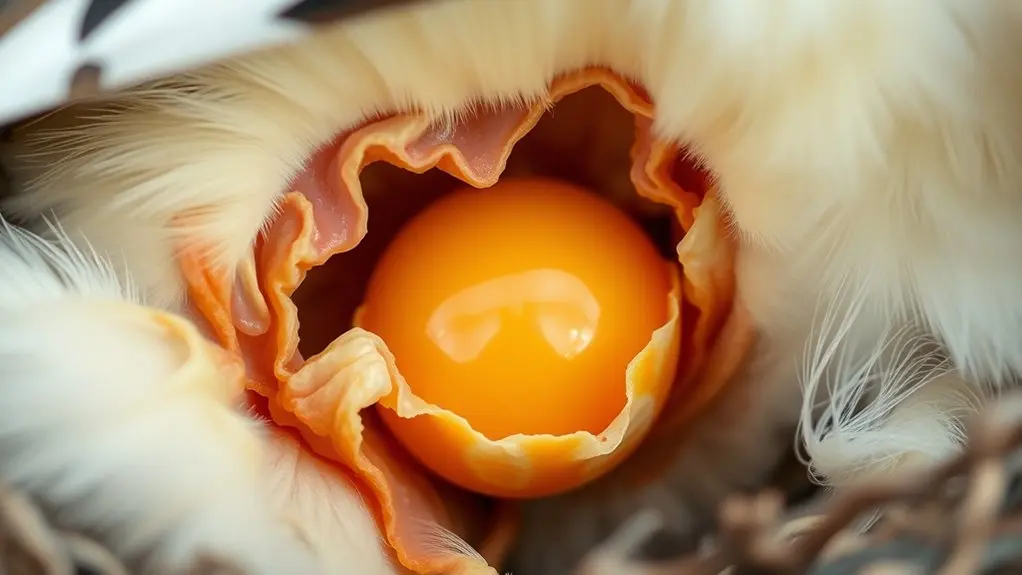
You’ll find that female birds usually develop only the left ovary and oviduct. In there, thousands of follicles mature during breeding season.
As an egg forms, it travels through different parts of the oviduct—the infundibulum, magnum, isthmus, and uterus. Each of these regions adds something special, like the albumen or the shell, over the course of about 24 hours.
When you understand this process, it’s easier to see how fertilization, membrane formation, and shell deposition all work together before the egg is finally laid.
Female Reproductive Anatomy
Because most female birds develop only the left ovary and oviduct, these structures play a crucial role in egg formation. In avian anatomy, this reproductive difference concentrates yolk and protein production in the left ovary follicles. Eggs pass through specialized oviduct regions, each contributing to egg composition.
Fertilization occurs in the infundibulum shortly after ovulation, before the egg advances. The uterus deposits calcium rapidly, forming the protective eggshell. Hormonal regulation, influenced by environmental factors, orchestrates this process.
| Oviduct Region | Function | Contribution to Egg |
|---|---|---|
| Infundibulum | Captures ovulated yolk | Site of fertilization |
| Magnum | Secretes albumen | Provides egg white proteins |
| Isthmus | Adds shell membranes | Structural layers |
| Uterus | Deposits calcium | Forms hard eggshell |
Egg Formation Process
When a yolk is released from the ovary, it immediately enters the infundibulum, where fertilization can happen if sperm are around.
The developing egg then moves to the magnum, where layers of albumen start forming around the yolk.
Next, in the isthmus, membranes develop to encase both the albumen and yolk.
After that, the egg reaches the uterus or shell gland.
Here, the eggshell, mostly made of calcium carbonate, forms over about 20 hours.
While the shell is forming, pigmentation patterns get added, giving each egg its unique colors and markings.
The whole process, from ovulation to a fully formed egg ready to be laid, takes roughly 24 to 26 hours, depending on the species.
It’s pretty amazing how precisely these stages are coordinated to produce a viable bird egg.
Egg Laying Sequence
After the egg completes its formation in the oviduct, the laying sequence begins. This involves coordinated muscular contractions and behavioral cues that get the bird ready for egg deposition. You’ll often notice birds showing brighter feather colors and starting nest-building behaviors during this time. These actions signal that they’re ready to reproduce.
| Stage | Key Activity |
|---|---|
| Muscular contractions | Propel the egg through oviduct |
| Behavioral cues | Nest building and feather display |
| Egg deposition | Laying occurs typically daily |
The whole egg-laying process takes about 24 to 26 hours, with one egg laid each day over several days. Fertilization happens early on, and the hard calcium carbonate shell is formed in the uterus to protect the egg. These physical and behavioral changes work together to help the bird reproduce successfully.
What Happens During the Bird Breeding Season
Although environmental cues like increasing daylight trigger hormonal changes, you’ll find that female birds focus their reproductive development primarily on the left ovary and oviduct during the breeding season. This specialization maximizes egg production, as the left ovary matures follicles sequentially to form eggs.
Meanwhile, changes in feather coloration and song patterns among birds play critical roles in mating rituals. They signal reproductive readiness to potential mates.
As eggs form in the oviduct, fertilization generally occurs in the infundibulum before the shell forms in the uterus. Females typically lay one egg per day over several days, then begin incubation after the clutch is complete.
During incubation, adult birds maintain ideal temperature and provide nutrients to support embryo development. This ensures successful reproduction throughout the breeding season.
How Hormones Control Egg Production in Birds
Because environmental factors like daylight length influence a bird’s internal processes, the hypothalamus plays a crucial role by secreting gonadotropin-releasing hormone (GnRH). GnRH prompts the anterior pituitary to release follicle-stimulating hormone (FSH) and luteinizing hormone (LH), key drivers of follicle development and ovulation.
Elevated estrogen levels, stimulated by FSH, facilitate ovarian follicle growth and increase calcium for eggshell formation. LH also regulates testosterone secretion, which modulates secondary sexual traits and reproductive behaviors.
This intricate hormonal feedback ensures precise reproductive timing, coordinating ovulation, egg formation, and nesting behaviors throughout the breeding season. You can see how this tightly controlled endocrine system enables birds to optimize egg production in response to environmental cues, maximizing reproductive success.
Clearing Up Common Myths About Bird Periods
When you hear people talk about birds having periods, it’s important to clarify that female birds don’t undergo menstrual cycles like mammals do. Their reproductive system focuses on ovulation and egg formation, not uterine lining shedding.
Here are four key points to clear up common myths:
- Birds lack a uterus and don’t shed uterine lining, so they don’t bleed or menstruate.
- Egg production is controlled by ovulation, influenced by environmental factors like daylight, unlike hormonal menstrual cycles.
- Changes in feather coloration and nest building behaviors signal reproductive readiness, not menstrual phases.
- Misunderstandings about bird anatomy often lead to the incorrect belief that birds experience periods.
Understanding these facts helps you appreciate how bird reproduction differs fundamentally from mammals. It’s pretty interesting once you get the details!
Frequently Asked Questions
Can Male Birds Influence the Timing of Egg-Laying?
Yes, male mate selection and courtship behaviors can trigger bird hormone influence in females, indirectly affecting egg-laying timing. Your presence stimulates hormonal changes, promoting reproductive readiness. But females primarily regulate timing through environmental factors.
Do All Bird Species Lay Eggs Year-Round?
Think of bird migration as a seasonal clock; you won’t see all birds laying eggs year-round. Their nesting behaviors align with environmental cues, so most species pause reproduction outside ideal conditions.
This pause helps ensure successful chick development. Birds basically time everything to when conditions are just right. It’s like they have their own built-in calendar.
How Long Does It Take for a Bird Egg to Hatch?
Egg incubation usually takes 10 to 21 days, depending on the species. You’ll notice nesting behavior, where parent birds keep their eggs warm. They maintain a temperature around 37°C to make sure the embryo develops properly.
This warmth is crucial until the eggs hatch. It’s pretty amazing how dedicated birds are during this time! They work hard to protect and care for their future chicks.
What Colors Do Bird Eggs Come in and Why?
Like nature’s palette, bird egg coloration spans whites, blues, greens, browns, and speckles. You’ll find evolutionary significance here, like camouflage and signaling health. These colors are shaped by pigments, diet, and environment.
This helps protect eggs from predators with precise adaptation. It’s pretty amazing how nature uses color for survival, right?
Can Birds Lay Eggs Without Fertilization?
Yes, you can observe bird reproductive behavior where females lay eggs without fertilization. The egg fertilization process isn’t required for egg formation. Hormonally regulated cycles trigger unfertilized eggs to develop and be laid regularly.
Conclusion
Now that you’ve unraveled the mystery, you see birds don’t get periods like mammals do. Their reproductive cycle is a finely tuned symphony of hormones, orchestrating egg development and laying without the crimson curtain call. Think of it as nature’s precise clockwork. No monthly shedding, just a deliberate, elegant process.
Understanding this helps you appreciate the unique biological rhythms that keep birds soaring, laying eggs, and thriving in their own remarkable way. It’s pretty amazing when you think about it! Birds have their own special way of doing things, and that’s what makes them so fascinating.