
You might wonder if birds can have twins in one egg. Typically, bird eggs support a single embryo because their reproductive systems and eggs are designed for one yolk and one developing chick.
Double-yolk eggs sometimes contain two embryos, but twin chicks hatching from one egg are extremely rare due to space and resource limits. When twins do form, they often compete and struggle to survive.
Understanding these biological details shows why such occurrences are so uncommon. It’s pretty fascinating to see how nature usually sticks to one chick per egg!
Why Birds Usually Have One Embryo Per Egg
Although it might seem possible for an egg to contain multiple embryos, birds typically develop only one embryo per egg because their reproductive system is specialized for single fertilization. Each egg contains a single yolk, supplying nutrients exclusively for one embryo’s growth. The egg’s shell and internal membranes are structurally adapted to support this singular development.
This specialization ensures efficient resource allocation, which is really important during demanding periods like bird migration when conserving energy is essential. Feather coloration, influenced by genetics and diet, also reflects this precise reproductive strategy. It plays a role in species identification and mating success rather than accommodating multiple embryos.
Instances of multiple embryos result from rare abnormalities, but the typical bird egg’s biology restricts embryonic count to one. This helps maintain reproductive efficiency and supports species survival.
How Bird Species and Egg Structure Affect Embryo Count
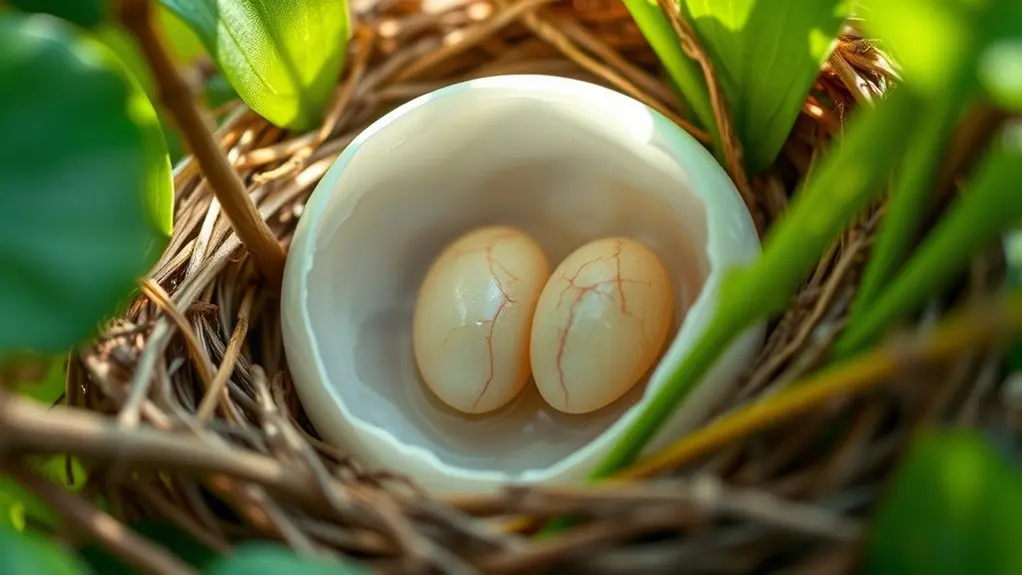
You’ll notice that differences in egg anatomy—like how thick the shell is or how the inside is divided—actually play a big role in determining how many embryos can grow inside one egg.
On top of that, different bird species have their own typical clutch sizes, shaped by evolution, which naturally limit how many embryos you’ll find in each egg.
Because of these biological factors, it’s usually just one embryo developing per egg. This setup helps make sure the embryo stays healthy and gets the right amount of resources it needs to grow.
Egg Anatomy Variations
When you examine bird eggs, you’ll find that their anatomy plays an essential role in determining how many embryos they can support. Eggshell composition varies among species, influencing gas exchange and protection, which indirectly affects embryo viability.
Yolk distribution within the egg is critical; most eggs contain a single large yolk that nourishes one embryo. However, in rare cases, multiple yolks may form inside one eggshell, potentially leading to the development of twins.
These double-yolked eggs contain two separate nutrient sources, enabling two embryos to grow simultaneously. Still, the structural limits of the eggshell and yolk arrangement often result in only one chick hatching successfully.
Understanding these anatomical variations helps explain why multiple embryos in one egg are uncommon across bird species.
Species-Specific Clutch Sizes
Because bird species have evolved diverse reproductive strategies, their clutch sizes and egg structures directly influence how many embryos develop per egg. Most bird eggs contain a single embryo. That’s because the egg shell is designed to enclose and protect one developing embryo, making sure it’s properly placed inside the egg.
Species like finches and parrots may lay multiple eggs per clutch, but each egg usually supports only one embryo. This happens because of internal reproductive constraints. The egg shell’s structure and the species-specific reproductive anatomy generally stop multiple embryos from forming at the same time in the same egg.
Although there are rare cases of twin embryos, these are exceptions. They’re caused by abnormal embryo placement, not by typical clutch size or egg structure. So, for the most part, one egg means one embryo.
Embryo Development Limits
Although bird species exhibit a range of reproductive adaptations, the physical characteristics of their eggs impose strict limits on embryo quantity. Eggshell flexibility and incubation temperature play vital roles in embryo survival, but the limited space inside each egg generally restricts embryo count to one.
Occasionally, species like finches produce eggs with two embryos. Yet competition and physical constraints often result in one embryo’s demise.
| Factor | Impact on Embryo Count | Example Species |
|---|---|---|
| Eggshell Flexibility | Limits expansion, restricting embryos | Pigeons |
| Incubation Temperature | Influences embryo viability | Finches |
| Egg Size & Shape | Constrains embryo development | Most passerines |
Understanding these factors helps explain why twins in one bird egg are extremely rare.
Formation and Causes of Double-Yolk Eggs
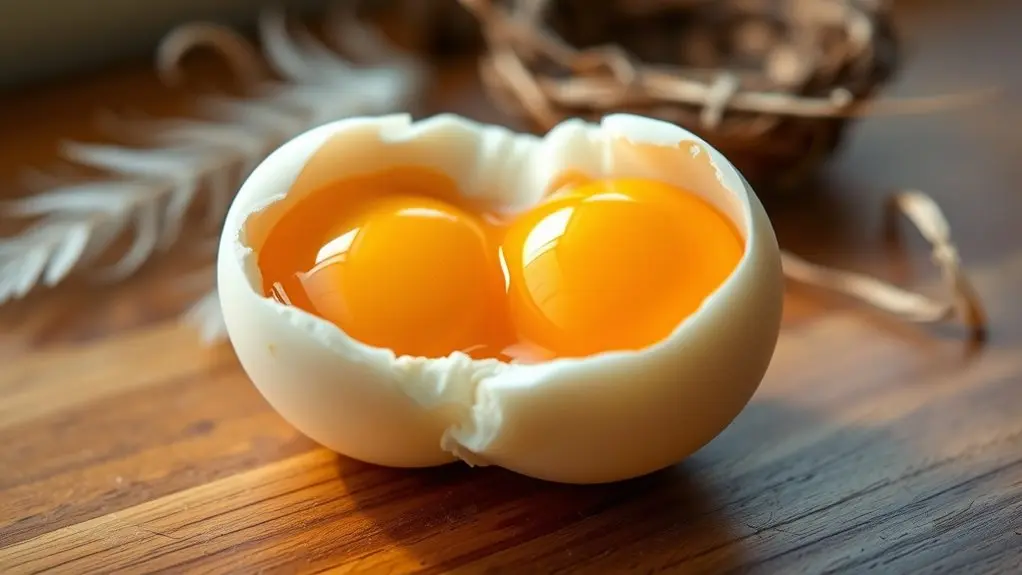
You’ll find that double-yolk eggs form when a hen releases two ova either at the same time or really close together. This causes both yolks to get enclosed within a single shell. It’s a pretty interesting phenomenon, and it happens more often in certain breeds like Rhode Island Reds and Leghorns.
You’ll notice it especially in young hens whose reproductive systems aren’t fully mature yet, or in older hens that are nearing the end of their laying period.
Double-Yolk Egg Formation
When a hen releases two ova either simultaneously or within a very short time frame, the result can be a double-yolk egg containing two yolks enclosed within a single shell. This phenomenon occurs primarily during early laying phases or late in the hen’s reproductive cycle.
You’ll notice that eggshell pigmentation remains consistent, as the shell forms normally around both yolks.
Nesting behaviors don’t change markedly in hens producing double-yolk eggs, which means the process is mostly physiological rather than behavioral. The formation is accidental, caused by the reproductive system releasing multiple ova before the first is fully encased.
While environmental factors like diet and stress can influence how often it happens, double-yolk eggs generally don’t indicate any health issues.
Understanding this precise formation helps clarify how twins can develop within a single avian egg. It’s pretty fascinating when you think about how the body sometimes just releases two ova together, resulting in these unique eggs.
Causes of Double Yolk
Understanding how double-yolk eggs form requires looking at the biological and genetic factors behind the release of multiple ova at once. When a hen releases two ova either at the same time or very close together, both can get fertilized and end up inside a single eggshell.
This usually happens in young hens with immature reproductive systems or older hens nearing the end of their laying cycle. Genetics also matter because some breeds are more likely to lay double-yolk eggs.
Interestingly, the eggshell color can change a bit in double-yolk eggs due to differences in how calcium is deposited during shell formation.
Nesting behaviors might also affect laying patterns by causing hormonal shifts that trigger the release of multiple ova.
Even though double-yolk eggs are bigger and a bit unusual, they usually just happen by chance. They’re not a health problem for the hen or anything to worry about.
Frequency in Bird Species
How often do double-yolk eggs occur across different bird species? You’ll find that they’re relatively common in young and older hens due to incomplete reproductive cycles. Species like ducks and quails experience higher frequencies, especially during peak laying periods.
This happens when two ova are released simultaneously or fail to separate during egg formation. Interestingly, eggshell pigmentation and nesting behaviors influence detection and survival. Species with camouflaged eggshells may conceal double-yolk eggs more effectively, which affects observation rates.
Despite occasional twin embryos, the survival rate remains low because limited space and nutrients restrict development. Understanding these patterns helps clarify why twin chicks in one egg are rare. It really comes down to species-specific reproductive physiology and ecological adaptations tied to eggshell traits and nesting strategies.
Can Double-Yolk Eggs Result in Two Chicks?
Although double-yolk eggs contain two separate yolks that can both be fertilized, you should know that the chances of two chicks hatching from one egg remain very low. The process is influenced by factors like eggshell pigmentation, which can affect heat absorption during avian incubation. This, in turn, impacts embryo viability.
Consider these points: both yolks must be fertilized for twin chicks to develop. Most double-yolk eggs only produce one viable embryo.
Plus, the physical space within the eggshell limits simultaneous development.
Even if two embryos develop, often only one chick successfully hatches. So, while double-yolk eggs have potential, the complexity of avian incubation and eggshell characteristics make twin hatching a rare event.
How Rare Are Twin Chicks From a Single Egg?
You should know that twin chicks from a single egg are pretty rare—happening in about 1 in every 1,000 to 10,000 hatching events. It’s not something you see every day.
This rarity comes down to a few reasons. For one, the egg usually can’t support more than one embryo because of its limited space and resources. Plus, most bird species typically develop just a single embryo per egg.
Knowing these points makes it easier to understand why successfully hatching twin chicks is such a rare and special event.
Frequency Of Avian Twins
Why do twin chicks from a single egg occur so rarely in birds? It’s primarily due to the precise embryonic development required. In most species, a single fertilized egg contains one embryo, making twins an exceptional anomaly.
You’ll find twin embryos more occasionally in species like quails or some waterfowl, but even then, it’s extremely uncommon. Consider these points: twin formation demands the egg to split or develop two embryos simultaneously, which is an unusual developmental event.
Most bird species’ reproductive systems are optimized for single embryo viability. Feather coloration and migration patterns often correlate with species that rarely exhibit twinning.
Documented cases of avian twins are sporadic, emphasizing their rarity in natural populations.
Understanding these aspects highlights how infrequent avian twins truly are.
Factors Influencing Twin Eggs
While twin chicks from a single egg remain an exceptional occurrence, several factors influence their formation and rarity. Twin eggs typically result from abnormal embryonic development or genetic mutations causing two embryos to develop simultaneously. This phenomenon is extremely rare, with only a few documented cases.
Eggshell coloration may indirectly reflect the egg’s health and quality, potentially affecting embryonic viability, though no direct link to twinning exists. Parental behavior also plays a role; attentive incubation and care can improve survival odds despite limited resources within the egg.
However, most twin embryos fail to hatch due to spatial and nutritional constraints. Understanding these factors helps clarify why twin chicks from one egg are extraordinary and seldom survive to fledging. It really shows the biological challenges inherent in avian twinning.
How Bird Twins Differ From Mammal Twins
Although mammals can develop multiple embryos simultaneously within a single uterus, birds typically produce only one embryo per egg due to their reproductive biology. This fundamental difference shapes how twins occur in each group.
Consider these distinctions:
- Bird eggs usually contain a single yolk and embryo; mammals can harbor multiple embryos in one uterus.
- Double-yolked eggs occasionally lead to two chicks but lack the genetic and developmental unity of mammal twins.
- Bird migration relies on precise physiological adaptations, including feather coloration, which are individually programmed and unlikely to synchronize in twins from one egg.
- Mammal twins often share placental structures, whereas bird embryos develop independently in separate eggs.
Understanding these differences clarifies why bird twins differ fundamentally from mammal twins in development and biology.
What Happens If Two Embryos Share One Egg?
What occurs when two embryos share a single bird egg depends largely on their origin and timing of development. If two separate fertilized cells are present, fraternal twins may develop, each with distinct genetic material.
Alternatively, a single fertilized egg can split early, producing identical twins sharing one egg.
A single fertilized egg splitting early can lead to identical twins sharing one bird egg.
The timing of this split influences whether the embryos share a placenta, sac, or both, which critically affects their growth. Late splitting can even lead to conjoined twins.
Occasionally, genetic mutations during this process may alter development or egg coloration, signaling abnormalities.
Although rare, these twin embryos must compete for limited resources inside one egg, impacting viability.
Understanding these dynamics helps explain how twin embryos interact and develop within a shared avian egg. It’s pretty fascinating how nature manages this delicate balance.
Raising Twin Chicks From a Single Egg: Signs and Challenges
When twin chicks develop inside a single egg, you face significant challenges related to limited nutrients and space. Such eggs often show unusual eggshell pigmentation, which can signal developmental anomalies. To raise twins successfully, there are some critical factors to keep in mind.
First, watch for changes in eggshell pigmentation because they might indicate abnormal embryonic growth. Also, keep the nest very clean to prevent infections, which twin chicks are especially vulnerable to.
Nutrient availability is another big deal since the twins have to share limited yolk resources.
You’ll want to observe the chicks closely for any signs of distress or developmental delays caused by their cramped conditions. Since twins from one egg are rare and often face health issues, your care should focus on keeping their environment hygienic and spotting subtle signs of stress early. Doing this can really help improve their chances of survival.
Factors Affecting Development of Twins in Bird Eggs
Since bird eggs usually contain just one embryo, having twins inside a single egg is pretty rare. It happens because of a mix of different factors. Sometimes, genetic mutations can cause the embryo to split early or lead to fertilization issues, which might result in twins.
The type of bird species matters a lot too. Some species are more likely to have these kinds of anomalies than others. On top of that, environmental factors like temperature and humidity play a role in whether the embryos survive.
Parental behavior is also important. When parents are attentive with incubation and feeding, twins have a better chance, even though developing two embryos in one egg is challenging.
Still, twin embryos often face higher risks, like malformations or fighting for resources inside the egg.
Looking at all these factors helps us understand why twin birds in a single egg are so uncommon. Usually, they come from complex and unusual biological events rather than normal reproduction.
Debunking Common Myths About Bird Twins
Although rare cases of multiple embryos have been reported, they often come from misunderstandings about bird reproduction. You should know that each bird egg forms from a single ovum, which produces only one embryo. Misconceptions happen even though the eggshell composition and nesting behaviors are designed to support single embryo development.
Rare reports of multiple embryos usually stem from misunderstandings; each bird egg starts from a single ovum producing one embryo.
Here are some key points to keep in mind:
- Eggshell composition creates a controlled environment for one embryo and helps prevent twins from forming.
- Nesting behaviors focus on incubating separate eggs, not multiple embryos inside one egg.
- Birds lay multiple eggs instead of having twins within a single egg.
- Identical twins don’t happen because a single embryo can’t split inside one egg.
Knowing these facts makes it easier to debunk myths about bird twins. It’s pretty interesting once you get the basics down!
Frequently Asked Questions
Do Any Bird Species Lay Eggs With More Than One Embryo?
Yes, some bird species can lay eggs with more than one embryo due to rare abnormalities in egg composition during bird reproduction. These cases involve polyembryony, where multiple embryos develop within a single egg’s shell.
It’s pretty unusual, but it does happen sometimes. So, while most bird eggs have just one embryo, these rare instances show that nature can surprise us with exceptions.
How Do Bird Parents Care for Unusually Large or Double-Yolk Eggs?
You’ll notice bird parents modify nesting behaviors for double-yolk eggs, often altering incubation duration.
Eggshell coloration may influence recognition, prompting extra care or rejection. Parents balance resource allocation and guarantee ideal development for unusually large eggs.
It’s pretty fascinating how they adjust things to make sure these unique eggs get the attention they need.
Can Environmental Factors Influence the Occurrence of Double-Yolk Eggs?
Yes, environmental factors like temperature and lighting can disrupt nutrient allocation during eggshell formation. This can cause hormonal imbalances that increase the chance of double-yolk eggs.
You’ll see this especially with nutritional deficiencies affecting yolk development. So, things like what the hens eat and their surroundings really matter when it comes to making double-yolk eggs.
Are Twin Chicks in One Egg Genetically Identical or Fraternal?
Twin chicks in one egg are usually fraternal because they come from separate fertilized embryos. This means there’s genetic variation between them.
Identical twins happen when a single embryo splits early in development. But that’s super rare in birds. So, most of the time, if you see twin chicks in one egg, they’re not identical.
What Role Does Incubation Temperature Play in Embryo Development?
You’ll find incubation temperature directly affects embryo development by influencing incubation duration and interacting with eggshell composition. Consistent ideal temperatures guarantee proper nutrient exchange through the shell, promoting healthy growth and reducing developmental anomalies.
Keeping the temperature steady is key because fluctuations can cause stress to the embryo. This stress might slow down development or even lead to abnormalities. So, maintaining the right warmth really makes a big difference in how well the embryo grows.
Conclusion
You might think bird eggs can’t support twins, but double-yolk eggs prove otherwise. They can contain two embryos. However, successful hatching is rare because of limited space and resource competition inside one egg.
While it’s unusual, twins can develop if conditions align perfectly. Understanding these factors clarifies that although bird twins from a single egg are exceptional, they’re biologically possible. This challenges the common belief that one egg strictly equals one chick.