
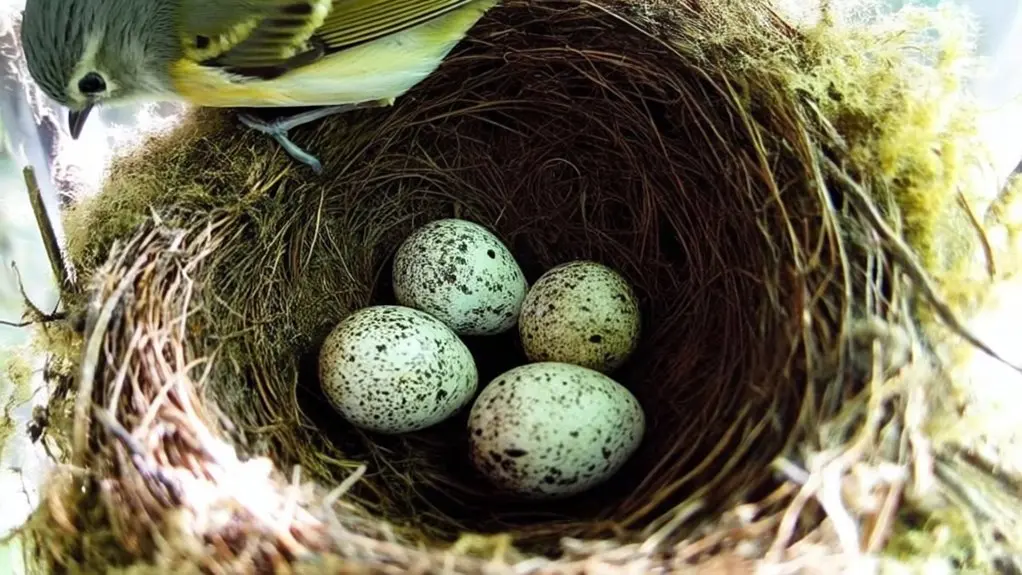
You can’t expect birds to move their eggs often because they rely on stable conditions for proper embryo development. Moving eggs disrupts temperature and humidity, which risks hatching success. Birds mainly reposition eggs to evenly distribute heat or respond to external threats, but they rarely shift nests.
Predators may cause nest abandonment, and legal protections often restrict handling nests or eggs. Understanding these behaviors and rules helps you support bird safety and reproductive success carefully. So, while birds do move their eggs sometimes, it’s not a common or casual thing.
Why Birds Usually Don’t Move Their Eggs
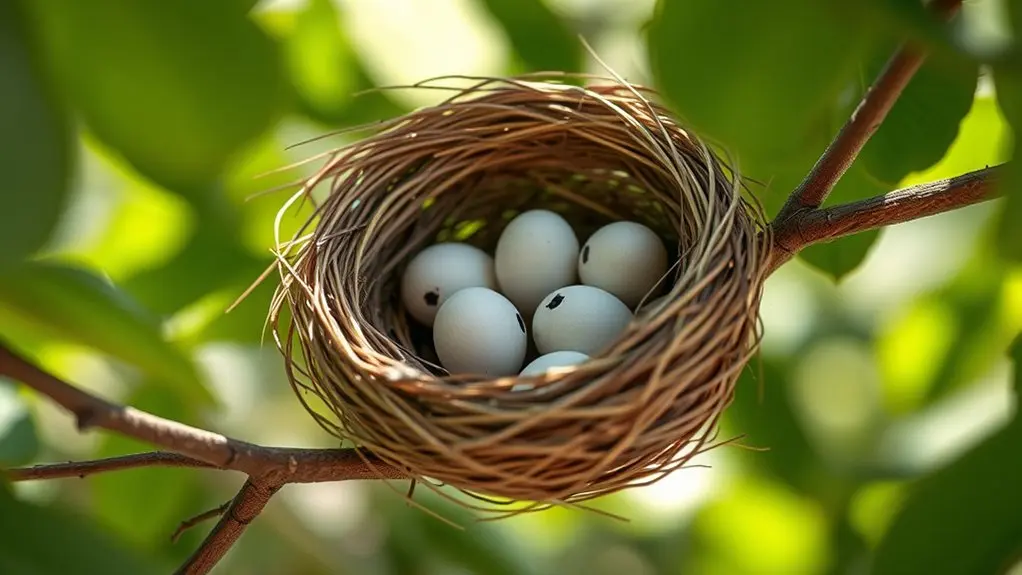
Because birds depend on stable incubation conditions, they usually don’t move their eggs after laying them. You’ll find that any movement can disrupt the precise temperature and humidity necessary for embryo development.
Birds rely heavily on egg recognition to identify their own eggs, minimizing the risk of misplacing them within the nest.
This behavioral adaptation ensures they focus on maintaining ideal incubation rather than relocating eggs.
Nest disturbance, often caused by predators or environmental factors, is typically the only scenario where eggs might be moved unintentionally.
In natural circumstances, most species prioritize protecting and incubating eggs in a fixed position, as shifting them could hinder proper growth.
Understanding these factors clarifies why egg movement is rare and generally linked to external disruptions rather than the birds’ intent.
How Bird Incubation and Egg Movement Affect Hatching

You’ll notice that the timing of incubation is super important for syncing up when the eggs hatch. Plus, moving the eggs around helps keep the temperature just right inside the nest.
Birds do this by shifting eggs closer to or farther from the heat source, which helps control the warmth needed for the embryos to grow. When you understand how these temperature changes work, it becomes clear how a bird’s incubation habits really affect whether the eggs hatch successfully.
Incubation Timing Effects
When birds move eggs during incubation, the timing of these movements really influences hatching patterns by changing temperature exposure and how fast development happens. You’ll notice that repositioning eggs early in incubation often makes those eggs hatch sooner because the temperature goes up and embryo growth speeds up.
On the other hand, moving eggs later can slow down development, which increases hatching asynchrony within the clutch. Timing during incubation is super important here.
Partial or full incubation behaviors decide when eggs get moved to keep temperature gradients just right.
By changing egg position throughout incubation, birds control how fast embryos grow. This can either synchronize hatching or let chicks emerge one after another.
Understanding how incubation timing affects egg temperature and movement really helps explain why hatching success and timing vary so much across different bird species.
Egg Repositioning Importance
Although bird species vary widely in their incubation strategies, egg repositioning plays a crucial role in ensuring proper embryo development and successful hatching. When you observe birds rotating and moving their eggs, they’re actively promoting even heat distribution, which reduces temperature gradients within the clutch.
This careful adjustment helps synchronize embryo development and optimizes hatching timing. You’ll also notice that egg repositioning supports egg camouflage and nest concealment by maintaining the eggs’ alignment with surrounding nest materials, reducing visibility to predators.
Depending on factors like clutch size and nest temperature, birds selectively reposition eggs from cooler to warmer areas, improving incubation efficiency. Understanding these behaviors highlights how dynamic egg movement directly influences both embryo viability and the protective function of the nest environment.
Temperature Impact Patterns
Because temperature plays a critical role in embryo development, birds actively move and turn their eggs to maintain even heat distribution within the nest. Egg temperature directly influences the rate of embryo growth and hatching success.
Repositioning behavior helps counteract temperature gradients, where center eggs tend to be warmer than peripheral ones.
This balancing act reduces hatching asynchrony, ensuring more uniform development.
You can visualize this temperature impact pattern through:
- Eggs clustered at the center receiving consistent warmth
- Peripheral eggs experiencing cooler microclimates
- Birds turning eggs to equalize heat exposure
- Repositioning eggs to optimize thermal conditions
How Predators Cause Nest Abandonment
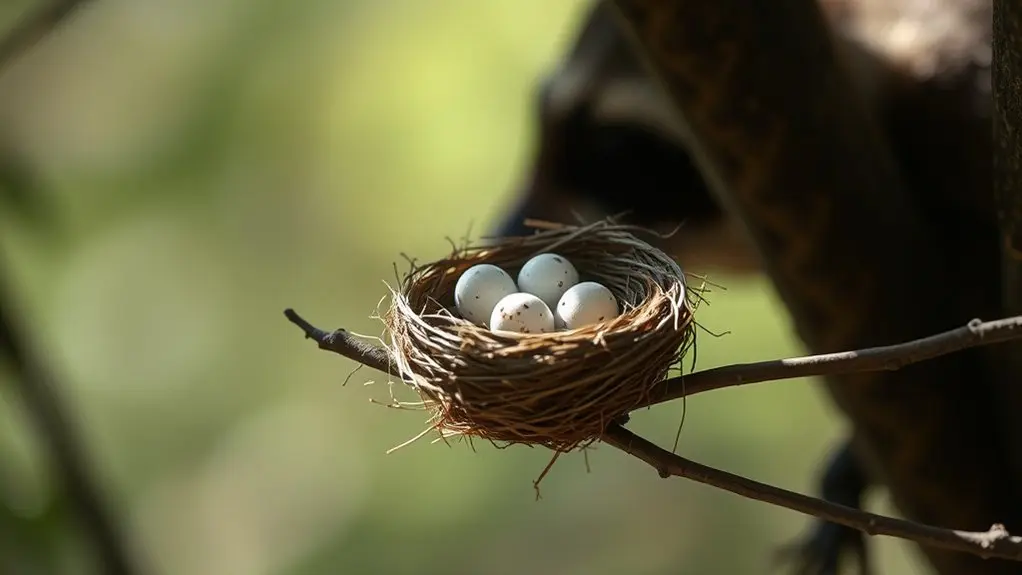
How do predators influence birds to abandon their nests? When predators like crows, rats, and lizards threaten nests by stealing eggs or attacking nestlings, birds often abandon the nest to avoid further danger.
Even though birds try to deter predators, the risk of losing their eggs or young remains high. They rarely move their nests once they are emptied or destroyed by predators. Instead, they tend to start multiple clutch attempts each season to make up for the losses.
This shows that predation is a main reason birds abandon nests, rather than simply moving their eggs.
| Predator Type | Impact on Nest | Bird Response |
|---|---|---|
| Crows | Egg theft and damage | Nest abandonment |
| Rats | Nestling predation | Increased clutch attempts |
| Lizards | Nest destruction | Avoidance, no relocation |
Legal Rules on Moving Bird Eggs and Nests
You need to follow the Migratory Bird Treaty Act whenever you’re handling bird eggs or nests. This law makes it clear that you can’t remove or move them without a proper permit.
For protected birds like mallards and robins, it’s especially important to stick to these permit rules, particularly during their breeding seasons.
Knowing these legal requirements not only helps you avoid penalties but also ensures you don’t disturb the birds while they’re nesting.
Migratory Bird Treaty Act
Although it may seem harmless to move bird eggs or nests, the Migratory Bird Treaty Act (MBTA) strictly prohibits such actions for protected species without proper permits. This federal law safeguards birds during critical phases like bird migration and nest construction.
Under the MBTA, you can’t legally remove or disturb nests or eggs of protected species such as mallards and robins.
Violations can lead to legal penalties. The Act permits exceptions only through authorized channels like the U.S. Fish and Wildlife Service.
Importantly, species like starlings and house sparrows are exempt, so you have more flexibility with their nests.
Key points include:
- Protecting migratory birds and breeding sites
- Prohibiting egg and nest movement without permits
- Enforcing penalties for unauthorized interference
- Allowing exceptions for non-protected species
Protected Species Overview
Because the Migratory Bird Treaty Act (MBTA) designates many bird species as protected, strict legal rules govern the handling, removal, or relocation of their eggs and nests. You must understand that moving nests or eggs of protected species, such as robins or mallards, is illegal without proper authorization.
These nests often employ nest camouflage to shield eggs from predators, enhancing breeding success.
Interfering with these nests disrupts crucial avian communication and parental care behaviors, potentially causing nest abandonment or failure. Federal laws protect these species during breeding seasons, allowing only authorized personnel with permits to handle nests under specific conditions.
Violating these protections can result in fines or legal action.
Permit Requirements
How do legal frameworks regulate the handling of bird eggs and nests? Under the U.S. Migratory Bird Treaty Act, you must obtain permits for any disturbance, relocation, or destruction of protected bird nests or eggs. This ensures responsible management of bird nesting and egg rotation, especially for species like robins and mallards.
Without authorization, moving these eggs or nests can lead to penalties. However, species such as starlings and house sparrows are excluded from protection, allowing more flexibility.
Before acting, contact wildlife authorities like the U.S. Fish and Wildlife Service to confirm regulations. Remember:
- Permits required for protected species’ nests and eggs
- Legal penalties for unauthorized relocation
- Some species exempt from protection
- Consultation with wildlife agencies advised
These rules safeguard avian populations during critical nesting periods. So, it’s always best to check first and follow the guidelines to protect our feathered friends.
How to Safely Handle or Move Bird Nests
When you need to move a bird’s nest, it’s essential to follow legal guidelines and minimize disturbance to the birds. Nest construction is delicate, so handle the nest gently to preserve its structure.
Moving a nest without a permit is generally illegal under the Migratory Bird Treaty Act, especially for species like robins or ducks.
If relocation is necessary, move the nest gradually in small increments, ideally when the parent isn’t incubating or brooding. This helps reduce stress and the risk of the parent rejecting the nest.
Using a floating platform or relocating it just a few inches helps the parent bird recognize and accept the new site.
Always observe parent behavior after moving the nest to ensure continued attendance. Avoid actions that might cause abandonment or harm to the eggs.
It’s really important to be patient and careful throughout the process.
What to Do If a Nest Is Disturbed or Abandoned
Despite careful handling and efforts to minimize disturbance, nests can still be disturbed or even abandoned due to various factors. When this happens, understanding parental behavior and nest camouflage is vital.
You should observe from a distance to assess if parents return, as disturbance often disrupts parental care temporarily.
Avoid touching or moving eggs; birds rarely move eggs themselves, and handling can increase abandonment risk.
If relocation is necessary, perform it gently and gradually, noting this method’s species-specific success rates.
Provide a safe environment by reducing predator access and environmental stressors that compromise nest camouflage and trigger abandonment.
If the nest is abandoned, recognize that birds may build a new nest nearby, continuing breeding efforts elsewhere.
Your minimal interference supports natural parental behavior and improves offspring survival chances.
Frequently Asked Questions
Can Birds Recognize Their Eggs by Sight or Smell?
You recognize birds rely mainly on egg recognition through sight, using shape and color patterns. Smell plays a minor role. Mistakes may cause nest abandonment, highlighting how critical visual cues are in protecting their eggs from parasitism.
Birds really depend on what they see to tell their eggs apart. They look at the shape and color patterns closely. Smell doesn’t matter as much in this process.
If they get it wrong, they might even abandon the nest. That shows just how important these visual clues are to keep their eggs safe from parasites.
Do Any Bird Species Ever Relocate Their Eggs Naturally?
You’ll rarely see birds uproot their eggs, as nesting behavior prioritizes stability during egg incubation. Some species may gently nudge eggs to optimize warmth, but full relocation is an uncommon, exceptional act rather than standard practice.
It’s kind of interesting because you’d think moving eggs might happen more often. But for most birds, keeping the nest steady is way more important. So, when it comes to relocating eggs, it’s definitely not the norm.
How Do Birds Repair Damaged Eggshells, if at All?
You won’t see birds perform eggshell regeneration, as they lack that ability. Instead, you’ll find them using nest repair strategies, like reinforcing nests or shielding cracked eggs, to protect embryos without fixing the shell itself.
Basically, birds have to get creative. They can’t just patch up the shell like we might imagine. So, they focus on making the nest a safer place instead.
Are There Cases of Birds Stealing Eggs From Other Nests?
Yes, you’ll find cases of nest parasitism where birds use egg mimicry to deceive hosts, laying eggs in others’ nests. Some species also steal or remove eggs to reduce competition or increase their offspring’s survival chances.
It’s pretty clever how they do this, right? By sneaking their eggs into another bird’s nest, they can save energy on raising their young. And sometimes, taking eggs from other nests helps their own chicks get a better shot at surviving.
Can Environmental Factors Influence a Bird’s Decision to Move Eggs?
You’d find it fascinating that over 60% of bird species adjust egg incubation by moving eggs to balance temperature. Environmental factors like nest predation risk and temperature shifts directly influence how and when you’d reposition eggs for survival.
It’s pretty interesting how birds sense these changes and act accordingly. They’re constantly monitoring their environment to make sure their eggs stay safe and warm. So, moving eggs isn’t random—it’s a smart survival tactic.
Conclusion
You might think moving bird eggs is like rearranging furniture, but it’s more like tampering with a delicate clock. It’s precise and risky. Birds rarely move their eggs because even slight shifts can disrupt incubation and reduce hatching success.
Predators and disturbances often cause abandonment. That’s why legal protections are so important. If you must intervene, handle nests with extreme care to avoid harm.
Remember, preserving natural processes ensures these fragile life stories continue ticking on their own. So, it’s best to let nature do its thing whenever you can.